

Find more articles on this and other psychiatry and CNS topics:
The Journal of Clinical Psychiatry
The Primary Care Companion for CNS Disorders
Managing bipolar mixed states should start by establishing a diagnosis, assessing for comorbidities, and clarifying targets for therapy. Differentiating between unipolar and bipolar disorder is important because these conditions have dissimilar efficacious pharmacotherapeutic options. To treat mixed states, atypical antipsychotics or divalproex have been shown to be effective, and antidepressants should generally be avoided. Because of the complexity of mixed episodes, monotherapy may be insufficient and patients may require combination treatment. As more medications become available in the treatment of bipolar disorder, algorithms can help clinicians make the appropriate treatment choices by offering recommendations for sequencing agents.
From the Editors

Are you a healthcare provider?
Add your NPI to personalize your JCP experience.
Please sign in or purchase this PDF for $40.
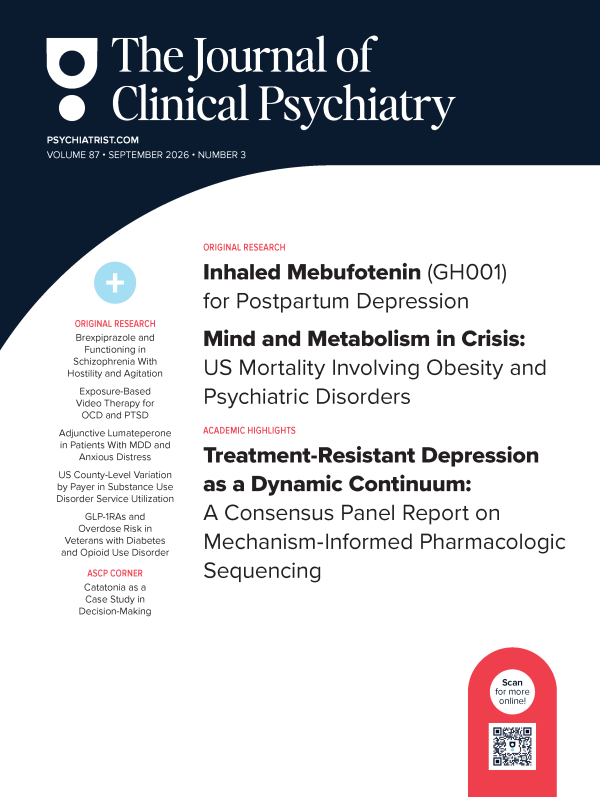
Vol 87 • 2026 • Number 3
Read the Current Issue
Original Research
Inhaled Mebufotenin (GH001) for Adult Patients with Postpartum Depression
Original Research
US Mortality Involving Obesity and Psychiatric Disorders
Academic Highlights
Treatment-Resistant Depression as a Dynamic Continuum: A Consensus Panel Report
Original Research
Effects of Brexpiprazole on Functioning in Patients with Schizophrenia Who Have Hostility and Agitation Symptoms
Original Research
Exposure-Based Video Therapy for OCD and PTSD
Original Research
Lumateperone as Adjunctive Therapy in Patients With Major Depressive Disorder and Anxious Distress
Insightful. Evidence-based. Human-centered.
Listen Now