The Evolving Psychedelic Paradigm
Beyond SSRIs: Why the Next Advance in GAD May Not Target Monoamines
July 7, 2026
The Remission Gap in GAD
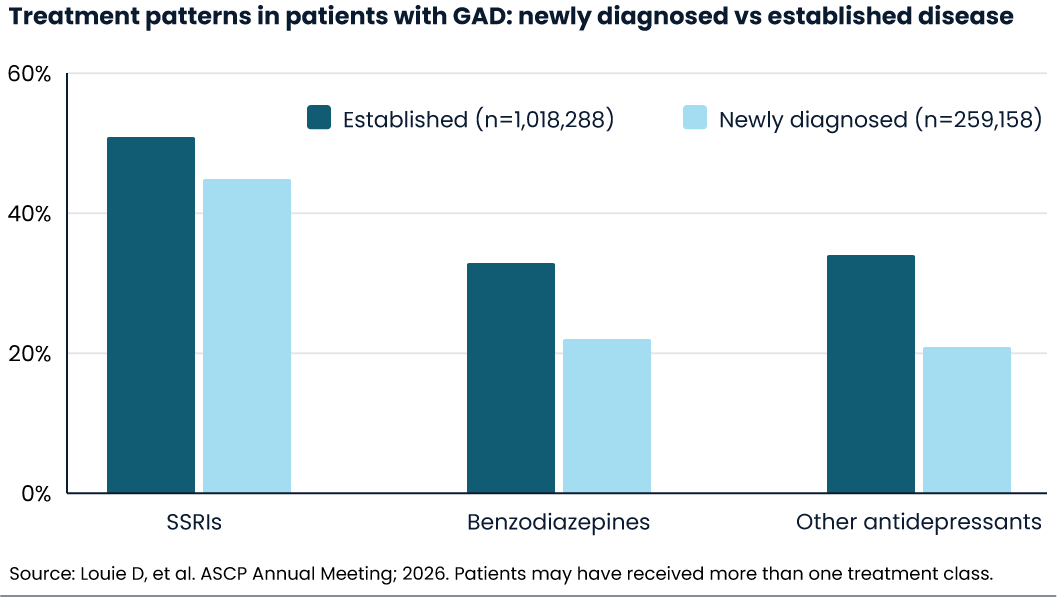
Serotonin reuptake inhibitors and serotonin-norepinephrine reuptake inhibitors remain the backbone of long-term GAD pharmacotherapy, and they help many patients. Full remission, though, is the exception rather than the rule. In a network meta-analysis of randomized GAD trials, active agents differed from placebo on remission, defined as a HAM-A score of 7 or less, but only by modest odds ratios; across the pooled trials, remission rates on active drugs clustered well below half, leaving a large number of treated patients with residual symptoms.1 Benefit also tends to accrue over weeks, and patients who do not respond often move through dose increases, switches, and augmentation, each carrying its own tolerability cost.2
Psychedelics as Mechanistic Diversity
What these first-line drugs share is their target. Whether a molecule blocks the serotonin transporter, the norepinephrine transporter, or both, its proximate action stays inside the monoamine system. These drugs are not inert at the level of plasticity: several antidepressants bind the BDNF receptor TrkB and engage neuroplasticity, a mechanism that may help explain both their benefit and their slow onset.3 The newer interest is in agents that engage plasticity more directly and quickly. Preclinical work characterizes classic psychedelics as psychoplastogens, compounds that produce rapid, sustained structural plasticity, including greater dendritic complexity, after a single exposure, an effect that requires activation of 5-HT2A receptors inside the cell rather than only at its surface.4
Translating Plasticity to the Clinic
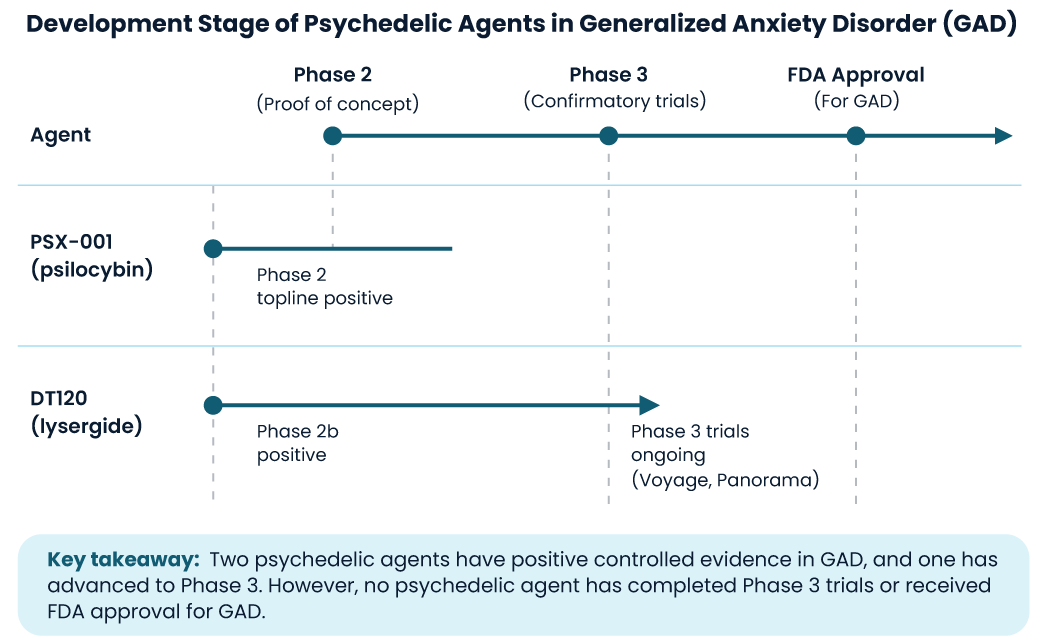
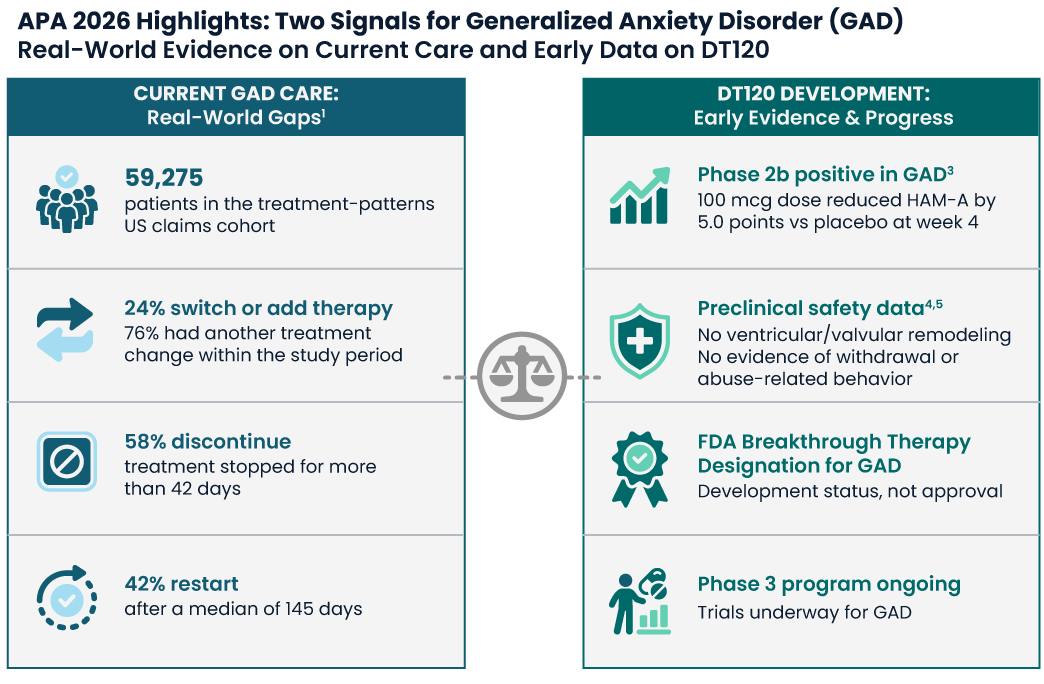
That mechanistic premise has begun to meet clinical data in anxiety. In a phase 2b dose-finding trial, a single 100 microgram dose of DT120 (lysergide) ODT, a 5-HT2A agonist, lowered HAM-A scores by a placebo-adjusted 5.0 points at week 4, the study’s prespecified primary outcome.5 The compound is investigational, but it is the first placebo-controlled signal that one administration of a non-monoaminergic agent can shift anxiety symptoms in GAD.5
Beyond the Monoamine Paradigm
None of this means the monoamine drugs have failed. They remain first-line, and for many patients they work well. What has changed is that psychiatry now has more than one mechanistic hypothesis to test in anxiety, something it has lacked for a generation. Whether plasticity-based agents produce durable benefit in practice is the question the current trials are investigating.
Comparison of Two Mechanisms for Treating Anxiety
| First-line monoamine drugs SSRIs and SNRIs |
Classic psychedelics 5-HT2A agonists, e.g., DT120 (lysergide) ODT |
|
| Molecular target | Serotonin and norepinephrine transporters at the cell membrane | 5-HT2A receptors, including intracellular receptors |
| Mechanism of action | Block monoamine reuptake; also engage neuroplasticity via TrkB, but gradually | Agonize 5-HT2A receptors; drive rapid structural plasticity after a single dose |
Both drug classes engage neuroplasticity; they differ in route and speed, not in whether plasticity occurs. Sources: Casarotto et al., Cell 2021; Vargas et al., Science 2023; and Robison et al., JAMA 2025.
References
- Kong W, Deng H, Wan J, et al. Comparative remission rates and tolerability of drugs for generalised anxiety disorder: a systematic review and network meta-analysis. Front Pharmacol. 2020;11:580858.
- Melaragno AJ. Pharmacotherapy for anxiety disorders: from first-line options to treatment resistance. Focus (Am Psychiatr Publ). 2021. PMCID: PMC8475920.
- Casarotto PC, Girych M, Fred SM, et al. Antidepressant drugs act by directly binding to TRKB neurotrophin receptors. Cell. 2021;184(5):1299-1313. doi:10.1016/j.cell.2021.01.034.
- Vargas MV, Dunlap LE, Dong C, et al. Psychedelics promote neuroplasticity through activation of intracellular 5-HT2A receptors. Science. 2023;379(6633):700-706.
- Robison R, Barrow R, Conant C, et al. Single treatment with MM120 (lysergide) in generalized anxiety disorder: a randomized clinical trial. JAMA. 2025;334(15):1358-1372.