Definium and Sensorium Report Data From Separate GAD Programs
Several investigational agents are being studied for their potential to treat generalized anxiety disorder (GAD). Definium Therapeutics and Sensorium Therapeutics reported results from separate GAD programs in company press releases and presented at Psych Congress 2026: Definium’s Phase 3 Voyage trial of DT120 (lysergide) orally disintegrating tablet (ODT), and Sensorium’s Phase 1a study of SNTX-2643.1,4 The findings from each program are discussed below.
SNTX-2643: Phase 1a Safety Data, With Exploratory Target- Engagement and EEG Findings
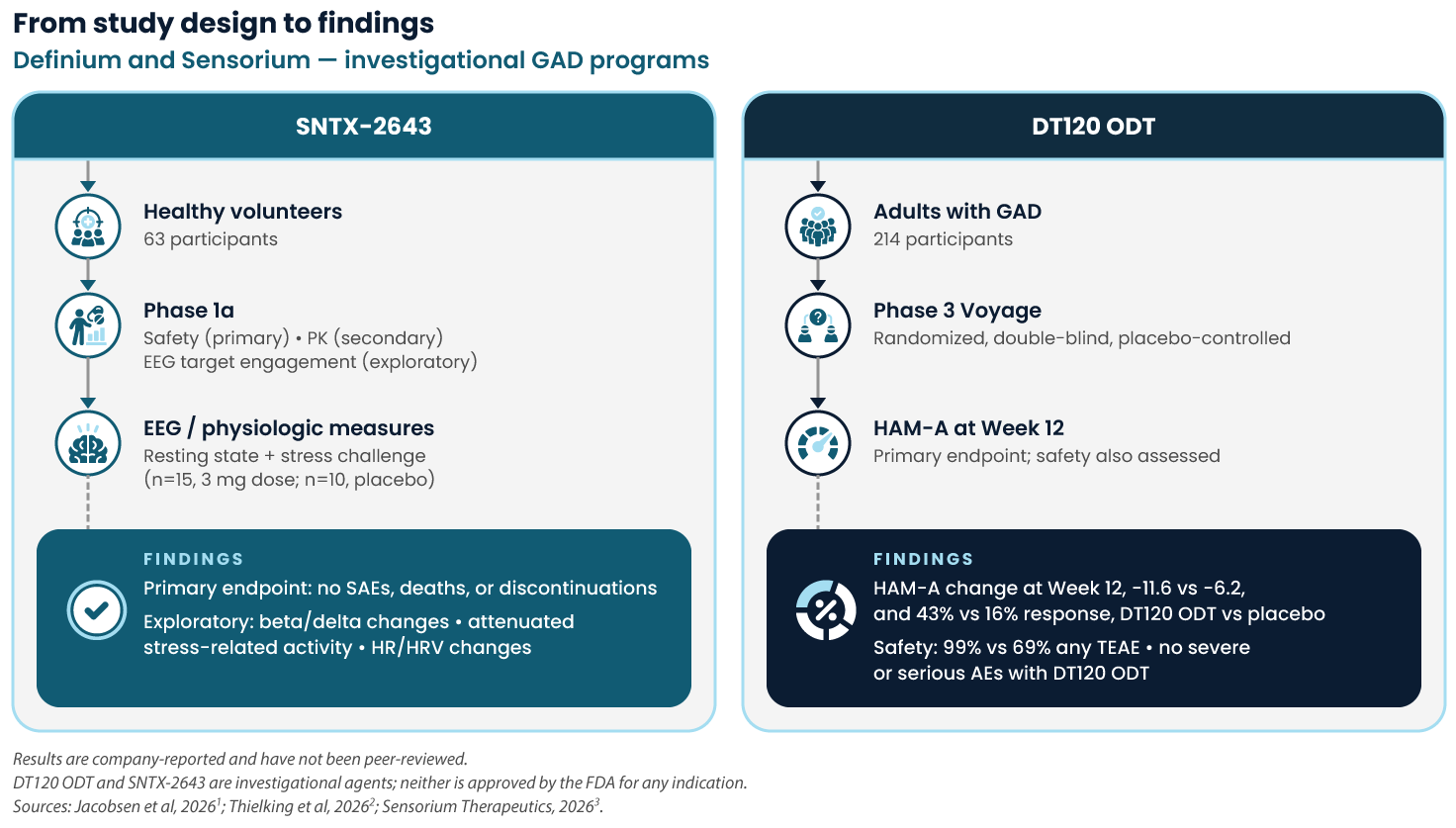
SNTX-2643 is a state-selective serotonin modulator.3 Sensorium’s Phase 1a study for SNTX-2643 enrolled 63 healthy volunteers across single-ascending-dose cohort plus a 25-person target-engagement cohort (15 on a 3 mg dose, 10 on placebo) that added EEG testing.3 Safety was the study’s primary endpoint; pharmacokinetics and EEG-based target engagement were secondary and exploratory endpoints, respectively.3
SNTX-2643 was generally well tolerated. Most treatment-emergent adverse events were mild and transient, with no serious adverse events, deaths, or discontinuations, and no clinically significant findings on laboratory testing, ECGs, or physical exams.3
In the target-engagement cohort, volunteers underwent EEG measurement during resting state and acute stress conditions. At rest, SNTX-2643 increased beta activity and reduced relative delta activity. During the stress challenge, beta- and gamma-band activity increased with placebo but was less pronounced with SNTX-2643. The SNTX-2643 group also had lower heart rate and higher heart rate variability.3 As reported by Sensorium, “The resting-state and stress-challenge findings showed different effects depending on the setting. At rest, SNTX-2643 shifted brain activity toward a more activated cortical profile. During acute psychological stress, it reduced the increase in high-frequency activity produced by the challenge.” These findings came from healthy volunteers and do not establish clinical efficacy.3
DT120 ODT: Voyage and Panorama, Two Phase 3 Trials That Both Met Their Primary Endpoint
Voyage was a randomized, double-blind, placebo-controlled Phase 3 trial of a single 100 µg dose of DT120 ODT against placebo in 214 adults aged 18 to 74 with DSM-5-confirmed GAD and baseline HAM-A of 20 or higher. Participants were randomized 1:1 DT120 ODT or placebo.1,2,5,6 The primary endpoint, HAM-A change at Week 12, was -11.6 with DT120 ODT versus -6.2 with placebo, a difference of 5.4 points (p<0.0001, Cohen’s d=0.81).1,5 HAM-A response, defined as a reduction of at least 50%, was reported in 43% of participants receiving DT120 ODT versus 16% on placebo (P<.0001).1,5
A treatment-emergent adverse event (TEAE) occurred in 99% of participants who received DT120 ODT and 69% who received placebo; 61% of DT120 ODT participants had mild events and 38% had moderate events, with no severe or serious adverse events in the DT120 ODT group.1,5 The most common TEAEs with DT120 ODT were illusion, nausea, and euphoric mood. No suicidal or self-injurious behavior was reported.1,5 Participants met End-of-Session Checklist criteria at an average of 6.4 hours, with 90% meeting all criteria by hour 8.5
Definium has also reported results from Panorama, a second Phase 3 GAD trial, which were comparable to the Voyage results.6,7 The Week 12 HAM-A results were -9.8 with 100 µg DT120 ODT versus -4.7 with placebo, a difference of 5.1 points (P<.0001; Cohen’s d=0.64).7 No new safety signals were reported.7
Investigational Psychedelic Data Are Emerging, but FDA Approval Is Still Required
Data on investigational psychedelics for GAD are emerging. DT120 ODT and SNTX-2643 are at different stages of development. DT120 ODT has completed two Phase 3 trials, with a pre-NDA meeting planned for the fourth quarter of 2026, while SNTX-2643 has completed Phase 1a testing in healthy volunteers. The 2 programs were not designed for direct comparison, and the results reported here are company-reported and have not been peer-reviewed. Neither DT120 ODT nor SNTX-2643 is approved by the FDA for GAD.
References
- Definium Therapeutics. Definium Therapeutics Announces Positive Topline Results from Phase 3 Voyage Study of DT120 ODT in Generalized Anxiety Disorder. Press release. August 12, 2026.
- Definium Therapeutics. Definium Therapeutics to Present Topline Data from Phase 3 Emerge and Voyage Trials Across Major Depressive Disorder and Generalized Anxiety Disorder at Psych Congress 2026. Press release. September 10, 2026.
- Sensorium Therapeutics. Sensorium Therapeutics Announces Positive Phase 1a Data for SNTX-2643 Showing Rapid and Sustained CNS Pharmacodynamic Activity. Press release. September 21, 2026.
- Brown C. The Novel Serotonin Transporter Modulator SNTX-2643: Results from a Pharmacokinetic and Target Engagement Evaluation in Healthy Adults. Poster 199 presented at: Psych Congress 2026; September 17-18, 2026; New Orleans, LA.
- Thielking PD, Jacobsen PL, Solomon TM, et al. Phase 3 Topline Results of DT120 (Lysergide) in Generalized Anxiety Disorder. Poster 195 presented at: Psych Congress 2026; September 17-18, 2026; New Orleans, LA.
- Jacobsen PL, Solomon TM, Jemison J, et al. Phase 3 Trial Design and Methodology: Treatment With DT120 (Lysergide) in Generalized Anxiety Disorder (GAD) & Major Depressive Disorder (MDD). Poster 196 presented at: Psych Congress 2026; September 15-19, 2026; New Orleans, LA.
- Definium Therapeutics. Definium Therapeutics Announces Positive Topline Results from Phase 3 Panorama Study of DT120 ODT in Generalized Anxiety Disorder. Press release. September 14, 2026.