Negative Symptoms Have Historically Been Less Responsive to Antipsychotic Treatment
Negative symptoms, including avolition, anhedonia, and reduced emotional expression, have historically been less responsive to antipsychotics than positive symptoms.1 Most antipsychotics act through dopamine D2 receptor antagonism or partial agonism, and their efficacy for negative symptoms has generally been limited.2 Xanomeline-trospium acts through agonism at M1 and M4 muscarinic receptors rather than direct D2 receptor antagonism; its efficacy in acute schizophrenia was demonstrated in a pooled analysis of the EMERGENT-1, EMERGENT-2, and EMERGENT-3 trials.3 What that same dataset shows for negative symptoms depends on which patients are counted and how negative-symptom burden is defined. One post hoc analysis restricted the sample to 64 of 640 participants who had prominent negative symptoms without predominant positive symptoms at baseline. Using the Positive and Negative Syndrome Scale (PANSS) Marder Negative Factor Score, the effect size in that subgroup was 1.18 versus 0.42 in the full pooled sample; the authors considered the finding preliminary because the subgroup was small.1 A subsequent post hoc analysis took the opposite approach, keeping the full pooled population and applying two different definitions of prominent negative symptoms to examine whether response varied by baseline severity.4
What that same dataset shows for negative symptoms depends on which patients are counted and how negative-symptom burden is defined.
Response Was Larger, Not Smaller, With Greater Negative-Symptom Severity
The analysis performed by Halassa et al.4 included the full pooled population of 640 participants. Response was defined as ≥30% improvement in PANSS total score at week 5, under two negative-symptom definitions.4 Under EPA-5 (≥2 of 7 PANSS negative items rated moderately severe or higher), 44.8% of patients with prominent negative symptoms responded on xanomeline-trospium versus 15.7% on placebo; non-prominent patients responded at 40.6% versus 22.3%. EPA-4 (≥3 items rated moderate or higher) showed a smaller treatment-placebo difference: prominent patients responded at 43.5% on xanomeline-trospium versus 20.5% on placebo, and non-prominent patients responded at 38.3% versus 21.3%.4 The treatment-placebo difference was larger for the prominent than non-prominent subgroup under both definitions; however, no treatment-by-severity interaction was tested statistically, so this pattern is descriptive rather than evidence of effect modification. Much of the widened gap under EPA-5 came from a lower placebo response in the prominent subgroup (15.7% vs 22.3%) rather than a higher response on xanomeline-trospium (44.8% vs 40.6%).4
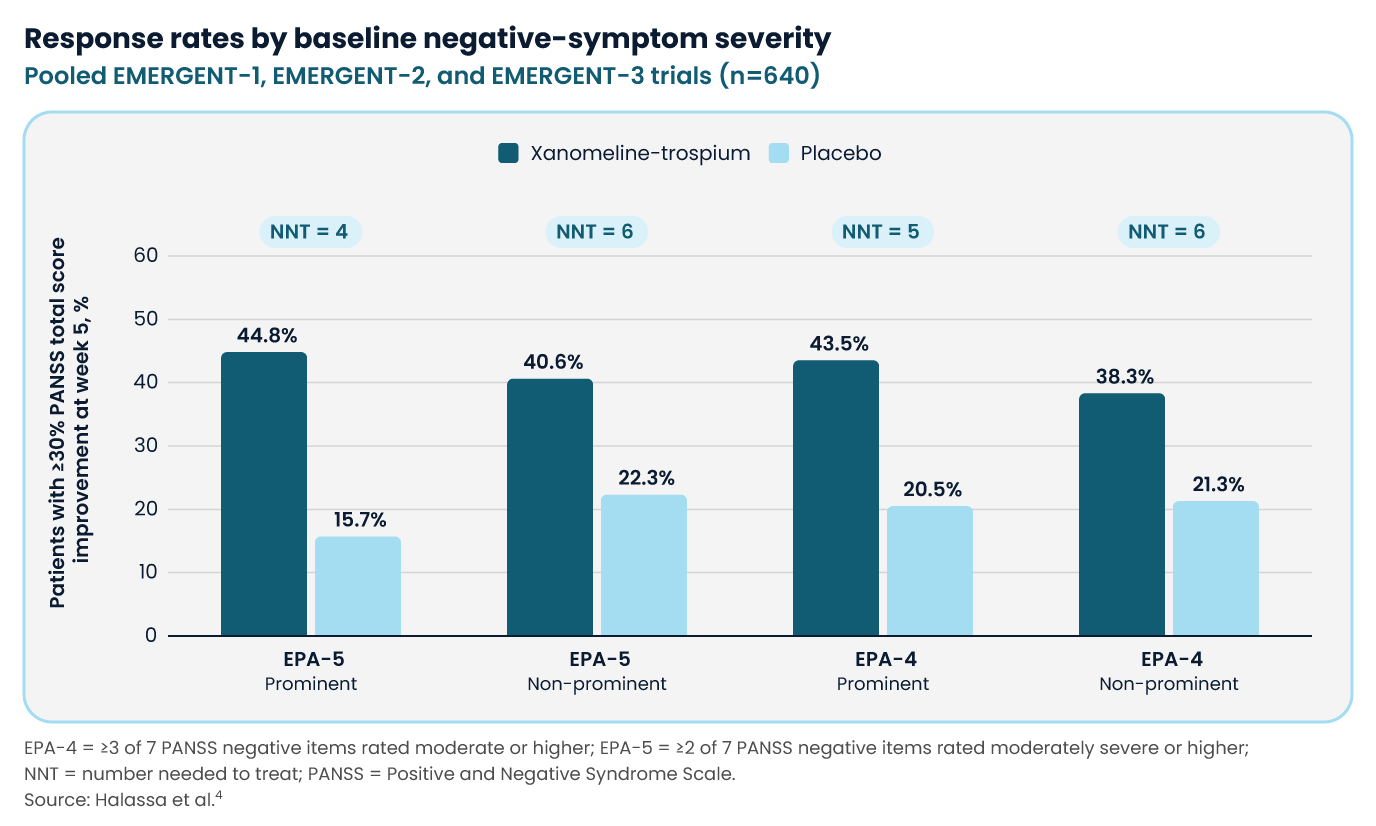
Across the four subgroups, 66.9% to 68.8% of patients on xanomeline-trospium and 44.3% to 53.1% on placebo had ≥1 treatment-emergent adverse event, with no treatment-emergent adverse event leading to death.4 In the pooled population, gastrointestinal events were the most common treatment-related adverse events, led by nausea (17.1% vs 3.2% on placebo).2 Across the severity definitions examined, greater negative-symptom burden was associated with a larger, not smaller, treatment-placebo difference.
Activity Is Supported; Superiority Remains Untested
Within the prominent negative-symptom subgroup in the Horan analysis, the treatment effect held at weeks 4 and 5 after changes in positive symptoms, disorganization, depression/anxiety, and hostility were entered as covariates, so negative-symptom improvement was not fully explained by improvement in those domains.1 A larger effect in patients with prominent negative symptoms is not the same as an advantage over other antipsychotics, and the available evidence does not establish superiority. The pooled EMERGENT trials were placebo-controlled with no active antipsychotic comparator, so they cannot directly test superiority over another antipsychotic; the absence of a comparison is not evidence of no difference.3 Separately, two network meta-analyses comparing xanomeline-trospium indirectly with other antipsychotics found no evidence of difference on negative-symptom outcomes.5,6 A prospective study with an active comparator and a prespecified negative-symptom outcome, in patients selected for stable, prominent negative symptoms, would be needed to test whether its negative-symptom effect exceeds that of other antipsychotics.
Financial support was provided by Bristol Myers Squibb. Psychiatrist.com independently developed the content and maintained final editorial control.
References
- Horan WP, Targum SD, Claxton A, Kaul I, Yohn SE, Marder SR, Miller AC, Brannan SK. Efficacy of KarXT on negative symptoms in acute schizophrenia: a post hoc analysis of pooled data from 3 trials. Schizophr Res. 2024;274:57-65.
- Kaul I, Claxton A, Sawchak S, Sauder C, Hassman HH, Kakar R, Walling DP, Citrome L, Miller AC, Brannan SK. Safety and tolerability of xanomeline and trospium chloride in schizophrenia: pooled results from the 5-week, randomized, double-blind, placebo-controlled EMERGENT trials. J Clin Psychiatry. 2025;86(1):24m15497.
- Kaul I, Sawchak S, Claxton A, Sauder C, Hassman HH, Kakar R, Walling DP, Citrome L, Zhu H, Miller AC, Brannan SK. Efficacy of xanomeline and trospium chloride in schizophrenia: pooled results from three 5-week, randomized, double-blind, placebo-controlled EMERGENT trials. Schizophrenia (Heidelb). 2024;10:102.
- Halassa MM, Krozer S, Elias M, Nicolas P, Appio J. Negative symptom severity at baseline and differential response to KarXT in schizophrenia: a post hoc analysis of the pooled EMERGENT-1, EMERGENT-2, and EMERGENT-3 trials. Presented at: Psych Congress; September 15-19, 2026; New Orleans, LA.
- Hickey C, Sidovar MF, Garcia A, Kramer K, Chang JA, Kupas K, Telukuntla V, Horgan J, Jameel H, Westley T, Gillard KK, Cutler AJ. Systematic review and network meta-analysis of the efficacy, safety and tolerability of xanomeline plus trospium chloride compared with eight oral antipsychotics for the acute treatment of schizophrenia. J Comp Eff Res. 2026:e260045.
- Schneider-Thoma J, Zhu Y, Qin M, Dong Y, Guan S, Wang J, Tian J, Lin X, Rodolico A, Siafis S, Bighelli I, Leucht S, et al. Comparative efficacy and tolerability of antidopaminergic and muscarinic antipsychotics for acute schizophrenia: a network meta-analysis of randomised controlled trials indexed in international English and Chinese databases. Lancet. 2026;407:876-891.