It’s as bad as we think it is.
That’s the unsettling sentiment from a new Gallup poll that exposes a clear erosion in how Americans view their own mental health. For the first time in the long-running survey, fewer than a third of U.S. adults describe their mental health as “excellent.” The revelation underscores a disturbing trend that started with the Covid pandemic.
The West Health-Gallup Center on Healthcare in America, which conducted the survey between Nov. 3-25, found that only 29% of adults were willing to grade their own mental health as excellent. Another 43% felt they had “good” mental health. The 72% total positive rate ranked three percentage points lower than the organization’s previous record low.
Pandemic Ripple Effects
Before the pandemic, Americans’ mental health ratings had held surprisingly steady. Between 2001 and 2019, at least 42% of adults consistently rated their mental well-being as excellent. But that figure fell off a cliff in late 2020 – roughly eight months into the life-changing lockdowns that upended the lives of virtually all Americans. Since then, the numbers continue to fall.
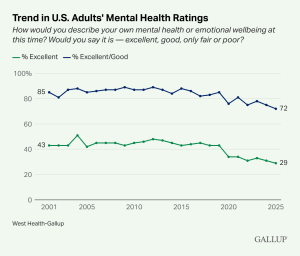
The deterioration in sentiment is hardly isolated. It’s infected nearly every major demographic.
- Younger adults, particularly Generation Z and millennials, have seen the sharpest dropoff. Both cohorts reported roughly 15-point drops in excellent mental health over the past six years.
- Even Generation X reported double-digit declines in mental health self assessments.
- And older baby boomers and Silent Generation survivors conceded smaller drops in confidence.
Education appears to play a role, according to Gallup’s pollsters. College graduates once reported much higher levels of excellent mental health than those without degrees. That gap has narrowed significantly as graduates’ ratings have fallen about 17 points since 2014–2019, compared with a 10-point drop among nongraduates.
Race and political affiliation paint a more muddled picture. White and Black Americans have experienced larger declines in mental health ratings than their Hispanic counterparts. And Republicans and independents have confessed to more pronounced drops than Democrats. Men and women report similar spirals.
A Silver Lining
It’s perhaps not so surprising then, that more Americans are looking for professional help. Nearly a quarter of the adults surveyed said that they’ve visited a mental health professional in the past year. And 8% of them reported more than 10 visits.
And even though Americans’ trust in their doctors remains stable, a growing number of adults seek out a second opinion.
Confidence in doctors tends to rise with age. Nearly 77% of those 65 and older trust their doctors. That’s better than the less than 60% of adults under 50 who feel the same.
Democrats are also much more likely than Republicans (or independents) to trust medical advice – without verification.
Losing Faith in the System
The discouraging survey appears on the heels of a similar report on the mental health care system itself.
The recent National Alliance on Mental Illness (NAMI) poll, conducted in partnership with Ipsos, found that most Americans think Congress isn’t doping enough to tackle the nation’s mental health challenges. They also overwhelmingly oppose federal cuts to core services such as supportive housing, Medicaid coverage, suicide prevention programs, and the 988 Suicide & Crisis Lifeline.
More specifically, nearly three in four adults oppose cuts to federal mental health jobs and programs. And strong majorities insist such cuts would make things worse. Consequently, about 83% of those surveyed support protecting Medicaid funding to help people access mental health care.
Nearly two-thirds of Americans believe Congress isn’t doing enough to address mental health needs. They share a similar conviction about the federal government, who they feel spends too little on mental health resources overall.
The prevailing sentiment suggests that while Americans labor under increased mental health pressure, they also want policymakers in Washington to do something about it.
“People are worried about their finances, their housing, and the uncertainty around them, including what kind of mental health care and support will be there for them moving forward,” NAMI CEO Daniel H. Gillison Jr. said. “With the strain on the country’s mental health system growing more dire, we have to come together and provide the resources that our communities need. We urge policymakers to act quickly to keep mental health care and services within reach for people who need it.”
Further Reading
Mental Health Progress Stalls At A Crossroads