
In 2024, The Journal of Clinical Psychiatry (JCP) launched its Focus on Psychotherapy section, an occasion that deserves recognition. Psychotherapy has long been, and should remain, an integral part of comprehensive psychiatric care. The creation of this section signals a commitment to advancing psychotherapy as a core component of our clinical treatment package within psychiatry.
The section has thus far featured important contributions to the field, including randomized clinical trials (RCTs) of:
- Prolonged exposure combined with either cognitive behavioral therapy (CBT) or sleep hygiene for insomnia (Colvonen et al, 2025;86[3]:24m15584);
- Interpersonal and social rhythm therapy (IPSRT) with or without quetiapine to lower suicidal ideation among patients with bipolar II disorder (Bailey et al, 2025;86[4]:24m15768);
- Intranasal oxytocin augmentation of behavioral couple therapy for alcohol (Flanagan et al, 2025; 86[2]:24m15627); and
- One-day CBT workshops for postpartum women conducted by public health nurses versus treatment as usual (Layton et al, 2025;86[2]:24m15712).
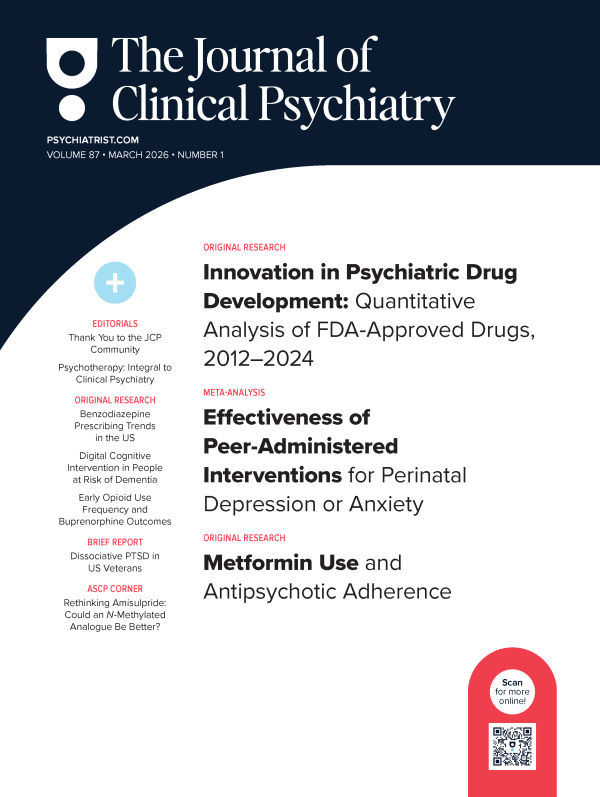
Notably, 2 of these RCTs combined psychotherapy with pharmacotherapy, with neither study finding an advantage for the combination regimen: psychotherapy alone provided significant benefit as a monotherapy. Such demonstrates the continued importance and clinical relevance of psychotherapy research. Other Focus on Psychotherapy articles included 2 meta-analyses, of posttraumatic stress disorder in military populations (Liu et al, 2025;86[2]:24r15571) and of peer-administered interventions for peripartum depression and anxiety (Mansoor et al, 2026;87[1]:25r15805); a patient treatment preference study; a post-COVID survey of psychotherapists about their in-office versus remote treatment preferences and practices; another survey of psychotherapy support strategies during psychedelic treatments; and more.
Clinical trials are expensive, and psychotherapies lack the equivalent of the pharmaceutical industry as a source of funding. Over the decades, research has established a strong empirical foundation for psychotherapy.
However, many fundamental clinical questions remain answered, and new ones arise alongside the expansion of digital therapeutics and the application of AI to mental health care. Continued research is needed to deepen our understanding of mechanisms of change, identify moderators and mediators of treatment response, clarify differential effectiveness across psychotherapeutic approaches and diagnoses, and determine how psychotherapies can be optimally tailored, delivered, and implemented across diverse populations and real-world clinical settings. At the same time, pressing questions arise regarding how clinical outcomes compare across in-person, virtual, and hybrid psychotherapy formats; how therapeutic alliance, engagement, and equity are affected by technology-delivered care; and how clinicians can integrate any emerging evidence-based tools into practice appropriately while maintaining safety, efficacy, and ethical standards.
The JCP Focus on Psychotherapy section is intended as a home for scholarship addressing these and related questions. We warmly encourage investigators conducting psychotherapy research—across modalities, populations, and levels of care—to submit your work. We are deeply grateful to our peer reviewers, whose thoughtful and thorough evaluations strengthen the quality and impact of this scholarship. To continue building a robust and inclusive review community, we invite interested colleagues to join our pool of reviewers. We especially encourage senior scholars to involve trainees and early-career colleagues in mentored peer review, helping cultivate the next generation of scientists and clinicians committed to advancing psychotherapy research. By advancing rigorous, clinically meaningful psychotherapy research, we strengthen the scientific foundation of psychiatric practice and support psychotherapy’s central role in improving patient outcomes. Psychotherapy remains vital to clinical psychiatry, and Focus on Psychotherapy welcomes your contributions to help ensure its continued growth, relevance, and impact.
Rachel C. Vanderkruik, PhD
John C. Markowitz, MD
Section Editors, Focus on Psychotherapy
Published Online: March 4, 2026.
https://doi.org/10.4088/JCP.26ed16341
© 2026 Physicians Postgraduate Press, Inc.
J Clin Psychiatry 2026;87(1):26ed16341
Editor’s Note: We encourage authors to submit papers for consideration as a part of our Focus on Psychotherapy section. Please contact John C. Markowitz, MD, at Psychiatrist.com/contact/markowitz or Rachel C. Vanderkruik, PhD, at Psychiatrist.com/contact/vanderkruik.
This PDF is free for all visitors!