An exhaustive new breakdown of more than 4,200 brain scans suggests that the roadmap of the human brain fails to adhere to a straight, predictable path over the course of one’s life.
Instead, a group of University of Cambridge researchers argues that it morphs into multiple, distinct phases, highlighted punctuated by four major “turning points” that reshape how different regions of the brain communicate with one another.
The study, appearing in Nature Communications, reviewed diffusion MRI data from infancy through age 90. Using advanced network-analysis tools and a specific machine-learning method, researchers uncovered clear structural shifts at the ages of 9, 32, 66, and 83. Those inflection points line up with major cognitive, hormonal, and health milestones.
What the team found suggests that the brain’s organizational structure develops throughout five broad epochs, each defined by its own blend of neural integration, specialization, and efficiency.
“These eras provide important context for what our brains might be best at, or more vulnerable to, at different stages of our lives,” lead researcher and Gates Cambridge Scholar Alexa Mousley, PhD, explained. “It could help us understand why some brains develop differently at key points in life, whether it be learning difficulties in childhood, or dementia in our later years.”
Methodology
To chart these shifts, the team assembled diffusion-imaging datasets that together span birth to old age, harmonizing scans from nine major research efforts. That gave them rare statistical power: more than 4,200 participants and a continuous age range from newborns to nonagenarians.
Using graph theory, they quantified 12 metrics describing how efficiently different brain regions communicate, how segregated local communities are, and how centrally important certain nodes appear to be in the network. Then they projected these metrics into “manifold” spaces—mathematical maps that highlight complex, multidimensional patterns.
From these maps emerged four recurrent pivot points across life.
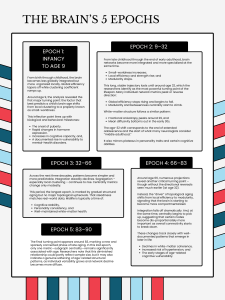
A Nonlinear Brain Architecture
Taken together, the findings back up the argument against the idea that the connectome matures and degrades along a neat curve. Instead, the brain reorganizes itself along distinct topological routes—some brief and turbulent, others long and calm. Each phase carries its own priorities for efficiency, specialization, and resilience.
And the moments when those priorities shift could represent some of the most consequential transitions in the human lifespan, both biologically and behaviorally.
“Looking back, many of us feel our lives have been characterised by different phases. It turns out that brains also go through these eras,” senior author and Cambridge Professor of Neuroinformatics Duncan Astle added. “Many neurodevelopmental, mental health and neurological conditions are linked to the way the brain is wired. Indeed, differences in brain wiring predict difficulties with attention, language, memory, and a whole host of different behaviours. Understanding that the brain’s structural journey is not a question of steady progression, but rather one of a few major turning points, will help us identify when and how its wiring is vulnerable to disruption.”
Further Reading
Scientists Chart the Brain’s Elegant, Messy Landscape