Schizophrenia takes a heavy toll on clinicians, patients, and their families. But it’s costing the U.S. economy. An exhaustive new analysis in JAMA Psychiatry has revealed that schizophrenia siphoned off nearly $367 billion from society in 2024 alone.
The study, which looked at both national and state-level costs, figures that about 3.1 million U.S. adults (nearly 1.2% of the adult population) were living with schizophrenia spectrum disorders last year. The researchers found that the overwhelming majority of the burden stems from lost productivity, reduced life expectancy, and the unpaid labor of family caregivers.
“Schizophrenia’s economic burden doesn’t sit in one place. It shows up across healthcare,
public programs, housing instability, and lost economic participation,” lead author Holly B. Krasa, MS, explained. “Behind every dollar figure is a person living with a serious medical
condition and a family trying to navigate fragmented systems, often without coordinated support.”
Methodology
Using a prevalence-based cost-of-illness model, the researchers estimated total excess costs attributable specifically to schizophrenia in 2024. These costs cover direct medical expenses, non-medical costs (such as housing and incarceration), and indirect costs tied to employment losses, disability, mortality, and caregiving.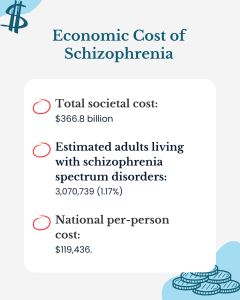
Of the $366.8 billion total, about $75 billion reflected direct costs. These included:
- $36.7 billion in health care spending,
- $35.2 billion tied to supportive housing and homelessness services,
- $11.9 billion associated with justice system involvement, and
- $5.1 billion in Social Security disability benefits.
As high as those numbers are, they still can’t compete with the estimated $291.8 billion in indirect costs:
- Lost wages and underemployment accounted for more than $55 billion,
- Reduced quality of life added another $41.4 billion,
- While premature mortality totalled $47.5 billion more.
Caregivers, however, accounted for the single largest component.
An Invisible (and Expensive) Workforce
The research team calculated that caregiver-related costs amounted to an estimated $165 billion in 2024. That figure includes $104.6 billion in unpaid labor, as well as lost productivity, out-of-pocket expenses, and increased health care costs that the caregivers themselves normally shoulder.
Researchers estimated that more than half of adults with schizophrenia rely on a caregiver, usually a family member. These caretakers normally cut back on their own work hours, leave the labor force altogether, or suffer health problems of their own.
Despite their scale, the authors add, policymakers all too often ignore these burdens during funding discussions.
Where People Live Matters
The researchers also looked at how living arrangements factor into the equation. More than two-thirds of adults with schizophrenia (roughly 68%) live independently or with family. Another 19% live in structured or supportive housing. The rest are either in long-term care facilities, living on the street, or are in jail.
Supportive housing and long-term care settings accounted for especially high per-person costs. Incarceration’s also costly, with justice-system-related expenses exceeding $11 billion nationally.
The findings, the authors propose, suggest that failures in community-based care often shift costs into more expensive and restrictive systems, such as jails, shelters, and nursing facilities.
A Patchwork of State Costs
While the national numbers remain daunting, state-level estimates have their own story to tell, mostly because of population differences. In California, for example, total schizophrenia-related costs exceeded $45 billion. On the other end of spectrum, Wyoming reported costs of barely more than $600 million.
Per-person costs also fluctuated wildly. Utah posted the lowest estimated annual cost per adult with schizophrenia at about $111,000, while Alaska topped the list at more than $126,000 per person. Several factors figured in the math, such as local wage rates, cost of living, homelessness prevalence, and patterns of service use.
Even small differences in housing stability or employment rates, the authors note, can translate into large shifts in overall economic burden.
Policy Implications
The authors argue that the findings point to clear intervention and prevention opportunities. Investments in coordinated care, supportive housing, and caregiver support might be expensive propositions in the short-term, but they can generate substantial long-term savings by curbing homelessness, incarceration, and premature death.
And yet federal research support has dried up in real terms for at least a decade, and a congressionally mandated effort to systematically track the cost of mental illness has yet to materialize. Without investment, the authors argue that the United States runs the risk of relying on the most expensive (and least humane) approach to schizophrenia care. As the authors point out, we already know the high price tag that comes attached to inaction. The question then becomes, will policymakers take note – and action?
Further Reading
New Clues Why Schizophrenia Patients Hear Voices
The Next Generation of Schizophrenia Treatment is Here
Children of Parents with Schizophrenia Face More Mental Health Issues