A sweeping new review warns those living with both schizophrenia and personality disorders face unique cognitive hurdles that hamper treatment and prolong recovery.
Despite the fact that as many as 40% of people with schizophrenia also meet the criteria for a personality disorder, the research still hasn’t caught up with the reality of how the two conditions interact with one another.
Appearing in Schizophrenia Research: Cognition, this new review covers 24 years of data. Despite that, the research uncovered only 10 studies worldwide that measured cognition specifically in patients with both diagnoses.
Most of the existing literature ignores patients with personality disorders or lumps them into the broader schizophrenia sample. And it’s a pattern that psychologists say might be making clinical decision-making harder than it has to be.
The Case for Cognition
Cognition remains one of the strongest predictors of functioning in schizophrenia. It influences whether a patient sticks with their treatment, succeeds in the workplace, engages socially, and benefits from therapy. Cognitive difficulties that cloud one’s thinking, mess with their memory, and challenges the interpretation of social cues can shape a one’s daily life more than hallucinations or delusions.
The University of Montreal researchers argue that if cognition drives recovery – and if personality disorders only make things more challenging – then the combination could produce distinct cognitive profiles that demand specialized care.
Even so, the data paint a cloudy picture.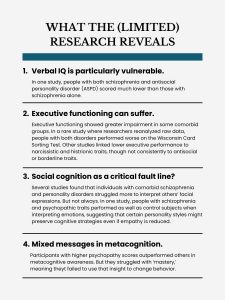
A Hidden Population With Higher Risks
The existing research has already established that people with both schizophrenia and personality disorders are more likely to experience severe symptoms, hospitalizations, medication non-adherence, victimization, and suicide attempts.
Yet this fresh review found that research rarely considers how their cognitive challenges might contribute to those risks. Or how targeted cognitive rehabilitation might help keep them at bay.
The authors suggest that personality disorders are often missed in acute care settings, where psychosis dominates clinical attention. Because many healthcare systems treat a single diagnosis at a time, comorbidity, even clinicians do catch it, rarely gets the attention it deserves – in the way it deserves.
The authors conclude with a call for future research to expand beyond isolated diagnostic silos. They propose:
- Widespread screening for personality disorders in schizophrenia care.
- Use of standardized cognitive assessments (like the MATRICS battery).
- Larger and more diverse study samples.
- And longitudinal research that tracks cognition over the course of illness.
Why It Matters Now
As research advances in precision psychiatry, failing to account for cognitive differences in comorbid patients could exacerbate disparities in treatment outcomes. Understanding how personality shapes cognition in schizophrenia could unlock a more tailored treatment approach – whether its social-cognitive training or personalized cognitive remediation.
At least for now, the evidence remains scarce. But the message is clear. Ignoring personality disorders in schizophrenia is worse than an oversight. It could be an existential threat to recovery for an entire subset of patients.
Further Reading
The Next Generation of Schizophrenia Treatment is Here
New Clues Why Schizophrenia Patients Hear Voices
Children of Parents with Schizophrenia Face More Mental Health Issues