
Have you ever been curious about how final decisions are made on manuscripts in the PCC? This often underlies questions from presenters I meet at conferences and from clinicians and researchers. It is also central to determining whether the PCC fits your needs and interests as a reader.
My north star is relevance to clinicians practicing in primary care and front-line psychiatric settings. While most have a focus on clinical phenomena, manuscripts about how we organize and conduct our practices and the issues we confront are of great interest. Manuscripts relevant to primary care and front-line psychiatrists often also will appeal to medical specialists in hospital and ambulatory settings. The introductory section of manuscripts should help answer the reader’s question, “Is this relevant to me?”
For research articles, I look for investigations relevant to problems we see in practice. The methods section should support readers’ assessing whether its findings are generalizable and relevant to the people they care for. It also informs the assessment of the validity of analyses. The measure used should support understanding of patient-centered outcomes in addition to any disease-oriented evidence. Ideally, measures used are ones that clinicians might utilize in practice. Research conducted by clinicians is often of great interest and frequently explores questions from their unique perspective. Research of treatments not yet available in clinical settings might be of interest if it provides insight into strategies soon to be available for conditions we manage.
Systematic and narrative reviews of practice-relevant topics help us consolidate our understanding. These reviews should clarify the literature search process used—a balanced synthesis and critique of the strengths and weaknesses of studies included and of the whole body of research. Has a consensus around “settled science” emerged? If not, what current controversies remain, and how do these alter the implications for our practices? At this point, inclusion in the review’s discussion of clearly labeled expert opinion–based guidance is reasonable. Manuscripts that simply list and uncritically summarize relevant studies are of limited value. Reviews that are based primarily on “expert opinion” or an unsystematic selection of studies are rarely of interest.
Case and case series reports are of interest if they elaborate on issues that practicing primary care/general psychiatry clinicians might encounter. These issues include unusual presentations and disease variants, side effects of treatments, and diagnostic and therapeutic dilemmas. If related to a rare disease, would the condition come to attention in our practices? Those that relate to care that is generally the purview of subspecialists are of little interest. Cases of interest sometimes explore topics unlikely to ever be the focus of investigators. In such cases, clarity as to the potential relevance to other patients is critical. Some case discussions are excellent for organizing reviews or updates regarding a clinical topic, including understanding of underlying mechanisms or current diagnostic and treatment strategies. They also serve as building blocks of case series reports. Other reports present evolving pathologies we encounter including, for example, new “recreational” substances and the consequences of social influences.
As your editor in chief, I have the tremendous privilege of support from an exceptional panel of reviewers. They answer 2 questions. First, is this manuscript relevant to the readers of the PCC? Second, how could the manuscript be improved? These answers then drive the question of how the manuscript should be revised and whether it is suitable for publication. Reviewers potentially serve as part of the research process through their feedback, which might lead to additional or revised analyses or reshaping of the final manuscript. In some ways, reviewers also serve as “senior authors” through assessing the balance and validity of interpretation of results and their relationship to relevant literature.
Complementing our reviewers, the PCC has a highly professional editorial staff that manage other aspects of review and ensure that the writing is clear, that manuscripts are properly formatted based on journal guidelines, that all potential conflicts of interest and funding have been disclosed, that all necessary consents and permissions have been obtained, that there are no concerns about undisclosed or inappropriate use of AI or of plagiarism, that references are verified, and that tables and figures are adequately explained.
I want to thank our authors, reviewers, and staff for their valuable work in keeping the PCC an excellent resource for those of us in, or interested in, primary care and general psychiatric practice.
Larry Culpepper, MD, MPH
Editor in Chief
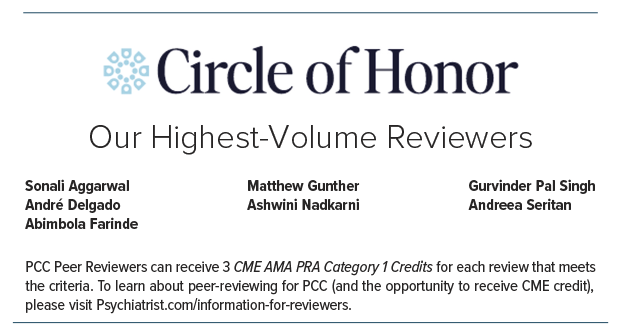
Reviewers for The Primary Care Companion for CNS Disorders
January 1, 2025–December 31, 2025
Article Information
Published Online: February 26, 2026. https://doi.org/10.4088/PCC.26ed04211
© 2026 Physicians Postgraduate Press, Inc.
To Cite: Culpepper L. Practice relevance as the north star: a message from the editor. Prim Care Companion CNS Disord. 2026;28(1):26ed04211.
Enjoy this premium PDF as part of your membership benefits!