The 5-Week Trials Left the Long-Term Questions Open
Side effects of antipsychotics contribute to poor medication adherence in schizophrenia, which affects nearly half of patients and raises the risk of relapse.1 Long-term tolerability matters for keeping patients on treatment, but trials of new antipsychotics are usually short term. For xanomeline-trospium, a pooled analysis of three 5-week placebo-controlled trials in 683 hospitalized adults with acute psychosis found mostly gastrointestinal adverse events, generally mild or moderate and transient.1 The authors noted that 5 weeks was too short to assess weight and motor effects and called for longer trials such as EMERGENT-5.1 The year-long, open-label trial in stable outpatients provides longer-term data on adverse events and treatment discontinuation.1,2
Symptom Scores Held Among Participants Who Stayed for the Year
EMERGENT-5 enrolled 566 stable outpatients who switched from another antipsychotic without cross-titration. The trial had no control group.2 Their mean baseline Positive and Negative Syndrome Scale (PANSS) total score was 66.0.2 The authors note that the 48.9% completion rate was similar to that of other year-long open-label trials.2 Among those who remained, the trial’s authors reported no signals of worsening symptoms and a trend toward improvement.2 Mean PANSS total scores were 5.5 points below baseline at week 52, with change evident from week 1. At week 52, 30.0% of those assessed had improved by at least 30%.2 Clinical Global Impression-Severity scores fell 0.4 points.2 No formal statistical testing was performed for these efficacy outcomes, and they cover only those still enrolled.2
Long-term tolerability matters for keeping patients on treatment, but trials of new antipsychotics are usually short term
Side Effects Followed the 5-Week Pattern
The 5-week trials enrolled more severely ill inpatients (mean baseline PANSS 97.3) and included placebo, so the two data sets are complementary.2 Any adverse event affected 67.9% of participants over 5 weeks (51.3% on placebo) and 82.3% over the year.1,2 In EMERGENT-5, 5.8% had a severe event and 7.2% a serious event, of which psychiatric events were the largest group.2 The most common events in the 5-week trials were nausea, constipation, dyspepsia, and vomiting, each affecting 13.5% to 18.5% on xanomeline-trospium, compared with 1.7% to 6.1% on placebo.1 Nausea, vomiting, and constipation again led in EMERGENT-5, at 23.1%, 20.3%, and 18.0%. The authors link these events to the drug’s muscarinic action.2
In the 5-week trials, the most common cholinergic events generally began within 2 weeks and lasted an average of 4 days for vomiting to 20 days for dry mouth. Their overall rate of these events peaked at 28.8% on day 7.1 Hypertension was recorded in 8.5% over 5 weeks and 10.4% over the year, though both papers note this may not reflect clinical hypertension.1,2 Akathisia affected 2.4% over 5 weeks (0.9% on placebo) and 1.2% over the year, with tardive dyskinesia in 0.4%.1,2 Mean weight rose 1.41 kg over 5 weeks (1.94 kg on placebo).1 Among those remaining in EMERGENT-5, mean weight was 2.2 kg below baseline at week 52, and the authors report no clinically meaningful motor, prolactin, or metabolic changes.2
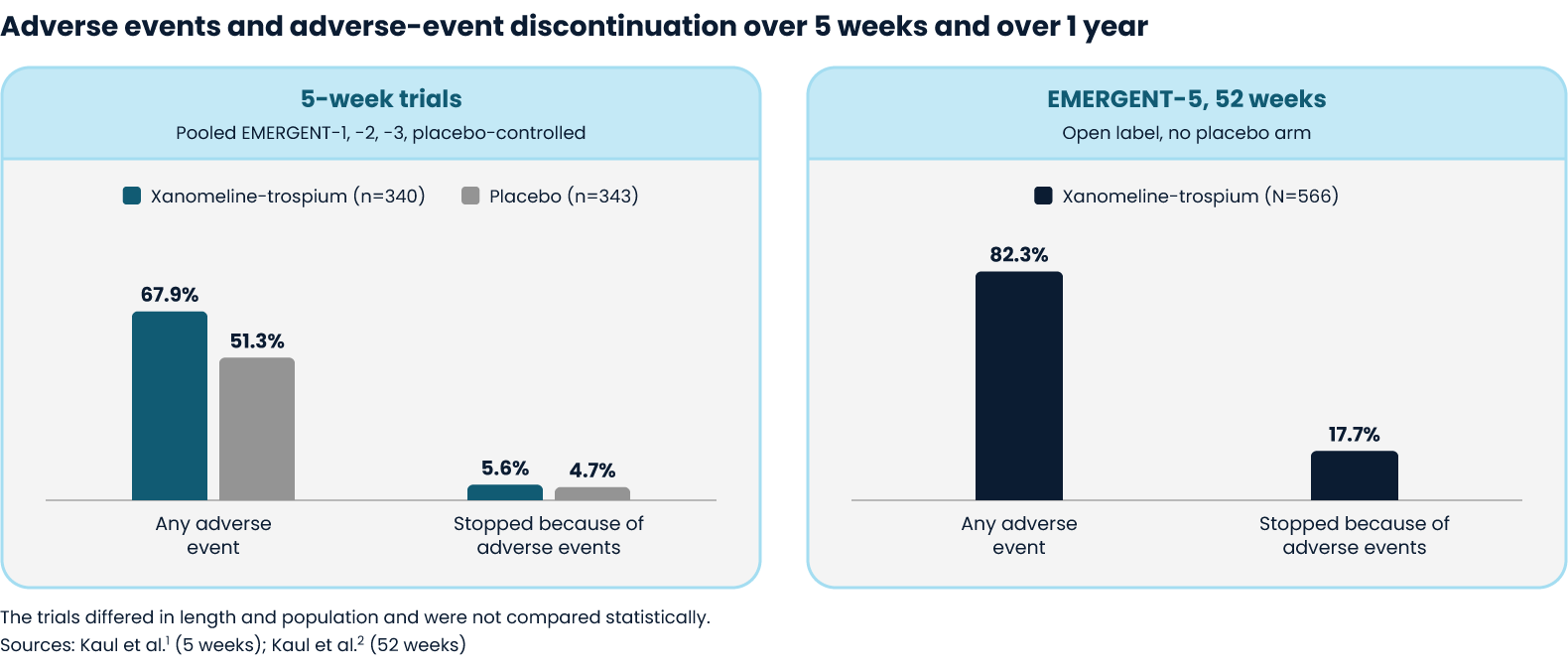
Adverse Events Ended Treatment for 5.6% Over 5 Weeks and 17.7% Over the Year
In the 5-week trials, 27.6% on xanomeline-trospium left early (22.7% on placebo), mainly by withdrawing consent, and 5.6% stopped because of adverse events (4.7% on placebo).1 Over the year, 51.1% left EMERGENT-5, with adverse events and withdrawn consent about equally common as reasons.2 Among the 17.7% of participants who discontinued by week 52 due to adverse events, nausea or vomiting were the most common causes.2
Side Effects Over a Year Resembled Those at 5 Weeks, With More Discontinuations
EMERGENT-5 provides long-term data unavailable from the five-week trials. The adverse events were the same as those the short-term trials, symptom scores stayed below baseline among participants who remained, and the authors reported no clinically meaningful motor, prolactin, or metabolic changes. More participants stopped for adverse events over the year (17.7%) than over 5 weeks (5.6%), but the longer follow-up and different populations mean the two rates are not directly comparable. These findings come from an open-label trial with no direct comparator, in which 48.9% of participants completed the year. Controlled data over comparable follow-up are needed to establish how this profile compares with that of other antipsychotics.
Financial support was provided by Bristol Myers Squibb. Psychiatrist.com independently developed the content and maintained final editorial control.
References
- Kaul I, Claxton A, Sawchak S, et al. Safety and tolerability of xanomeline and trospium chloride in schizophrenia: pooled results from the 5-week, randomized, double-blind, placebo-controlled EMERGENT trials. J Clin Psychiatry. 2025;86(1):24m15497. doi:10.4088/JCP.24m15497
- Kaul I, Claxton A, Chaturvedi S, et al. Long-term efficacy, safety, and tolerability of xanomeline and trospium chloride in schizophrenia: a 52-week, open-label trial (EMERGENT-5). Schizophr Res. 2026;288:86-94. doi:10.1016/j.schres.2025.12.015