CES Is One of the Non-Drug Approaches Explored for Anxiety
Medication and psychological therapies are well-accepted treatments for generalized anxiety disorder (GAD) and other anxiety disorders. Over time, non-drug approaches beyond psychotherapy have also been explored, including neurostimulation.1 Cranial electrotherapy stimulation (CES), a self-administered treatment, is one such approach.2,3 The US Food and Drug Administration (FDA) regulates CES as a Class II prescription device when used for anxiety or insomnia.4 Trials comparing CES with an inactive sham device in patients with anxiety, often alongside depression, date back to the 1970s and were pooled in meta-analyses published in 2022 and 2023.1,5,6 Each approach’s role among non-drug treatment options depends on what it has been shown to do and how directly that evidence applies to GAD.
CES Delivers a Low-Intensity Current Through Proposed Brain Pathways
In CES, a small device passes a low-intensity current through electrodes on the head, such as earlobe clips.7 Unlike electroconvulsive therapy, it is not intended to induce a seizure.4 One proposal is that the current modulates brainstem, limbic, and prefrontal regions and shifts autonomic balance toward parasympathetic activity. Electroencephalography studies have also found inconsistent changes in alpha-band activity, and these pathways have yet to be confirmed directly.7 A newer, related approach, electrical vestibular nerve stimulation, applies current through electrodes behind the ears to stimulate the vestibular nerve.3,8
Pooled Trials Show Reduced Anxiety Symptoms
A 2022 meta-analysis of 11 randomized trials (794 participants) found that CES moderately reduced anxiety symptoms compared with controls (Hedges g, −0.63; 95% CI, −0.95 to −0.30), though results varied widely. The effect was larger in primary anxiety (g, −1.22) than in anxiety secondary to conditions such as chronic pain (g, −0.33).6 A 2023 meta-analysis limited to patients whose primary complaints included anxiety (8 trials, 337 participants) found a large effect (standardized mean difference, −0.96; 95% CI, −1.19 to −0.73), whether CES was used alone or added to medication.1
Neither analysis was limited to GAD, and the reviews graded the evidence differently. The 2023 analysis rated certainty as high, judging that sham devices limited bias,1 whereas a 2018 systematic review rated it low strength and found that no trial had adequately blinded patients.5 For data closer to GAD, one sham-controlled trial enrolled 115 adults with primary anxiety disorders, most often GAD (53%); after 1 hour daily CES for 5 weeks, Hamilton Anxiety Rating Scale scores fell 32.8%, compared with 9.1% with sham (P = 0.001).2
Ear-Clip CES and Vestibular Stimulation Have Separate Evidence
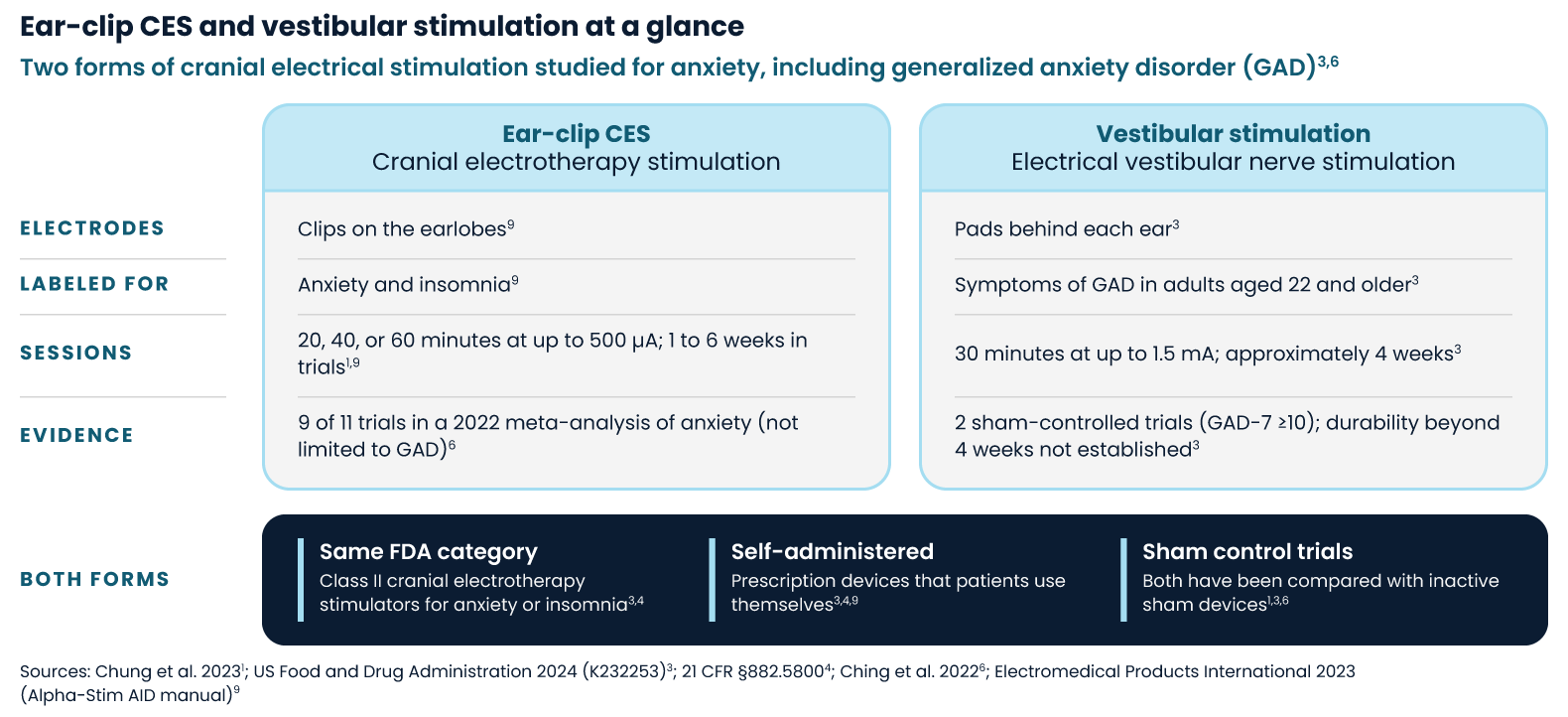
The pooled evidence in the 2022 analysis comes mainly from ear-clip CES; 9 of 11 trials used Alpha-Stim devices. This device’s US labeling covers anxiety and insomnia and requires a prescription. Sessions last 20, 40, or 60 minutes at currents up to 500 µA, and trials have used treatment courses of 1 to 6 weeks.6,9,1
Vestibular nerve stimulation falls in the same FDA category but was not part of the pooled trials.1,3,6 Its evidence comes from one device, Modius Stress, FDA-cleared for home use to treat the symptoms of GAD in adults aged 22 and older over approximately 4 weeks; durability beyond 4 weeks has not been established. The FDA reviewed two sham-controlled trials in adults with GAD-7 scores of 10 or higher. In one (87 adults, daily 30-minute home sessions), the difference from sham was not statistically significant (P = 0.14).3 In the other (60 adults, 20 clinic sessions), GAD-7 scores fell 7.4 vs 2.2 points with sham (P <0 .001).10
Reported Side Effects Are Mild
Neither meta-analysis reported severe adverse events, although side-effect reporting was incomplete; ear discomfort or pain was most common in the 2022 analysis.1,6 The ear-clip device’s labeling describes side effects as rare, mild, and self-limiting, including dizziness, skin irritation, and headache. Standard precautions include avoiding use with pacemakers or implanted or wearable defibrillators, and during pregnancy, where safety has not been established.9 Both devices’ labels advise against driving or hazardous tasks during and, in some cases, for several hours after treatment.3,9
Trials in Diagnosed GAD Would Clarify Benefit and Durability
Ear-clip CES and vestibular nerve stimulation broaden the range of non-drug approaches being explored for anxiety, but their roles in GAD care should be considered separately. Most evidence for ear-clip CES comes from trials of anxiety more broadly, while vestibular nerve stimulation has been studied in separate trials involving GAD symptoms. Further studies in people with diagnosed GAD can help clarify which patients may benefit from each approach and how these treatments could be used in clinical practice.
References
- Chung FC, Sun CK, Chen Y, et al. Efficacy of electrical cranial stimulation for treatment of psychiatric symptoms in patients with anxiety: a systematic review and meta-analysis. Front Psychiatry. 2023;14:1157473. doi:10.3389/fpsyt.2023.1157473
- Barclay TH, Barclay RD. A clinical trial of cranial electrotherapy stimulation for anxiety and comorbid depression. J Affect Disord. 2014;164:171-177. doi:10.1016/j.jad.2014.04.029
- US Food and Drug Administration. 510(k) premarket notification K232253: Modius Stress. March 27, 2024. Accessed October 20, 2026. https://www.accessdata.fda.gov/cdrh_docs/pdf23/K232253.pdf
- Cranial electrotherapy stimulator. 21 CFR §882.5800. Accessed October 20, 2026. https://www.ecfr.gov/current/title-21/chapter-I/subchapter-H/part-882/subpart-F/section-882.5800
- Shekelle PG, Cook I, Miake-Lye IM, et al. The Effectiveness and Risks of Cranial Electrical Stimulation for the Treatment of Pain, Depression, Anxiety, PTSD, and Insomnia: A Systematic Review. VA ESP Project #05-226. US Department of Veterans Affairs; 2018.
- Ching PY, Hsu TW, Chen GW, Pan CC, Chu CS, Chou PH. Efficacy and tolerability of cranial electrotherapy stimulation in the treatment of anxiety: a systemic review and meta-analysis. Front Psychiatry. 2022;13:899040. doi:10.3389/fpsyt.2022.899040
- Brunyé TT, Patterson JE, Wooten T, Hussey EK. A critical review of cranial electrotherapy stimulation for neuromodulation in clinical and non-clinical samples. Front Hum Neurosci. 2021;15:625321. doi:10.3389/fnhum.2021.625321
- Curry G, Zhang SD, McAnena L, Price RK, Sittlington JJ. Repeated electrical vestibular nerve stimulation reduces anxiety in people with moderate-to-severe anxiety: a randomized, sham-controlled trial: the Modius Anxiety Study. Neuromodulation. 2026;29(4):626-636. doi:10.1016/j.neurom.2025.11.008
- Electromedical Products International. Alpha-Stim AID Owner’s Manual (US). IFU-CUS-002 Rev J; 2023.
- Goothy SSK, Chouhan RS, Raghavan RV, et al. A randomized, double blind, sham-controlled clinical trial to evaluate the efficacy of electrical vestibular nerve stimulation (VeNS), compared to a sham control for generalized anxiety disorder. Clin EEG Neurosci. 2026;57(2):152-160. doi:10.1177/15500594251328080