Understanding MDD: Beyond the Symptoms
Major depressive disorder (MDD) involves episodes of depressed mood or loss of interest or pleasure, with changes in sleep, appetite, energy, concentration, or other symptoms.1,4 DSM-5 requires 5 or more of 9 symptoms during the same 2-week period, with clinically significant distress or impairment.4 These episodes can impair daily functioning and reduce quality of life, with medical comorbidities and social factors adding to the burden.1
The Mental and Substance Use Disorders Prevalence Study (MDPS), a general-population study of US adults aged 18 to 65 (n = 5,679), used clinician-administered structured interviews to assess DSM-5 disorders from 2020 to 2022. An estimated 15.5% (95% CI, 13.6%-17.5%) met criteria for past-year MDD, about 31.4 million adults.2 The sample included adults in households, prisons, homeless shelters, and state psychiatric hospitals, and its data were collected during the COVID-19 pandemic.2 Prevalence estimates, however, do not capture the full burden of MDD, including how severe episodes are, how long they last, whether they recur, and how soon treatment begins.
MDD Affects About 1 in 5 Adults Over a Lifetime
Because MDD is episodic, past-year figures miss earlier episodes. In the 2012 – 2013 National Epidemiologic Survey on Alcohol and Related Conditions III (NESARC-III), a nationally representative survey of 36,309 US adults, 20.6% met criteria for MDD during their lifetime.3 Both surveys applied DSM-5 criteria.2,3 Because the surveys differ in period, interview method, and population, their estimates cannot be interpreted as a change in prevalence over time.
Severe Symptoms Were Common in Two National Surveys
NESARC-III also graded severity among 7,432 adults with lifetime MDD, classifying the worst lifetime episode by symptom count (mild: 5; moderate: 6-7; severe: 8-9 symptoms): 49.5% were severe, 39.7% moderate, and 10.8% mild.³ The National Comorbidity Survey Replication (NCS-R), a DSM-IV household survey of 9,090 adults, assessed symptom severity during the worst month of the past year using a self-report scale (QIDS-SR); 38.0% of 514 past-year cases were severe and 12.9% very severe.5 Although the measures and time frames differ, approximately half of cases fell into the highest severity categories in each survey.
In the same NCS-R analysis, adults with past-year MDD reported a mean of 35.2 days in the past year when depression left them totally unable to work or carry out normal activities, and 59.3% reported severe or very severe impairment in home, work, relationship, or social roles.5
The Course of MDD Ranges From a Single Episode to Years of Symptoms
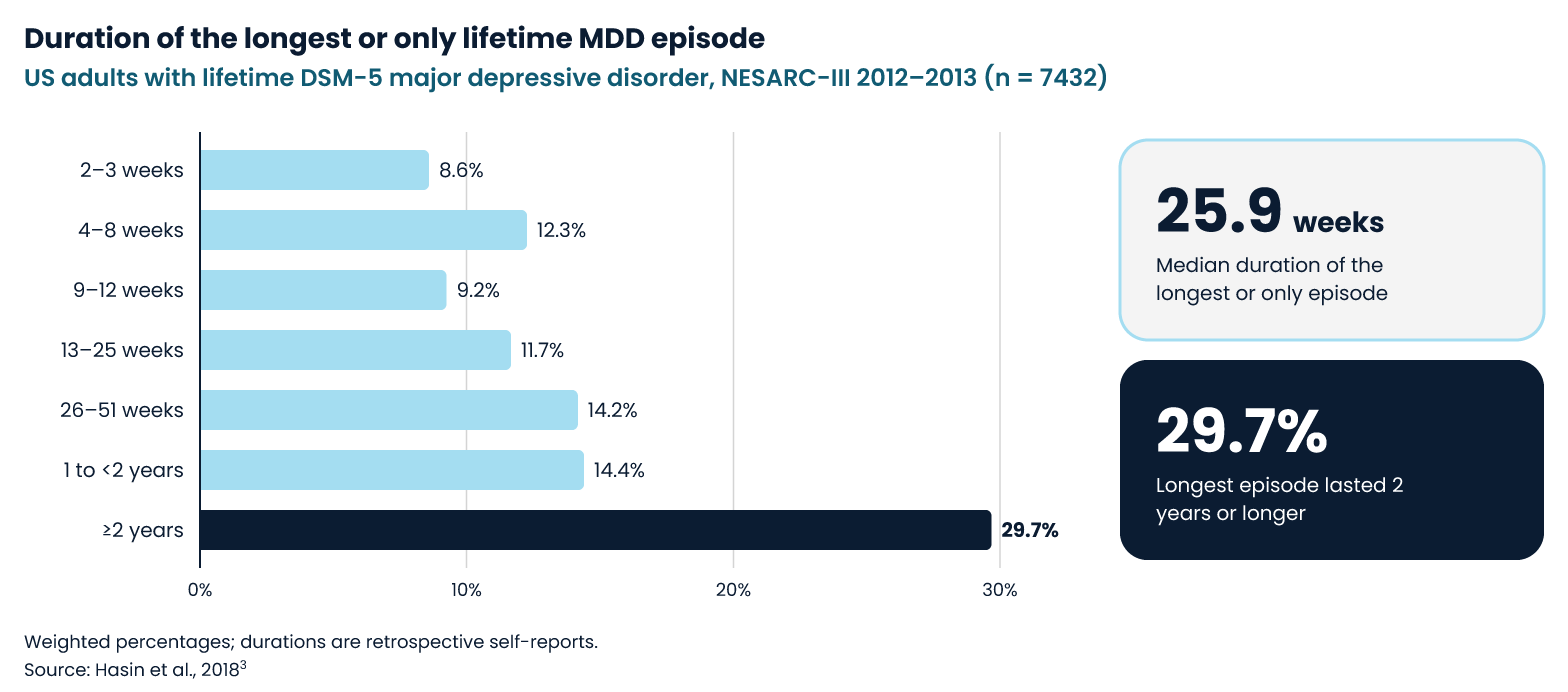
NESARC-III respondents with lifetime MDD recalled a mean of 3.86 episodes. The median duration of the longest episode was 25.9 weeks, and 29.7% reported a longest episode lasting at least 2 years.3 In a 23-year Baltimore community cohort of 92 adults with first-onset MDD, about half recovered without further episodes, about 35% experienced recurrences, and about 15% never had a year free of episodes.6 A systematic review found that within 15 years of recovery, 35% of people in general-population studies had a recurrence, compared with 85% in specialized mental health care.7
Time to First Treatment Can Span Several Years
In NESARC-III, 69.4% of adults with lifetime MDD reported receiving treatment, with a mean delay of 47.5 months (about 4 years) from onset.3 A separate analysis of the full NCS-R sample (n = 9,282) examined initial professional contact rather than treatment receipt. Among adults with a lifetime major depressive episode, 37.4% made contact in the year of onset. Overall, an estimated 88.1% would eventually make contact; among those who made contact after the year of onset, the median delay was 8 years.8 This median and the NESARC-III mean are not directly comparable, and neither establishes whether care was adequate.3,8
The Burden of MDD Unfolds Over Time
Prevalence alone does not reflect the full burden of MDD, which also includes episode severity, functional impairment, duration, recurrence, and access to timely treatment. The impact of these factors varies considerably between individuals, even among those who meet the same diagnostic criteria. For clinicians, considering these dimensions can help inform a more complete assessment of illness and treatment needs.
References
- Marx W, Penninx BWJH, Solmi M, et al. Major depressive disorder. Nat Rev Dis Primers. 2023;9:44. doi:10.1038/s41572-023-00454-1
- Ringeisen H, Edlund MJ, Guyer H, et al. Mental and Substance Use Disorders Prevalence Study (MDPS): Findings Report. RTI International; 2023. https://www.rti.org/publication/mental-substance-use-disorders-prevalence-study-findings-report
- Hasin DS, Sarvet AL, Meyers JL, et al. Epidemiology of adult DSM-5 major depressive disorder and its specifiers in the United States. JAMA Psychiatry. 2018;75(4):336-346. doi:10.1001/jamapsychiatry.2017.4602
- American Psychiatric Association. Diagnostic and Statistical Manual of Mental Disorders. 5th ed, text revision. American Psychiatric Association Publishing; 2022. doi:10.1176/appi.books.9780890425787
- Kessler RC, Berglund P, Demler O, et al. The epidemiology of major depressive disorder: results from the National Comorbidity Survey Replication (NCS-R). JAMA. 2003;289(23):3095-3105. doi:10.1001/jama.289.23.3095
- Eaton WW, Shao H, Nestadt G, Lee HB, Bienvenu OJ, Zandi P. Population-based study of first onset and chronicity in major depressive disorder. Arch Gen Psychiatry. 2008;65(5):513-520. doi:10.1001/archpsyc.65.5.513
- Hardeveld F, Spijker J, De Graaf R, Nolen WA, Beekman ATF. Prevalence and predictors of recurrence of major depressive disorder in the adult population. Acta Psychiatr Scand. 2010;122(3):184-191. doi:10.1111/j.1600-0447.2009.01519.x
- Wang PS, Berglund P, Olfson M, Pincus HA, Wells KB, Kessler RC. Failure and delay in initial treatment contact after first onset of mental disorders in the National Comorbidity Survey Replication. Arch Gen Psychiatry. 2005;62(6):603-613. doi:10.1001/archpsyc.62.6.603