Switching Antipsychotics Raises Questions About Symptom Control and Tolerability
Discontinuation or switching of antipsychotics is common in schizophrenia, but either may be accompanied by symptom worsening and increased relapse risk, as Chepke et al note.1 For clinicians switching a stable patient to xanomeline-trospium, key questions include whether symptom control is maintained, which adverse effects emerge and when, and how often they lead to treatment discontinuation. To help answer these questions, researchers examined adverse event data from the EMERGENT-5 trial, which followed 566 outpatients with stable symptoms who received xanomeline-trospium monotherapy for up to 52 weeks.2
EMERGENT-5 Studied Stable Outpatients on Monotherapy
EMERGENT-5 was a 52-week, open-label trial without a placebo or comparator group.2 It enrolled adults who were taking a daily oral antipsychotic and had not required hospitalization or crisis care for worsening symptoms in the 8 weeks before screening.2 Participants discontinued their previous antipsychotic before starting xanomeline-trospium, without cross-titration, and received xanomeline-trospium as their only antipsychotic.1,2 Of 566 participants, 277 (48.9%) completed 52 weeks.2 The primary endpoint was the incidence of treatment-emergent adverse events, while secondary endpoints examined efficacy (e.g., change in Positive and Negative Syndrome Scale and Clinical Global Impression-Severity [CGI-S] scores). Results were summarized descriptively, without statistical testing, and covered only participants still enrolled.2
Symptom ratings held steady in participants who remained on treatment, and gastrointestinal adverse events occurred early and were the leading reason participants stopped
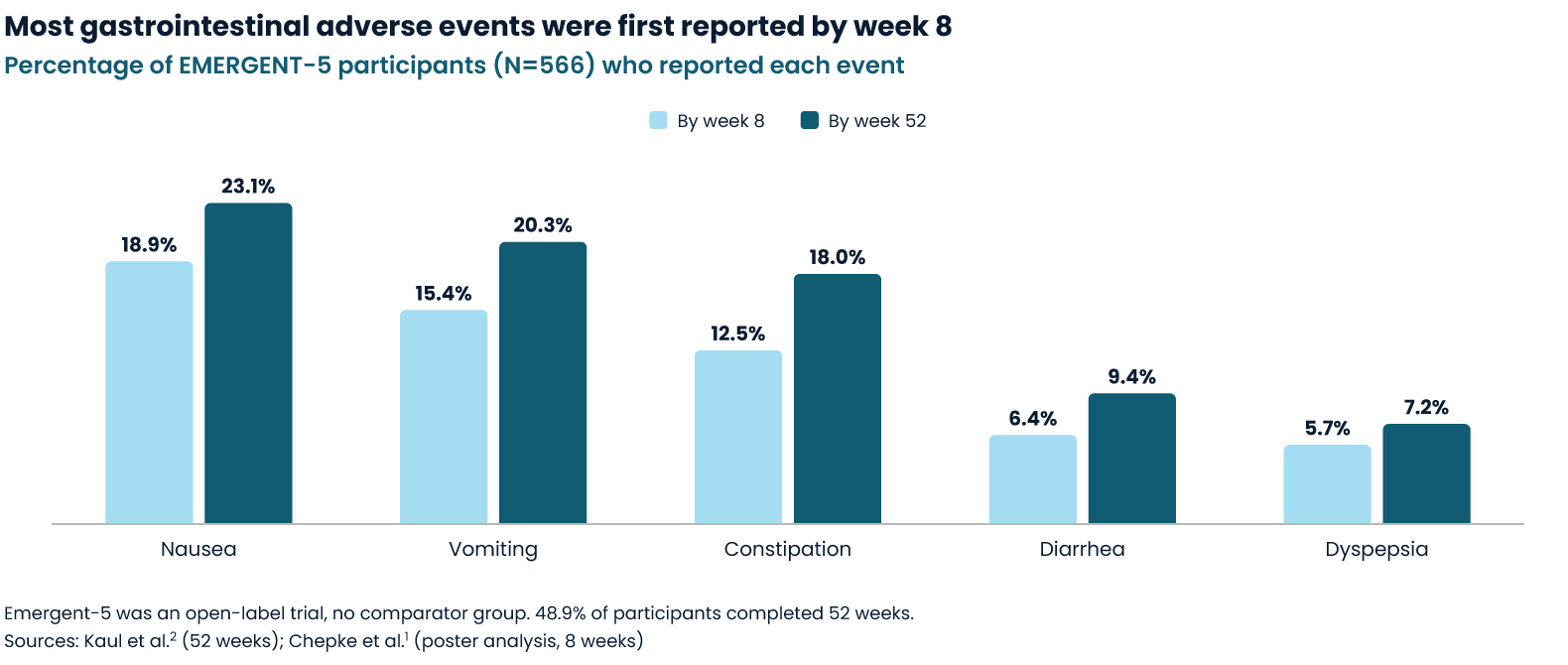
Most Gastrointestinal Adverse Events Were Reported by Week 8, and Symptom Scores Held Steady
Mean CGI-S scores fell from 3.4 at baseline to 3.0 among participants assessed at week 52; the authors reported that total symptom scores remained stable throughout.2 Over 52 weeks, 82.3% of participants experienced at least one adverse event.2 Most events were mild or moderate, and 5.8% of participants had severe events.2 Serious adverse events, most often psychiatric, occurred in 7.2%, including 2 deaths from unknown causes that investigators judged unrelated to treatment.2 Nausea was reported in 23.1% of participants, vomiting in 20.3%, and constipation in 18.0%.2 In an ECNP 2026 poster, Chepke et al. reported weeks 1 to 8 separately, with nausea in 18.9%, vomiting in 15.4%, and constipation in 12.5%.1 Together, the trial and poster findings suggest that most of these gastrointestinal adverse events were first reported within the first 8 weeks.1,2
Adverse events led 17.7% of participants to stop trial medication.2 Nausea (5.1%) and vomiting (4.1%) were the most frequently reported adverse events leading to discontinuation, followed by schizophrenia recorded as an adverse event (2.1%).2 Liver function test elevations exceeding 3 times the upper limit of normal were reported in 3.0% of participants.2
Open-Label Follow-Up Links Switching to Stable Symptoms and Early Gastrointestinal Events
For clinicians switching a stable outpatient to xanomeline-trospium, there are important questions that need to be answered: does symptom control hold, which adverse effects appear and when, and how often do they end treatment? EMERGENT-5 helps answer them. Symptom ratings held steady in participants who remained on treatment, and gastrointestinal adverse events occurred early and were the leading reason participants stopped. However, the open-label design, absence of a comparator group, and 48.9% completion rate limit interpretation. Controlled data with a comparator arm are needed to determine how much of the symptom stability and the adverse event burden reflects xanomeline-trospium itself.
Financial support was provided by Bristol Myers Squibb. Psychiatrist.com independently developed the content and maintained final editorial control.
References
- Chepke C, Kempf B, Appio J, et al. Efficacy and safety of xanomeline/trospium chloride during transition from atypical antipsychotics in participants with stable schizophrenia symptoms in EMERGENT-5. Poster PS01-1222 presented at: 39th European College of Neuropsychopharmacology Congress; October 10-13, 2026; Munich, Germany.
- Kaul I, Claxton A, Chaturvedi S, et al. Long-term efficacy, safety, and tolerability of xanomeline and trospium chloride in schizophrenia: a 52-week, open-label trial (EMERGENT-5). Schizophr Res. 2026;288:86-94. doi:10.1016/j.schres.2025.12.015