About 1 in 4 Adults With MDD Were Treated in General Medical Settings
For many adults with major depressive disorder (MDD), depression care takes place at least partly outside specialty mental health settings. In the National Comorbidity Survey Replication (NCS-R), a 2001-2002 national survey of 9,090 US adults, 27.2% of respondents with past-year MDD who completed the severity assessment (n=514) were treated in the general medical sector, which includes primary care, and 31.6% in the specialty mental health sector; some received care in both.1 This makes general medical settings important for recognizing depression, although patients may present with physical rather than emotional symptoms and one visit may not be enough to identify it.
Depression Often Presented Physically, and Primary Care Clinicians Recognized About Half of Cases
In a 1991-1992 World Health Organization study at 15 primary care centers in 14 countries, including the United States, 1,146 of 5,447 patients who underwent a structured assessment met criteria for major depression. Of these, 69% reported only somatic symptoms as their reason for the visit, and 11% denied depressed mood and feelings of guilt or worthlessness when interviewed.2
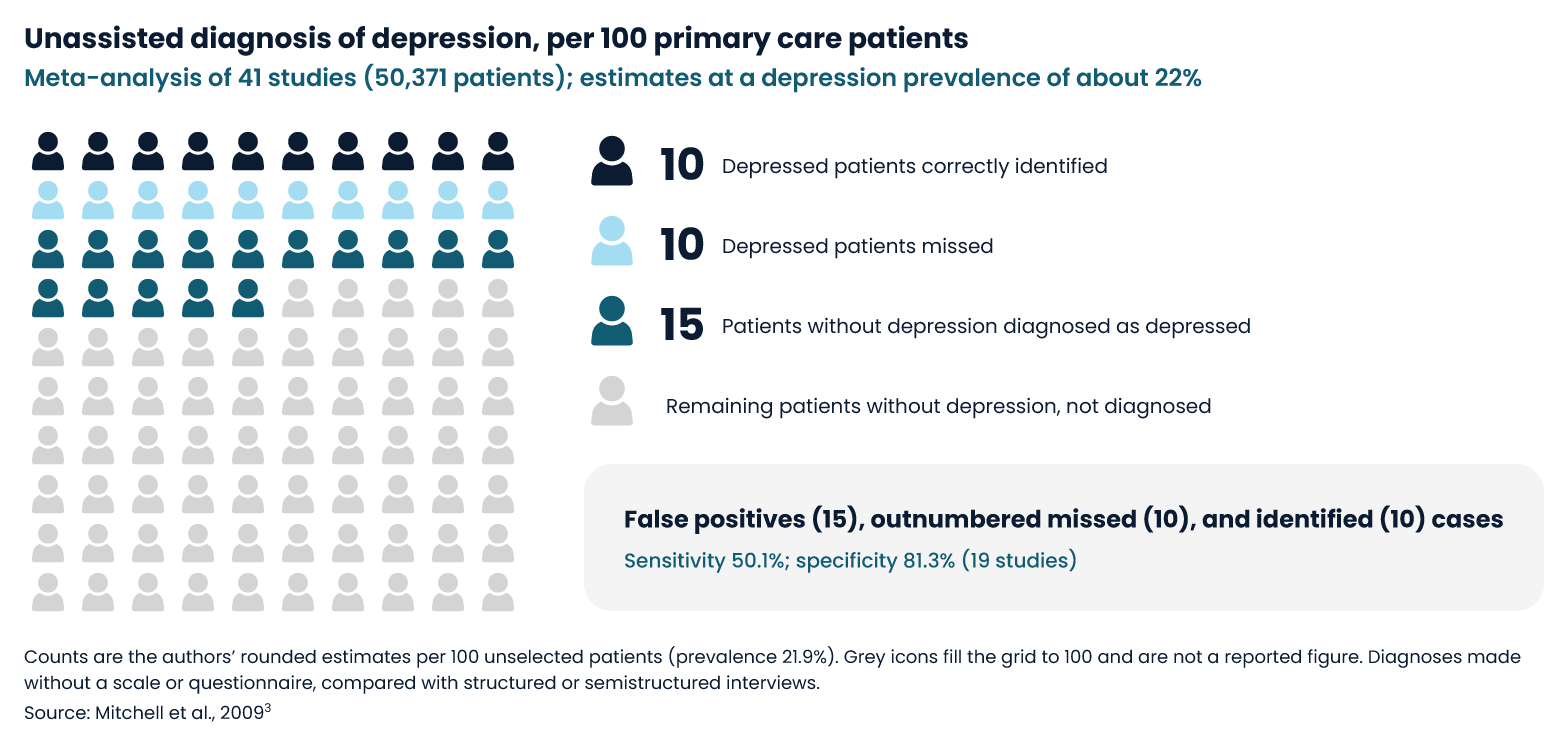
These presentations can make depression harder to recognize. A meta-analysis by Mitchell and colleagues from 41 international studies (50,371 patients), including US studies, compared primary care clinicians’ unassisted diagnoses, made without a scale or questionnaire, with structured or semi-structured interviews. Primary care clinicians correctly identified depression in 47.3% of cases (95% CI, 41.7%-53.0%). Accuracy was higher with prospective assessment over 3 to 12 months than with a one-time assessment or case-note review.3
A Validated Questionnaire Existed, but Recorded Screening Was Uncommon
The 9-item Patient Health Questionnaire (PHQ-9), validated in 2001, assesses the 9 DSM-IV criteria for depression over the past 2 weeks. In that validation study, a score of 10 or greater had a sensitivity and specificity of 88% for major depression among 580 primary care patients who also underwent a structured interview with a mental health professional.4 Two decades later, a separate meta-analysis by Negeri and colleagues of 100 studies (44,503 participants) found a pooled sensitivity and specificity of 85% at the same cutoff in studies using semi-structured interviews.5
In the National Ambulatory Medical Care Survey, depression screening was recorded at 1.4% of visits to non-psychiatrist physicians by adults without a depression diagnosis from 2005 to 2015.6 In 2023, the US Preventive Services Task Force (USPSTF) recommended depression screening for adults 19 years or older without a diagnosed mental health disorder or recognized signs or symptoms of depression (grade B).7
Recognizing Depression Takes More Than a Single Visit
The studies suggest that depression in primary care often presents with physical complaints, is identified by primary care clinicians in about half of cases, and is more accurately identified through assessment over time than at a single visit. Because the studies used different populations and methods, their figures are not directly comparable. Mitchell and colleagues concluded that reassessment could improve diagnosis,³ and the USPSTF recommends further diagnostic evaluation of positive screens.⁷ For clinicians, a positive screen or a suspicion of depression is the start of the assessment, not its end.
References
- Kessler RC, Berglund P, Demler O, et al. The epidemiology of major depressive disorder: results from the National Comorbidity Survey Replication (NCS-R). JAMA. 2003;289(23):3095-3105. doi:10.1001/jama.289.23.3095
- Simon GE, VonKorff M, Piccinelli M, Fullerton C, Ormel J. An international study of the relation between somatic symptoms and depression. N Engl J Med. 1999;341(18):1329-1335. doi:10.1056/NEJM199910283411801
- Mitchell AJ, Vaze A, Rao S. Clinical diagnosis of depression in primary care: a meta-analysis. Lancet. 2009;374(9690):609-619. doi:10.1016/S0140-6736(09)60879-5
- Kroenke K, Spitzer RL, Williams JBW. The PHQ-9: validity of a brief depression severity measure. J Gen Intern Med. 2001;16(9):606-613. doi:10.1046/j.1525-1497.2001.016009606.x
- Negeri ZF, Levis B, Sun Y, et al. Accuracy of the Patient Health Questionnaire-9 for screening to detect major depression: updated systematic review and individual participant data meta-analysis. BMJ. 2021;374:n2183. doi:10.1136/bmj.n2183
- Bhattacharjee S, Goldstone L, Vadiei N, Lee JK, Burke WJ. Depression screening patterns, predictors, and trends among adults without a depression diagnosis in ambulatory settings in the United States. Psychiatr Serv. 2018;69(10):1098-1100. doi:10.1176/appi.ps.201700439
- US Preventive Services Task Force. Screening for depression and suicide risk in adults: US Preventive Services Task Force recommendation statement. JAMA. 2023;329(23):2057-2067. doi:10.1001/jama.2023.9297