CBT Is One of Several Distinct Cognitive Therapies for GAD
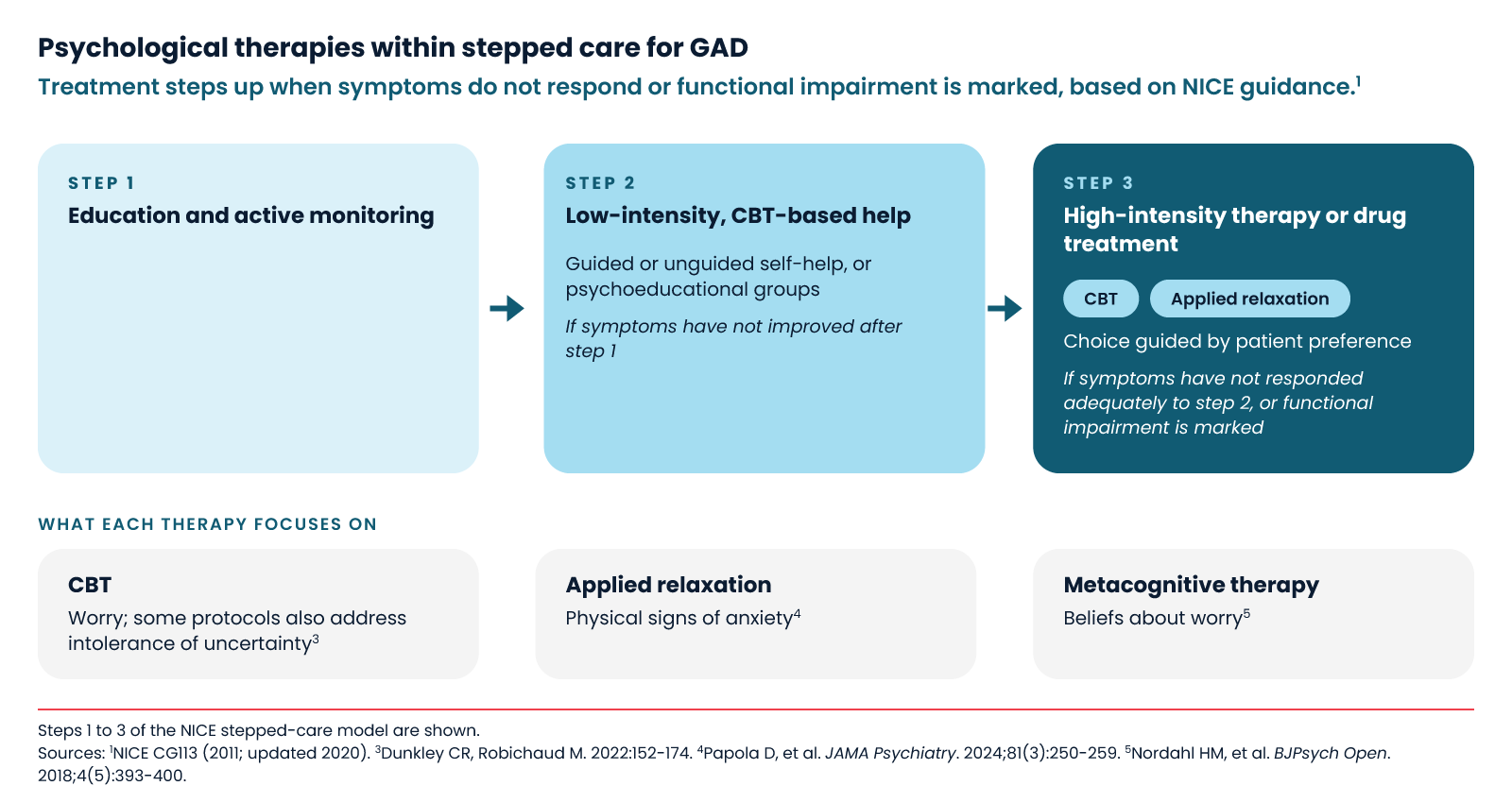
Treatment for generalized anxiety disorder (GAD) can involve pharmacological and nonpharmacological approaches, including medication and psychological therapy, used individually or in combination.1,2 Guidance from the National Institute for Health and Care Excellence (NICE) describes several psychological treatment options within a stepped approach.1 Among these options, cognitive behavioral therapy (CBT) focuses on worry, with some protocols also addressing intolerance of uncertainty.3 Other cognitive therapies approach anxiety differently: applied relaxation emphasizes the physical signs of anxiety and metacognitive therapy targets beliefs about worry.4,5
Treatments Vary From CBT-Based Self-Help to Full Courses of Therapy
In NICE’s stepped approach, people whose symptoms have not improved after education and active monitoring are offered guided or unguided self-help, or psychoeducational groups, based on CBT principles.1 A 2024 meta-analysis of 12 trials, mostly against waiting lists, found outcomes favoring low-intensity CBT (Hedges g, −0.67), defined as up to 8 sessions of up to 2 hours each.6 If symptoms have not responded adequately to low-intensity interventions, or functional impairment is marked, people choosing a high-intensity psychological intervention are offered CBT or applied relaxation, usually 12 to 15 weekly 1-hour sessions.1
CBT Addresses Worry Directly
One CBT protocol targeting intolerance of uncertainty comprises 6 modules covering psychoeducation, worry awareness, beliefs about worry and uncertainty, safety behaviors, and behavioral experiments. Other modules address problem-solving, written exposure to hypothetical worries, and relapse prevention.3
In a 2025 series of meta-analyses of 39 GAD trials, mostly against waiting lists, the effect favoring CBT was larger against waiting lists (Hedges g, 1.02; 30 trials) than against care as usual (g, 0.50; 7 trials).7 In a 2024 network meta-analysis, CBT showed a moderate-certainty advantage over treatment as usual, defined as assessment only, with or without information or minimal therapist contact (standardized mean difference [SMD], −0.74). Overall, 35% of trials were at high risk of bias.4 Beyond 12 months, a 2020 review of mainly low-quality trials across anxiety-related disorders found an effect favoring CBT over control conditions in GAD (g, 0.22).8
Applied Relaxation Focuses on Physical Signs of Anxiety
Applied relaxation teaches patients to recognize early signs of anxiety and use relaxation skills promptly.9 In the network meta-analysis previously cited, relaxation therapies, including applied relaxation, showed a low-certainty benefit over treatment as usual (SMD, −0.59). This finding was no longer statistically significant when trials at high risk of bias were excluded. The analysis found no statistically significant differences in effectiveness among the psychotherapies it compared.4
Metacognitive Therapy Focuses on Beliefs About Worry
Metacognitive therapy focuses on beliefs about worry, including whether it is uncontrollable, dangerous, or useful.5 In a 2018 trial of 81 adults, it was delivered in up to 12 weekly sessions. Among completers, 65% in the metacognitive therapy group met recovery criteria on the main worry measure after treatment, compared with 38% in the CBT group and none on a waiting list. These findings come from a single trial and warrant caution in interpretation. The authors of both treatment protocols coauthored the trial.5
Cognitive Therapies Are One Option Within Stepped Care for GAD
Of the therapies discussed here, CBT has the most support, with moderate-certainty benefit over treatment as usual and larger effects against waiting lists, while the evidence for applied relaxation and metacognitive therapy is less certain. In NICE’s stepped approach, a high-intensity psychological intervention is offered alongside drug treatment as a choice guided by patient preference, because the guideline found no evidence that either is better.1 The trials discussed here compared therapy mostly with waiting lists or usual care, so how psychological and drug treatments compare, or work together, in GAD remains an open question.
References
- National Institute for Health and Care Excellence. Generalised anxiety disorder and panic disorder in adults: management. Clinical guideline CG113. Published January 26, 2011. Updated June 15, 2020. Accessed October 10, 2026. https://www.nice.org.uk/guidance/cg113
- Agency for Care Effectiveness, Ministry of Health Singapore. Generalised anxiety disorder: easing burden and enabling remission. ACE Clinical Guideline. Published March 26, 2025. Accessed October 10, 2026. https://www.ace-hta.gov.sg/healthcare-professionals/ace-repository-for-clinical-guidelines/generalised-anxiety-disorder-easing-burden-and-enabling-remission/
- Dunkley CR, Robichaud M. Cognitive behavioral therapy for generalized anxiety disorder: targeting intolerance of uncertainty. In: Todd G, Branch R, eds. Evidence-Based Treatment for Anxiety Disorders and Depression: A Cognitive Behavioral Therapy Compendium. Cambridge University Press; 2022:152-174. doi:10.1017/9781108355605.010
- Papola D, Miguel C, Mazzaglia M, et al. Psychotherapies for generalized anxiety disorder in adults: a systematic review and network meta-analysis of randomized clinical trials. JAMA Psychiatry. 2024;81(3):250-259. doi:10.1001/jamapsychiatry.2023.3971. Published correction appears in JAMA Psychiatry. 2024;81(3):320.
- Nordahl HM, Borkovec TD, Hagen R, et al. Metacognitive therapy versus cognitive-behavioural therapy in adults with generalised anxiety disorder. BJPsych Open. 2018;4(5):393-400. doi:10.1192/bjo.2018.54
- Powell CLYM, Chiu CY, Sun X, So SH. A meta-analysis on the efficacy of low-intensity cognitive behavioural therapy for generalised anxiety disorder. BMC Psychiatry. 2024;24(1):10. doi:10.1186/s12888-023-05306-6
- Cuijpers P, Harrer M, Miguel C, et al. Cognitive behavior therapy for mental disorders in adults: a unified series of meta-analyses. JAMA Psychiatry. 2025;82(6):563-571. doi:10.1001/jamapsychiatry.2025.0482
- van Dis EAM, van Veen SC, Hagenaars MA, et al. Long-term outcomes of cognitive behavioral therapy for anxiety-related disorders: a systematic review and meta-analysis. JAMA Psychiatry. 2020;77(3):265-273. doi:10.1001/jamapsychiatry.2019.3986
- Hayes-Skelton SA, Roemer L, Orsillo SM, Borkovec TD. A contemporary view of applied relaxation for generalized anxiety disorder. Cogn Behav Ther. 2013;42(4):292-302. doi:10.1080/16506073.2013.777106