Worry Defines GAD, and Treatment Choice Matters
Excessive, hard-to-control worry is the defining feature of generalized anxiety disorder (GAD). Psychotherapy and pharmacotherapy, mainly SSRIs and SNRIs, are first-line treatments and are often combined.1 Not every patient responds to first-line treatment, and side effects and patient preference also shape the choice.1 Across studies of psychiatric disorders, mostly depression, about 3 in 4 people preferred psychological treatment to medication.2
Mindfulness-based stress reduction (MBSR) and mindfulness-based cognitive therapy (MBCT) are manualized, group-based, nonpharmacological programs proposed as psychological treatments.3 They may reduce worry and rumination, forms of repetitive thought common in anxiety, and may strengthen emotion regulation and attentional control.4,5 Their focus on how people respond to repetitive thought provides a rationale for studying them in GAD.
MBSR Was Developed for Stress, MBCT for Depressive Relapse
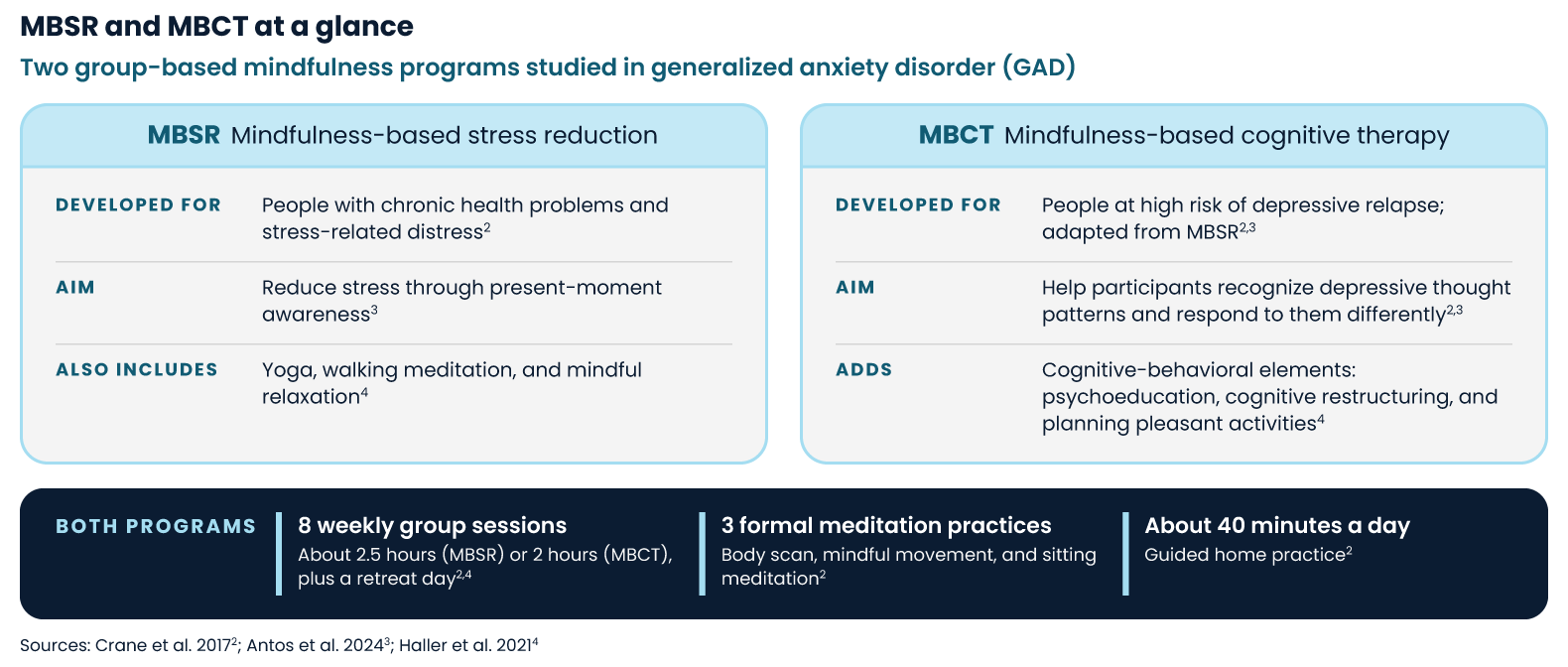
MBSR was developed for people with chronic health problems and stress-related distress, and aims to reduce stress through present-moment awareness.4,6 MBCT, adapted from MBSR, was designed to teach people at high risk of depressive relapse the skills to stay well. It adds cognitive-behavioral elements, such as psychoeducation, cognitive restructuring, and planning pleasant activities, to help participants recognize depressive thought patterns and respond to them differently.4,6,7
Both are built around three formal meditation practices: the body scan, mindful movement, and sitting meditation. MBSR also includes yoga, walking meditation, and mindful relaxation.6,7 Standard curricula consist of 8 weekly group sessions, about 2.5 hours for MBSR and 2 hours for MBCT, plus a retreat day.6,7 Participants are asked to complete about 40 minutes of guided home practice daily.6 The commitment is considerable but time-limited. Safety data in anxiety disorders are limited: adverse events have been inadequately reported, and trials that reported them found no greater incidence with MBSR or MBCT than with usual care.7
Mindfulness May Change How Patients Respond to Worry
One proposed mechanism by which MBSR and MBCT may reduce anxiety is decentering, the capacity to step back and observe thoughts and feelings rather than be absorbed by them. Decentering comprises three interrelated processes: meta-awareness, disidentification from internal experience, and reduced reactivity to thought content.8 Decentering is typically measured with self-report instruments, most often the decentering subscales of the Experiences Questionnaire and Toronto Mindfulness Scale.8
Hölzel and colleagues proposed a model in which mindfulness meditation works through four processes: attention regulation, body awareness, emotion regulation, and a change in perspective on the self.5 In mediation studies of MBSR and MBCT across conditions, the strongest evidence implicates reduced cognitive and emotional reactivity, with moderate evidence for mindfulness, rumination, and worry as mediators and preliminary evidence for self-compassion and psychological flexibility.9 Given the methodological limitations of these studies, these mechanisms remain provisional.9
Early Evidence Points to Short-Term Benefit
The GAD-specific evidence base is small: a 2024 systematic review and meta-analysis identified 4 studies of 8-week MBSR or MBCT programs (334 patients). Against inactive or unspecified controls (3 trials, 212 patients), the pooled effect on anxiety symptoms was large (standardized mean difference [SMD], −1.92; 95% CI, −3.44 to −0.40). Against psychoeducation (2 trials, 211 patients), the difference was not significant (SMD, −0.31; 95% CI, −0.90 to 0.28). Heterogeneity was considerable (I² = 95% and 78%, respectively). Certainty was rated low to very low, mainly because of risk of bias, inconsistency, and indirectness.3
A 2024 network meta-analysis of 65 GAD trials grouped third-wave therapies, including mindfulness- and acceptance-based approaches. Together, they outperformed usual care at end of treatment (SMD, −0.76; moderate certainty). At 3 to 12 months, the difference was smaller and no longer significant.10 Across anxiety disorders, a 2021 systematic review and meta-analysis likewise found short-term benefit when added to usual care, with smaller effects for MBSR than CBT.7
Better-Controlled Trials Are the Next Step
MBSR and MBCT are structured, nonpharmacological programs that may offer short-term benefits, although the GAD-specific evidence remains limited and heterogeneous. Decentering and related processes are candidate mechanisms.3,9 Trials with evidence-based controls and longer follow-up could clarify which components help most, whether benefits last, and how to tailor treatment to individual patients.3,10 Such trials could help define where mindfulness fits in GAD care.
References
- Penninx BWJH, Pine DS, Holmes EA, Reif A. Anxiety disorders. Lancet. 2021;397(10277):914-927. doi:10.1016/S0140-6736(21)00359-7
- McHugh RK, Whitton SW, Peckham AD, Welge JA, Otto MW. Patient preference for psychological vs pharmacologic treatment of psychiatric disorders: a meta-analytic review. J Clin Psychiatry. 2013;74(6):595-602. doi:10.4088/JCP.12r07757
- Williams MM, Honan CA, Skromanis S, Sanderson B, Matthews AJ. Psychological outcomes and mechanisms of mindfulness-based training for generalised anxiety disorder: a systematic review and meta-analysis. Curr Psychol. 2024;43(6):5318-5340. doi:10.1007/s12144-023-04695-x
- Antos Z, Zackiewicz K, Tomaszek N, Modzelewski S, Waszkiewicz N. Beyond pharmacology: a narrative review of alternative therapies for anxiety disorders. i. 2024;12(9):216. doi:10.3390/diseases12090216
- Hölzel BK, Lazar SW, Gard T, Schuman-Olivier Z, Vago DR, Ott U. How does mindfulness meditation work? Proposing mechanisms of action from a conceptual and neural perspective. Perspect Psychol Sci. 2011;6(6):537-559. doi:10.1177/1745691611419671
- Crane RS, Brewer J, Feldman C, et al. What defines mindfulness-based programs? The warp and the weft. Psychol Med. 2017;47(6):990-999. doi:10.1017/S0033291716003317
- Haller H, Breilmann P, Schröter M, Dobos G, Cramer H. A systematic review and meta-analysis of acceptance- and mindfulness-based interventions for DSM-5 anxiety disorders. Sci Rep. 2021;11(1):20385. doi:10.1038/s41598-021-99882-w
- Guo L. The correlation between mindfulness, decentering, and psychological problems: a structural equation modeling meta-analysis. Mindfulness. 2024;15(8):1873-1895. doi:10.1007/s12671-024-02395-6
- Gu J, Strauss C, Bond R, Cavanagh K. How do mindfulness-based cognitive therapy and mindfulness-based stress reduction improve mental health and wellbeing? A systematic review and meta-analysis of mediation studies. Clin Psychol Rev. 2015;37:1-12. doi:10.1016/j.cpr.2015.01.006
- Papola D, Miguel C, Mazzaglia M, et al. Psychotherapies for generalized anxiety disorder in adults: a systematic review and network meta-analysis of randomized clinical trials. JAMA Psychiatry. 2024;81(3):250-259. doi:10.1001/jamapsychiatry.2023.3971. Published correction appears in JAMA Psychiatry. 2024;81(3):320.