A 2026 Panel Defined Reassessment Points at 2 and 4 to 6 Weeks
After starting treatment for major depressive disorder (MDD), clinicians assess whether patients are improving and when treatment adjustments may be needed. A 2026 consensus panel report by Clayton and colleagues recommends measurement-based care from treatment onset, with reassessments at approximately 2 weeks and again at 4 to 6 weeks.1 However, early improvement does not always predict the eventual outcome, and achieving remission may require successive treatment steps. STAR*D and research on measurement-based care and early response put these decisions in perspective.
Remission Declined Across STAR*D Steps and Was Higher With Measurement-Based Care
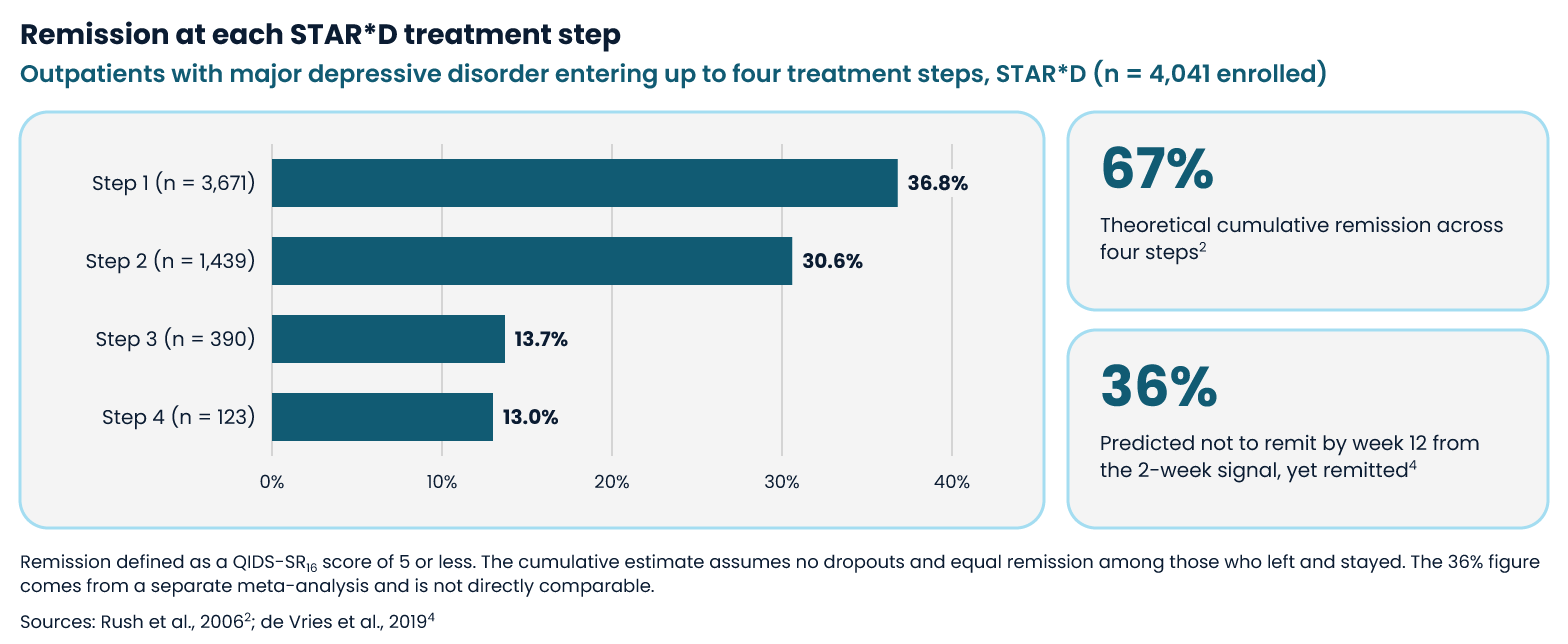
In the Sequenced Treatment Alternatives to Relieve Depression (STAR*D) study, Rush and colleagues enrolled 4,041 outpatients with MDD.2 Of these, 3,671 were analyzed at step 1, and 1,439, 390, and 123 entered steps 2, 3, and 4. Remission, defined as a QIDS-SR16 score of 5 or less, was achieved by 36.8%, 30.6%, 13.7%, and 13.0% at the respective steps.2 The authors estimated a theoretical cumulative remission rate of 67%, assuming no dropouts and equal remission rates among those who left and stayed.2
Remission also differed with how symptoms were tracked. Zhu and colleagues pooled 7 studies involving 2,019 participants with depressive disorders to evaluate measurement-based care, defined as routinely administered outcome measures with practitioner and patient review to inform clinical decision-making.3 In 5 studies with 1,518 participants, unadjusted remission rates were 52.8% with measurement-based care and 43.0% with comparison conditions (odds ratio [OR], 1.83; 95% CI, 1.12-2.97). The difference in clinical response, pooled from 3 studies with 1,112 participants, did not reach significance (OR, 1.66; 95% CI, 0.66-4.17).3 The authors noted the small number of trials, high risk of bias, and significant heterogeneity as limitations.3 These rates are not directly comparable with STAR*D’s.
Early Nonimprovement Did Not Exclude Remission, and a Panel Tied Referral to Complexity
In an individual patient data meta-analysis of 30 trials and 6,058 antidepressant-treated participants, de Vries and colleagues evaluated the predictive value of early symptom improvement by week 2, defined as at least 20% improvement.4 Among test-set participants the model predicted would not remit by week 12, 36% did, compared with 51% of all test-set participants. The authors concluded that absence of early improvement does not rule out later response or remission with certainty, and that adapting antidepressant treatment because of limited improvement in the first 2 weeks would be premature for some patients, although such changes might be appropriate when a fast response is essential.4 They added that lack of early improvement can identify a high-risk group that may need more intensive monitoring or additional counselling.4
The Clayton report also described failure of 2 adequate antidepressant trials as a common pragmatic threshold for specialty referral. In the panel’s view, diagnostic uncertainty, comorbidity burden, functional collapse, or acute risk justify earlier referral.1
These Findings Favor Early Reassessment Backed by Measurement
Limited improvement by week 2 signals higher risk but does not determine the outcome. In the de Vries analysis, 36% of participants predicted not to remit by week 12 nevertheless achieved remission, while STAR*D showed that remission remained possible across all four treatment steps.2,4 Measurement-based care, which was associated with higher remission in pooled trials, provides a way to act on that signal by tracking symptom changes and informing treatment decisions.3 When adequate treatment steps fail or clinical complexity increases, the Clayton panel describes specialty referral as a transition point in care rather than a treatment failure.1
References
- Clayton AH, Asbach M, Cabrera P, et al. Treatment-resistant depression as a dynamic continuum: a consensus panel report on mechanism-informed pharmacologic sequencing. J Clin Psychiatry. 2026;87(3):htrdachi2508. doi:10.4088/JCP.htrdachi2508
- Rush AJ, Trivedi MH, Wisniewski SR, et al. Acute and longer-term outcomes in depressed outpatients requiring one or several treatment steps: a STAR*D report. Am J Psychiatry. 2006;163(11):1905-1917. doi:10.1176/ajp.2006.163.11.1905
- Zhu M, Hong RH, Yang T, et al. The efficacy of measurement-based care for depressive disorders: systematic review and meta-analysis of randomized controlled trials. J Clin Psychiatry. 2021;82(5):21r14034. doi:10.4088/JCP.21r14034
- de Vries YA, Roest AM, Bos EH, et al. Predicting antidepressant response by monitoring early improvement of individual symptoms of depression: individual patient data meta-analysis. Br J Psychiatry. 2019;214:4-10. doi:10.1192/bjp.2018.122