What a Self-Reported Score Actually Records
Quality of life instruments are widely used as an index of how a patient is doing, and a rise in the score is interpreted as a gain in functioning. What a self-reported score actually represents is the patient’s own judgment of their life. Self-reported quality of life tracks current mood more closely than other elements of everyday functioning.1,3 A rising score therefore leaves open what improved. Symptoms explain only a modest share of the variance in the score, and what does move with symptoms is largely mood. That influence of mood on self-assessment is seen in patients and healthy people alike.
Symptoms Explain a Small Share of the Variance
Eack and Newhill quantified how much of the score symptoms account for. Pooling 56 studies from 1966 to 2005, they found only modest associations with composite quality of life: general psychopathology at r = -0.34, negative symptoms at -0.25, and positive symptoms at -0.20. General psychopathology, the strongest of the three, explained no more than 12% of the variance, and under 8% in longitudinal studies.1 Most of what a quality of life score reflects lies outside symptom severity.
What a self-reported score actually represents is the patient’s own judgment of their life.
Self-Reports Track Mood More Closely Than Function
One candidate for the remainder is the patient’s mood at the time of rating. Oliveri and colleagues asked whether depression shapes how patients rate their own social functioning, and included healthy controls to test whether the effect is specific to schizophrenia. Stable outpatients (n=218) and controls (n=154) self-reported their social functioning on the Specific Levels of Functioning scale. After entering sex, diagnosis, and depression as predictors, only depression entered the model and accounted for 23% of the variance in self-reported functioning. Depression correlated with self-reported functioning at r = -0.44 in patients and -0.55 in controls.2 The association held in people without the diagnosis, and the authors concluded that the effect is not confined to schizophrenia. Both measures were self-reported, so shared method variance cannot be excluded.2 A transdiagnostic review reports the same pattern at the instrument level.3
Affective Symptoms Predicted the Most Domains
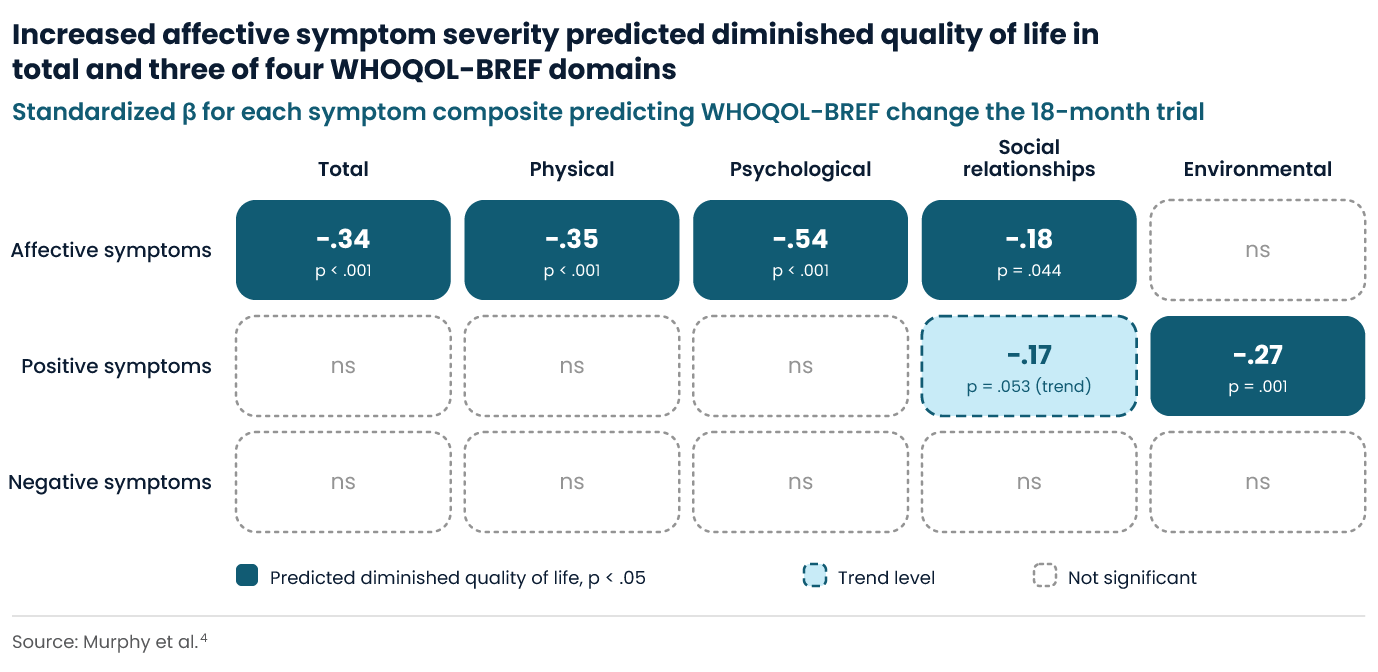
Repeated assessment of the same patients separates the symptom changes that accompany quality of life change from those that do not. Murphy and colleagues analyzed an 18-month randomized trial with active psychosocial treatment in both arms, in which 102 early-course patients were assessed on the WHOQOL-BREF at baseline, 9 months, and 18 months. Increases in affective symptoms predicted lower total, physical, psychological and social relationships quality of life, and increases in positive symptoms predicted lower environmental quality of life; no other symptom class predicted any domain at P < .05.4 Results should be read with caution, because antipsychotic use was an inclusion criterion and missing data reached 29.7%.4 Affective change was the only class associated with the total score, reaching three of the four domains.
Pair the Quality of Life Score With a Symptom Measure
Quality of life scores respond to more than function. Symptoms account for only a small share of the variance in these scores, and most of that share comes from mood and anxiety symptoms rather than psychosis. An improvement in the total may reflect reduced depression or anxiety rather than gains in daily functioning. Pairing the instrument with a depression or anxiety scale separates the two.
Financial support was provided by Bristol Myers Squibb. Psychiatrist.com independently developed the content and maintained final editorial control.
References
- Eack SM, Newhill CE. Psychiatric symptoms and quality of life in schizophrenia: a meta-analysis. Schizophr Bull. 2007;33(5):1225-1237. doi:10.1093/schbul/sbl071
- Oliveri LN, Awerbuch AW, Jarskog LF, Penn DL, Pinkham A, Harvey PD. Depression predicts self assessment of social function in both patients with schizophrenia and healthy people. Psychiatry Res. 2020;284:112681. doi:10.1016/j.psychres.2019.112681
- Correll CU, Cortese S, Solmi M, et al. Beyond symptom improvement: transdiagnostic and disorder-specific ways to assess functional and quality of life outcomes across mental disorders in adults. World Psychiatry. 2025;24(3):296-318. doi:10.1002/wps.21338
- Murphy SM, Flores AT, Sarpal DK, Keshavan MS, Eack SM. Quality of life in schizophrenia: symptomatic markers of improvement over time. Psychiatr Rehabil J. 2026;49(3):247-252. doi:10.1037/prj0000690