TRD Estimates Vary Widely With How It Is Defined
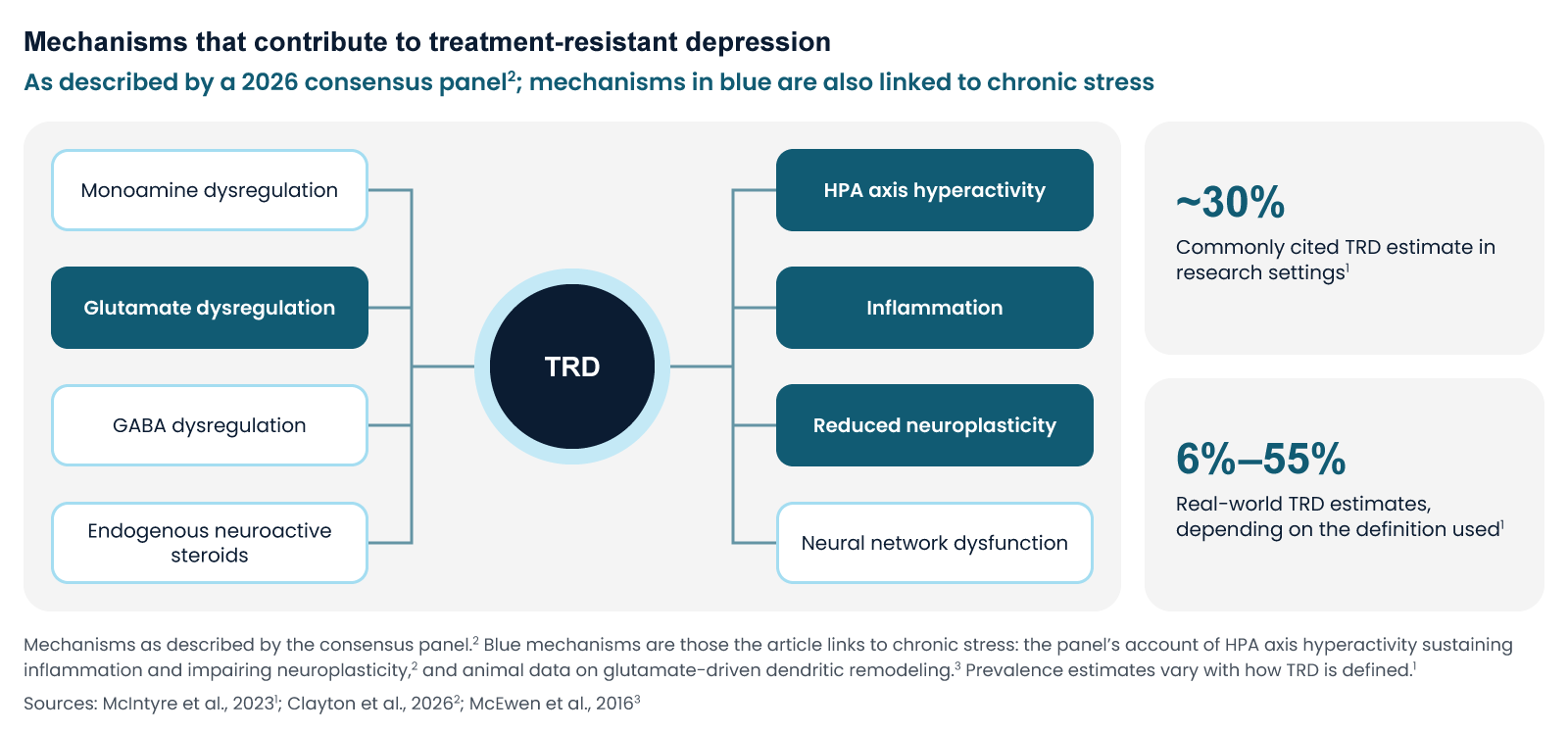
For patients with major depressive disorder (MDD) who do not respond adequately to at least 2 antidepressants given at adequate doses and for adequate durations, the condition is commonly classified as treatment-resistant depression (TRD). McIntyre and colleagues noted that TRD is often cited as affecting about 30% of people treated with antidepressants in research settings, while real-world estimates range from 6% to 55%.1 Most definitions rely on the number of failed treatment trials. However, treatment history alone does not explain the biological processes that contribute to resistance or whether the changes underlying it can be reversed.
A Consensus Panel Described 8 Interacting Mechanisms in TRD
A 2026 consensus panel report by Clayton and colleagues characterized TRD as a dynamic continuum shaped by illness biology, patient complexity, and cumulative treatment history, rather than a fixed end point defined only by the number of failed treatments.2 The panel described 8 mechanisms that contribute to TRD: monoamine, glutamate, and γ-aminobutyric acid (GABA) dysregulation; endogenous neuroactive steroids; neural network dysfunction; inflammation; reduced neuroplasticity; and hypothalamic-pituitary-adrenal (HPA) axis hyperactivity.
Chronic Stress Remodeled Dendrites in Animals, With Related Findings in Humans
According to the panel, stress-related HPA axis hyperactivity sustains inflammatory signaling and impairs neuroplastic processes.2 McEwen and colleagues reviewed animal studies in which chronic stress caused hippocampal CA3 dendrites to debranch and shorten, with glutamate release contributing to this remodeling. Similar structural changes were observed in the medial prefrontal cortex (PFC).3 Woo and colleagues linked chronic stress-related PFC spine loss to changes in brain-derived neurotrophic factor (BDNF) and mammalian target of rapamycin complex 1 (mTORC1) signaling implicated in this process.4
In humans, chronic stress has been associated with reduced PFC gray matter volume,4 while postmortem studies of people with depression identified smaller hippocampal pyramidal cell nuclei and fewer glial cells, without evidence of neuronal loss.3 Although these findings suggest structural alterations, they do not establish that the same dendritic changes observed in animal models occur in humans.
Remodeling Was Largely Reversible, and Glutamate Signaling Is a Proposed Plasticity Route
McEwen and colleagues described these changes as largely reversible and adaptive. In young animals, medial PFC dendrites regrew after stress ended, though less readily in older animals. Regrown dendrites were closer to the cell body, suggesting that the neurons are altered by stress.3
In 2019, the US Food and Drug Administration approved esketamine nasal spray, the first glutamate-modulating antidepressant, for adults with TRD.1,5 Van Hoogdalem and colleagues outlined its proposed mechanism: esketamine is thought to preferentially block NMDA receptors on inhibitory GABAergic interneurons, briefly disinhibiting glutamate release and, in turn, activating postsynaptic AMPA receptors. Downstream BDNF release and mTORC1 activation reportedly promote synapse formation, although the precise mechanism is still being established.5 This pathway overlaps with the one Woo and colleagues implicated in stress-related spine loss.4
These Findings Frame TRD as a Changeable State
These findings support the panel’s view of TRD as a dynamic continuum: a state rather than a verdict.2 Animal studies suggest that stress-related synaptic changes are largely reversible; if similar plasticity occurs in people, resistance to one treatment need not represent a permanent state. McEwen and colleagues proposed that pharmacologic approaches or behavioral interventions, such as physical activity, may increase plasticity in ways that help behavioral therapy work better in depression.3
References
- McIntyre RS, Alsuwaidan M, Baune BT, et al. Treatment-resistant depression: definition, prevalence, detection, management, and investigational interventions. World Psychiatry. 2023;22(3):394-412. doi:10.1002/wps.21120
- Clayton AH, Asbach M, Cabrera P, et al. Treatment-resistant depression as a dynamic continuum: a consensus panel report on mechanism-informed pharmacologic sequencing. J Clin Psychiatry. 2026;87(3):htrdachi doi:10.4088/JCP.htrdachi2508
- McEwen BS, Nasca C, Gray JD. Stress effects on neuronal structure: hippocampus, amygdala, and prefrontal cortex. Neuropsychopharmacology. 2016;41(1):3-23. doi:10.1038/npp.2015.171
- Woo E, Sansing LH, Arnsten AFT, Datta D. Chronic stress weakens connectivity in the prefrontal cortex: architectural and molecular changes. Chronic Stress (Thousand Oaks). 2021;5:24705470211029254. doi:10.1177/24705470211029254
- van Hoogdalem MW, Fu DJ, Drevets WC, Zannikos PN. Esketamine nasal spray: mechanism of action, clinical, and translational science. Clin Transl Sci. 2026;19(4):e doi:10.1111/cts.70527