
Abstract
The randomized clinical trial (RCT) is a gold-standard research design for the evaluation of cause and effect in medical disciplines. Fidelity of patient and rater blinding is one of many variables that support the internal validity of RCTs. When drugs have known, common, discernible psychological or somatic effects, experience or lack of experience of these effects can result in patients recognizing that they are receiving drug or placebo, respectively. Such functional unblinding can enhance or reduce treatment expectations and magnify or diminish placebo mechanisms, depending on whether patients are receiving drug or placebo. The internal validity of the study is thereby compromised. This article discusses blinding, the need for blinding, indices suggested for quantifying the integrity of blinding, questions that need to be asked to assess blinding, why assessing blinding only at study endpoint is desirable for ethical and scientific reasons, and the complexities of interpreting unblinding. It is suggested that, first, unblinding should not be interpreted merely as a yes or no result; it should be interpreted in the context of why it happened. Second, unblinding should not be presented as a standalone finding; it should be interpreted in the context of how it affects internal and external validity. Third, whether or not unblinding is considered to affect internal validity depends on whether internal validity is rigidly defined or defined with nuances. Finally, internal validity need not be a sacred cow; external validity may trump internal validity in certain contexts. A Blinding Internal Validity Index is suggested: this is the percentage of patients in whom unblinding has not compromised internal validity, with internal validity defined narrowly or broadly, as per the preference of the investigator.
J Clin Psychiatry 2026;87(4):26f16740
Author affiliations are listed at the end of this article.
From the Editors

Are you a healthcare provider?
Add your NPI to personalize your JCP experience.
The abbreviation RCT expands to “randomized controlled trial”; in medical intervention contexts, it effects. expands more specifically to “randomized clinical trial”; the latter is a subset of the former.
The RCT is a gold-standard research design for the evaluation of cause and effect in medicine and science. Randomized clinical trials typically compare one or more experimental interventions with one or more comparator interventions. In the rest of this article, we will consider RCTs that are randomized clinical trials of a single study drug versus a single therapeutically inert comparator, placebo.
Placebo may be inactive or active. Inactive placebo is a substance that is not expected to exert noticeable psychological or somatic effects; active placebo is a substance that is not expected to benefit the condition that is being treated (it is therapeutically inert), but does produce noticeable psychological or somatic
A study has good internal validity if it addresses the research question in a scientifically sound manner; research design, study methods, and statistical analysis should all be appropriate; there should be no bias. Studies that have good internal validity are scientifically sound; the results can be trusted. In RCTs, fidelity of blinding is one of many variables that support internal validity.
Blinding
In RCTs, patients are blind to the treatment that they are receiving if they do not know whether they are receiving the study drug or placebo. The study staff who rate patient outcomes are blind if they do not know to which treatment arm patients (whom they are rating) belong. Allocation concealment, masking, and blinding are terms that are commonly used in these contexts. Allocation concealment usually refers to the method of blinding; masking and blinding are generally considered synonymous. Some authors prefer “masking” over “blinding” because being “blind” also describes a medical condition.
Need for Blinding
In RCTs, patients need to be blind to treatment allocation all through the study because, if they are not blind, their expectation of benefits and adverse effects may enhance the placebo and nocebo response in the active treatment arm, and their lack of expectation of benefits and adverse effects may suppress the placebo and nocebo response in the placebo arm. Thus, the difference between drug and placebo with regard to beneficial and adverse effects may be magnified by expectations that are not an intrinsic property of the treatment.
In RCTs, raters need to be blind to treatment allocation all through the study because, if they are not blind, they may consciously or unconsciously interpret and record patient data in a more favorable or less favorable manner, depending on what treatment they know that the patient received and what they believe about the treatment. Again, the difference between drug and placebo with regard to beneficial and adverse effects may be distorted by beliefs that are not an intrinsic property of the treatment.
Blinding is especially important when outcomes are subjective (eg, perception of pain, rating of depression severity). The importance of patients and raters both being blind to treatment allocation was recognized as early as in the first half of the 20th century,1 if not earlier.
Single-Blind, Double-Blind, and Triple-Blind Studies
RCTs can be single-blind, double-blind, and even triple-blind. The commonest single-blind situation is one in which the nature of the treatment cannot be concealed from the patient. For example, patients will know whether they are meditating, practicing yoga, exercising, receiving electroconvulsive therapy, or receiving active psychotherapy because these are interventions for which “matching placebo” interventions are almost impossible to create. So, in a single-blind study, patients are aware of what treatment they are receiving, but raters are blind to the intervention.
In double-blind studies, neither patients nor investigators (the latter comprise the raters and often the rest of the treating team, as well) know which patient is receiving which intervention. In triple-blind studies, other study staff involved with collection or processing of the data (eg, the statistical team) may also be blind to treatment allocation. RCTs conducted in medicine and neuropsychiatry are most commonly double-blind.
Unblinding
Patients may be unblinded in many ways. They may accidentally learn from study staff or case notes that they are receiving drug or placebo. Or, they may try to find out what they are receiving, such as by unscrewing their capsules and inspecting and tasting the contents. Or, functional unblinding (described in the next section) may occur.
When unblinding occurs as a rare instance, bias is small. When unblinding occurs as a common event, bias is substantial and compromises the internal validity of the study. Functional unblinding can be common in some RCTs, especially RCTs of psychedelic drugs and ketamine.
Functional Unblinding
Functional unblinding is unblinding that occurs when the study drug has noticeable psychological or somatic effects, whether beneficial or adverse; sedation with psychotropic medication is a common example. Patients who recognize such effects can easily infer that they are receiving the study drug; and from this point onward, an expectancy effect may contribute to an unknown extent to the efficacy and adverse effect outcomes.
Functional unblinding may likewise occur when patients (who were educated about drug psychophysiological effects during the study consenting process) experience no psychological or somatic effects at all and conclude that they are receiving placebo; the loss of the expectancy effect may likewise prejudice efficacy and adverse effect outcomes.
Because functional unblinding can, through these mechanisms, amplify drug vs placebo differences for efficacy as well as adverse effect outcomes, the true cause-effect relationship between drug and outcome cannot be validly determined; internal validity is compromised. It may be noted here that the US Food and Drug Administration declined approval of MDMA for the treatment of posttraumatic stress disorder because of inadequate blinding (among other reasons) in the RCTs; this, despite compelling evidence of efficacy.2
Active Placebo for Mitigation of the Risk of Functional Unblinding
One way to reduce the risk of functional unblinding is to administer active placebo instead of inactive placebo. As an example, for an RCT that examines the antidepressant efficacy of ketamine infusions, the use of midazolam as an active placebo results in better blinding than the use of saline as an inactive placebo.2 However, functional unblinding can occur with active placebo, as well. In the ketamine versus midazolam example, midazolam is merely sedating; it does not cause dissociative, neurological, and perceptual effects as ketamine might. When patients are educated about drug effects during the informed consent procedures, or when patients search online for the effects of these drugs, it could be easy for them to recognize which drug they are receiving based on what they experience with the study medication.
Assessing Unblinding
Blinding integrity is typically assessed at the end of the study; investigators ask patients to guess what treatment they had received. Raters are likewise questioned. If blinding integrity is perfect, the guesses should be equally distributed between drug and placebo. If patient and rater guesses are correct more frequently than can be expected by chance, blinding integrity is likely to have been compromised.
Surprisingly, few RCTs assess and report the fidelity of blinding; this is even more surprising, and is of particular concern, when the study drug has noticeable psychological or somatic effects. As a striking example, in a systematic review of the literature on blinding in RCTs of psychedelic drugs (including ketamine), Orsini et al2 found that only 33 (30%) of 112 RCTs (examining 7 drugs for 13 indications) assessed the integrity of blinding.
Methods for Assessing Unblinding
Formal methods have been described for the assessment of unblinding.3 The best-known ones are those by James et al,4 Bang et al,5,6 and Petroff et al.7
James et al4 suggested weights for correct, “don’t know”, and wrong guesses, depending on scientific desirability, and described a method to calculate a blinding index for the study. They also proposed a method for statistical analysis. Notably, these authors suggested that the “don’t know” guess implies blinding integrity and should be accepted as a valid guess.
Bang et al5 considered that a “don’t know” guess could be a socially desirable response to investigator enquiry. They further considered that patients who say “don’t know” probably do have an inner suspicion; or, at least, may not sit exactly on the fence. They proposed a new blinding index, based on a multinomial procedure. This Bang blinding index is obtained separately for each treatment arm; it thus captures the extent of unblinding separately for drug and for placebo. The index is interpreted as the percentage of unblinding that has occurred beyond that attributable to chance.
In a later paper, Bang et al6 recommended questions that need to be asked and how investigators should proceed with the assessment and interpretation of unblinding. Specifically, they proposed assessment of treatment received (drug, placebo, or “don’t know”), strength of certainty of the guess (on a 1–5 scale), and a forced guess (for those who responded “don’t know”).
Petroff et al7 presented guessing scenarios that exposed the limitations of the James and Bang blinding indices. They suggested a ‘‘simple blinding index’’ and a statistical package that estimates this blinding index along with its 95% confidence interval and P value. They asserted that their index is easy to interpret because it is the difference in probabilities for guessing A rather than B, where A and B are the treatments administered.
Questions That Need to Be Asked
Three questions assume importance in assessing blinding integrity: what, why, and when. With regard to “what,” patients are asked what treatment they think they have received; they can be encouraged to guess if they feel that one possibility is more likely than the other; and it could also be useful to know how strongly convinced they are that their guess is right.6
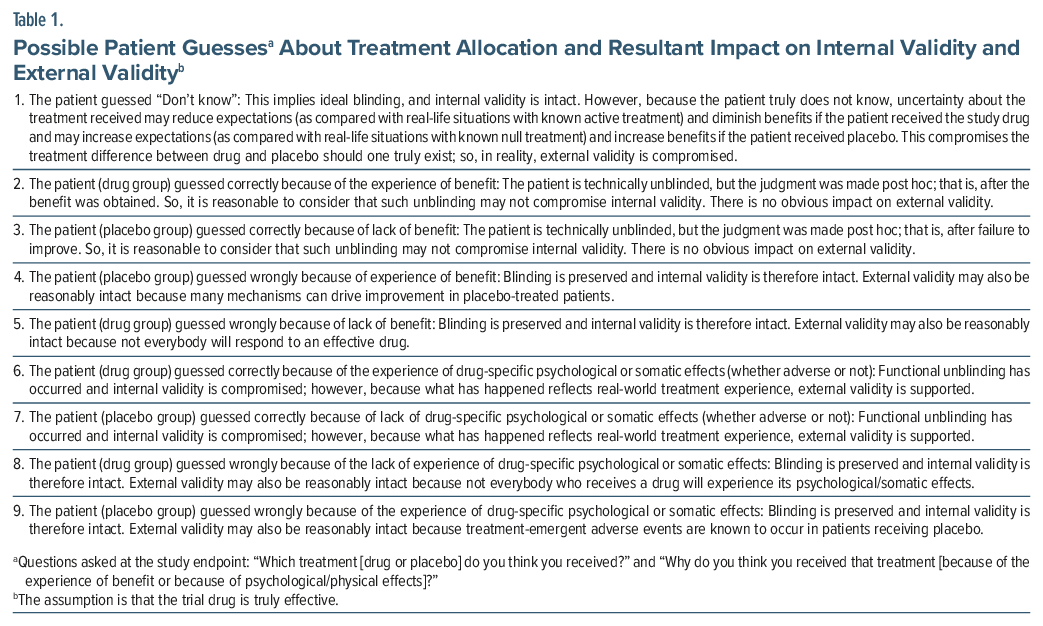
It is also necessary to ask patients why they made that guess; was it because of the experience of benefit or because of the experience of a psychological or somatic effect, whether adverse or not. Whether such unblinding is a bias or not arguably depends on the treatment that the patient actually received. This is explained in a later section and in Table 1.
Finally, it is necessary to ask patients when they first suspected that their guess was the assigned treatment. This question is important because functional unblinding that occurred early during a study can bias outcomes from an earlier point in time, potentially resulting in a larger impact.
When Blinding Is Best Assessed
Blinding is typically assessed at study endpoint. However, some authors recommended assessment at 2 or more points during the course of the study; this can capture the point at which patients were unblinded as well as changes in guesses across the study.7,8 These recommendations notwithstanding, from an ethical perspective as well as to avoid compromising internal validity, blinding is best assessed only at study endpoint. The key to the discussion here is that when blinding is assessed early during the course of the study, patients are forced to actively think about treatment allocation at that time. A Hawthorne effect may then arise, where the act of assessment alters the outcome being assessed.
When blinding is assessed early during a study, from an ethical perspective, if patients commit themselves to the guess that they are receiving placebo, there is a risk that the guess may get anchored, and their expectations from treatment may drop. So, the assessment could prejudice future improvement in these patients, regardless of what treatment they are actually receiving. An assessment that has potential to harm patients is unethical.
With regard to internal validity, regardless of what patients guess (drug or placebo), if the guess is wrong, expectations awoken and anchored through the assessment could move outcomes in a direction away from what might be expected from the actual treatment allocation; the result could be a reduction in the true difference between drug and placebo. And, if the guess is right, the verum effects for benefit and harm could both be magnified. In both situations, internal validity is affected. The assumption here is that the drug is truly effective and truly has adverse effects.
Additionally, if the assessment is conducted early during the course of the study and if patients guess rightly or wrongly that they are receiving placebo, what motivation do they have to adhere to the dispensed medication and to continue in the trial? The assessment can then increase the risk of low treatment adherence and study dropout.
As a side note, it may be argued that serial assessment of efficacy and adverse effects during the course of a study may induce a similar Hawthorne effect. Countering such an argument, patients would have been made aware that recovery is a gradual process; and, anyway, patients do improve during the course of a study through placebo-related and other mechanisms9; and, crucially, there is no discussion (during such assessments) about what treatment patients believe they might be receiving. In contrast, making patients guess what they are receiving brings the possibility of receiving placebo to the forefront of consciousness, triggering the risk that expectations will be formally aroused or dampened.
The Complexities of Interpreting Unblinding
Formal methods for the assessment of unblinding, such as the indices proposed by James et al,4 Bang et al,5 and Petroff et al,7 yield single numbers that quantify unblinding. However, a single number,4,7 or a single number for each treatment arm,5 does not help an understanding of the complexities involved. These complexities are listed and explained in Table 1.
Four points are salient in the table. First, unblinding should not be interpreted as a yes or no result; it should be interpreted in the context of why it happened. Second, unblinding should not be presented as a standalone finding; it should be interpreted in the context of how it affects internal and external validity. Third, whether or not unblinding affects internal validity depends on whether internal validity is rigidly defined or defined with nuances. Finally, one should consider whether internal validity is a sacred cow or whether external validity can trump internal validity in certain contexts.
Internal Validity vs External Validity
From the perspective of pure science, for the efficacy of a treatment to be upheld, studies should have internal validity. As explained earlier, unblinding compromises internal validity; so, RCTs in which unblinding occurs cannot support the intervention studied. However, if this is dogma, then many interventions that help patients in medicine and psychiatry should not be recommended; these interventions include physical exercise, yoga, meditation, cognitive behavioral therapy, and electroconvulsive therapy, among others.
This problematic situation arises when the reason for unblinding cannot be separated from the treatment, and when appropriate controls are impossible or almost impossible to create. In such situations, there may be room to consider whether the external validity of the treatment suffices for its acceptance. That is, the treatment is consistently effective in real-world study designs in which patients are fully aware of what treatment they receive.
As a philosophical point, if the efficacy of a treatment is consistent, should it matter if a part of the efficacy is driven by expectancy and related nonspecific effects rather than by the intrinsic action of the treatment? Nonspecific factors are recognized, studied, and consciously harnessed in psychotherapy10,11; so, why not in psychopharmacology, as well? Arguments have even been proposed for harnessing placebo mechanisms for the benefit of patients.12
A Blinding Internal Validity Index?
Table 1 allows a head count of patients for whom internal validity is versus is not preserved (and ditto for external validity); so, a Blinding Internal (or External) Validity Index can easily be calculated separately for each treatment group as well as for the study as a whole. Such a blinding index would be the number of patients for whom internal (or external) validity is preserved, divided by the total number of patients, and expressed as a percentage.
This index is interpreted as the percentage of patients in whom blinding supports internal validity, with internal validity defined narrowly or broadly, as per the preference of the investigator. What threshold is adopted to determine satisfactoriness of this index needs to be based on empirical studies.
As a side note here, the narrow or broad definitions for internal validity refer to whether or not the investigator chooses to reject or accept, respectively, the suggestions for interpreting unblinding described in Table 1.
A limitation of this index is that it assumes that the guess was based either on experience (or lack of experience) of benefits or on experience (or lack of experience) of psychological/somatic effects; but what of patients who base their guess on both? The investigator must then painstakingly reason whether or not internal and external validity have been compromised in that situation in order to classify the patients for the calculation of the Index.
Further complicating the situation, and not considered in the table, is the matter of when unblinding occurred in those in whom it did. It should be obvious that the biasing effect of the unblinding is likely to be larger if it occurred earlier rather than later during the course of the trial. The greater the biasing effect, the greater the extent to which internal validity is compromised. The matter of time of unblinding is not reflected in any blinding index.
Take-Home Message
In RCTs, assessing functional unblinding and its impact on internal validity needs to be performed through careful enquiry at a patient level (Table 1) before being considered at the study level (Blinding Internal Validity Index). Study-level decisions need to be taken about whether (or not) to prioritize internal validity over external validity, and if internal validity is prioritized, whether a narrow definition of internal validity should be applied or a broader definition (Table 1).
Rater Unblinding
Whereas this article has predominantly focused on unblinding of patients, similar considerations apply when assessing unblinding of raters. Although study staff who rate efficacy and adverse effects are usually not the same, efficacy raters may be unblinded by patients inadvertently disclosing drug-related symptoms that they experienced.
Parting Note
Disulfiram is an example of a treatment the efficacy of which depends on patient unblinding.
Article Information
Published Online: November 9, 2026. https://doi.org/10.4088/JCP.26f16740
© 2026 Physicians Postgraduate Press, Inc.
To Cite: Andrade C. Functional unblinding and its implications for the internal validity of randomized controlled clinical trials: the science may be nuanced. J Clin Psychiatry. 2026;87(4):26f16740.
Author Affiliations: Department of Clinical Psychopharmacology and Neurotoxicology, National Institute of Mental Health and Neurosciences, Bangalore, India; Department of Psychiatry, Kasturba Medical College, Manipal Academy of Higher Education, Manipal, India.
Corresponding Author: Chittaranjan Andrade, MD, Department of Clinical Psychopharmacology and Neurotoxicology, National Institute of Mental Health and Neurosciences, Bangalore 560029, India ([email protected]).
Relevant Financial Relationships: None.
Funding/Support: None.
 Each month in his online column, Dr Andrade considers theoretical and practical ideas in clinical psychopharmacology with a view to update the knowledge and skills of medical practitioners who treat patients with psychiatric conditions.
Department of Clinical Psychopharmacology and Neurotoxicology, National Institute of Mental Health and Neurosciences, Bangalore, India. Please contact Chittaranjan Andrade, MD, at Psychiatrist.com/contact/andrade.
References (12)

- D’Arcy Hart P. A change in scientific approach: from alternation to randomised allocation in clinical trials in the 1940s. BMJ. 1999;319(7209):572–573. PubMed
- Orsini DK, Wong S, Di LS, et al. Blinding integrity in psychedelic randomized clinical trials: a systematic review. JAMA Psychiatry. 2026;83(7):755–769. PubMed
- Kolahi J, Bang H, Park J. Towards a proposal for assessment of blinding success in clinical trials: up-to-date review. Community Dent Oral Epidemiol. 2009;37(6):477–484. PubMed CrossRef
- James KE, Bloch DA, Lee KK, et al. An index for assessing blindness in a multi-centre clinical trial: disulfiram for alcohol cessation-a VA cooperative study. Stat Med. 1996;15(13):1421–1434. PubMed CrossRef
- Bang H, Ni L, Davis CE. Assessment of blinding in clinical trials. Control Clin Trials. 2004;25(2):143–156. PubMed
- Bang H, Flaherty SP, Kolahi J, et al. Blinding assessment in clinical trials: a review of statistical methods and a proposal of blinding assessment protocol. Clin Res Regul Aff. 2010;27(2):42–51. CrossRef
- Petroff D, Bacak M, Dagres N, et al. A simple blinding index for randomized controlled trials. Contemp Clin Trials Commun. 2024;42:101393. PubMed CrossRef
- Rees JR, Wade TJ, Levy DA, et al. Changes in beliefs identify unblinding in randomized controlled trials: a method to meet CONSORT guidelines. Contemp Clin Trials. 2005;26(1):25–37. PubMed CrossRef
- Andrade C. There’s more to placebo improvement than the placebo effect, alone. J Clin Psychiatry. 2012;73(10):1322–1325. PubMed CrossRef
- Wampold BE. How important are the common factors in psychotherapy? An update. World Psychiatry. 2015;14(3):270–277. PubMed CrossRef
- Wampold BE, Flückiger C. The alliance in mental health care: conceptualization, evidence and clinical applications. World Psychiatry. 2023;22(1):25–41. PubMed CrossRef
- Burke MJ, Sandra DA, Peciña M, et al. Harnessing placebo effects and mitigating nocebo effects: implications for clinical practice in psychiatry and medicine. Lancet Psychiatry. 2026;13(5):413–425. PubMed CrossRef
This PDF is free for all visitors!