

Abstract
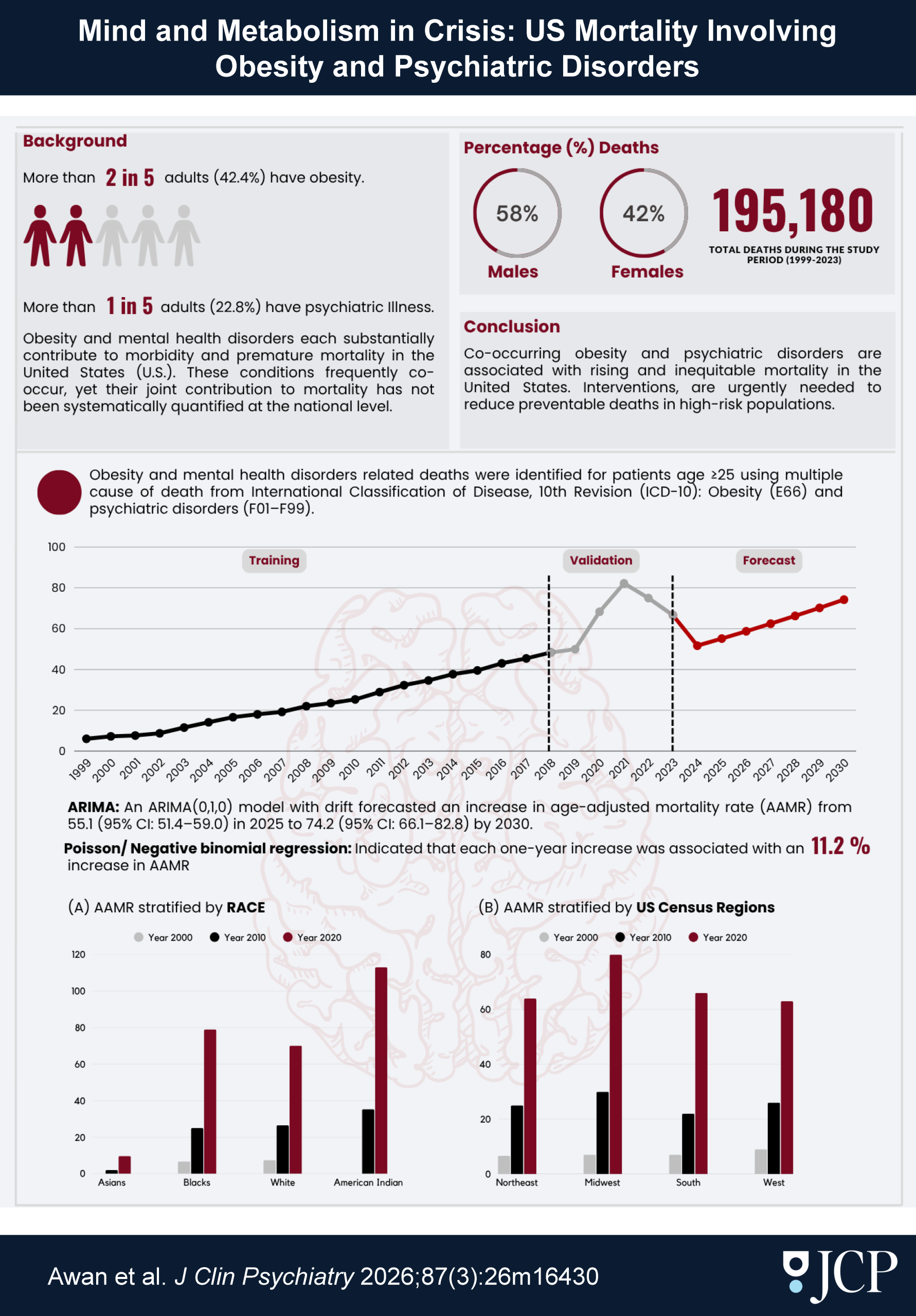
Background: Obesity and psychiatric disorders are major contributors to morbidity and premature mortality in the US and frequently co-occur, yet their joint mortality burden has not been systematically quantified nationally.
Methods: We conducted a retrospective population-based study of adults aged ≥25 years using the CDC WONDER Multiple Cause of Death database (1999–2023). Deaths were identified using ICD-10 codes for obesity (E66) and psychiatric disorders (F01–F99). Age-adjusted mortality rates (AAMRs) were calculated, and trends were assessed using joinpoint regression to estimate annual percent change (APC). Future trends through 2030 were forecasted using autoregressive integrated moving average (ARIMA) modeling. Sociodemographic and geographic disparities were examined using multivariable Poisson regression, reporting incidence rate ratios (IRRs).
Results: A total of 195,180 deaths were identified. AAMRs increased from 6.0 to 82.2 per million between 1999–2021, then declined to 66.6 per million in 2023. The steepest increases occurred in 1999–2005 (APC=+19.2%) and 2018–2021 (APC=+20.6%). Substance use disorders showed the highest burden (AAMR=29.8), followed by mood (2.6), organic (2.2), and psychotic (1.0) disorders. Mortality was higher in males (IRR=1.41) and adults aged 65–74 years (IRR=8.34). Per-capita mortality was highest among American Indian/Alaska Native populations and lowest among Asian individuals (IRR=0.09). ARIMA projected a rebound to 74.2 per million by 2030.
Conclusion: Co-occurring obesity and psychiatric disorders are associated with rising and inequitable mortality in the US, underscoring the need for integrated obesity care, metabolic monitoring, and targeted substance use interventions.
J Clin Psychiatry 2026;87(3):26m16430
Author affiliations are listed at the end of this article.
From the Editors

Are you a healthcare provider?
Add your NPI to personalize your JCP experience.
Members Only Content
This full article is available exclusively to Professional tier members. Subscribe now to unlock the HTML version and gain unlimited access to our entire library plus all PDFs. If you're already a subscriber, please log in below to continue reading.
References (51)

- GBD 2019 Mental Disorders Collaborators. Global, regional, and national burden of 12 mental disorders in 204 countries and territories, 1990-2019: a systematic analysis for the Global Burden of Disease Study 2019. Lancet Psychiatry. 2022;9(2):137–150.
- National-level and state-level prevalence of overweight and obesity among children, adolescents, and adults in the USA, 1990–2021, and forecasts up to 2050. Lancet Lond Engl. 2024;404(10469):2278–2298.
- Emmerich SD, Fryar CD, Stierman B, et al. Obesity and Severe Obesity Prevalence in Adults: United States, August 2021-August 2023. NCHS Data Brief;2024;(508). doi:10.15620/cdc/159281 CrossRef
- Results from the 2022. National Survey on Drug Use and Health (NSDUH): Key Substance Use and Mental Health Indicators in the United States | SAMHSA Library. https://library.samhsa.gov/product/results-2022-national-survey-drug-use-and-health-nsduh-key-substance-use-and-mental-health. Accessed October 2, 2025
- Ward ZJ, Willett WC, Hu FB, et al. Excess mortality associated with elevated body weight in the USA by state and demographic subgroup: a modelling study. eClinicalMedicine. 2022;48:101429. CrossRef
- Druss BG, Zhao L, Von Esenwein S, et al. Understanding excess mortality in persons with mental illness: 17-year follow up of a nationally representative US survey. Med Care. 2011;49(6):599–604. PubMed CrossRef
- Sippel LM, Myers AL, Brooks JM, et al. Risk and protective factors in relation to early mortality among people with serious mental illness: perspectives of peer support specialists and service users. Psychiatr Rehabil J. 2022;45(4):343–351. CrossRef
- Afzal M, Siddiqi N, Ahmad B, et al. Prevalence of overweight and obesity in people with severe mental illness: systematic review and meta-analysis. Front Endocrinol. 2021;12:769309.
- Simon GE, Von Korff M, Saunders K, et al. Association between obesity and psychiatric disorders in the US adult population. Arch Gen Psychiatry. 2006;63(7):824–830.
- Milaneschi Y, Simmons WK, van Rossum EFC, et al. Depression and obesity: evidence of shared biological mechanisms. Mol Psychiatry. 2019;24(1):18–33.
- Sohail MU, Aisha E, Waqas SA, et al. Trends in obesity-related ischemic heart disease mortality among adults in the United States from 1999 to 2020. Future Cardiol. 2025;21(7):479.
- Ebert T, Hamuda N, City-Elifaz E, et al. Trends in CV mortality among patients with known mental and behavioral disorders in the US between 1999 and 2020. Front Psychiatry. 2023;14:1255323. CrossRef
- Ali H, Patel P, Dahiya DS, et al. Prediction of early-onset colorectal cancer mortality rates in the United States using machine learning. Cancer Med. 2024;13(1):e6880.
- Dansana D, Kumar R, Das Adhikari J, et al. Global forecasting confirmed and fatal cases of COVID-19 outbreak using autoregressive integrated moving average model. Front Public Health. 2020;8:580327.
- Barros VB, Schmidt FFV, Filho ADPC. Mortality, survival, and causes of death in mental disorders: comprehensive prospective analyses of the UK Biobank cohort. Psychol Med. 2023;53(8):3480–3489.
- Olfson M, Blanco C, Wang S, et al. National trends in the mental health care of children, adolescents, and adults by office-based physicians. JAMA Psychiatry. 2014;71(1):81–90.
- Davis C, Curtis C, Levitan RD, et al. Evidence that “food addiction” is a valid phenotype of obesity. Appetite. 2011;57(3):711–717.
- Volkow ND, Wang GJ, Tomasi D, et al. Pro v con reviews: is food addictive?. Obes Rev Off J Int Assoc Study Obes. 2013;14(1):2–18.
- Michaud A, Vainik U, Garcia-Garcia I, et al. Overlapping neural endophenotypes in addiction and obesity. Front Endocrinol. 2017;8. doi:10.3389/fendo.2017.00127. CrossRef
- Lirola MJ, Cangas AJ, Cerezuela JL, et al. Relationship between lifestyle, body composition, and psychological well-being in individuals with severe mental disorders: a comprehensive analysis. J Psychiatr Res. 2025;190:161–168. CrossRef
- Martland R, Teasdale S, Murray RM, et al. Dietary intake, physical activity and sedentary behaviour patterns in a sample with established psychosis and associations with mental health symptomatology. Psychol Med. 2023;53(4):1565–1575. PubMed
- Noortman L, de Winter L, van Voorst A, et al. Screening and prevalence of cardiometabolic risk factors in patients with severe mental illness: a multicenter cross-sectional cohort study in the Netherlands. Compr Psychiatry. 2023;126:152406. PubMed
- Momen NC, Plana-Ripoll O, Agerbo E, et al. Mortality associated with mental disorders and comorbid general medical conditions. JAMA Psychiatry. 2022;79(5):444–453. PubMed
- Goldfarb M, De Hert M, Detraux J, et al. Severe mental illness and cardiovascular disease: JACC state-of-the-art review. J Am Coll Cardiol. 2022;80(9):918–933. PubMed
- Holt RIG, Mitchell AJ. Diabetes mellitus and severe mental illness: mechanisms and clinical implications. Nat Rev Endocrinol. 2015;11(2):79–89. PubMed
- Fu X, Wang Y, Zhao F, et al. Shared biological mechanisms of depression and obesity: focus on adipokines and lipokines. Aging. 2023;15(12):5917–5950. PubMed
- Capuron L, Lasselin J, Castanon N. Role of adiposity-driven inflammation in depressive morbidity. Neuropsychopharmacol Off Publ Am Coll Neuropsychopharmacol. 2017;42(1):115–128.
- Robles B, Kuo T, Galván A. Understanding the neuroscience underpinnings of obesity and depression: implications for policy development and public health practice. Front Public Health. 2021;9:714236. PubMed
- Radjabzadeh D, Bosch JA, Uitterlinden AG, et al. Gut microbiome-wide association study of depressive symptoms. Nat Commun. 2022;13(1):7128. PubMed
- Spertus J, Horvitz-Lennon M, Abing H, et al. Risk of weight gain for specific antipsychotic drugs: a meta-analysis. Npj Schizophr. 2018;4(1):1–7.
- Dayabandara M, Hanwella R, Ratnatunga S, et al. Antipsychotic-associated weight gain: management strategies and impact on treatment adherence. Neuropsychiatr Dis Treat. 2017;13:2231–2241. PubMed
- Gafoor R, Booth HP, Gulliford MC. Antidepressant utilisation and incidence of weight gain during 10 years’ follow-up: population based cohort study. BMJ. 2018;23:k1951.
- Mazereel V, Detraux J, Vancampfort D, et al. Impact of psychotropic medication effects on obesity and the metabolic syndrome in people with serious mental illness. Front Endocrinol. 2020;11:573479. PubMed CrossRef
- Wang Y, Huang Y, Al JMM, et al. Rising obesity-associated mortality in men: exploration of gender disparity from the Global Burden of Disease Study, 1990-2019. J Gen Intern Med. 2025;40(5):1097–1106. PubMed
- Camacho-Ruiz JA, Galvez-Sánchez CM, Galli F, et al. Patterns and challenges in help-seeking for addiction among men: a systematic review. J Clin Med. 2024;13(20):6086.
- Karaye IM, Maleki N, Hassan N, et al. Trends in alcohol-related deaths by sex in the US, 1999-2020. JAMA Netw Open. 2023;6(7):e2326346. PubMed
- Spencer MR. Drug Overdose Deaths in the United States, 2002–2022. 2024;(491).
- Forde AT, Crookes DM, Suglia SF, et al. The weathering hypothesis as an explanation for racial disparities in health: a systematic review. Ann Epidemiol. 2019;33:1–18.e3. PubMed
- Liu B, Du Y, Wu Y, et al. Trends in obesity and adiposity measures by race or ethnicity among adults in the United States 2011-18: population based study. The BMJ. 2021;372:n365. PubMed
- Ruiz JM, Steffen P, Smith TB. Hispanic mortality paradox: a systematic review and meta-analysis of the longitudinal literature. Am J Public Health. 2013;103(3):e52–e60.
- James WL, Brindley C, Purser C, et al. Conceptualizing rurality: the impact of definitions on the rural mortality penalty. Front Public Health. 2022;10:1029196. PubMed
- Monnat SM, Peters DJ, Berg MT, et al. Using census data to understand county-level differences in overall drug mortality and opioid-related mortality by opioid type. Am J Public Health. 2019;109(8):1084–1091. PubMed
- Çolak H. Future projections of elderly obesity in the United States using time series models. Obes Med. 2025;56:100627.
- Ali H, Rasheed W, Moond V, et al. Obesity related mortality in the next generation: projections based on machine learning for young Americans (1999–2035). Obes Sci Pract. 2025;11(2):e70062. CrossRef
- Peng TR, Chen JA, Lee JA, et al. The optimal dosage and duration of metformin for prevention and treatment of antipsychotic-induced weight gain: an updated systematic review and meta-analysis. Schizophr Bull. 2025;51(3):625–636. PubMed
- Carolan A, Hynes-Ryan C, Agarwal SM, et al. Metformin for the prevention of antipsychotic-induced weight gain: guideline development and consensus validation. Schizophr Bull. 2024;51(5):sbae205–1205.
- Wilding JPH, Batterham RL, Calanna S, et al. Once-weekly semaglutide in adults with overweight or obesity. N Engl J Med. 2021;384(11):989–1002. PubMed
- Jastreboff AM, Aronne LJ, Ahmad NN, et al. Tirzepatide once weekly for the treatment of obesity. N Engl J Med. 2022;387(3):205–216. PubMed
- Lincoff AM, Brown-Frandsen K, Colhoun HM, et al. Semaglutide and cardiovascular outcomes in obesity without diabetes. N Engl J Med. 2023;389(24):2221–2232. PubMed
- Wharton S, Blevins T, Connery L, et al. Daily oral GLP-1 receptor agonist orforglipron for adults with obesity. N Engl J Med. 2023;389(10):877–888. PubMed
- Rosenstock J, Hsia S, Ruiz LN, et al. Orforglipron, an oral small-molecule GLP-1 receptor agonist, in early type 2 diabetes. N Engl J Med. doi:10.1056/NEJMoa2505669. CrossRef