
Abstract
Objective: Anxious distress is associated with poor outcomes in the treatment of major depressive disorder (MDD). This exploratory post hoc analysis utilized data from a phase 3 study to investigate adjunctive lumateperone 42 mg efficacy in patients with MDD with inadequate antidepressant therapy (ADT) response and anxious distress.
Methods: Outpatients (18–65 y) had DSM-5–defined MDD with inadequate response to 1-2 ADTs in the current depressive episode, Montgomery-Åsberg Depression Rating Scale (MADRS) Total score ≥24, and Clinical Global Impression-Severity (CGI-S) score ≥4 (July 2021–February 2024). Patients were randomized to 6-week oral lumateperone 42 mg+ADT (n=239) or placebo+ADT (n=242). Efficacy was assessed in patients with or without DSM-5–defined anxious distress.
Results: Of 481 patients, 43% met criteria for anxious distress. Lumateperone+ADT significantly improved MADRS Total score from baseline to Day 43 versus placebo+ADT in patients with anxious distress (least squares mean difference vs placebo [LSMD]= −6.8; 95% CI=−9.00 to −4.51; effect size [ES]=0.85; P<.0001) or without (LSMD=−3.5; 95% CI=−5.47 to −1.58; ES=0.44; P <.001). MADRS response and remission rates at Day 43 were significantly greater with lumateperone+ADT in both subgroups (P<.05). At Day 43, lumateperone+ADT significantly improved CGI-S score (P<.0001), MADRS inner tension item (P<.001), and Quick Inventory of Depressive Symptomatology-Self Report-16 item Total score (P<.05) in both subgroups. Generalized Anxiety Disorder-7 item Total score significantly improved at Day 43 with lumateperone+ADT in patients with anxious distress (P <.0001) but did not reach statistical significance in those without anxious distress (P=.379).
Conclusion: Adjunctive lumateperone 42 mg significantly improved depression and anxiety symptoms in patients with MDD with inadequate ADT response and anxious distress.
Trial Registration: ClinicalTrials.gov identifier: NCT04985942
J Clin Psychiatry 2026;87(3):26m16409
Author affiliations are listed at the end of this article.
From the Editors

Are you a healthcare provider?
Add your NPI to personalize your JCP experience.
Major depressive disorder (MDD) with anxious distress is challenging to treat and can lead to poor clinical outcomes.1,2 Little evidence is available to guide treatment decisions for these patients. We conducted this exploratory post hoc analysis of a phase 3, randomized, double-blind, placebo-controlled trial to assess the efficacy of adjunctive lumateperone in patients with MDD with inadequate antidepressant therapy (ADT) response who also met criteria for anxious distress.
The co-occurrence of MDD with anxiety is common and pernicious3; more than half (53%) of patients with MDD in the Sequenced Treatment Alternatives to Relieve Depression (STAR*D) study had comorbid anxiety at baseline.3 Patients with MDD and comorbid anxiety have worse clinical outcomes than those without, including greater overall depression severity, poorer cognitive and physical functioning, greater medical comorbidity, worse quality of life, and increased suicidality.1,4 Patients with MDD and comorbid anxiety also have reduced response to ADT,2,3 highlighting the unmet medical need in this prevalent patient cohort.
To help clinicians properly recognize and treat major depressive episodes (MDEs) with notable comorbid anxiety, an anxious distress specifier was added in the Diagnostic and Statistical Manual of Mental Disorders, Fifth Edition (DSM-5).5 In pooled analyses from 7 randomized, double-blind, placebo-controlled studies of adjunctive atypical antipsychotics in MDD, 75% of patients met the DSM-5 criteria for MDD with anxious distress,2 further illustrating the predominance of this challenging symptom presentation. Because patients with MDD commonly identify anxiety as one of the most bothersome symptoms with high impact across multiple domains of life (eg, family, work, sleep, financial),2,6 providing evidence of treatment efficacy is a clinical imperative.
Many patients with MDD do not respond to standard monotherapy ADT.7 Thus, clinicians employ a variety of treatment strategies to address incomplete response (eg, optimize dosage, switch or combine ADTs, augment with another pharmacologic agent).8–12 In a real-world analysis in patients with MDD, augmenting ADT significantly reduced rates of hospitalizations and lowered medical costs compared with switching monotherapy ADT.13 Specifically, augmenting ADT with an antipsychotic agent has consistent evidence of efficacy and is a recommended first-line adjunctive strategy.8–10 Using an atypical antipsychotic as the first type of adjunctive therapy has significant benefits on healthcare resource utilization and costs for patients with MDD.14 However, despite the evidence supporting adjunctive antipsychotic use, this approach is underutilized, as studies reported that only 17%–20% of patients with MDD taking adjunctive therapy were prescribed an atypical antipsychotic.14,15
Several post hoc analyses have demonstrated that adjunctive antipsychotics may also provide benefit to patients with MDD and anxious distress.16–20 Previously US Food and Drug Administration–approved atypical antipsychotics for adjunctive MDD treatment have tolerability concerns (eg, weight gain, extrapyramidal symptoms [EPS], and metabolic disturbances).21 Some safety concerns can lead to additional long-term effects, such as the presence of EPS, which can predict tardive dyskinesia.22 More treatment options are needed for the comorbid occurrence of MDD with anxious distress, which is challenging to treat, as patients are less likely to respond or remit compared with those without anxious distress.3
Lumateperone is an atypical antipsychotic indicated for the following: treatment of schizophrenia in adults; treatment of depressive episodes associated with bipolar I or II disorder (bipolar depression) in adults, as monotherapy and as adjunctive therapy with lithium or valproate; and treatment of MDD in adults as adjunct to ADT.23 Lumateperone is a potent serotonin 5-HT2A receptor antagonist, a dopamine D2 receptor presynaptic partial agonist and postsynaptic antagonist, a D1 receptor-dependent indirect modulator of glutamatergic AMPA (α-amino-3-hydroxy-5-methyl-4-isoxazolepropionic acid) and NMDA (N-methyl-D-aspartate) currents, and a serotonin reuptake inhibitor.24,25 Additionally, lumateperone has negligible binding to H1, 5-HT2C, and muscarinic receptors, which may limit sedation and weight gain,24 and a lower striatal D2 receptor occupancy than other antipsychotics, which may reduce EPS risk.26 In preclinical investigations, lumateperone decreased anxiety-like activity in rodents, while stimulating activity in the mammalian target of rapamycin complex 1 signaling pathway in the prefrontal cortex,27 demonstrating potential anxiolytic properties of lumateperone. The 5-HT2A pathway also has been implicated in anxiety, as treatment with adjunctive 5-HT2A antagonists can increase the anxiolytic properties of selective serotonin reuptake inhibitors.28 The novel mechanism of action of lumateperone, in part targeting the glutamatergic system, may yield particular efficacy for patients with MDD and anxious distress due to the involvement of glutamate in depression and anxiety.29,30
The efficacy of adjunctive lumateperone in patients with MDD with inadequate ADT response was demonstrated in 2 phase 3, randomized, double-blind, placebo-controlled clinical trials (Study 501 [NCT04985942],31 Study 502 [NCT05061706]32). In each study, lumateperone 42 mg+ADT met primary and key secondary efficacy endpoints, significantly improving depression symptoms and disease severity at Day 43 measured by Montgomery-Åsberg Depression Rating Scale (MADRS) Total score and Clinical Global Impression-Severity (CGI-S) scale, respectively.31,32
This post hoc analysis, which was exploratory and hypothesis generating in nature, evaluated the efficacy of lumateperone 42 mg+ADT in patients with MDD with inadequate ADT response who met DSM-5 criteria for anxious distress at baseline in Study 501.
METHODS
Study Design and Patients
Data from patients with MDD with or without anxious distress were extracted from Study 501, a phase 3, randomized, double-blind, placebo-controlled trial conducted from July 2021 to February 2024 (ClinicalTrials.gov identifier: NCT04985942). Detailed methods of the study have been published previously.31 The study had a screening period (up to 2 weeks), a 6-week double-blind treatment period, and a 1-week safety follow-up period. Participants were randomized (1:1) to 6-week, oral, once-daily lumateperone 42 mg+ADT or placebo+ADT.
Male or female outpatients (aged 18–65 years) meeting DSM-5 criteria for MDD, confirmed using the Mini-International Neuropsychiatric Interview (MINI),33 were included. Patients were experiencing a current MDE (MADRS Total34 score ≥24 and CGI-S35 score ≥4) and had a Quick Inventory of Depressive Symptomatology-Self Report-16 item (QIDS-SR-16)36 score ≥14 at screening and baseline. Patients also had inadequate response to 1–2 antidepressant monotherapies of at least the minimum effective dose for ≥6 weeks’ duration in the current MDE, with inadequate response (<50% improvement) confirmed by the Antidepressant Treatment Response Questionnaire.37 Anxious distress was defined at screening per DSM-5 criteria (ie, presence of ≥2 anxiety symptoms during most days of an MDE: feeling keyed up or tense; feeling unusually restless; difficulty concentrating due to worry; fear that something awful might happen; feeling that one might lose control of oneself)5 and confirmed by the anxious distress MINI module.
Exclusion criteria included a lifetime psychiatric diagnosis other than MDD (eg, schizophrenia, schizoaffective disorder, bipolar disorder, other psychotic disorders), a significant risk for suicidal behavior, and a ≥25% decrease in MADRS Total score or QIDS-SR-16 Total scores between screening and baseline. Although anxiety disorders (eg, panic attack, generalized anxiety disorder) as a primary disorder were exclusionary, patients with anxiety symptoms were allowed, provided the symptoms did not require concurrent treatment.
The study complied with the Declaration of Helsinki and Good Clinical Practice guidelines and was approved by the appropriate institutional review board (IRB)/independent ethics committee (IRB Protocol #120213126 was initially approved by WCG IRB [Princeton, New Jersey]; Supplementary Methods contains a full list). Written informed consent was obtained from participants before entering the study.
Post Hoc Analysis
Outcomes were analyzed in patients with anxious distress (≥2 DSM-5 anxiety symptoms) and without anxious distress (<2 symptoms). MADRS Total and CGI-S scores were analyzed in the modified intent-to-treat (mITT) population (all randomized patients who received ≥1 dose of study drug, had a baseline MADRS Total score, and had ≥1 postbaseline MADRS Total score). As seen in other investigations,2,17,19,38 MADRS item 3 (inner tension) was used as a proxy outcome for anxious distress since it closely resembles the DSM-5 anxious distress specifier “Feeling keyed up or tense.” Patient-reported outcomes, the QIDS-SR-16 Total score and Generalized Anxiety Disorder-7 Item (GAD-7) Total score,39 were analyzed in the intent-to-treat population (all randomized patients who received ≥1 dose of study drug and had a baseline MADRS Total score). QIDS-SR-16 is a 16-item self-report scale of depression severity with a total score ranging from 0–27.36 GAD-7 is a 7-item self-report screening tool for generalized anxiety disorder with items rated on a 4-point scale (0 = not at all to 3 = nearly every day); scores range from 0–21, and higher scores indicate more severe anxiety symptoms.40
Safety parameters (adverse events [AEs], EPS-related treatment-emergent AEs [TEAEs], and laboratory assessments) were measured in the safety population (all randomized patients who received ≥1 dose).
Statistical Analysis
For MADRS Total score and CGI-S score mean change from baseline, estimates and P values for lumateperone 42 mg+ADT versus placebo+ADT comparisons were based on a mixed-effects model for repeated measures (MMRM) with treatment group, site (or pooled site), visit, subgroup (with vs without anxious distress), treatment group-by-subgroup, subgroup-by-visit, treatment group-by-visit, and treatment-by-subgroup-by-visit interactions as fixed effects, baseline and baseline-by-visit as covariates using the observed data only. An unstructured covariance matrix was used to model the correlation among repeated measurements within patients.
For MADRS response (≥50% MADRS Total score decrease from baseline) and remission (MADRS Total score ≤10), odds ratio estimates and P values were based on a logistic regression model with terms for treatment, subgroup, treatment-by-subgroup, and baseline MADRS Total score; patients with missing MADRS Total score at the visit were considered nonresponders or nonremitters. Numbers needed to treat (NNTs) were calculated for patients with MADRS Total score response and remission. Analyses of change from baseline in MADRS inner tension item score and GAD-7 Total score were performed using an MMRM similar to the primary efficacy parameter. For QIDS-SR-16 Total score mean change from baseline, estimates and P value for lumateperone 42 mg+ADT versus placebo+ADT comparison were based on an analysis of covariance model with terms for treatment group, subgroup, treatment group-by-subgroup, and site (or pooled site) as factors and baseline total score as covariate. The analyses presented here are post hoc and were not adjusted for multiplicity.
Safety analyses were summarized descriptively in treatment arms by subgroup (with versus without anxious distress). AEs were evaluated using the Medical Dictionary for Regulatory Activities version 24.0.
RESULTS
Patients
The mITT population comprised 481 patients (lumateperone+ADT, n=239; placebo+ADT, n= 242) with MDD with inadequate ADT response who were experiencing an MDE. At baseline, 207 patients (43.0%) met DSM-5 criteria for anxious distress (lumateperone+ADT, n=109; placebo+ADT, n= 98); 274 patients (57.0%) did not meet the criteria (lumateperone+ADT, n=130; placebo+ADT, n= 144).
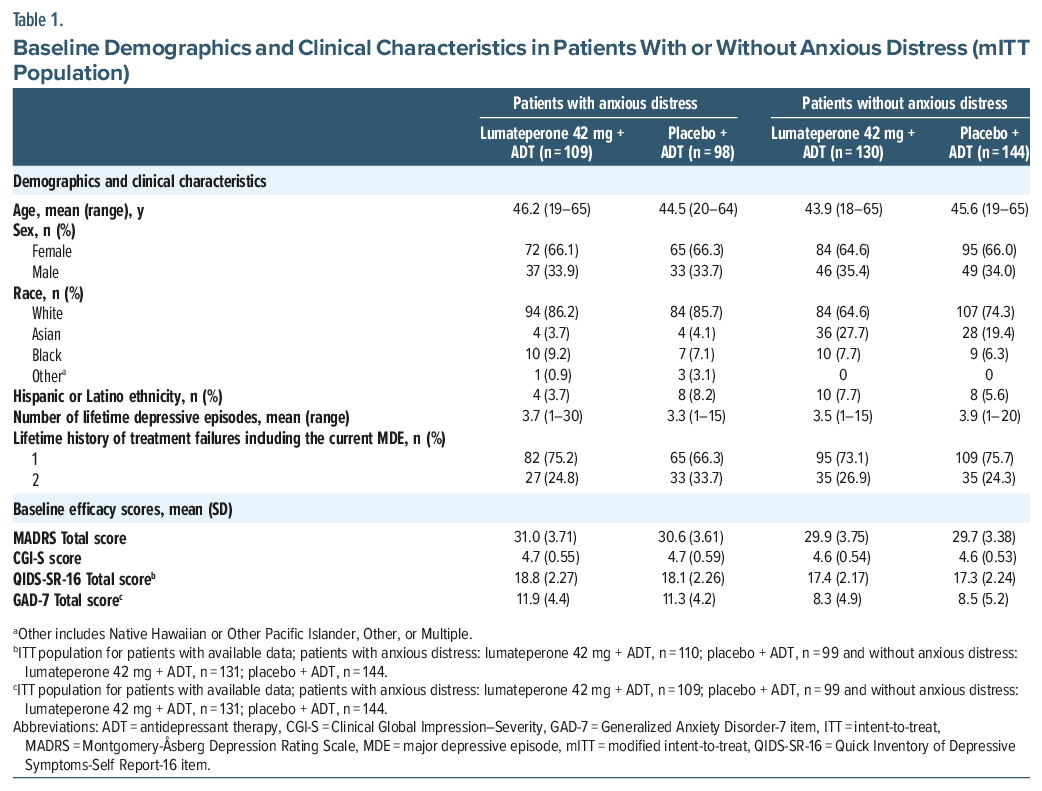
Most demographic and baseline characteristics were similar between patients with and without anxious distress (Table 1). The population without anxious distress had a larger proportion of Asian patients and lower baseline GAD-7 Total scores versus the population with anxious distress (Table 1).
Efficacy
Lumateperone+ADT significantly improved MADRS Total score from baseline to Day 43 versus placebo+ADT in patients with anxious distress (P<.0001) and in patients without anxious distress (P <.001) (Figure 1A, Supplementary Table 1). With lumateperone+ADT, significant improvement in MADRS Total score occurred early in patients with anxious distress (Day 15) and without anxious distress (Day 8) and persisted throughout the study. The effect size (ES) at Day 43 was 0.85 for lumateperone-treated patients with anxious distress and 0.44 for those without anxious distress.
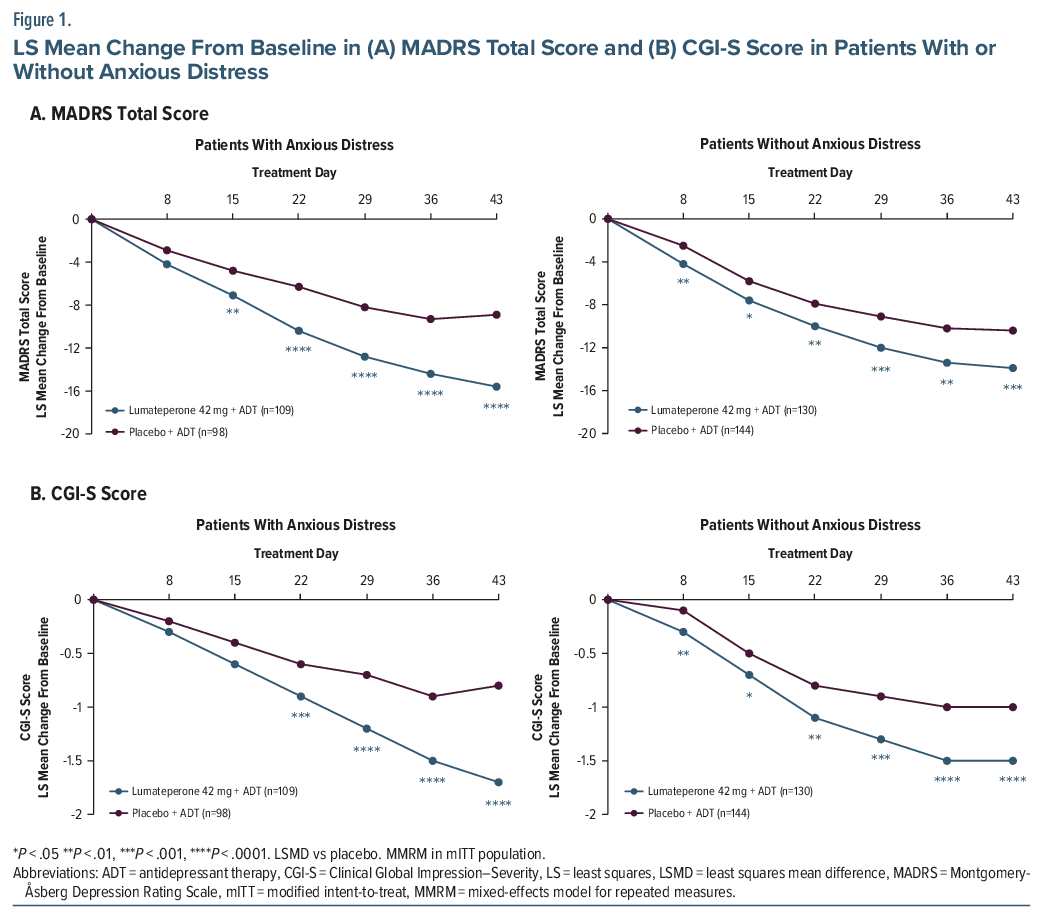
At Day 43, lumateperone+ADT significantly improved CGI-S score versus placebo+ADT in patients with anxious distress (P < .0001) and without anxious distress (P < .0001) (Figure 1B, Supplementary Table 1). Significant improvement in CGI-S score occurred with lumateperone+ADT by Day 22 for patients with anxious distress and by Day 8 for patients without anxious distress and persisted throughout the study. The ES at Day 43 was 0.91 in patients with anxious distress and 0.50 in patients without anxious distress.
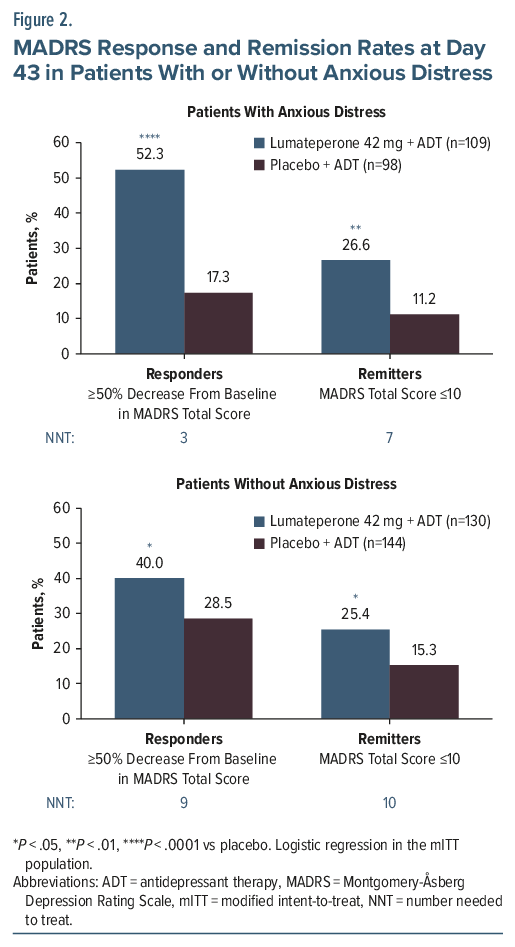
In patients with anxious distress, a significantly higher proportion of patients treated with lumateperone+ADT than placebo+ADT achieved MADRS response (P<.0001) and remission (P <.01) at Day 43 (Figure 2, Supplementary Table 1). Similarly, in patients without anxious distress, lumateperone+ADT treatment led to significantly greater MADRS response (P<.05) and remission (P <.05) rates at Day 43 versus placebo+ADT (Figure 2, Supplementary Table 1). The NNTs for MADRS response and remission were 3 and 7, respectively, for patients with anxious distress, and 9 and 10 for patients without anxious distress.
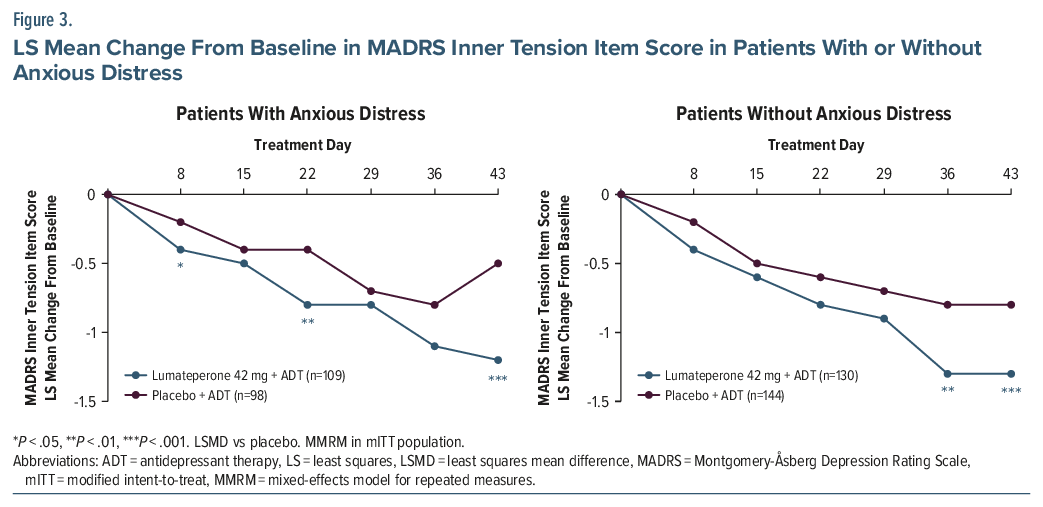
Change from baseline to Day 43 in MADRS item 3 (inner tension) was statistically significant in favor of lumateperone+ADT versus placebo+ADT in patients with anxious distress (P<.001) and without anxious distress (P <.001) (Figure 3, Supplementary Table 1).
The change in QIDS-SR-16 Total score at Day 43 was statistically significant with lumateperone+ADT versus placebo+ADT in patients with anxious distress (ES, 0.80; P<.0001) and without anxious distress (ES, 0.28; P <.05) (Figure 4A, Supplementary Table 1).
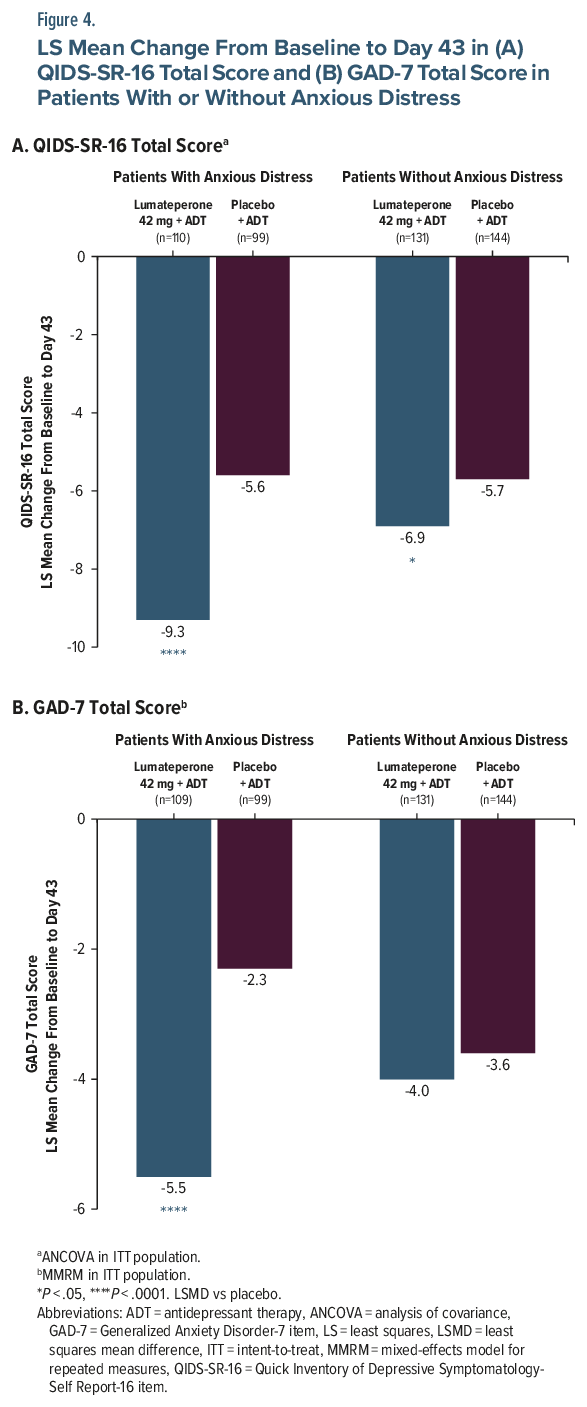
As reported previously, lumateperone+ADT significantly improved GAD-7 Total score versus placebo+ADT from baseline to Day 43 in the overall study population (least squares mean difference vs placebo [LSMD], −1.6; 95% CI, −2.31 to −0.93; ES, −0.43; P <.0001).31 The change from baseline to Day 43 in GAD-7 Total score was statistically significant with lumateperone+ADT versus placebo+ADT in patients with anxious distress (P<.0001) but not in patients without anxious distress (P =.379) (Figure 4B, Supplementary Table 1). The change in GAD-7 Total score in the placebo+ADT group was smaller in patients with anxious distress (−2.3) versus those without anxious distress (−3.6) (Figure 4B).
Safety
Among patients receiving lumateperone+ADT, 62.7% of patients with anxious distress and 54.2% of those without anxious distress experienced ≥1 TEAE (Supplementary Table 2). Discontinuation rate of lumateperone+ADT due to AEs was 4.5% in those with anxious distress and 6.9% in those without anxious distress. Among patients receiving lumateperone+ADT, 9.1% and 3.8% of those with and without anxious distress, respectively, experienced ≥1 EPS-related TEAE. Changes in metabolic parameters and prolactin levels were minimal across subgroups (Supplementary Table 2).
DISCUSSION
This exploratory, hypothesis-generating, post hoc analysis of data from patients with MDD with inadequate ADT response demonstrated significant improvement with adjunctive lumateperone versus adjunctive placebo in patients with DSM-5–defined anxious distress. Significant improvements with adjunctive lumateperone occurred across measures of depression (MADRS Total score, QIDS-SR-16 Total score), anxiety (GAD-7 Total score, MADRS inner tension item), and global disease severity (CGI-S score) in patients with anxious distress. Significant improvements with adjunctive lumateperone also occurred in all outcomes in patients without anxious distress, except for the change in GAD-7 score at Day 43, which did not reach statistical significance.
Beyond statistically significant differences, improvement was also clinically meaningful, as seen in the high percentage of adjunctive lumateperone-treated patients with MDD and anxious distress who achieved MADRS response (52%; NNT= 3) and remission (27%, NNT=7). MADRS response (40%; NNT=9) and remission (25%; NNT=10) were also achieved in patients without anxious distress. In psychiatric practice, an NNT under 10 for dichotomous variables is considered clinically meaningful,41 further supporting the relevance of our findings.
Post hoc analyses have investigated adjunctive antipsychotics in patients with MDD with concurrent anxiety symptoms defined using criteria other than the DSM-5 (eg, DSM-5 proxies,17,19,42 Hamilton Depression Rating Scale [HAM-D] anxiety/somatization factor score,16,18–20 and Hamilton Anxiety Rating Scale score16,20,43). With adjunctive brexpiprazole, the NNTs were large for patients with anxious distress (per DSM-5 proxies; NNT=10) or with anxious depression (per HAM-D anxiety/somatization factor; NNT=16).19 In this study, the LSMD in MADRS Total score for adjunctive lumateperone versus adjunctive placebo (−6.8), with an ES of 0.85 and an NNT of 3 for response, along with improved anxiety symptoms (ie, GAD-7, MADRS inner tension item), suggests that adjunctive lumateperone is highly efficacious in patients with MDD and anxious distress. Adjunctive lumateperone also demonstrated efficacy in patients with MDD without anxious distress, as indicated by the change in MADRS Total score (LSMD, −3.5; ES, 0.44), NNT of 9 for response, and significant improvement in MADRS inner tension item. The use of MADRS item 3 (inner tension) as a proxy outcome for anxious distress is supported in patients with MDD, as it is similar to “feeling keyed up or tense” in the DSM-5 anxious distress specifier.2,5,17,19,38 Additionally, in a post hoc analysis of a phase 3, randomized, double-blind, placebo-controlled trial (NCT04285515), lumateperone 42 mg monotherapy significantly improved depressive symptoms and global disease severity in patients with MDD or bipolar disorder with mixed features and anxious distress.44 These results suggest a promising role for adjunctive lumateperone in patients with MDD with or without anxious distress.
This post hoc analysis measured GAD-7 score, which was developed as a self-reported screening tool to capture the anxiety construct defined in the DSM-IV45 and is responsive in evaluating changes in anxiety symptoms and anxiety severity.39,46 Thus, it is notable that lumateperone+ADT significantly improved GAD-7 Total score at Day 43 in patients meeting anxious distress criteria at baseline, with an LSMD of −3.2.
Lumateperone has a distinct pharmacology that simultaneously modulates multiple neurotransmitters (ie, serotonin, dopamine, glutamate), with unique activity as an indirect modulator of glutamatergic transmission with D1-dependent augmentation of NMDA and AMPA activity.25 Facilitation of glutamatergic signaling is thought to result in rapid antidepressant effects,47 and evidence also suggests a role for glutamatergic neurotransmission in anxiety-related disorders.30 Collectively, the unique mechanism of lumateperone, along with preclinical and clinical evidence,27,31,32 supports its potential efficacy in treating depression with comorbid anxiety symptoms.
Regardless of the presence/absence of anxious distress, lumateperone+ADT was generally well tolerated, with minimal changes observed in metabolic parameters. Among patients receiving lumateperone+ADT, more patients with than without anxious distress experienced TEAEs and EPS-related TEAEs, yet discontinuation rates due to AEs were lower in those with anxious distress (4.5%) versus without anxious distress (6.9%).
In our analysis, anxious distress was defined by DSM-5 criteria, and the MINI anxious distress module was used at the screening visit to confirm the anxious distress diagnosis, which are strengths of our investigation. Limitations include the post hoc nature of the analysis, without adjustment for multiplicity, and the eligibility criteria of the original study. Patients with a primary anxiety disorder or anxiety symptoms needing concurrent treatment were excluded, which might reduce the generalizability of our findings in populations with anxiety symptoms in excess of those required for anxious distress. Since benzodiazepines and nonbenzodiazepine anxiolytics were not allowed, anxiolytic effects were likely related to lumateperone+ADT.
Overall, in this exploratory post hoc analysis, lumateperone 42 mg+ADT significantly improved symptoms of depression and anxiety in patients with MDD with inadequate ADT response. Thus, these results suggest that adjunctive lumateperone is a promising new treatment option for patients with MDD with inadequate ADT response with or without comorbid anxious distress.
Article Information
Published Online: September 14, 2026. https://doi.org/10.4088/JCP.26m16409
© 2026 Physicians Postgraduate Press, Inc.
Submitted: March 2, 2026; accepted June 22, 2026.
To Cite: Sachs GS, Durgam S, Earley WR, et al. Lumateperone as adjunctive therapy in patients with major depressive disorder and anxious distress: post hoc analysis of a phase 3, randomized, double-blind trial. J Clin Psychiatry. 2026;87(3):26m16409.
Author Affiliations: Massachusetts General Hospital, Boston, Massachusetts (Sachs); Signant Health, Plymouth Meeting, Pennsylvania (Sachs); Employee of Intra-Cellular Therapies, a Johnson & Johnson company, Bedminster, New Jersey (Earley, Chen); Former employee of Intra-Cellular Therapies, a Johnson & Johnson company, Bedminster, New Jersey (Durgam, Kozauer); Duke-NUS, Singapore (Masand).
Corresponding Author: Suresh Durgam, MD, former employee of Intra-Cellular Therapies, a Johnson & Johnson company, 135 US Highway 202/206, Suite 6, Bedminster, NJ 07921 ([email protected]).
Financial Disclosures: Dr Sachs is an employee of Signant Health and has served as a consultant for AbbVie, Kintsugi, Neumora Therapeutics, Rapport, Seaport, and 4M Therapeutics. Earley and Chen are full-time employees of Intra-Cellular Therapies, a Johnson & Johnson company. Drs Durgam and Kozauer are former employees of Intra-Cellular Therapies, a Johnson & Johnson company. Dr Masand has served as a consultant for AbbVie, Intra-Cellular Therapies, Karuna Therapeutics, Neumora Therapeutics, and Neurocrine Biosciences; has served on speakers bureaus for AbbVie, BMS, Neurocrine Biosciences, Vanda Pharmaceuticals, and Intra-Cellular Therapies; and has stock ownership in Relmada Therapeutics.
Funding/Support: This study was funded by Intra-Cellular Therapies, a Johnson & Johnson company.
Role of the Sponsor: Intra-Cellular Therapies, a Johnson & Johnson company, was responsible for the design, analysis, interpretation, and publication of this study.
Previous Presentations: Poster presented at American Society of Clinical Psychopharmacology (ASCP) Annual Meeting, May 27–30, 2025, Scottsdale, Arizona; Psych Congress Elevate Annual Meeting, May 28–31, 2025, Las Vegas, Nevada; Psych Congress Annual Meeting, September 17–21, 2025, San Diego, California; CNS Summit 2025, November 2–5, 2025, Boston, Massachusetts; and Neuroscience Education Institute (NEI) Fall Congress, November 6–9, 2025, Colorado Springs, Colorado.
Data Availability: Data will be made available on reasonable request, subject to review and meeting criteria.
Author Contributions: Drs Durgam, Earley, Kozauer, and Chen participated in study design and study conduct. All authors participated in data analysis/interpretation and writing/critical review.
Acknowledgments: The authors thank all study investigators, research staff, and patients for their participation in the primary study. Medical writing support was provided by Carol Brown, MS, and Kendall Foote, PhD, of Nucleus Global, an Inizio company, funded by Intra-Cellular Therapies, a Johnson & Johnson company.
Supplementary Material: Available at Psychiatrist.com.
Clinical Points
- Major depressive disorder (MDD) with comorbid anxious distress is challenging to treat, and little evidence is available to guide treatment decisions.
- Adjunctive lumateperone significantly improved symptoms of depression and anxiety in this post hoc analysis of a phase 3 study, suggesting that this treatment regimen is a promising option for patients with MDD with inadequate antidepressant response with or without comorbid anxious distress.
References (47)

- Fava M, Rush AJ, Alpert JE, et al. What clinical and symptom features and comorbid disorders characterize outpatients with anxious major depressive disorder: a replication and extension. Can J Psychiatry. 2006;51(13):823–835. PubMed CrossRef
- Brown MT, DiBenedetti DB, Danchenko N, et al. Symptoms of anxiety and irritability in patients with major depressive disorder. J Depress Anxiety. 2016;5:3.
- Fava M, Rush AJ, Alpert JE, et al. Difference in treatment outcome in outpatients with anxious versus nonanxious depression: a STAR*D report. Am J Psychiatry. 2008;165(3):342–351. PubMed
- Chan HN, Rush AJ, Nierenberg AA, et al. Correlates and outcomes of depressed out-patients with greater and fewer anxious symptoms: a CO-MED report. Int J Neuropsychopharmacol. 2012;15(10):1387–1399. PubMed
- Diagnostic and Statistical Manual of Mental Disorders: DSM-5. American Psychiatric Association. Washington, DC. 2013.
- Baune BT, Florea I, Ebert B, et al. Patient expectations and experiences of antidepressant therapy for major depressive disorder: a qualitative study. Neuropsychiatr Dis Treat. 2021;17:2995–3006. PubMed
- Rush AJ, Trivedi MH, Wisniewski SR, et al. Acute and longer-term outcomes in depressed outpatients requiring one or several treatment steps: a STAR*D report. Am J Psychiatry. 2006;163(11):1905–1917. PubMed
- Nuñez NA, Joseph B, Pahwa M, et al. Augmentation strategies for treatment resistant major depression: a systematic review and network meta-analysis. J Affect Disord. 2022;302:385–400. PubMed
- Rafeyan R, Papakostas GI, Jackson WC, et al. Inadequate response to treatment in major depressive disorder: augmentation and adjunctive strategies. J Clin Psychiatry. 2020;81(3):OT19037BR3. PubMed
- Lam RW, Kennedy SH, Adams C, et al. Canadian Network for Mood and Anxiety Treatments (CANMAT) 2023 Update on clinical guidelines for management of major depressive disorder in adults: réseau canadien pour les traitements de l’humeur et de l’anxiété (CANMAT) 2023: mise à jour des lignes directrices cliniques pour la prise en charge du trouble dépressif majeur chez les adultes. Can J Psychiatry. 2024;69(9):641–687. PubMed
- Nelson JC, Papakostas GI. Atypical antipsychotic augmentation in major depressive disorder: a meta-analysis of placebo-controlled randomized trials. Am J Psychiatry. 2009;166(9):980–991. PubMed CrossRef
- Papakostas GI, Shelton RC, Smith J, et al. Augmentation of antidepressants with atypical antipsychotic medications for treatment-resistant major depressive disorder: a meta-analysis. J Clin Psychiatry. 2007;68(6):826–831. PubMed CrossRef
- Masand PS, Nabulsi N, Laliberté F, et al. Health care resource utilization and costs associated with switching versus augmenting antidepressant monotherapy in second-line treatment of major depressive disorder. J Affect Disord. 2025;391:119787. CrossRef
- Jain R, Laliberté F, Germain G, et al. Treatment patterns, health care resource utilization, and costs associated with use of atypical antipsychotics as first vs subsequent adjunctive treatment in major depressive disorder. J Manag Care Spec Pharm. 2023;29(8):896–906. PubMed
- Jain R, Higa S, Keyloun K, et al. Treatment patterns during major depressive episodes among patients with major depressive disorder: a retrospective database analysis. Drugs Real World Outcomes. 2022;9(3):477–486. PubMed
- Bandelow B, Bauer M, Vieta E, et al. Extended release quetiapine fumarate as adjunct to antidepressant therapy in patients with major depressive disorder: pooled analyses of data in patients with anxious depression versus low levels of anxiety at baseline. World J Biol Psychiatry. 2014;15(2):155–166. PubMed CrossRef
- McIntyre RS, Weiller E, Zhang P, et al. Brexpiprazole as adjunctive treatment of major depressive disorder with anxious distress: results from a post-hoc analysis of two randomised controlled trials. J Affect Disord. 2016;201:116–123. PubMed CrossRef
- Trivedi MH, Thase ME, Fava M, et al. Adjunctive aripiprazole in major depressive disorder: analysis of efficacy and safety in patients with anxious and atypical features. J Clin Psychiatry. 2008;69(12):1928–1936. PubMed
- Thase ME, Weiller E, Zhang P, et al. Adjunctive brexpiprazole in patients with major depressive disorder and anxiety symptoms: post hoc analyses of three placebo-controlled studies. Neuropsychiatr Dis Treat. 2019;15:37–45. PubMed CrossRef
- Fava M, Masand PS, Maletic V, et al. Efficacy of adjunctive cariprazine on anxiety symptoms in patients with major depressive disorder: post hoc analysis of a randomized placebo-controlled trial. J Clin Psychiatry. 2025;86(2):24m15506. PubMed
- Spielmans GI, Berman MI, Linardatos E, et al. Adjunctive atypical antipsychotic treatment for major depressive disorder: a meta-analysis of depression, quality of life, and safety outcomes. PLoS Med. 2013;10(3):e1001403. PubMed CrossRef
- Tenback DE, Van Harten PN, Slooff CJ, et al. Evidence that early extrapyramidal symptoms predict later tardive dyskinesia: a prospective analysis of 10,000 patients in the European Schizophrenia Outpatient Health Outcomes (SOHO) study. Am J Psychiatry. 2006;163(8):1438–1440. PubMed CrossRef
- Caplyta Lumateperone. Intra-Cellular Therapies. Prescribing information; 2026.
- Snyder GL, Vanover KE, Zhu H, et al. Functional profile of a novel modulator of serotonin, dopamine, and glutamate neurotransmission. Psychopharmacol (Berl). 2015;232(3):605–621.
- Titulaer J, Radhe O, Danielsson K, et al. Lumateperone-mediated effects on prefrontal glutamatergic receptor-mediated neurotransmission: a dopamine D(1) receptor dependent mechanism. Eur Neuropsychopharmacol. 2022;62:22–35. PubMed
- Vanover KE, Davis RE, Zhou Y, et al. Dopamine D(2) receptor occupancy of lumateperone (ITI-007): a positron emission tomography study in patients with schizophrenia. Neuropsychopharmacol. 2019;44(3):598–605. PubMed CrossRef
- Dutheil S, Watson LS, Davis RE, et al. Lumateperone normalizes pathological levels of acute inflammation through important pathways known to be involved in mood regulation. J Neurosci. 2023;43(5):863–877. PubMed
- Lin J, Liu W, Guan J, et al. Latest updates on the serotonergic system in depression and anxiety. Front Synaptic Neurosci. 2023;15:1124112. PubMed
- McIntyre RS, Jain R. Glutamatergic modulators for major depression from theory to clinical use. CNS Drugs. 2024;38(11):869–890. PubMed
- Riaza Bermudo-Soriano C, Perez-Rodriguez MM, Vaquero-Lorenzo C, et al. New perspectives in glutamate and anxiety. Pharmacol Biochem Behav. 2012;100(4):752–774.
- Durgam S, Earley WR, Kozauer SG, et al. Lumateperone as adjunctive therapy in patients with major depressive disorder: results from a randomized, double-blind, phase 3 trial. J Clin Psychiatry. 2025;86(4):25m15848. PubMed
- Durgam S, Earley WR, Kozauer SG, et al. Adjunctive lumateperone in patients with major depressive disorder: results from a randomized, double-blind, phase 3 trial. Am J Psychiatry. 2025;182(12):1072–1082. PubMed
- Sheehan DV, Lecrubier Y, Sheehan KH, et al. The Mini-International Neuropsychiatric Interview (M.I.N.I.): the development and validation of a structured diagnostic psychiatric interview for DSM-IV and ICD-10. J Clin Psychiatry. 1998;59(Suppl 20:22-33):22–57. quiz 34-57.
- Montgomery SA, Åsberg M. A new depression scale designed to be sensitive to change. Br J Psychiatry. 1979;134(4):382–389. PubMed
- Guy W. ECDEU. Assessment Manual for Psychopharmacology. U.S. Department of Health, Education, and Welfare; 1976.
- Rush AJ, Trivedi MH, Ibrahim HM, et al. The 16-Item Quick Inventory of Depressive Symptomatology (QIDS), clinician rating (QIDS-C), and self-report (QIDS-SR): a psychometric evaluation in patients with chronic major depression. Biol Psychiatry. 2003;54(5):573–583. PubMed CrossRef
- Chandler GM, Iosifescu DV, Pollack MH, et al. RESEARCH: validation of the Massachusetts General Hospital Antidepressant Treatment History Questionnaire (ATRQ). CNS Neurosci Ther. 2010;16(5):322–325.
- McIntyre RS, Woldeyohannes HO, Soczynska JK, et al. The prevalence and clinical characteristics associated with Diagnostic and Statistical Manual Version-5-defined anxious distress specifier in adults with major depressive disorder: results from the International Mood Disorders Collaborative Project. Ther Adv Chronic Dis. 2016;7(3):153–159. PubMed CrossRef
- Spitzer RL, Kroenke K, Williams JB, et al. A brief measure for assessing generalized anxiety disorder: the GAD-7. Arch Intern Med. 2006;166(10):1092–1097. PubMed
- Rutter LA, Brown TA. Psychometric properties of the generalized anxiety disorder scale-7 (GAD-7) in outpatients with anxiety and mood disorders. J Psychopathol Behav Assess. 2017;39(1):140–146. PubMed
- Citrome L, Ketter TA. When does a difference make a difference? Interpretation of number needed to treat, number needed to harm, and likelihood to be helped or harmed. Int J Clin Pract. 2013;67(5):407–411. PubMed CrossRef
- McIntyre RS, Bubolic S, Zhang Z, et al. Effects of adjunctive brexpiprazole on individual depressive symptoms and functioning in patients with major depressive disorder and anxious distress: post hoc analysis of three placebo-controlled studies. J Clin Psychopharmacol. 2024;44(2):133–140. PubMed
- McIntyre A, Gendron A, McIntyre A. Quetiapine adjunct to selective serotonin reuptake inhibitors or venlafaxine in patients with major depression, comorbid anxiety, and residual depressive symptoms: a randomized, placebo-controlled pilot study. Depress Anxiety. 2007;24(7):487–494. PubMed CrossRef
- Durgam S, Kozauer SG, Earley WR, et al. Lumateperone in the treatment of patients with major depressive disorder and bipolar disorder with anxious distress and mixed features. Abstract P234 Presented at the 62nd American College of Neuropsychopharmacology (ACNP) Annual Meeting, December 3-6,. 2023;48:63–210. Accessed August 12, 2025. https://www.nature.com/articles/s41386-023-01755-5.Neuropsychopharmacol
- Diagnostic and Statistical Manual of Mental Disorders: DSM-IV. American Psychiatric Association. 1994.
- Rose M, Devine J. Assessment of patient-reported symptoms of anxiety. Dialogues Clin Neurosci. 2014;16(2):197–211. PubMed
- Du J, Machado-Vieira R, Maeng S, et al. Enhancing AMPA to NMDA throughput as a convergent mechanism for antidepressant action. Drug Discov Today Ther Strateg. 2006;3(4):519–526. PubMed
This PDF is free for all visitors!