
Abstract
Treatment-resistant depression (TRD) affects a substantial proportion of patients with major depressive disorder and is associated with significant functional impairment, elevated suicide risk, and increased treatment complexity. In December 2025, a multidisciplinary expert consensus panel convened in Boston, Massachusetts, to address contemporary challenges in the identification and pharmacologic management of TRD. The panel concluded that TRD is best understood as a dynamic continuum reflecting the interaction between illness biology, patient complexity, and cumulative treatment history—not a categorical end point defined only by a fixed number of prior failures. Early identification of inadequate antidepressant response through measurement-based care, diagnostic reassessment, and active comorbidity management is essential to preventing entrenched resistance and functional decline. Pharmacologic sequencing should prioritize mechanistic diversity, with nonresponse prompting a mechanism switch and partial response prompting augmentation; as resistance arises, timely referral and consideration of therapies targeting glutamatergic signaling and potentially related neuroplasticity are warranted. Special populations—including patients with suicidality, comorbid anxiety or trauma, and unrecognized bipolarity—require faster escalation and closer monitoring. To support clinical implementation, the panel developed a 4-stage framework—spanning initial detection through high-acuity interventions—that operationalizes these recommendations across levels of care. These consensus recommendations are intended to help clinicians act earlier, sequence treatments more strategically, and match pharmacologic choices to the biology underlying each patient’s resistance.
J Clin Psychiatry 2026;87(3):htrdachi2508
From the Editors

Are you a healthcare provider?
Add your NPI to personalize your JCP experience.
This Academic Highlights section of The Journal of Clinical Psychiatry presents the highlights of the consensus panel meeting “Treatment-Resistant Depression as a Dynamic Continuum: A Consensus Panel Report on Mechanism-Informed Pharmacologic Sequencing” which was held on December 6, 2025, in Boston, Massachusetts.
The meeting was chaired by Anita H. Clayton, MD, Department of Psychiatry and Neurobehavioral Sciences, University of Virginia School of Medicine, Charlottesville, Virginia (correspondence: [email protected]; PO Box 800623, Charlottesville, VA 22908). The faculty were Michael Asbach, DMSc, PA-C, Psych-CAQ, Dent Neurologic Institute, Amherst, New York; Patricia Cabrera, MD, Johnson & Johnson, Titusville, New Jersey; Cristina Cusin, MD, Department of Psychiatry, Harvard Medical School, Boston, Massachusetts; Jay Fawver, MD, Department of Psychiatry, Indiana University School of Medicine, Indianapolis, Indiana; Jordan F. Karp, MD, Department of Psychiatry, University of Arizona College of Medicine—Tucson; and Laura Leahy, DrNP, APRN, FAANP, FAAN, Founder, APNSolutions, LLC.
Financial disclosures appear at the end of the article.
This evidence-based, peer-reviewed Academic Highlights article was prepared by Healthcare Global Village, Inc. The panel meeting for the development of this article was funded by Janssen Scientific Affairs, LLC who also funded article processing charges, medical writing, editorial, and other assistance. Editorial support was provided by Carl Clay, PhD, and P. Benjamin Everett, PhD, with funding from Janssen Scientific Affairs, LLC. The sponsor performed a courtesy review for medical accuracy. The opinions expressed herein are those of the faculty and do not necessarily reflect the views of Healthcare Global Village, Inc., the publisher, or the commercial supporters. Free access to this article is funded by Janssen Scientific Affairs, LLC.
Published Online: September 4, 2026.
To Cite: Clayton AH, Asbach M, Cabrera P, et al. Treatment-resistant depression as a dynamic continuum: a consensus panel report on mechanism-informed pharmacologic sequencing. J Clin Psychiatry. 2026;87(3):JCP.htrdachi2508.
To Share: https://doi.org/10.4088/JCP.htrdachi2508
© 2026 Physicians Postgraduate Press, Inc.
Introduction: Rationale and Conceptual Framework
Major depressive disorder (MDD) remains one of the leading causes of disability worldwide, yet a substantial proportion of patients fail to achieve remission despite appropriate treatment. Across clinical trials and real-world settings, approximately one-third of individuals with MDD experience persistent symptoms following multiple antidepressant trials, a clinical scenario commonly referred to as treatment-resistant depression (TRD).1 Clinically, TRD is associated with greater symptom chronicity, functional impairment, and morbidity, while health care systems bear a disproportionate share of utilization and cost. In the United States alone, TRD accounts for a substantial share of the economic burden associated with MDD.1 Despite advances in pharmacotherapy, treatment for TRD continues to represent a major unmet clinical need.
Although TRD is widely recognized, its definition and clinical application remain inconsistent. In both clinical practice and research, TRD is most often operationalized as an inadequate response (ie, <50% improvement2) to at least 2 antidepressant trials of adequate dose and duration within the current depressive episode.3 While this definition offers pragmatic simplicity, it inadequately reflects the heterogeneity of depressive illness and the realities of real-world care and is more derived from the regulatory framework required for approval of new agents for TRD. It does not fully account for subtherapeutic dosing, insufficient duration, poor adherence, diagnostic uncertainty, or the influence of comorbid psychiatric and medical conditions.3 As a result, patients may be labeled as treatment resistant without a clear understanding of whether resistance reflects true biological nonresponsiveness or potentially modifiable clinical factors. Reflecting these limitations, an international consensus has argued for a shift in framing toward the term “difficult-to-treat depression,” defined as depression that continues to cause significant burden despite usual treatment efforts, which emphasizes ongoing, individualized management of persistent illness rather than a binary determination of resistance.4 The panel recognized the value of this perspective but retained the term TRD for consistency with current regulatory and clinical usage.
Importantly, TRD should not be solely conceptualized as a categorical state that emerges abruptly after a fixed number of treatment failures. There is the common belief that TRD is the same as “treatment refractory,” but “treatment resistant” can be identified as early as after 2 lines of treatment. Similarly, the idea that TRD is caused by numerous treatment failures is not compatible with our current biological understanding of depression. Rather, TRD represents a continuum of increasing treatment complexity that evolves over time. Biological vulnerability, psychological processes, environmental stressors, and treatment-related factors interact dynamically, often through epigenetic mechanisms, shaping both illness trajectory and treatment responsiveness.5 From this perspective, resistance may develop gradually as ineffective or poorly matched interventions accumulate, and opportunities for timely reassessment and mechanistic change are missed.
This continuum-based view has important implications for clinical decision-making. Early symptom improvement is a robust predictor of long-term outcome, yet in routine practice, ineffective treatments are frequently continued without structured reassessment.6 Early improvement, often defined as approximately 20% symptom reduction within 2 weeks of initiating therapy and 25%–50% reduction in symptoms by 4–6 weeks on validated measures such as the Patient Health Questionnaire-9 (PHQ-9) and the 5-item World Health Organization Well-Being Index (WHO-5), has been shown to predict subsequent remission.7,8 The absence of early measurement-based evaluation contributes to treatment inertia, delayed escalation, and progressive functional decline.9–11
Within this context, 2 complementary approaches to defining TRD are useful. A practical definition emphasizes early, measurement-based thresholds to guide clinical action. Failure to meet early response benchmarks should prompt reconsideration of treatment strategy rather than prolonged continuation of ineffective therapy. However, reliance on response thresholds alone risks oversimplification when applied without adequate diagnostic clarity or contextual assessment.
Accordingly, a broader conceptual framework is required. Depression is increasingly understood as arising from a complex adaptive system in which biological, psychological, and environmental forces interact dynamically, often through epigenetic mechanisms.5,12 Within this framework, TRD is not viewed as a fixed clinical trait or an absolute biological barrier. Rather, it represents a state of therapeutic nonresponsiveness within a complex system, signaling that the current intervention has failed to engage the specific mechanisms required to shift the system toward recovery. Consequently, the “resistance” observed is relative to the intervention’s mechanism of action, necessitating a timely transition to alternative therapeutic targets.
Emerging evidence suggests that inflammatory markers, neurotrophic factors, and other circulating biomarkers may differentiate subtypes of depression.13–15 In addition, pharmacogenomic variability—including pharmacokinetic genotypes (eg, CYP2D6) affecting drug metabolism and systemic exposure and pharmacodynamic genotypes (eg, SLC6A4) affecting target engagement—can influence antidepressant response. These factors often contribute to apparent resistance, where a patient’s lack of response or poor tolerability reflects a pharmacologic mismatch rather than an inherent inability to achieve remission.16,17
Despite the availability of clinical practice guidelines, uncertainty persists regarding optimal timing of reassessment, criteria for escalation, selection of mechanistically distinct therapies, and referral pathways for patients with evolving or established TRD. Guidelines are effective at establishing whether an intervention is supported by evidence but frequently provide limited operational guidance for implementation across heterogeneous patient populations or complex real-world settings.18,19 As a result, clinicians rely heavily on individual judgment and local practice patterns, leading to substantial variations in care.
To address these gaps, a multidisciplinary expert consensus panel was convened to examine contemporary challenges in the identification and pharmacologic management of TRD. The objectives of the panel were to develop a clinically actionable conceptual framework, define practical indicators for early identification and escalation, and achieve consensus on evidence-based pharmacologic sequencing informed by underlying mechanisms and real-world constraints. Through facilitated discussion and review of publicly available evidence, the panel proposed an approach emphasizing early reassessment, routine use of measurement-based care to guide decisions, and avoidance of treatment inertia through timely switching or augmentation.
Currently, intranasal esketamine and olanzapine/fluoxetine combination are the only pharmacologic agents with specific regulatory indications for TRD. Esketamine is indicated for use in the United States in adults with TRD as monotherapy or in conjunction with an oral antidepressant. Patients in the short-term TRD studies included those who had not responded adequately to at least 2 different antidepressants of adequate dose and duration in the current depressive episode. In clinical practice, atypical antipsychotics are frequently utilized to augment antidepressant outcomes in partial responders, an approach recommended as an augmentation option across contemporary treatment guidelines,20–22 while off-label ketamine use is a strategy that may be used in more refractory cases.23 The framework and recommendations presented in this Academic Highlights are intended to support timely, mechanism-informed decision-making across levels of care and reduce unwarranted variation in the treatment of MDD and TRD.
Methods
In December 2025, a multidisciplinary panel of experts in psychiatry, psychopharmacology, and the clinical management of TRD convened for an in-person consensus meeting in Boston, Massachusetts. The purpose of the meeting was to develop a clinically oriented framework for the assessment and staged management of TRD, with emphasis on treatment sequencing, mechanistic considerations, and real-world implementation.
The meeting was conducted using a structured agenda with facilitated discussion. To maintain a focused and clinically actionable scope, discussion was limited to the pharmacologic management of TRD, with nonpharmacologic interventions addressed only when necessary for contextual completeness. Panelists reviewed and discussed publicly available evidence from clinical trials, regulatory guidance, and relevant clinical practice literature and shared experiential insights from routine clinical care. Consensus was achieved through iterative discussion, with areas of agreement reflected in the recommendations presented in this article.
This article summarizes the consensus perspectives generated during the panel meeting and is intended to support clinicians in applying evidence-based and patient-centered approaches to the management of TRD across care settings.
Early Identification, Escalation, and Referral in MDD and TRD
Early identification of inadequate antidepressant response is a critical determinant of long-term outcomes in MDD. Multiple analyses have demonstrated that early symptom improvement (within 2 weeks) is strongly associated with subsequent remission, while the absence of early improvement predicts poor response and chronicity.6,24 Despite this evidence, treatment inertia remains common in both primary care and psychiatric practice, with ineffective therapies often continued for extended periods without structured reassessment.
Measurement-based care provides a practical framework for identifying evolving evidence of treatment resistance. Validated tools such as the PHQ-9, WHO-5, Beck Depression Inventory, 7-item Generalized Anxiety Disorder, Insomnia Severity Index, Snaith-Hamilton Pleasure Scale, Clinician Global Impression-Improvement scale, and Patient Global Impression-Improvement scale allow for measurable patient-and clinician-rated outcome metrics of symptom burden, functional impairment, and overall well-being.7,8 Regardless of the measure utilized, the panel reached consensus that objective improvement of at least 20% within 2 weeks of initiating therapy and at least 50% within 4–6 weeks has consistently been associated with a higher likelihood of remission, which is highly consistent with the literature.6,9,24 These thresholds align with current treatment guidelines: The Canadian Network for Mood and Anxiety Treatments (CANMAT) defines early improvement as a 20% or greater symptom reduction within 2–4 weeks and response as a 50% or greater reduction,20 and the Department of Veterans Affairs and the Department of Defense (VA/DoD) and National Institute for Health and Care Excellence (NICE) guidelines likewise treat a 50% or greater improvement as the threshold for response over a 4-to 6-week trial.21,22 Failure to achieve these thresholds should prompt timely modification of treatment rather than prolonged continuation of the same strategy.10,11
The panel agreed that escalation decisions should be guided not only by symptom change but also by ensuring adequate dosing and reassessment of diagnosis, adherence, tolerability, comorbidities, and prior treatment trials. Apparent nonresponse may reflect pseudo-resistance driven by misdiagnosis, including unrecognized bipolar spectrum illness, trauma-related disorders, substance use, or untreated medical contributors such as sleep apnea, chronic pain, thyroid disease, or cardiometabolic conditions.3 In addition, poor adherence and treatment discontinuation related to medication tolerability, including burdensome adverse effects or cumulative side effect load, are common and often underrecognized contributors to apparent treatment failure.25–27 Addressing these factors is essential before concluding that depression is truly treatment resistant.
The panel noted that when early improvement is not observed at a known therapeutic dose, treatment escalation generally involves either switching or augmentation. Pharmacogenomic factors, such as ultrarapid metabolizer status, can reduce drug exposure and may, in specific patients, warrant dose adjustment guided by therapeutic drug monitoring or selection of an alternative agent.28 Early response, noted as ≥20% reduction in symptom severity within 2 weeks, has been shown to predict stable response and remission with high sensitivity, whereas its absence is a strong predictor of subsequent treatment failure. Nonresponse, noted subjectively or based upon outcome metrics as <25% improvement in 4–6 weeks,2 often leads clinicians to consider an agent with a different mechanism of action, such as switching from an selective serotonin reuptake inhibitor (SSRI) to a therapy targeting a different monoaminergic pathway or a glutamatergic pathway. Partial response, noted as >20% symptom reduction in 2 weeks but between 25% and 50% in 4–6 weeks,2,24 by contrast, may be more amenable to augmentation strategies, including the addition of evidence-based pharmacologic agents or intensified psychological support. Measurement-based care supports this distinction by allowing clinicians to differentiate between no response and partial response early in the treatment course.29
Further, the panel noted that referral decisions represent a critical inflection point in the management of MDD and TRD. A common pragmatic threshold for referral to specialty care is failure of 2 adequate antidepressant trials. However, rigid adherence to numerical thresholds may delay appropriate escalation in clinically complex cases. Diagnostic uncertainty, persistent functional impairment, intolerable adverse effects, significant comorbidity burden, or limited treatment options in primary care settings may justify earlier referral to psychiatric specialists.30,31 Suicidality represents an independent accelerator for escalation and referral. Patients with acute or persistent suicidal ideation require expedited evaluation and may benefit from higher-acuity care settings or advanced interventions. In such cases, the goal shifts from incremental symptom improvement to risk reduction and rapid stabilization, often necessitating specialty infrastructure and close monitoring.32,33
Consensus Statement 1
“Early Recognition of Inadequate Antidepressant Response Should Guide Timely Treatment Modification.” Timely detection of insufficient improvement is essential to optimizing outcomes in MDD. Clinicians should evaluate response at an adequate/potentially therapeutic dose using measurement-based care, with meaningful early improvement defined as at least 20% symptom reduction at 2 weeks and between 25% and 50% reduction by 4–6 weeks. Failure to meet these thresholds should prompt timely modification of treatment, typically switching for nonresponders (<25% improvement) and augmentation for partial responders (25–50% improvement).
Although emerging biomarkers and pharmacogenomic tools have generated interest in refining the early identification of treatment resistance, their routine clinical utility remains limited. Polymorphisms in pharmacokinetic enzymes such as CYP2D6, CYP1A2, CYP2B6, CYP2C9, and CYP2C19 and in the pharmacodynamic genotypes for serotonin transporter gene SLC6A4 or COMT enzyme may influence antidepressant metabolism and response and contribute to apparent resistance in some patients.34,35 However, it was noted that current evidence for pharmacokinetic variants primarily informs dosing adjustments to improve tolerability and reduce adverse effects rather than predicting antidepressant efficacy.16 Furthermore, the clinical utility of these tests is often limited in the setting of polypharmacy, where drug-drug interactions can lead to phenoconversion—a phenomenon where extrinsic factors override a patient’s genetic profile, creating a genotype-phenotype mismatch.36 For these reasons, the tools should be viewed as adjunctive rather than determinative and must be interpreted within a broader clinical context.
Collectively, the consensus panel noted that early identification, structured reassessment, and timely escalation or referral represent core components of effective MDD and TRD management. Failure to act on early signals of nonresponse increases the risk of entrenched resistance, cumulative functional decline, and prolonged patient suffering. These considerations underscore the need for clear, practical frameworks to guide escalation decisions across levels of care.6,9,11,24
Consensus Statement 2
“Adequacy of Treatment Requires Diagnostic Clarity and Comorbidity Assessment.” An antidepressant trial should be considered “adequate” only when diagnostic clarity, therapeutic dosing, appropriate duration, and confirmed adherence with acceptable medication tolerability are established, and when comorbid conditions are actively assessed and treated. Misdiagnosis (eg, bipolarity), trauma exposure, anxiety disorders, medical contributors, or substance misuse may create pseudoresistance and must be addressed before labeling depression as treatment resistant.
Mechanistic Pathways and Treatment Strategy in MDD and TRD
The biological underpinnings of MDD and TRD extend well beyond monoaminergic dysfunction (Figure 1). While serotonergic, noradrenergic, and dopaminergic systems play an important role in mood regulation, growing evidence indicates that TRD is characterized by broader disturbances involving neuroplasticity, stress-response systems, neural network connectivity, inflammation, and glutamatergic and GABAergic signaling.5,12 These interacting pathways help explain both the heterogeneity of depressive presentations and the variable response to conventional antidepressant therapies.
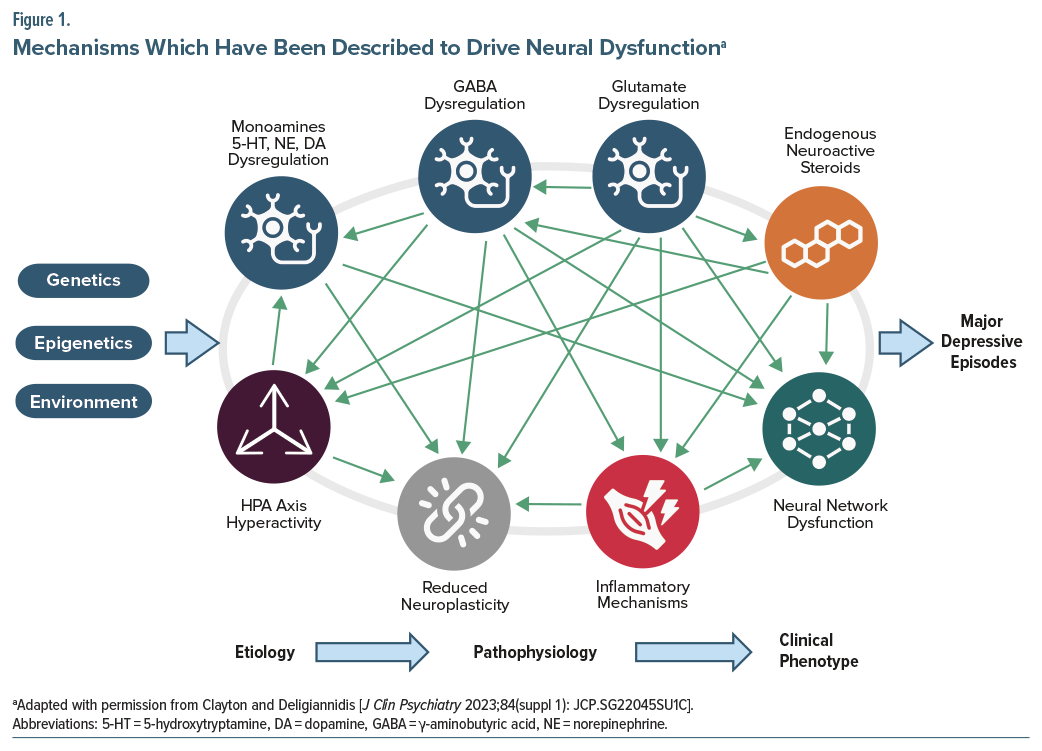
Traditional monoaminergic antidepressants exert their effects primarily through gradual modulation of synaptic serotonin, norepinephrine, and dopamine.17,37 For many patients, these mechanisms are sufficient to restore mood and function. However, in patients with TRD, targeting monoaminergic pathways alone may be insufficient to adequately engage downstream processes critical to recovery, including synaptogenesis, circuit-level recalibration, and adaptive stress regulation. This limitation is reflected clinically in delayed or absent symptom improvement despite adequate dosing and duration.
Contemporary models conceptualize depression as a disorder of maladaptive neural circuitry rather than isolated neurotransmitter deficits.5,38 Dysregulation within frontolimbic networks, impaired top-down cognitive control, and hyperreactivity of stress and emotional processing systems contribute to persistent depressive symptoms. These network-level abnormalities are influenced by genetic vulnerability and environmental exposures, including chronic stress and early-life adversity, which can induce epigenetic changes that alter neural responsiveness over time.39
Glutamatergic dysfunction has emerged as a particularly relevant pathway in TRD.3,5,38 Glutamate is the primary excitatory neurotransmitter in the brain and plays a central role in synaptic plasticity and learning. Excessive or dysregulated glutamatergic signaling may contribute to excitotoxic stress, impaired synaptic function, and altered network connectivity.5,38 In this context, agents that modulate glutamatergic transmission, including N-methyl-D-aspartate (NMDA) receptor antagonists, appear capable of producing antidepressant effects by potentially restoring synaptic plasticity and recalibrating dysfunctional circuits 5,38 while potentially mitigating detrimental glutamate toxicity by blocking the extrasynaptic NMDA receptor from glutamate spillover.40
Similarly, disruptions in GABAergic inhibitory signaling may contribute to impaired emotional regulation and heightened stress sensitivity in depression.3,5 Altered balance between excitatory and inhibitory neurotransmission can perpetuate maladaptive network activity, reinforcing depressive symptomatology. Stress-related dysregulation (hyperactivity) of the hypothalamic-pituitary-adrenal axis further compounds these effects by sustaining inflammatory signaling and impairing neuroplastic processes.
Importantly, these mechanistic domains do not operate independently. Monoaminergic signaling, glutamate–γ-aminobutyric acid (GABA) balance, neuroplasticity, stress pathways, and inflammatory processes are tightly interconnected.3,5,38 Failure to achieve adequate clinical response may therefore reflect insufficient engagement of one or more of these systems rather than global resistance to treatment. From a clinical perspective, this reinforces the importance of reassessing mechanism of action of medications when early improvement is not observed.
The panel reached consensus that mechanistic understanding should directly inform treatment strategy. Repeated cycling within the same neurotransmitter class is unlikely to yield benefit when prior trials have failed to produce meaningful response. Instead, lack of response should prompt consideration of therapies that engage alternative or downstream biological targets, particularly those linked to synaptic plasticity and circuit-level regulation. Partial responders, by contrast, may benefit from augmentation strategies that enhance or complement existing mechanisms.
This biologically informed approach provides a rationale for timely mechanistic pivots in TRD, rather than prolonged reliance on incremental dose adjustments or repeated within-class substitutions. Aligning treatment selection with underlying pathophysiology increases the likelihood of restoring a trajectory toward functional recovery and remission, reducing cumulative treatment burden.
Consensus Statement 3
“Mechanistic Diversity Should Guide Pharmacologic Sequencing.” Pharmacologic sequencing in MDD and TRD should prioritize mechanistic diversity rather than only repeated trials with medications that utilize the same mechanism of action. Partial response should prompt augmentation, while nonresponse should prompt a mechanism switch. When multiple mechanisms fail, consideration should be given to therapies that target glutamate-GABA dysregulation or other non-monoaminergic downstream pathways linked to synaptic plasticity.
Evidence-Based Pharmacologic Sequencing and Staging in MDD and TRD
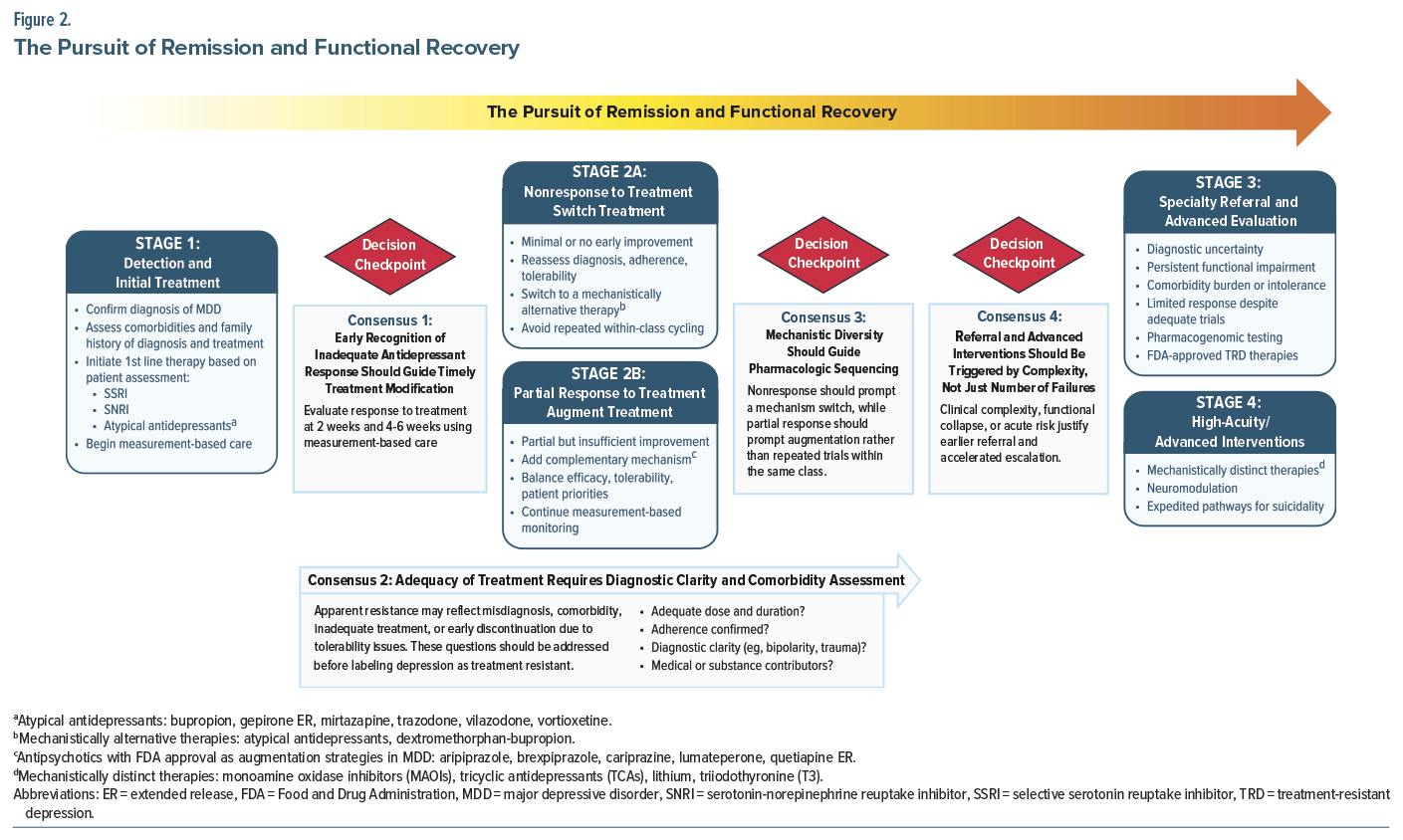
The panel emphasized that pharmacologic sequencing in MDD and TRD should be understood as a framework for clinical risk stratification rather than a rigid, linear algorithm. Patients move through stages of treatment based on response, tolerability, clinical complexity, and urgency. While the timing of specialty referral is driven by clinical need rather than rigid trial count, the initiation of therapies with specific regulatory indications for TRD remains aligned with established evidence-based thresholds. Across all stages, the panel’s recommendations assume routine use of measurement-based care to systematically assess symptoms, functioning, and tolerability and are aligned with established clinical practice guidelines.20,21,31 The goal of sequencing is to restore a trajectory toward remission and functional recovery by aligning treatment selection with evolving clinical needs and underlying biology (Figure 2). Although the panel’s charge centered on pharmacologic sequencing, evidence-based psychotherapies, including cognitive behavioral therapy, interpersonal therapy, and others, remain integral components of care and appropriate adjuncts across all stages of treatment.
Stage 1: Detection and Initial Treatment
Stage 1 typically applies to patients who are treatment naïve or who have had minimal prior exposure to antidepressant therapy. The panel noted that treatment at this stage should involve an adequately dosed trial of an appropriate antidepressant. SSRIs are commonly used, chosen based on symptom profile, comorbidities, prior treatment history, and patient preference. However, the panel recommended that for patients with comorbid pain, a serotonin-norepinephrine reuptake inhibitor (SNRI) may be a more appropriate initial choice,41,42 while for patients with prominent anergy or comorbid attention-deficit/ hyperactivity disorder, bupropion represents a reasonable first-line option.43,44 Importantly, the literature indicates that approximately 60%–80% of antidepressants are prescribed outside of psychiatric specialty settings, underscoring the importance of early collaboration among primary care clinicians, advanced practice providers, and psychiatrists.45,46
The primary objectives of Stage 1 are diagnostic accuracy, assessment of medication tolerability, early symptom improvement, and identification of patients who may require earlier escalation of care. Measurement-based care should be initiated at treatment onset, with structured reassessment at approximately 2 weeks to assess tolerability and early signal of response, and again at 4–6 weeks to evaluate efficacy, especially if the initial dose required an increase to a therapeutic dose. This early reassessment schedule concurs with NICE guidelines, which suggests reviewing symptoms as early as 2 weeks,22 and with CANMAT guidelines, which advises inquiring about side effects within 2 weeks and defines early improvement as a 20% or greater reduction in symptoms within 2–4 weeks.20 Telehealth modalities and the involvement of allied health care providers may facilitate early assessment of response at the 2-week time point. Failure to demonstrate early improvement (>20%) following the achievement of an adequate dose should not be viewed as a passive observation, but rather as a signal to reassess diagnosis, dosing, adherence, or the overall treatment strategy.
Stage 2: Escalation Through Switching or Augmentation
Stage 2 builds directly on the structured reassessment initiated in Stage 1. When early improvement is not observed despite adequate dose and duration of treatment, escalation is warranted. Stage 2 includes 2 distinct but complementary pathways, switching (Stage 2A) and augmentation (Stage 2B). The choice between these approaches should be guided by degree of response, tolerability, and mechanistic considerations.
Stage 2A: Switching (Nonresponse)
In patients who demonstrate minimal or no improvement despite adequate dose and duration, a mechanistic switch is generally warranted. This may involve transitioning from an SSRI/SNRI monoaminergic agent to an atypical antidepressant (eg, bupropion or mirtazapine) or to a therapy engaging non-monoaminergic pathways. Orally available agents with non-monoaminergic activity such as dextromethorphan-bupropion, which is approved for MDD that pairs NMDA receptor antagonism with norepinephrine-dopamine reuptake inhibition, broaden the options for a mechanistic switch at this stage.47 Repeated cycling within the same pharmacologic class without meaningful response increases the risk of treatment inertia and should be avoided.
Stage 2B: Augmentation (Partial/ Inadequate Response)
Patients who exhibit partial/inadequate response (25%–49% improvement from baseline) with an antidepressant medication alone may benefit from augmentation strategies that enhance or complement the existing mechanism of action. Food and Drug Administration (FDA)–approved augmentation options include the atypical antipsychotics, aripiprazole, brexpiprazole, cariprazine, lumateperone, and extended-release quetiapine for MDD.48 This recommendation concurs with established guidelines that endorse second-generation antipsychotic augmentation as an evidence-based option for inadequate antidepressant response.20,21
The panel noted that other evidence-supported augmentation options include lithium, thyroid hormone, bupropion, and mirtazapine. Selection among augmentation strategies should be informed by residual symptom burden, prior treatment history, mechanistic considerations, tolerability, metabolic and cognitive risk, medical and psychiatric comorbidities, logistical requirements, and patient priorities. Measurement-based monitoring remains essential to confirm that augmentation produces meaningful and sustained incremental benefit.
Stage 3: Specialty Referral and Advanced Evaluation
Referral to specialty care represents a critical transition point rather than a treatment failure. While failure of 2 adequately conducted antidepressant trials is often cited as a threshold for referral for TRD, clinical complexity should also drive timing. Diagnostic uncertainty, persistent functional impairment, comorbid psychiatric or medical conditions, intolerance to multiple therapies, or limited treatment options in primary care may justify earlier referral.
The VA/DoD guidelines21 recommend that patients with partial or no response to initial pharmacotherapy be reassessed for possible diagnostic error, co-occurring conditions, and treatment adherence. Specialty evaluation at this stage should include explicit attention to bipolar spectrum illness and substance use disorders, both of which can present as apparent treatment resistance and are important co-occurring conditions to identify in patients with MDD. Structured screening tools such as the Rapid Mood Screener49 for bipolar disorder and the Alcohol Use Disorders Identification Test50 for problematic alcohol use can facilitate this evaluation efficiently. When concern for bipolarity is clinically significant, early referral is warranted rather than continued antidepressant escalation.
Specialty evaluation allows for more nuanced diagnostic clarification, access to a broader range of pharmacologic strategies, closer monitoring, and consideration of adjunctive tools such as pharmacogenomic testing when clinically appropriate. At this stage, such testing may be reasonable to inform medication selection or dosing in patients with atypical response patterns, repeated intolerance, complex polypharmacy, or prior treatment failure, with available evidence suggesting that potential clinical benefit is greatest among individuals with repeated nonresponse or TRD. Such testing should be used to complement, rather than replace, clinical judgment primarily through appropriate dosing or informed drug interactions to avoid.51–53
As treatment resistance is identified, specialty settings may also provide the infrastructure necessary to evaluate and, when appropriate, administer advanced interventions. Currently, the olanzapine/fluoxetine combination and intranasal esketamine are the only pharmacologic agents expressly approved by the FDA for the treatment of TRD.54,55 While the olanzapine/fluoxetine combination utilizes synergistic monoaminergic pathways, esketamine represents a distinct class of therapy. Although off-label ketamine use has become increasingly common in clinical practice, esketamine remains the only glutamatergic agent FDA-approved for the TRD indication and can be administered as monotherapy or in conjunction with an oral antidepressant.3,45,55–57 When considered, these approaches require careful patient selection, explicit discussion of regulatory status, safety considerations, durability of benefit, and close longitudinal monitoring. Importantly, referral does not mandate immediate initiation of advanced interventions but ensures that appropriate expertise and infrastructure are available as treatment complexity increases.
Stage 4: High-Acuity and Advanced Pharmacologic Interventions
Stage 4 encompasses patients with established TRD who require mechanistically distinct or higher-acuity interventions. This may include therapies targeting glutamatergic signaling and related neuroplasticity, or other downstream pathways, as well as interventions requiring supervised administration or specialized monitoring. Patients with acute or persistent suicidality may require expedited movement to this stage, often in conjunction with higher-acuity care settings. Although the panel’s focus was pharmacologic, nonpharmacologic interventions, including evidence-based psychotherapy and neuromodulation such as repetitive transcranial magnetic stimulation, are appropriate considerations at this stage and should be incorporated through referral when clinically indicated.
At this stage, treatment goals continue to prioritize restoration of function alongside stabilization and the prevention of relapse. While shared decision-making is foundational to all stages of care, it becomes particularly critical in Stage 4; the shift toward more invasive, time-consuming, or supervised interventions necessitates rigorous evaluation of treatment burden, safety, and patient values to guide therapeutic selection.
Consensus Statement 4
“Referral and Advanced Pharmacologic Interventions Should Be Triggered by Complexity, Not Just the Number of Failures.” Referral to a specialist and consideration of pharmacogenomic testing or elaborate pharmacologic treatments should be based on clinical complexity or urgency rather than only the count of prior treatment failures. Diagnostic uncertainty, comorbidity burden, functional collapse, or acute risk justify earlier referral and accelerated pharmacologic escalation.
Special Populations, Comorbidities, and Operational Considerations
The panel noted that clinical heterogeneity is the rule rather than the exception in MDD and TRD. Certain patient populations and comorbid conditions warrant heightened clinical vigilance, earlier reassessment, and, in some cases, accelerated movement through treatment stages. Failure to account for these factors may contribute to apparent treatment resistance and suboptimal outcomes.
Special Populations and Clinical Complexity
Suicidality represents the most urgent modifier of treatment strategy. Patients with acute or persistent suicidal ideation require expedited evaluation, closer monitoring, and, when appropriate, rapid escalation to higher-acuity or specialty care.32,58,59 In these cases, the primary objective shifts from incremental symptom improvement to immediate risk reduction and stabilization, often necessitating access to advanced or supervised pharmacologic interventions.32,58,59
The panel noted that comorbid anxiety disorders, trauma-related conditions, and substance use disorders frequently complicate treatment response in MDD.
These comorbidities may attenuate antidepressant efficacy, increase the likelihood of adverse effects, or obscure early signals of response. When childhood trauma is suspected or disclosed, use of structured screening tools such as the Adverse Childhood Experiences scale may be informative.39 Patients with prominent anxiety or trauma histories may benefit from earlier mechanistic pivots and more frequent measurement-based monitoring, rather than prolonged trials of incremental monoaminergic adjustments.
Bipolar spectrum illness remains a critical consideration in patients with poor or inconsistent antidepressant response. Unrecognized bipolarity may manifest as apparent treatment resistance or antidepressant intolerance. Careful assessment of mood history, family history, and treatment-emergent mood instability is essential before escalating antidepressant therapy.
Medical comorbidities, including chronic pain, sleep disorders, cardiometabolic disease, and neurodegenerative conditions, can meaningfully influence both symptom presentation and treatment selection. In older adults, polypharmacy, altered pharmacokinetics, and heightened sensitivity to adverse effects necessitate a greater emphasis on tolerability and safety when sequencing therapies. Sex-specific factors also merit consideration, as emerging evidence suggests that women may be at higher risk for developing TRD and may experience differential treatment responses.
Operationalizing TRD Care in Real-World Practice
Operational barriers remain a major challenge in the effective management of TRD. Time constraints, limited access to specialty care, inconsistent use of measurement-based tools, and fragmented care pathways contribute to treatment inertia and delayed escalation.9,10 Integrating brief, validated symptom and function measures into routine visits can facilitate timely reassessment without adding substantial burden to clinical workflow.
Shared decision-making is central to effective TRD management. The panel emphasized the value of using a structured framework to guide these discussions, explicitly eliciting both treatment goals and side effects patients wish to avoid. One practical approach discussed during the meeting involves asking patients to identify 3 meaningful goals they hope to achieve with treatment and then list any side effects they absolutely wish to avoid. This framework helps anchor treatment selection in patient priorities, balances tolerability with realistic functional goals, and shifts the focus from symptom reduction alone toward recovery-oriented outcomes such as restoration of function, return to work, or reengagement in social activities. Framing treatment decisions as a collaborative process reinforces engagement and may improve adherence during complex or prolonged treatment courses. This approach also aligns naturally with measurement-based care, allowing patient-defined goals and tolerability priorities to be tracked longitudinally alongside symptom measures to inform timely treatment adjustments across stages. The panel noted that the Frequency, Intensity, and Burden of Side Effects Rating scale was a helpful, measurement-based tool for monitoring side effects.60
Coordination across levels of care is particularly important as patients progress through treatment stages. Clear communication between primary care clinicians, psychiatrists, and advanced practice providers helps ensure continuity, minimizes duplication of ineffective strategies, and supports timely referral when complexity increases. Structured collaborative care models, in which a depression care manager supports the primary care clinician with psychiatric consultation and systematic follow-up, have improved depression outcomes in randomized trials such as the Informing the Pathway of COPD Treatment trial, with benefits sustained well beyond the active intervention period.61 Simple operational steps, such as a brief message to the patient through the electronic health record portal 1–2 weeks after a specialty consultation or a phone call from a care team member, can improve adherence and reinforce timely follow-up and reassessment without adding substantial burden. Telehealth and digital assessment tools may play a complementary role in extending access and supporting monitoring, particularly in underserved or resource-limited settings.
Closing Perspective
TRD should not only be viewed as a static diagnosis reached after a predetermined number of failed treatments. Multiple sequential treatment failures do not cause TRD; rather, they reveal an underlying biological complexity and a more difficult-to-treat illness state that was likely present from the outset. TRD should therefore be conceptualized as a progressive and multidimensional clinical challenge that reflects the interaction between illness biology, patient complexity, and treatment strategy over time. Early identification of inadequate response, structured reassessment, and mechanism-informed treatment sequencing are critical to preventing entrenched resistance and cumulative functional decline.
The consensus framework presented in this Academic Highlights emphasizes timely action, mechanistic diversity, and clinical flexibility. By aligning treatment strategies with underlying biology, patient complexity, and real-world constraints, clinicians can improve the likelihood of functional recovery and remission and reduce unwarranted variation in care for patients with MDD and TRD.
Financial Disclosures
Drs Clayton, Asbach, Cusin, Fawver, Karp, and Leahy received an honorarium from Johnson & Johnson for participation in the panel meeting. Dr Cabrera is employed by Johnson & Johnson. Dr Clayton has received consulting fees from Axsome Therapeutics; Aytu BioPharma, Inc; Intra-Cellular Therapies; Janssen Research & Development, LLC; MycoMedica Life Sciences; Neumora Therapeutics, Inc*; Neurocrine Biosciences; Reunion Neurosciences; Seaport Therapeutics; Sirtsei Pharmaceuticals, Inc; and S1 Biopharma; grant/ research support from Janssen; Neumora Therapeutics*; Neurocrine Biosciences; NIH; Otsuka*; Relmada Therapeutics, Inc*; Reunion Neuroscience, Inc; S1 Biopharma; and Daré Bioscience*; advisory board fees from AbbVie, Inc.; ACCUMIN; Actinogen; AdhereTech; Axsome Therapeutics; Aytu BioPharma, Inc.; Intra-Cellular Therapies; Janssen Research & Development, LLC; LivaNova; MycoMedica Life Sciences; Reunion Neuroscience, Inc.; S1 Biopharma; and Vella Bioscience, Inc. (*denotes relationship has ended); and other financial/ material support (eg, royalties) from Ballantine Books/Random House, Changes in Sexual Functioning Questionnaire, and Guilford Publications. Dr Asbach is an employee of DENT Neurologic Institute; has been on speakers’ bureaus and a consultant for Bristol-Myers Squibb, Intracellular Therapies, and Axsome Therapeutics; has been a consultant for Biogen Inc; and has received honoraria for speaking/teaching from Psych Congress, Psychiatric Times, Decera Clinical Education, and Shenandoah University. Dr Cabrera is an employee of Johnson & Johnson Innovative Medicines and has stock options in Johnson & Johnson (through employee program). Dr Cusin has received grant/research support from ATAI, LivaNova, and Abbott; has received honoraria for speaking/teaching from Intracellular; and has received advisory board fees from Janssen, ACADIA, Boehringer, and Compass Therapeutics. Dr Fawver has received honoraria for speaking/teaching from Alkermes, Axsome, Biogen, and Johnson & Johnson. Dr Karp has received grant/research support from Johnson & Johnson Neuroscience; has received advisory board fees from Otsuka, Johnson & Johnson Neuroscience, and Biogen within the last 2 years; and has received compensation for senior editorial service on The Journal of Clinical Psychiatry and The American Journal of Geriatric Psychiatry. Dr Leahy has received honoraria for speaking/teaching from Sage/Biogen (Zurzuvae); has received advisory board fees from Johnson & Johnson Mood Consulting Committee Advisory Board (treatment-resistant depression), Janssen Scientific Affairs Mood Consulting Committee Advisory Board (Spravato), and Emergent US, Advisory Board (naloxone); and received royalties from American Psychiatric Association for a clinical textbook (2013).
References (61)

- Zhdanava M, Pilon D, Ghelerter I, et al. The prevalence and national burden of treatment-resistant depression and major depressive disorder in the United States. J Clin Psychiatry. 2021;82(2):20m13699. PubMed
- Nierenberg AA, DeCecco LM. Definitions of antidepressant treatment response, remission, nonresponse, partial response, and other relevant outcomes: a focus on treatment-resistant depression. J Clin Psychiatry. 2001;62(suppl 16):5–9.
- McIntyre RS, Alsuwaidan M, Baune BT, et al. Treatment-resistant depression: definition, prevalence, detection, management, and investigational interventions. World Psychiatry. 2023;22(3):394–412.
- McAllister-Williams RH, Arango C, Blier P, et al. The identification, assessment and management of difficult-to-treat depression: an international consensus statement. J Affect Disord. 2020;267:264–282.
- Dean J, Keshavan M. The neurobiology of depression: an integrated view. Asian J Psychiatr. 2017;27:101–111.
- Ciudad A, Alvarez E, Roca M, et al. Early response and remission as predictors of a good outcome of a major depressive episode at 12-month follow-up: a prospective, longitudinal, observational study. J Clin Psychiatry. 2012;73(2):185–191. PubMed CrossRef
- Kroenke K, Spitzer RL, Williams JB. The PHQ-9: validity of a brief depression severity measure. J Gen Intern Med. 2001;16(9):606–613.
- Topp CW, Ostergaard SD, Sondergaard S, et al. The WHO-5 well-being index: a systematic review of the literature. Psychother Psychosom. 2015;84(3):167–176. PubMed
- Sheehan JJ, LaVallee C, Maughn K, et al. Real-world assessment of treatment inertia in the management of patients treated for major depressive disorder in the USA. J Comp Eff Res. 2024;13(1):e230091.
- Henke RM, Zaslavsky AM, McGuire TG, et al. Clinical inertia in depression treatment. Med Care. 2009;47(9):959–967.
- Ghio L, Gotelli S, Cervetti A, et al. Duration of untreated depression influences clinical outcomes and disability. J Affect Disord. 2015;175:224–228.
- Ongur D, Paulus MP. Embracing complexity in psychiatry-from reductionistic to systems approaches. Lancet Psychiatry. 2025;12(3):220–227.
- Kim JM, Kang HJ, Lee JY, et al. Differentiating subtypes of major depressive disorder using serum biomarkers. J Clin Psychiatry. 2025;86(3):25m15828.
- Rimti FH, Shahbaz R, Bhatt K, et al. A review of new insights into existing major depressive disorder biomarkers. Heliyon. 2023;9(8):e18909.
- Zhang E, Huang Z, Zang Z, et al. Identifying circulating biomarkers for major depressive disorder. Front Psychiatry. 2023;14:1230246.
- Bousman CA, Bengesser SA, Aitchison KJ, et al. Review and consensus on pharmacogenomic testing in psychiatry. Pharmacopsychiatry. 2021;54(1):5–17.
- Harmer CJ, Duman RS, Cowen PJ. How do antidepressants work? New perspectives for refining future treatment approaches. Lancet Psychiatry. 2017;4(5):409–418.
- Woolf SH, Grol R, Hutchinson A, et al. Clinical guidelines: potential benefits, limitations, and harms of clinical guidelines. BMJ. 1999;318(7182):527–530.
- Institute of Medicine (US) Committee on Standards for Developing Trustworthy Clinical Practice Guidelines. Clinical Practice Guidelines We Can Trust. Graham R, Mancher M, Miller WD, et al, eds. National Academies Press (US);2011.
- Lam RW, Kennedy SH, Adams C, et al. Canadian Network for Mood and Anxiety Treatments (CANMAT) 2023 Update on Clinical Guidelines for Management of Major Depressive Disorder in Adults: reseau canadien pour les traitements de l’humeur et de l’anxiete (CANMAT) 2023: mise a jour des lignes directrices cliniques pour la prise en charge du trouble depressif majeur chez les adultes. Can J Psychiatry. 2024;69(9):641–687. CrossRef
- VA/DoD Clinical Practice Guideline. The Management of Major Depressive Disorder. US Government Printing Office; 2022. https://www.healthquality.va.gov/healthquality/guidelines/mh/mdd/vadodmddcpgfinal508.pdf. Accessed January 8, 2026
- National Institute for Health and Care Excellence. Depression in adults: treatment and management. NICE guideline NG222. NICE; 2022.
- Sanacora G, Frye MA, McDonald W, et al. A consensus statement on the use of ketamine in the treatment of mood disorders. JAMA Psychiatry. 2017;74(4):399–405. PubMed CrossRef
- Szegedi A, Jansen WT, van Willigenburg AP, et al. Early improvement in the first 2 weeks as a predictor of treatment outcome in patients with major depressive disorder: a meta-analysis including 6562 patients. J Clin Psychiatry. 2009;70(3):344–353. PubMed CrossRef
- Kane JM, Kishimoto T, Correll CU. Non-adherence to medication in patients with psychotic disorders: epidemiology, contributing factors and management strategies. World Psychiatry. 2013 Oct;12(3):216–226.
- Dibonaventura M, Gabriel S, Dupclay L, et al. A patient perspective of the impact of medication side effects on adherence: results of a cross-sectional nationwide survey of patients with schizophrenia. BMC Psychiatry. 2012;12:20. PubMed CrossRef
- Velligan DI, Sajatovic M, Hatch A, et al. Why do psychiatric patients stop antipsychotic medication? A systematic review of reasons for nonadherence to medication in patients with serious mental illness. Patient Prefer Adherence. 2017;11:449–468. PubMed CrossRef
- Bousman CA, Stevenson JM, Ramsey LB, et al. Clinical Pharmacogenetics Implementation Consortium (CPIC) guideline for CYP2D6, CYP2C19, CYP2B6, SLC6A4, and HTR2A genotypes and serotonin reuptake inhibitor antidepressants. Clin Pharmacol Ther. 2023;114(1):51–68. PubMed CrossRef
- American Psychiatric Association. Resource Document on the Implementation of Measurement-Based Care in Clinical Practice. American Psychiatric Association. https://www.psychiatry.org/getattachment/3d9484a0-4b8e-4234-bd0d-c35843541fce/Resource-Document-on-Implementation-of-Measurement-Based-Care.pdf. Accessed August 28, 2025
- Zimmerman M, McGlinchey JB, Posternak MA, et al. How should remission from depression be defined? The depressed patient’s perspective. Am J Psychiatry. 2006;163(1):148–150. PubMed
- American Psychiatric Association. Practice Guideline for the Treatment of Patients with Major Depressive Disorder. 3rd ed; 2010.
- Brenner LA, Capaldi V, Constans J, et al. Assessment and management of patients at risk for suicide: synopsis of the 2024 U.S. Department of Veterans Affairs and U.S. Department of Defense Clinical Practice Guidelines. Ann Intern Med. 2025;178(3):416–425. PubMed CrossRef
- Norris DR, Clark MS. The suicidal patient: evaluation and management. Am Fam Physician. 2021;103(7):417–421. PubMed
- Darney K, Lautz LS, Bechaux C, et al. Human variability in polymorphic CYP2D6 metabolism: implications for the risk assessment of chemicals in food and emerging designer drugs. Environ Int. 2021;156:106760. PubMed CrossRef
- Veldic M, Ahmed AT, Blacker CJ, et al. Cytochrome P450 2C19 poor metabolizer phenotype in treatment resistant depression: treatment and diagnostic implications. Front Pharmacol. 2019;10:83. PubMed
- Shah RR, Smith RL. Addressing phenoconversion: the Achilles’ heel of personalized medicine. Br J Clin Pharmacol. 2015;79(2):222–240. PubMed
- Hirschfeld RM. History and evolution of the monoamine hypothesis of depression. J Clin Psychiatry. 2000;61(Suppl 6):4–6.
- Price RB, Duman R. Neuroplasticity in cognitive and psychological mechanisms of depression: an integrative model. Mol Psychiatry. 2020;25(3):530–543. PubMed
- Felitti VJ, Anda RF, Nordenberg D, et al. Relationship of childhood abuse and household dysfunction to many of the leading causes of death in adults. The Adverse Childhood Experiences (ACE) Study. Am J Prev Med. 1998;14(4):245–258. PubMed CrossRef
- Hardingham GE, Bading H. Synaptic versus extrasynaptic NMDA receptor signalling: implications for neurodegenerative disorders. Nat Rev Neurosci. 2010;11(10):682–696. PubMed
- Marks DM, Shah MJ, Patkar AA, et al. Serotonin-norepinephrine reuptake inhibitors for pain control: premise and promise. Curr Neuropharmacol. 2009;7(4):331–336. PubMed
- Birkinshaw H, Friedrich CM, Cole P, et al. Antidepressants for pain management in adults with chronic pain: a network meta-analysis. Cochrane Database Syst Rev. 2023;5(5):CD014682. PubMed
- Wilens TE, Spencer TJ, Biederman J, et al. A controlled clinical trial of bupropion for attention deficit hyperactivity disorder in adults. Am J Psychiatry. 2001;158(2):282–288. PubMed
- Maneeton N, Maneeton B, Srisurapanont M, et al. Bupropion for adults with attention-deficit hyperactivity disorder: meta-analysis of randomized, placebo-controlled trials. Psychiatry Clin Neurosci. 2011;65(7):611–617. PubMed
- Barkil-Oteo A. Collaborative care for depression in primary care: how psychiatry could “troubleshoot” current treatments and practices. Yale J Biol Med. 2013;86(2):139–146. PubMed
- Hughes PM, Annis IE, McGrath RE, et al. Psychotropic medication prescribing across medical providers, 2016-2019. Psychiatr Serv. 2024;75(5):477–480. PubMed
- Iosifescu DV, Jones A, O’Gorman C, et al. Efficacy and safety of AXS-05 (Dextromethorphan-bupropion) in patients with major depressive disorder: a phase 3 randomized clinical trial (GEMINI). J Clin Psychiatry. 2022;83(4):21m14345. PubMed
- Wright BM, Eiland EH, Lorenz R. Augmentation with atypical antipsychotics for depression: a review of evidence-based support from the medical literature. Pharmacotherapy. 2013;33(3):344–359. PubMed CrossRef
- McIntyre RS, Patel MD, Masand PS, et al. The Rapid Mood Screener (RMS): a novel and pragmatic screener for bipolar I disorder. Curr Med Res Opin. 2021;37(1):135–144. PubMed
- Saunders JB, Aasland OG, Babor TF, et al. Development of the Alcohol Use Disorders Identification Test (AUDIT): WHO collaborative project on early detection of persons with harmful alcohol Consumption-II. Addiction. 1993;88(6):791–804. PubMed CrossRef
- Rosenblat JD, Lee Y, McIntyre RS. Does pharmacogenomic testing improve clinical outcomes for major depressive disorder? A systematic review of clinical trials and cost-effectiveness studies. J Clin Psychiatry. 2017;78(6):720–729. PubMed CrossRef
- Bousman CA, Hopwood M. Commercial pharmacogenetic-based decision-support tools in psychiatry. Lancet Psychiatry. 2016;3(6):585–590. PubMed
- Bousman CA, Arandjelovic K, Mancuso SG, et al. Pharmacogenetic tests and depressive symptom remission: a meta-analysis of randomized controlled trials. Pharmacogenomics. 2019;20(1):37–47.
- Symbyax (olanzapine and fluoxetine) capsules for oral use. Package insert. Eli Lilly and Company; 2003.
- Spravato (esketamine) nasal spray CPI. Janssen Pharmaceuticals, Inc.; 2025.
- Jelen LA, Stone JM. Ketamine for depression. Int Rev Psychiatry. 2021;33(3):207–228. PubMed
- Lopez-Diaz A, Murillo-Izquierdo M, Moreno-Mellado E. Off-label use of ketamine for treatment-resistant depression in clinical practice: european perspective. Br J Psychiatry. 2019;215(2):447–448. PubMed
- Practice guideline for the assessment and treatment of patients with suicidal behaviors. Am J Psychiatry. 2003;160(11 Suppl):1–60.
- National Institute for Health and Care Excellence (NICE). Suicide prevention. 2022. NICE guideline NG225. https://www.nice.org.uk/guidance/ng225. Accessed January 7, 2026
- Wisniewski SR, Rush AJ, Balasubramani GK, et al. Self-rated global measure of the frequency, intensity, and burden of side effects. J Psychiatr Pract. 2006;12(2):71–79.
- Hunkeler EM, Katon W, Tang L, et al. Long term outcomes from the IMPACT randomised trial for depressed elderly patients in primary care. BMJ. 2006;332(7536):259–263. PubMed
This PDF is free for all visitors!