
Abstract
Objective: People with schizophrenia often experience hostility and agitation, which can worsen their functioning. This post hoc analysis aimed to investigate the effects of brexpiprazole on functioning in schizophrenia in relation to hostility and agitation symptoms.
Methods: Short-term data were pooled from three 6-week, randomized, double-blind, placebo-controlled trials of brexpiprazole tablets in adult inpatients with acute schizophrenia (DSM-IV-TR criteria), conducted at sites worldwide from July 2011 to December 2014. Long-term data were pooled from two 52-week, open-label extension trials conducted from September 2011 to February 2016. Functioning was measured using the Personal and Social Performance (PSP) scale, strengthened by removing the “disturbing and aggressive behaviors” domain to be independent of hostility and agitation. Participants were stratified according to baseline hostility, defined using the Positive and Negative Syndrome Scale (PANSS) hostility item, and agitation, defined using the PANSS-Excited Component subscale.
Results: At baseline, 692/ 1,385 participants (50.0%) had hostility and 784 (56.6%) had agitation. At Week 6, PSP score change (least-squares mean difference [95% confidence interval]) favored brexpiprazole 2–4 mg/day versus placebo in participants with hostility (2.82 [0.58–5.07]; P = .014), without hostility (3.42 [1.37–5.48]; P = .001), and with agitation (4.05 [2.01–6.10]; P < .001), but not those without agitation (2.09 [–0.18 to 4.36]; P = .071). PSP score improved and stabilized over 58 weeks (408 participants analyzed).
Conclusion: Brexpiprazole may improve functioning in adults with schizophrenia, even if they have hostility and agitation symptoms.
Trial Registration: Data used in this post hoc analysis are from the following ClinicalTrials.gov identifiers: NCT01396421, NCT01393613, NCT01810380, NCT01397786, and NCT01810783.
J Clin Psychiatry 2026;87(3):26m16448
Author affiliations are listed at the end of this article.
From the Editors

Are you a healthcare provider?
Add your NPI to personalize your JCP experience.
People with schizophrenia often experience symptoms of hostility.1 Hostility can be defined as “an underlying negative attitude toward situations and other people,” with symptoms including sarcasm and anger.2 People with schizophrenia may also experience symptoms of agitation,3,4 which are distinct from hostility.2 Agitation can be defined as “excessive motor or verbal activity,” with symptoms including restlessness and heightened response to stimuli.2,5 Both hostility and agitation require active management to prevent their escalation into aggressive behaviors, whether toward the person themself, others, or property.6,7
Schizophrenia is associated with deficits in functioning,8 and the presence of hostility and agitation is linked to even worse functioning.9,10 This may be due to the negative impact of these symptoms on social cognition, as well as the impact of hostile suspicion on interpersonal interactions.10 Deficits in functioning are an important treatment target in schizophrenia, including early-phase schizophrenia.11–13
Brexpiprazole, an atypical antipsychotic, significantly improved schizophrenia symptoms (primary end point) and functioning (secondary end point) versus placebo in two phase 3 randomized controlled trials with fixed doses,14,15 supported by a third trial with flexible dosing.16 Post hoc analyses of these trials showed that brexpiprazole improved hostility and agitation symptoms versus placebo.17,18 Certain other atypical antipsychotics may also improve functioning in schizophrenia19; however, effects on functioning have not been studied specifically in participants with hostility and agitation (including for brexpiprazole). The aim of this post hoc pooled analysis was to investigate the effects of brexpiprazole on functioning in adults with schizophrenia with and without hostility and agitation symptoms, over the short term and long term.
METHODS
Trial Designs and Participants
This was a post hoc analysis of five phase 3 clinical trials that were conducted in compliance with the World Medical Association Declaration of Helsinki and the International Conference on Harmonisation Good Clinical Practice Consolidated Guideline. Ethics approval is not required for a post hoc analysis; the original trials were approved by relevant institutional review boards (as listed in Meade et al20). Participants provided written informed consent for the original trials after the intervention and possible side effects were fully explained.
The short-term analysis included data from 3 similarly designed 6-week, randomized, double-blind, placebo-controlled, parallel-group trials of brexpiprazole in schizophrenia: VECTOR (ClinicalTrials.gov identifier: NCT01396421), BEACON (NCT01393613), and LIGHTHOUSE (NCT01810380).14–16 Across the trials, data were collected from July 2011 to December 2014.
The designs of the short-term trials are published.14–16 In brief, investigators at sites in Asia, Europe, North America, and South America enrolled adult (aged 18–65 years) inpatients with an acute exacerbation of schizophrenia by Diagnostic and Statistical Manual of Mental Disorders, Fourth Edition, Text Revision (DSM-IV-TR) criteria. Participants had responded to antipsychotic treatment in the past and would benefit from hospitalization or continued hospitalization in the opinion of the investigators. People experiencing their first episode of schizophrenia or with DSM-IV-TR mental health diagnoses (other than schizophrenia) or substance use disorders were excluded.
Participants were randomly allocated to brexpiprazole or placebo (oral tablets) for 6 weeks. Brexpiprazole dosing arms were 0.25, 2, or 4 mg (fixed) in VECTOR; 1, 2, or 4 mg (fixed) in BEACON; and 2–4 mg (flexible) in LIGHTHOUSE. LIGHTHOUSE also had a quetiapine extended-release arm that was included for assay sensitivity, not for comparison with brexpiprazole, and is not discussed further. Use of other antipsychotics, antidepressants, or mood stabilizers (including lithium and anticonvulsants) was prohibited. Short-acting benzodiazepines were permitted as rescue medication for agitation and insomnia, but not in the 12 hours before efficacy and safety assessments.
The long-term analysis included additional data from two 52-week, open-label extension trials: ZENITH (ClinicalTrials.gov identifier: NCT01397786) and Study 14644B/LIGHTHOUSE extension (NCT01810783).21,22 Across the trials, data were collected from September 2011 to February 2016.
The design of ZENITH is published, and Study 14644B is available online.21,22 In brief, investigators at sites in Asia, Europe, North America, and South America enrolled participants who had completed 6 weeks of treatment in the short-term trials. ZENITH also enrolled participants from other sources (a maintenance trial, or no previous trial). In ZENITH, participants were outpatients; in Study 14644B, participants were outpatients or inpatients. All participants were allocated flexibly dosed brexpiprazole 1–4 mg/day (oral tablets) for up to 52 weeks. ZENITH was amended to 26 weeks during the trial due to the safety profile of brexpiprazole being established; this only affected a minority of participants in ZENITH (11.2%). Concomitant medication restrictions aligned with those in the short-term trials.
Outcome Measures
Functioning. The Personal and Social Performance (PSP) scale is a clinician-reported measure of functioning in 4 domains: (A) socially useful activities (including work and study), (B) personal and social relationships, (C) self-care, and (D) disturbing and aggressive behaviors.23 The severity of each domain is rated as “absent,” “mild,” “manifest, but not marked,” “marked,” “severe,” or “very severe.”23 A total score in the range of 1 (very severe) to 100 (absent) is derived by cross-referencing the 4 domain ratings with a scoring table that provides descriptions for 10-point categories.23 For example, a score of 41–50 requires “marked” severity in at least 2 domains from A–D, or “severe” severity on at least 1 domain from A–C with any severity on D.23 More specific scores within each 10-point category are based on clinician judgment.23 The PSP has been validated against other relevant scales and has good test-retest reliability and inter-rater reliability.23–26 While estimates vary, a change of approximately 10 points (ie, 1 category) has been suggested as potentially clinically meaningful.25,26
Given that one of the PSP domains is disturbing and aggressive behaviors (with provided examples ranging from mild rudeness to causing injuries),23 PSP scores are driven, in part, by hostility and agitation behaviors. To avoid this confounding factor when investigating the relationship between functioning and hostility/agitation, the PSP was modified informally using a novel approach developed for this post hoc analysis. Simply, the requirements for domain D (disturbing and aggressive behaviors) were removed from the scoring table, and data for domains A–C only were used to determine the 10-point score category. For example, a score of 41–50 now required “marked” severity in at least 2 domains from A–C, or “severe” severity in at least 1 domain from A–C. A specific score within each 10-point category could not be determined without clinician judgment, so the midpoint was used (ie, 41–50 was coded as 45). The exception was 81–90 and 91–100, which are entirely based on clinician judgment (all of A–D are “absent”), and so were coded as the midpoint of 81–100 (ie, 90).
Hostility. Hostility was assessed using the Positive and Negative Syndrome Scale (PANSS) hostility item (P7), defined as “verbal and nonverbal expressions of anger and resentment, including sarcasm, passive-aggressive behavior, verbal abuse, and assaultiveness,” as used in many previous analyses of antipsychotics.2,18,27–30 Like other PANSS items, P7 is clinician-reported and scored on a 7-point severity scale, where 1=absent, 2= minimal, 3= mild, 4= moderate, 5= moderate to severe, 6=severe, and 7=extreme.31
In this analysis, baseline hostility was defined as a P7 score of ≥3 points (mild severity or worse), as used previously.2,18,27,28 Consequently, hostility response was defined as a P7 score shift to <3 points (absent or minimal severity).
Agitation. Agitation was assessed using the PANSS-Excited Component (EC) subscale, as used in many previous analyses of antipsychotics.18,27,32–37 The PANSS-EC comprises 5 PANSS items: excitement (P4), hostility (P7), tension (G4), uncooperativeness (G8), and poor impulse control (G14).38,39 The 5 items are summed, ranging from 5=absent to 35=extreme. The PANSS-EC has been validated against other relevant scales and has good test-retest reliability and inter-rater reliability.38
In this analysis, baseline agitation was defined as a PANSS-EC score of ≥14 points and at least 1 of the 5 items rated ≥4 (moderate severity or worse), as used previously.32,33,35,40 Agitation response was defined as a ≥40% improvement in PANSS-EC, which is a widely used definition in acute agitation,32,34–37,40 based upon a clinically relevant, data-driven definition (a clinician global rating of “much improved”).38
Statistical Analysis
Post hoc analyses are exploratory and hypothesis-generating.
For short-term analyses, participant data were pooled to generate brexpiprazole 2–4 mg/day (the approved dose range for adults in the US) and placebo groups. These groups were then stratified according to the presence or absence of hostility and, separately, agitation at baseline. PSP score changes were analyzed using a mixed model for repeated measures with observed data (no imputation) and terms of treatment, visit, visit by treatment interaction, baseline value by visit interaction, and trial. Cohen d effect sizes were calculated. The modified (3-domain) PSP was used for the main analysis, and the standard (4-domain) PSP as a sensitivity analysis. Hostility response and agitation response were analyzed with observed data using Cochran–Mantel–Haenszel statistics. All P values were nominal and evaluated at a 2-sided 0.05 level with no adjustment for multiplicity.
For long-term analyses, data for participants taking brexpiprazole 2–4 mg/day in the short-term trials were combined with data for participants taking brexpiprazole 1–4 mg/day in the long-term trials. This allowed the analysis of up to 58 weeks of continuous brexpiprazole treatment. Although the 1-mg dose is below the approved dose range, only a minority of participants took this dose, and they could not be excluded due to flexible dosing. Participants who rolled over from placebo in the short-term trials or who were enrolled from other sources were not included in this analysis. Participants were stratified according to the presence or absence of hostility and, separately, agitation at baseline, as in the short-term analysis. Baseline was defined as the start of the short-term trials. PSP score changes, hostility response, and agitation response over 58 weeks were determined using descriptive statistics for observed cases data.
All analyses used SAS version 9.4 (SAS Institute Inc; Cary, NC).
RESULTS
Participants
In the 6-week short-term analysis, 1,414 participants were randomly allocated to brexpiprazole 2–4 mg (n = 883) or placebo (n = 531), 1,411 received at least 1 dose (n = 882, n = 529), and 1,385 had a baseline and postbaseline PANSS measurement (n = 868, n = 517), forming the analysis sample (as used in previous post hoc analyses).17 The trials were completed by 617/883 participants (69.9%) on brexpiprazole and 335/531 (63.1%) on placebo.17 Reasons for discontinuation (most commonly withdrawal of consent, adverse event, and lack of efficacy) are published elsewhere.17
Participants had a mean age of 39–40 years, the sex distribution was 39.0% female and 61.0% male, and the race distribution was 5.9% Asian, 23.8% Black, and 65.7% White, with other races making up 4.7%.41 At baseline, participants had a mean PANSS total score of 96 and a mean PSP score of 44.41 The mean modified (3-domain) PSP score was 45. The proportion of participants with hostility at baseline was 434/868 (50.0%) for brexpiprazole and 258/517 (49.9%) for placebo. The proportion of participants with agitation at baseline was 483/868 (55.6%) for brexpiprazole and 301/517 (58.2%) for placebo.
In the 58-week long-term analysis, 408 participants were analyzed, and 177 (43.4%) completed 58 weeks of brexpiprazole treatment, as reported elsewhere.17 At baseline, participants had a mean PANSS total score of 97 and a mean PSP score of 44.42 The mean modified (3-domain) PSP score was 44. The proportion of participants with hostility at baseline was 196/407 (48.2%). The proportion of participants with agitation at baseline was 237/407 (58.2%).
Change in Functioning (PSP)
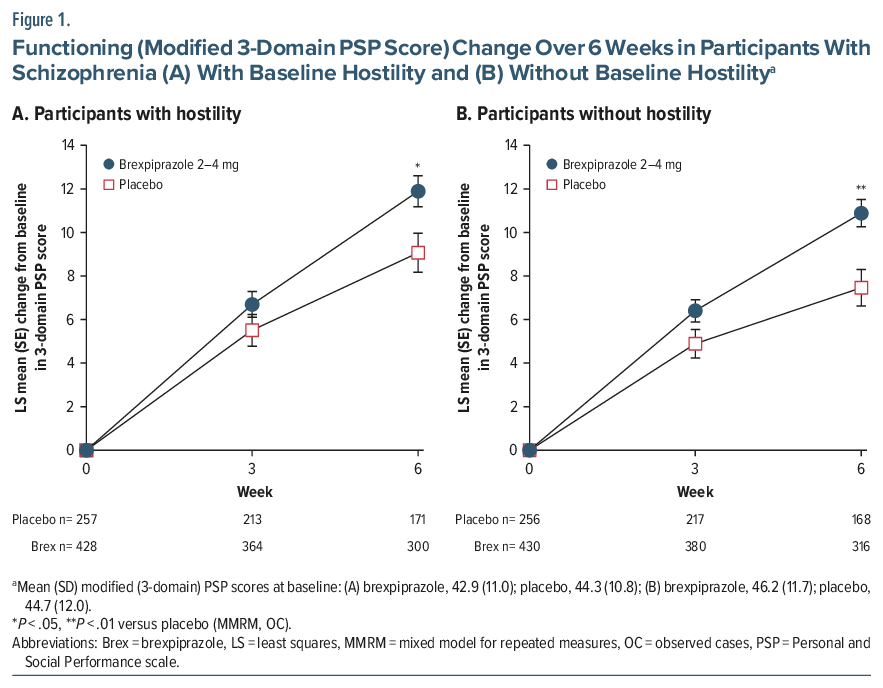
Over 6 weeks in participants with hostility, modified (3-domain) PSP score improved more with brexpiprazole than placebo: least squares (LS) mean difference, 2.82 (95% confidence interval [CI], 0.58–5.07); P=.014; Cohen d, 0.19 (95% CI, 0.04–0.35) (Figure 1A; Table 1). Similar improvement was observed in participants without hostility: LS mean difference, 3.42 (95% CI, 1.37–5.48); P=.001; Cohen d, 0.26 (95% CI, 0.10–0.41) (Figure 1B).
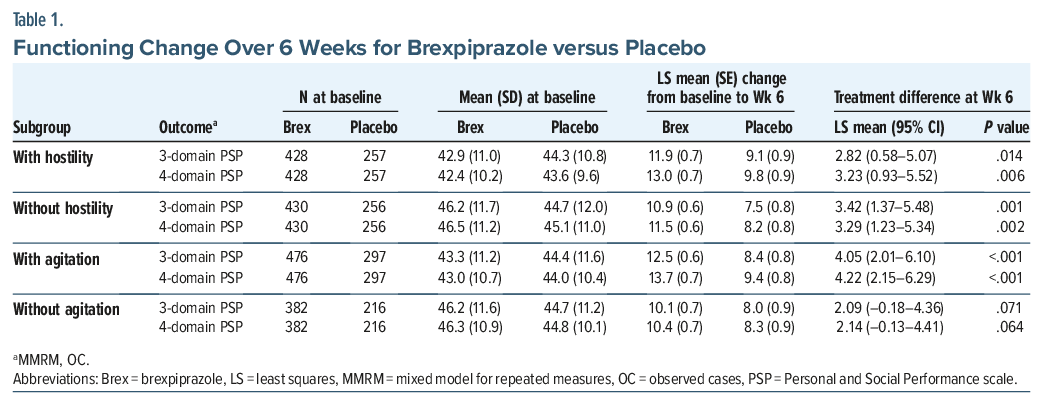
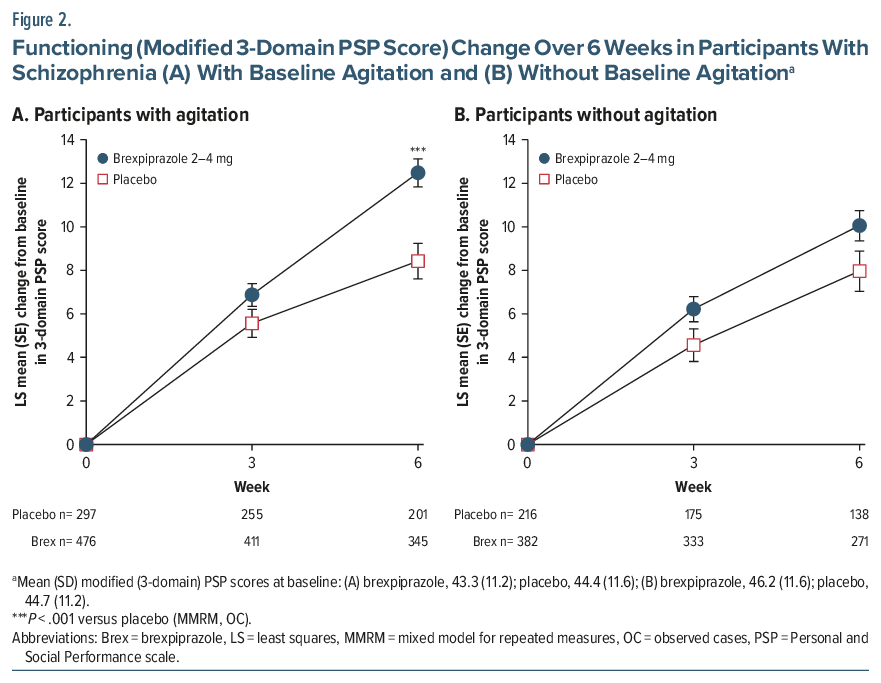
Over 6 weeks in participants with agitation, modified (3-domain) PSP score improved more with brexpiprazole than placebo: LS mean difference, 4.05 (95% CI, 2.01–6.10); P < .001; Cohen d, 0.29 (95% CI, 0.14–0.43) (Figure 2A; Table 1). Participants without agitation showed nonsignificant improvement: LS mean difference, 2.09 (95% CI, –0.18 to 4.36); P = .071; Cohen d, 0.15 (95% CI, –0.01 to 0.32) (Figure 2B).
The standard (4-domain) PSP sensitivity analysis produced similar results to the modified (3-domain) PSP analysis (Table 1).
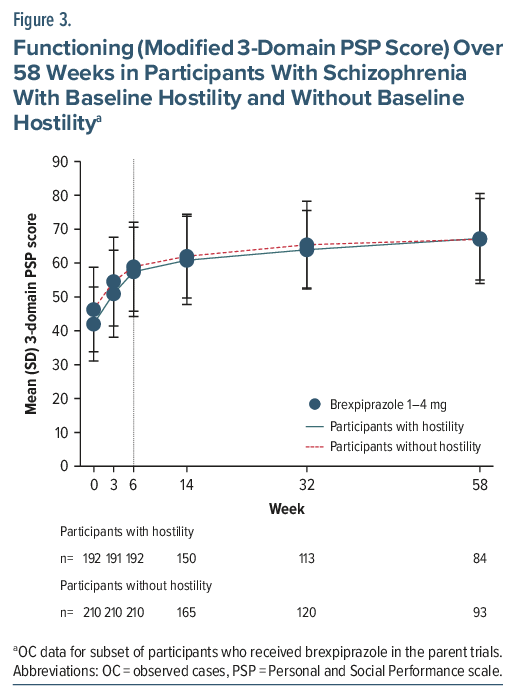
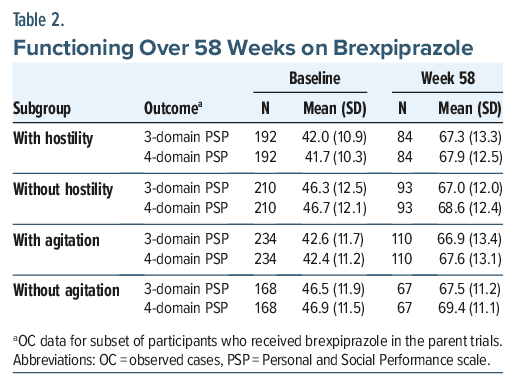
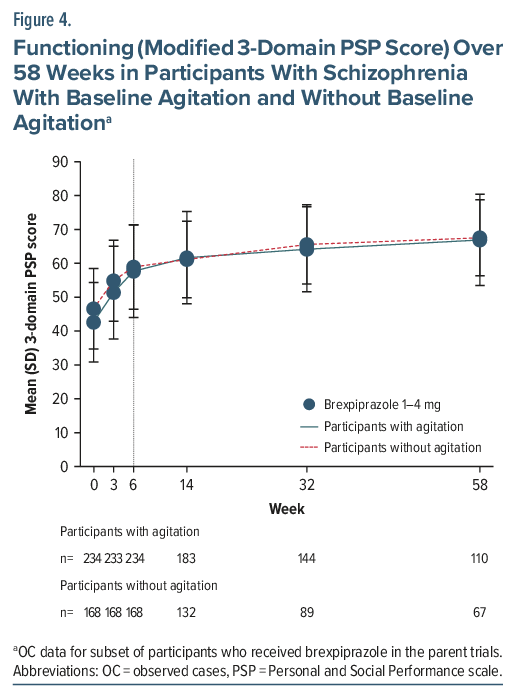
Over 58 weeks of brexpiprazole treatment, modified (3-domain) PSP score improved and stabilized in participants with hostility and without hostility (Figure 3; Table 2). Similarly, modified (3-domain) PSP score improved and stabilized over 58 weeks in participants with agitation and without agitation (Figure 4; Table 2).
Change in Hostility (PANSS P7 Response)
In the short term, hostility response (ie, hostility at baseline but not at Week 6) was shown in 218/300 participants (72.7%) on brexpiprazole and 105/170 (61.8%) on placebo. The relative risk was 1.18 (95% CI, 1.03–1.36) in favor of brexpiprazole; P = .019.
With long-term brexpiprazole treatment, hostility response was shown in 95/115 participants (82.6%) at Week 32 and 77/85 (90.6%) at Week 58.
Change in Agitation (PANSS-EC Response)
In the short term, agitation response (ie, agitation at baseline but not at Week 6) was shown in 143/345 participants (41.4%) on brexpiprazole and 68/200 (34.0%) on placebo. The relative risk was 1.21 (95% CI, 0.95–1.53) in favor of brexpiprazole; P = .12.
With long-term brexpiprazole treatment, agitation response was shown in 95/146 participants (65.1%) at Week 32 and 86/111 (77.5%) at Week 58.
DISCUSSION
In this post hoc analysis of phase 3 clinical trials, brexpiprazole was associated with greater improvement in functioning than placebo (P<.05) over 6 weeks in adults with schizophrenia who had hostility and agitation symptoms. Brexpiprazole was also associated with greater without hostility, but not in adults without agitation (a numerical improvement was noted). The mean within-group change from baseline was >10 points (ie, 1 PSP category) in all brexpiprazole subgroups, indicating that changes were clinically meaningful regardless of the presence or absence of hostility or agitation. Improvement in functioning from baseline continued over up to 58 weeks of brexpiprazole treatment, to a similar degree in participants with and without hostility and agitation symptoms. Prior analyses of brexpiprazole not stratified by symptoms also showed PSP improvement over 6 weeks (Cohen d, 0.31), with improvements in all 4 domains, and a 58-week functional response rate of 84.2%.42 Deficits in functioning are a core aspect of schizophrenia,43 an essential component of recovery,44 and an important treatment target that is meaningful to people with schizophrenia.11,45 Overall, these results show that brexpiprazole may be a valuable treatment option for people with schizophrenia and deficits in functioning, even when presenting with hostility and agitation (and also anxiety, as reported in a prior study41).
Regarding the nonsignificant difference versus placebo in adults without agitation, this may suggest that the effect of brexpiprazole on functioning is mediated, in part, by reduction in agitation. It is also noteworthy that all observed between-group effect sizes were reduced by a large placebo response (7.5–9.1 points across modified PSP analyses).
A comprehensive meta-analysis has identified several other atypical antipsychotics that may improve functioning in schizophrenia (lurasidone, olanzapine, paliperidone, and quetiapine).19 However, only brexpiprazole has been studied and demonstrated improvement in functioning in participants with hostility and agitation. Furthermore, other atypical antipsychotics are variously associated with activating effects, sedating effects, and weight gain,19 which can negatively impact functioning.46 Although the present analysis did not address safety, brexpiprazole is considered neither activating nor sedating in schizophrenia (akathisia, 5.5%; somnolence, 2.3%; sedation, 2.1%).47 Selecting a treatment with tolerable side effects is an important consideration when targeting improvement in functioning,48 and the tolerability of brexpiprazole in schizophrenia is well established,49 including in participants with hostility.18
As well as functioning, hostility and agitation symptoms improved in participants taking brexpiprazole, as shown by rates of clinically meaningful response. This result aligns with prior post hoc analyses of brexpiprazole in schizophrenia showing overall mean improvements in hostility and agitation.17,18 In one post hoc analysis, the reduction in hostility was independent of positive symptoms, akathisia, and somnolence, indicating a specific antihostility effect.18 Most other atypical antipsychotics (including aripiprazole, asenapine, clozapine, lurasidone, olanzapine, risperidone, and ziprasidone) have also shown specific effects on hostility in schizophrenia, generally in post hoc analyses.2
Strengths of this analysis include the large 6-week sample (1,385 participants analyzed), and the assessment of up to 58 weeks of continuous treatment. The PSP is an established measure of functioning, strengthened for this analysis by removing the disturbing and aggressive behaviors domain to measure functioning independent of hostility and agitation. The similar scores obtained for the modified (3-domain) PSP and standard (4-domain) PSP scales support this approach, while also suggesting that domain removal may not be necessary for future analyses.
Limitations include that this was a post hoc, exploratory, hypothesis-generating analysis of trials that were not designed to study hostility and agitation symptoms, and with no adjustment for multiple comparisons. Consequently, these results need to be repeated in a prespecified analysis. People with substance-use disorders were excluded, which reduces generalizability. There was no active comparator to contrast with brexpiprazole. Benzodiazepine rescue medication was permitted in the original clinical trials, which may have temporarily improved symptoms, though benzodiazepines could not be taken prior to efficacy measurements. Hostility was measured by a single PANSS item because validated hostility inventories were not included in the trials. For agitation, the PANSS-EC response definition was developed for use in acute episodes of agitation, not 6-week trials.32,38 With regard to the modified (3-domain) PSP, it lacks precision (the midpoint of the 10-point categories was used), has reduced variability (due to the removal of a domain), and requires further validation. The PSP scoring table gives greater importance to disturbing and aggressive behaviors than the other domains,23 and this could not be accounted for in the 3-domain scores. Finally, it is not known if raters would answer PSP questions differently in the absence of the disturbing and aggressive behaviors domain (eg, by considering the impact of these behaviors on the personal and social relationships domain).
In conclusion, this post hoc analysis showed that brexpiprazole may improve functioning in adults with schizophrenia, even if they have hostility and agitation symptoms. Clinicians and people with schizophrenia may wish to consider brexpiprazole as a treatment option to help achieve the goal of returning to their normal daily activities.
Article Information
Published Online: July 20, 2026. https://doi.org/10.4088/JCP.26m16448
© 2026 Physicians Postgraduate Press, Inc.
Submitted: March 27, 2026; accepted June 9, 2026.
To Cite: Citrome L, Farovik A, Palma AM, et al. Effects of brexpiprazole on functioning in patients with schizophrenia who have hostility and agitation symptoms: post hoc analysis of short- and long-term trials. J Clin Psychiatry 2026;87(3):26m16448.
Author Affiliations: Department of Psychiatry and Behavioral Sciences, New York Medical College, Valhalla, New York (Citrome); Medical Affairs, H. Lundbeck A/S, Valby, Denmark (Farovik, Yildirim); Medical and Real-World Data Analytics, Otsuka Pharmaceutical Development & Commercialization Inc., Princeton, New Jersey (Palma).
Corresponding Author: Murat Yildirim, MD, PhD, H. Lundbeck A/S, Ottiliavej 9, 2500 Copenhagen, Denmark ([email protected]).
Author Contributions: Dr Citrome: conceptualization, methodology, writing – review & editing. Dr Farovik: conceptualization, methodology, project administration, supervision, writing – review & editing. Dr Palma: conceptualization, data curation, formal analysis, methodology, software, validation, visualization, writing – review & editing. Dr Yildirim: conceptualization, methodology, project administration, supervision, writing – review & editing.
Relevant Financial Relationships: Dr Citrome has served as a consultant for Abbvie, Acadia, Adheretech, Altus, Alumis, Axsome, Alkermes, Arc, Auritec, Autobahn, Avant Healthcare Solutions, Biogen, BioXcel, BMS/Karuna, Boehringer Ingelheim, Cadent, Cerevel, Clario/Medavante/Prophase, Clinilabs, Compass, Corcept, Definium, Delpor, Eisai, Enteris BioPharma, Health Wellness Partners, HLS, Idorsia, Inmune Bio, Intra-Cellular, Johnson & Johnson/Janssen, Little Bear, Lundbeck, Luye, Lyndra, Maplight, Marvin, Mindmed, Neurelis, Neushen, Neumora, Neurocrine, Noema, Novartis, Noven, Orexo, Otsuka, Ovid, Pontifax/Draig, Praxis, PSL, Real Chemistry, Relmada, Renew Research, Response, Reviva, Sage, Seaport, Sumitomo/Sunovion, Supernus, Teva, University of Arizona, Vanda, Wells-Fargo, and one-off ad hoc consulting for individuals/ entities conducting marketing, commercial, or scientific scoping research; speaker for Abbvie, Acadia, Alkermes, BMS, Eisai, Idorsia, Intra-Cellular, Johnson & Johnson/Janssen, Lundbeck, Luye, Neopharm, Neurocrine, Noven, Otsuka, Recordati, Takeda, Teva, Vanda, and CME activities organized by medical education companies such as Decera Clinical Education/Clinical Education Alliance/Clinical Care Options, CME Institute, CMEology, HMP/Psych Congress, Medscape/WebMD, MultiMedia Medical LLC, Neuroscience Education Institute, NEI, Paradigm, Real Psychiatry/Efficient, Real World CE, Rockpointe, Total CME, Vindico, and Universities, Professional Organizations/Societies and Advocacy Associations (MHA); owns small amounts of health-related shares of common stock in multiple companies in a portfolio managed externally, and stock options in Reviva; and earns royalties/publishing income from Taylor & Francis (Editor-in-Chief, Current Medical Research and Opinion, 2022-date), UpToDate (reviewer), Springer Healthcare (book), Elsevier (Topic Editor, Psychiatry, Clinical Therapeutics, through Spring 2025). Drs Farovik and Yildirim are full-time employees of H. Lundbeck A/S. Dr Palma is a full-time employee of Otsuka Pharmaceutical Development & Commercialization Inc.
Funding/Support: This work was supported by Otsuka Pharmaceutical Development & Commercialization Inc. (Princeton, NJ, USA) and H. Lundbeck A/S (Valby, Denmark).
Role of the Sponsor: The sponsors were involved in the design of the research, the analysis and interpretation of data, the writing and reviewing of this article, and the decision to submit for publication. The sponsors paid the free access fee.
Previous Presentation: Parts of this work were presented in poster form at the 36th European College of Neuropsychopharmacology (ECNP) Congress; October 7–10, 2023; Barcelona, Spain.
Data Availability Statement: To submit inquiries related to Otsuka clinical research, or to request access to individual participant data (IPD) associated with any Otsuka clinical trial, please visit https://clinical-trials.otsuka.com/. For all approved IPD access requests, Otsuka will share anonymized IPD on a remotely accessible data sharing platform.
Acknowledgment: Medical writing and editorial support was provided by Chris Watling, PhD, and colleagues of the Prime Group of Companies (Knutsford, UK); this support was funded by Otsuka Pharmaceutical Development & Commercialization Inc. and H. Lundbeck A/S. The sponsors thank the people who took part in these studies and their families.
ORCID: Leslie Citrome: https://orcid.org/0000-0002-6098-9266; Anton M Palma: https://orcid.org/0000-0003-1009-4701; Murat Yildirim: https://orcid.org/0000-0001-6192-1047
Clinical Points
- People with schizophrenia often experience hostility and agitation symptoms, which can worsen their functioning.
- Brexpiprazole may be a valuable treatment option to improve functioning in adults with schizophrenia, even if they have hostility and agitation symptoms.
References (49)

- Ochoa S, Suarez D, Novick D, et al. Factors predicting hostility in outpatients with schizophrenia: 36-month results from the SOHO study. J Nerv Ment Dis. 2013;201(6):464–470. PubMed CrossRef
- Citrome L, Volavka J. Specific anti-hostility effects of atypical antipsychotics in persons with schizophrenia: from clozapine to cariprazine. Harv Rev Psychiatry. 2021;29(1):20–34. CrossRef
- Mi W, Zhang S, Liu Q, et al. Prevalence and risk factors of agitation in newly hospitalized schizophrenia patients in China: an observational survey. Psychiatry Res. 2017;253:401–406. PubMed CrossRef
- Sacchetti E, Valsecchi P, Tamussi E, et al. Psychomotor agitation in subjects hospitalized for an acute exacerbation of schizophrenia. Psychiatry Res. 2018;270:357–364.
- Lindenmayer JP. The pathophysiology of agitation. J Clin Psychiatry. 2000;61(Suppl 14):5–10.
- Holloman GH Jr, Zeller SL. Overview of Project BETA: best practices in evaluation and treatment of agitation. West J Emerg Med. 2012;13(1):1–2.
- Swanson JW, Swartz MS, Van Dorn RA, et al. A national study of violent behavior in persons with schizophrenia. Arch Gen Psychiatry. 2006;63(5):490–499.
- Rabinowitz J, Berardo CG, Bugarski-Kirola D, et al. Association of prominent positive and prominent negative symptoms and functional health, well-being, healthcare-related quality of life and family burden: a CATIE analysis. Schizophr Res. 2013;150(2–3):339–342. PubMed CrossRef
- Millier A, Amri I, Toumi M. Burden associated with agitation in schizophrenia. Value Health. 2014;17(7):A766.
- Cao X, Chen S, Xu H, et al. Global functioning, cognitive function, psychopathological symptoms in untreated patients with first-episode schizophrenia: a cross-sectional study. Psychiatry Res. 2022;313:114616. CrossRef
- Corripio I, Fraguas D, García-Portilla MP, et al. Functioning in schizophrenia: recommendations of an expert panel. Schizophr Res. 2024;270:317–322.
- Gorwood P, Yildirim M, Madera-McDonough J, et al. Assessment of functional recovery in patients with schizophrenia, with a focus on early-phase disease: results from a Delphi consensus and narrative review. BMC Psychiatry. 2025;25(1):398. CrossRef
- Fagiolini A, Yildirim M, Arango C, et al. Plain language summary of publication: what experts agree about using long-acting injectable antipsychotic medicine for people early in their experience of schizophrenia. Ther Adv Psychopharmacol. 2026;16:20451253261426822. CrossRef
- Kane JM, Skuban A, Ouyang J, et al. A multicenter, randomized, double-blind, controlled phase 3 trial of fixed-dose brexpiprazole for the treatment of adults with acute schizophrenia. Schizophr Res. 2015;164(1-3):127–135. PubMed CrossRef
- Correll CU, Skuban A, Ouyang J, et al. Efficacy and safety of brexpiprazole for the treatment of acute schizophrenia: a 6-week randomized, double-blind, placebo-controlled trial. Am J Psychiatry. 2015;172(9):870–880. CrossRef
- Marder SR, Hakala MJ, Josiassen MK, et al. Brexpiprazole in patients with schizophrenia: overview of short- and long-term phase 3 controlled studies. Acta Neuropsychiatr. 2017;29(5):278–290. PubMed CrossRef
- Marder SR, Meehan SR, Weiss C, et al. Effects of brexpiprazole across symptom domains in patients with schizophrenia: post hoc analysis of short- and long-term studies. Schizophr Bull Open. 2021;2(1):sgab014. CrossRef
- Citrome L, Ouyang J, Shi L, et al. Effect of brexpiprazole on agitation and hostility in patients with schizophrenia: post hoc analysis of short- and long-term studies. J Clin Psychopharmacol. 2019;39(6):597–603.
- Huhn M, Nikolakopoulou A, Schneider-Thoma J, et al. Comparative efficacy and tolerability of 32 oral antipsychotics for the acute treatment of adults with multi-episode schizophrenia: a systematic review and network meta-analysis. Lancet. 2019;394(10202):939–951. PubMed CrossRef
- Meade N, Shi L, Meehan SR, et al. Efficacy and safety of brexpiprazole in patients with schizophrenia presenting with severe symptoms: post-hoc analysis of short- and long-term studies. J Psychopharmacol. 2020;34(8):829–838. PubMed CrossRef
- Forbes A, Hobart M, Ouyang J, et al. A long-term, open-label study to evaluate the safety and tolerability of brexpiprazole as maintenance treatment in adults with schizophrenia. Int J Neuropsychopharmacol. 2018;21(5):433–441. CrossRef
- Lundbeck H. A/S. Interventional, open-label, flexible-dose extension study of brexpiprazole in patients with schizophrenia [Study 14644B synopsis]. 2016. Accessed June 2, 2025. https://www.lundbeck.com/global/our-science/clinical-trials/study-synopses-disclaimer/study-synopses
- Morosini PL, Magliano L, Brambilla L, et al. Development, reliability and acceptability of a new version of the DSM-IV Social and Occupational Functioning Assessment Scale (SOFAS) to assess routine social functioning. Acta Psychiatr Scand. 2000;101(4):323–329. PubMed
- Nasrallah H, Morosini P, Gagnon DD. Reliability, validity and ability to detect change of the Personal and Social Performance scale in patients with stable schizophrenia. Psychiatry Res. 2008;161(2):213–224. PubMed CrossRef
- Patrick DL, Burns T, Morosini P, et al. Reliability, validity and ability to detect change of the clinician-rated Personal and Social Performance scale in patients with acute symptoms of schizophrenia. Curr Med Res Opin. 2009;25(2):325–338. PubMed CrossRef
- Lee SC, Tang SF, Lu WS, et al. Minimal detectable change of the Personal and Social Performance scale in individuals with schizophrenia. Psychiatry Res. 2016;246:725–729. CrossRef
- Citrome L, Durgam S, Lu K, et al. The effect of cariprazine on hostility associated with schizophrenia: post hoc analyses from 3 randomized controlled trials. J Clin Psychiatry. 2016;77(1):109–115. PubMed CrossRef
- Citrome L, Álvarez-Barón E, Gabarda-Inat I, et al. The specific anti-hostility effect of lurasidone in patients with an acute exacerbation of schizophrenia: results of pooled post hoc analyses in adolescents and adults. Int Clin Psychopharmacol. 2025;40(4):214–223. CrossRef
- Volavka J, Czobor P, Citrome L, et al. Efficacy of aripiprazole against hostility in schizophrenia and schizoaffective disorder: data from 5 double-blind studies. J Clin Psychiatry. 2005;66(11):1362–1366. PubMed CrossRef
- Volavka J, Czobor P, Derks EM, et al. Efficacy of antipsychotic drugs against hostility in the European First-Episode Schizophrenia Trial (EUFEST). J Clin Psychiatry. 2011;72(7):955–961. CrossRef
- Kay SR, Fiszbein A, Opler LA. The Positive and Negative Syndrome Scale (PANSS) for schizophrenia. Schizophr Bull. 1987;13(2):261–276.
- Citrome L. Comparison of intramuscular ziprasidone, olanzapine, or aripiprazole for agitation: a quantitative review of efficacy and safety. J Clin Psychiatry. 2007;68(12):1876–1885. PubMed CrossRef
- Marder SR, West B, Lau GS, et al. Aripiprazole effects in patients with acute schizophrenia experiencing higher or lower agitation: a post hoc analysis of 4 randomized, placebo-controlled clinical trials. J Clin Psychiatry. 2007;68(5):662–668. PubMed CrossRef
- Allen MH, Citrome L, Pikalov A, et al. Efficacy of lurasidone in the treatment of agitation: a post hoc analysis of five short-term studies in acutely ill patients with schizophrenia. Gen Hosp Psychiatry. 2017;47:75–82. PubMed CrossRef
- Pratts M, Citrome L, Grant W, et al. A single-dose, randomized, double-blind, placebo-controlled trial of sublingual asenapine for acute agitation. Acta Psychiatr Scand. 2014;130(1):61–68. PubMed CrossRef
- De Filippis S, Cuomo I, Lionetto L, et al. Intramuscular aripiprazole in the acute management of psychomotor agitation. Pharmacotherapy. 2013;33(6):603–614.
- Kinon BJ, Stauffer VL, Kollack-Walker S, et al. Olanzapine versus aripiprazole for the treatment of agitation in acutely ill patients with schizophrenia. J Clin Psychopharmacol. 2008;28(6):601–607. PubMed CrossRef
- Montoya A, Valladares A, Lizán L, et al. Validation of the excited component of the Positive and Negative Syndrome Scale (PANSS-EC) in a naturalistic sample of 278 patients with acute psychosis and agitation in a psychiatric emergency room. Health Qual Life Outcomes. 2011;9:18. PubMed CrossRef
- Kay SR, Sevy S. Pyramidical model of schizophrenia. Schizophr Bull. 1990;16(3):537–545.
- Zeller S, Zun L, Cassella JV, et al. Response to inhaled loxapine in patients with schizophrenia or bipolar I disorder: PANSS-EC responder analyses. BJPsych Open. 2017;3(6):285–290. PubMed CrossRef
- Ismail Z, Kapadia S, Palma AM, et al. Brexpiprazole for anxiety symptoms in schizophrenia: a pooled analysis of short- and long-term trials. Curr Med Res Opin. 2025;41(8):1535–1548. PubMed
- Correll CU, He Y, Therrien F, et al. Effects of brexpiprazole on functioning in patients with schizophrenia: post hoc analysis of short- and long-term studies. J Clin Psychiatry. 2022;83(2):20m13793. PubMed
- Handest R, Molstrom IM, Gram Henriksen M, et al. A systematic review and meta-analysis of the association between psychopathology and social functioning in schizophrenia. Schizophr Bull. 2023;49(6):1470–1485. CrossRef
- Correll CU, Kishimoto T, Nielsen J, et al. Quantifying clinical relevance in the treatment of schizophrenia. Clin Ther. 2011;33(12):B16–B39. PubMed
- Ramsay CE, Broussard B, Goulding SM, et al. Life and treatment goals of individuals hospitalized for first-episode nonaffective psychosis. Psychiatry Res. 2011;189(3):344–348. PubMed CrossRef
- Tandon R, Lenderking WR, Weiss C, et al. The impact on functioning of second-generation antipsychotic medication side effects for patients with schizophrenia: a worldwide, cross-sectional, web-based survey. Ann Gen Psychiatry. 2020;19:42. PubMed CrossRef
- Citrome L. Activating and sedating adverse effects of second-generation antipsychotics in the treatment of schizophrenia and major depressive disorder: absolute risk increase and number needed to harm. J Clin Psychopharmacol. 2017;37(2):138–147. PubMed
- Correll CU, Ismail Z, McIntyre RS, et al. Patient functioning, life engagement, and treatment goals in schizophrenia. J Clin Psychiatry. 2022;83(5):LU21112AH21112.
- Correll CU, Mafi CE, Fagiolini A, et al. Brexpiprazole in the management of schizophrenia: a consensus report of best practices from acute to maintenance treatment. Neuropsychiatr Dis Treat. 2025;21:1857–1883. PubMed
This PDF is free for all visitors!