
See related commentary by McIntyre
Bipolar disorder (BD) and major depressive disorder (MDD) affect ∼7 million and ∼21 million adults in the US, respectively.1,2 More importantly, they reduce life expectancy by 8–14 years on average,2,3 often due to cardiometabolic comorbidities.4,5 Psychotropics may further increase this cardiometabolic risk.6,7
Glucagon-like peptide-1 receptor agonists (GLP-1RAs), indicated for type 2 diabetes mellitus (T2DM) and weight loss,7 have seen a 5-fold increase in their market share since 2020.8,9 More recently, GLP-1RAs were associated with improved mood symptoms and cognition.6,8,10,11 By mitigating psychotropic-associated weight gain, GLP-1RAs may reduce cardiometabolic burden and treatment discontinuation among those with mood disorders.6,7 This study examined 12-month period prevalence and trends (2018–2023) for GLP-1RA fills and prescriber specialty among privately insured US adults (18–64) with and without mood disorders and GLP-1RA-associated comorbidities.
Methods
Using MarketScan claims and encounters data,12 we included individuals with ≥1 year of enrollment and who were eligible for prescription coverage (N=27,240,373).13 International Classification of Diseases, Tenth Revision (ICD-10) codes were used to identify annual presence of BD (F30-F31), MDD (F32-F33), T2DM (E11), obesity (E66.0, E66.8, E66.9, Z68.30-Z68.39), stroke (I63), all diabetes (E08-E13), myocardial infarction (I21), obstructive sleep apnea (G47.33), chronic kidney disease (N18), and metabolic dysfunction–associated steatohepatitis (K75.81). The mood disorder cohort was identified by the presence of ICD-10 codes with ≥1 inpatient admission or ≥2 outpatient visits.13 When both BD and MDD were present, BD superseded. Regardless of diagnostic status in each annual period, drug claims were used to calculate annual dispensation rates for metformin and GLP-1RAs, including liraglutide, semaglutide, dulaglutide, exenatide, and tirzepatide. Metformin was used as a comparator due to overlapping indications.14,15 Among those with mood disorders, prescribing providers were identified by the visit closest to the “initial” fill of a GLP-1 prescription up to 90 days prior.
Results
The study included 27,240,373 subjects with and without mood disorders from 2018 to 2023, contributing an average of 3 years of data (84,256,167 person-years). Approximately 9.4% had a mood disorder (BD=12.3%, MDD=87.7%), and these individuals were younger (median age: BD =35 years, MDD=37 years, vs no mood disorder=40 years), more often female (BD=65.4%, MDD=68.7%, vs 50.1%), and more likely to have T2DM (BD=7.8%, MDD=6.4%, vs 5.8%) and obesity (BD=16.0%, MDD=14.9%, vs 7.4%).
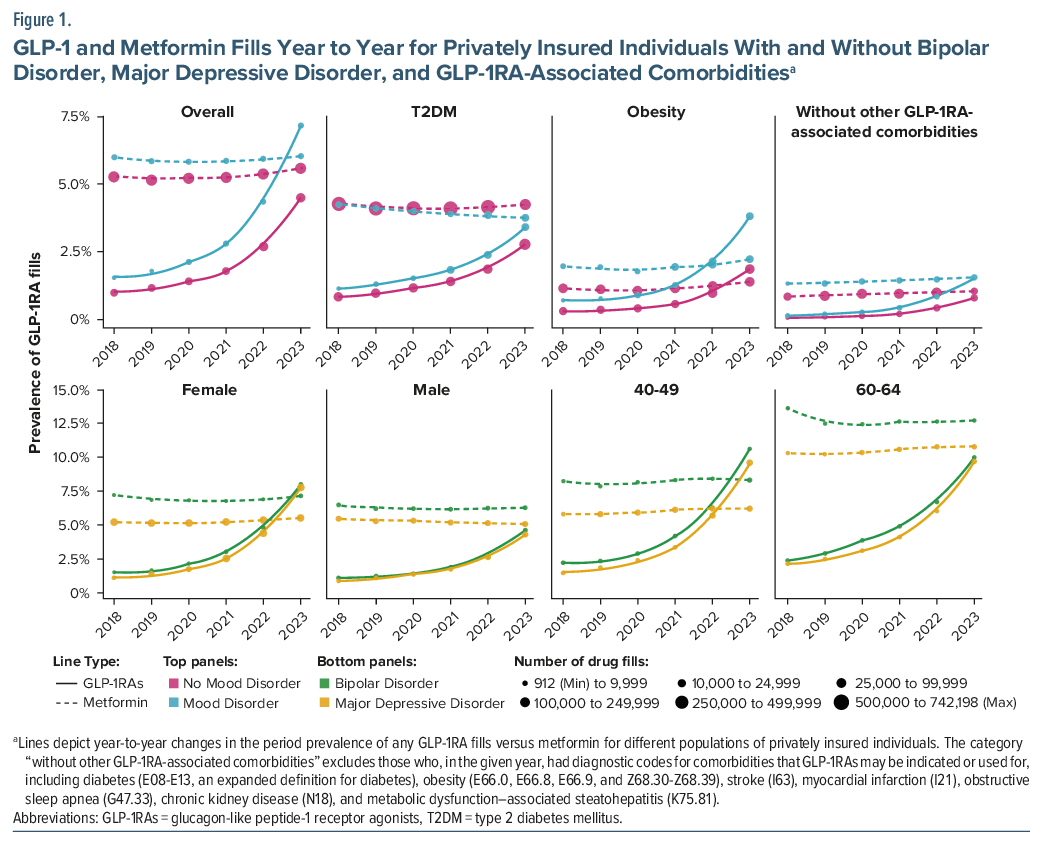
Among those with mood disorders, GLP-1RA prescription fills increased from 1.5% (2018) to 7.2% (2023), compared to 6.0% for metformin (Figure 1). In general, GLP-1RA fills were more prevalent and more rapidly increasing for older females and those with mood disorders, regardless of comorbidities. Family practitioners prescribed ∼26% of all GLP-1RAs from 2018 to 2023. Nurse practitioners showed the fastest uptake (17.6% in 2023; 25-fold increase from 2018), while psychiatrists accounted for ∼6% with minimal change.
Discussion
GLP-1RA fills increased rapidly between 2018 and 2023.16 High fill rates among those with mood disorders could reflect that multimorbidity begets more treatment.6,17 The increase among those with mood disorders and without comorbid indications for GLP-1RAs may also reflect emerging evidence of benefits for mood disorders and substance use.6,8,10 However, psychiatrists prescribed only 6% of all GLP-1RAs. The literature on the function and risk of GLP-1RAs in the context of mood disorders remains nascent.6,18,19 Others have suggested that GLP-1RA prescription among those with mental health disorders may sometimes be significantly lower due to side effects and cost.20 This study is limited by the absence of indication data and the use of diagnostic codes, which may misclassify GLP-1RA use and underreport disease. Until the effect of GLP-1RAs on the psychopathology and treatment of mood disorders is clarified, behavioral health clinicians should recognize that individuals with mood disorders are often prescribed GLP-1RAs outside of psychiatry.
Article Information
Published Online: June 1, 2026. https://doi.org/10.4088/JCP.26br16352
© 2026 Physicians Postgraduate Press, Inc.
J Clin Psychiatry 2026;87(3):26br16352
Submitted: January 30, 2026; accepted April 10, 2026.
To Cite: Breitzig MT, Trippetti TR, Kong L, et al. Prevalence of GLP-1 receptor agonist use among privately insured individuals with mood disorders. J Clin Psychiatry. 2026;87(3):26br16352.
Author Affiliations: Henry Ford Health, Center for Healthcare Improvement, Detroit, Michigan (Breitzig); Department of Psychiatry and Behavioral Health, Penn State College of Medicine, Hershey, Pennsylvania (Breitzig, Saunders, Liu); Department of Public Health Sciences, Penn State College of Medicine, Hershey, Pennsylvania (Trippetti, Kong, Liu); Dauten Family Center for Bipolar Treatment Innovation, Massachusetts General Hospital, Boston, Massachusetts (Nierenberg); Department of Psychiatry, Harvard Medical School, Boston, Massachusetts (Nierenberg).
Corresponding Author: Guodong Liu, PhD, Department of Public Health Sciences, Suite 2200, Mail Code A210, Penn State College of Medicine, 90 Hope Drive, Hershey, PA 17033 ([email protected]).
Relevant Financial Relationships: None reported.
Funding/Support: The project described was supported by the National Center for Advancing Translational Sciences (UL1TR002014) and the National Institute of Mental Health (T32MH125792) of the National Institutes of Health. The content is solely the responsibility of the authors and does not necessarily represent the official views of the National Institutes of Health.
Role of the Funder/Sponsor: The funders had no role in the design and conduct of the study; collection, management, analysis, and interpretation of the data; preparation, review, or approval of the manuscript; and decision to submit the manuscript for publication.
Data Sharing Statement: Merative MarketScan® data were used for this analysis and are available for purchase from Merative.
ORCID: Mason T. Breitzig: https://orcid.org/0000-0002-4820-3670; Lan Kong: https://orcid.org/0000-0001-6098-9445; Erika F. H. Saunders: https://orcid.org/0000-0001-7222-0828
References (20)

- National Institute of Mental Health. Major depression. Accessed May 30, 2025. https://www.nimh.nih.gov/health/statistics/major-depression
- Nierenberg AA, Agustini B, Köhler-Forsberg O, et al. Diagnosis and treatment of bipolar disorder: a review. JAMA. 2023;330(14):1370–1380. CrossRef
- Laursen TM, Musliner KL, Benros ME, et al. Mortality and life expectancy in persons with severe unipolar depression. J Affect Disord. 2016;193:203–207. PubMed CrossRef
- Gadermann AM, Alonso J, Vilagut G, et al. Comorbidity and disease burden in the NCS-R. Depress Anxiety. 2012;29(9):797–806. PubMed CrossRef
- Yin J, Ma T, Li J, et al. Association of mood disorder with cardiometabolic multimorbidity trajectory and life expectancy, a prospective cohort study. J Affect Disord. 2022;312:1–8. PubMed CrossRef
- Carmellini P, Cuomo A, Rescalli MB, et al. GLP-1 receptor agonists in mood disorders: a psychiatric perspective. Life. 2025;15(9):1422. PubMed CrossRef
- McIntyre RS, Kwan ATH, Rosenblat JD, et al. Psychotropic drug–related weight gain and its treatment. Aust J Pharm. 2024;181(1):26–38. PubMed CrossRef
- Moiz A, Filion KB, Tsoukas MA, et al. The expanding role of GLP-1 receptor agonists: a narrative review of current evidence and future directions. EClinicalMedicine. 2025;86:103363. PubMed CrossRef
- Tsipas S, Khan T, Loustalot F, et al. Spending on glucagon-like peptide-1 receptor agonists among US adults. JAMA Netw Open. 2025;8(4):e252964. PubMed CrossRef
- Li S, Sabbah SG, Kwan ATH, et al. Repurposing glucagon-like peptide-1 (GLP-1) receptor agonists for the treatment of depression: a systematic review of preclinical, observational and clinical investigations. Eur Neuropsychopharmacol. 2025;99:56–67. PubMed CrossRef
- Ali M, Ahmed A, Khan BA, et al. Efficacy of GLP-1 agonists in psychiatric illnesses: a scoping review. Prim Care Companion CNS Disord. 2025;27(3):24nr03828. CrossRef
- Merative MarketScan Research Databases. Published online December 8, 2025. Accessed December 22, 2025. https://www.merative.com/documents/merative-marketscan-research-databases
- Liu G, Kong L, Baweja R, et al. Gender disparity in bipolar disorder diagnosis in the United States: a retrospective analysis of the 2005–2017 MarketScan Commercial Claims database. Bipolar Disord. 2022;24(1):48–58. PubMed CrossRef
- Daggolu J, Chen H. Effect of concurrent metformin on adherence to and persistence of treatment with second-generation antipsychotics in nondiabetic patients. J Clin Psychiatry. 2025;87(1):25m15808. PubMed CrossRef
- Siskind D, Hahn M, Correll CU, et al. Glucagon-like peptide-1 receptor agonists for antipsychotic-associated cardio-metabolic risk factors: a systematic review and individual participant data meta-analysis. Diabetes Obes Metab. 2019;21(2):293–302. PubMed CrossRef
- Rodriguez PJ, Gratzl S, Goodwin Cartwright BM, et al. First-time prescribing of GLP-1 receptor agonists from 2018-2023: a descriptive analysis. Epidemiology. 2023.
- Rodriguez-Seijas C, Eaton NR, Stohl M, et al. Mental disorder comorbidity and treatment utilization. Compr Psychiatry. 2017;79:89–97. PubMed CrossRef
- Tempia VS, Nicastri A, Perazza F, et al. The impact of GLP-1 receptor agonists (GLP-1 RAs) on mental health: a systematic review. Curr Treat Options Psych. 2024;11(4):310–357. CrossRef
- Kornelius E, Huang JY, Lo SC, et al. The risk of depression, anxiety, and suicidal behavior in patients with obesity on glucagon like peptide-1 receptor agonist therapy. Sci Rep. 2024;14(1):24433. CrossRef
- Wagner E, Højlund M, Fiedorowicz JG, et al. Disparities in diabetes treatment and monitoring for people with and without mental disorders: a systematic review and meta-analysis. Lancet Psychiatry. 2026;13(2):112–124. CrossRef
This PDF is free for all visitors!