Two Analyses of Treatment Limitations
Generalized anxiety disorder (GAD) and treatment-resistant depression (TRD) are chronic psychiatric conditions in which many patients do not achieve durable relief. A real-world claims analysis presented at the American Psychiatric Association (APA) Annual Meeting characterized treatment patterns in newly diagnosed GAD.1 Baseline data presented at the American Society of Clinical Psychopharmacology (ASCP) Annual Meeting, reported as preliminary interim results, described the population enrolled in two Phase 3 trials in TRD.2 The analyses are not directly comparable, but each documents challenges in current pharmacotherapy: limited treatment durability in newly diagnosed GAD, and a severe, treatment-resistant course in depression.
Treatment Instability in Newly Diagnosed GAD
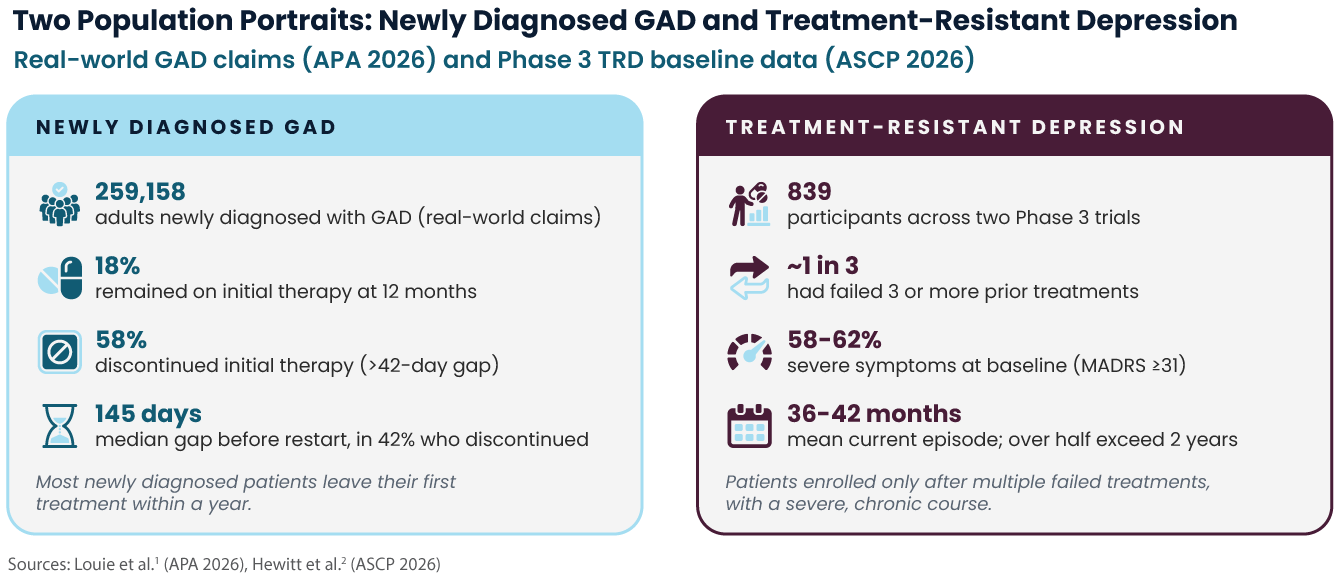
Among 259,158 adults newly diagnosed with GAD, 76% received pharmacotherapy within 12 months, most often an SSRI (45%), a benzodiazepine (22%), or an atypical antidepressant (21%).1 In a treatment-patterns sub-cohort of 59,275 patients followed from treatment initiation, 18% remained on their initial therapy through the year. Fifty-eight percent discontinued, defined as an interruption exceeding 42 days, and 24% switched or added a medication. Among those who discontinued, 42% restarted after a median of 145 days, and 76% of patients who changed treatment underwent a further change within the study period.
Comorbidity Differs by Treatment Persistence
Patients who did not persist on treatment differed from those who did. Psychiatric comorbidity was more common in the non-persistent group (26.4% vs 20.4%), including major depressive disorder (17.3% vs 12.6%).1 Medical and neurologic conditions and overall symptom burden showed the same direction, with Medicaid coverage more common among non-persistent patients (17% vs 9%). These comparisons were unadjusted, and claims data cannot establish why treatment changed, but they identify a subgroup with greater psychiatric and medical comorbidity.
Severity and Chronicity in the TRD Trials
The TRD trials enrolled patients who had already failed multiple treatments (839 participants across the two trials). Entry required failure to respond to two, three, or four pharmacological treatments, each taken at an adequate dose for at least eight weeks in the current episode; approximately one-third of participants had failed three or more.2 The data indicate a severe and chronic population, with 58% to 62% meeting the threshold for severe symptoms at baseline, the current episode had lasted a mean of 36 to 42 months with more than half exceeding two years, and mean lifetime depressive episodes of 7.5 and 6.2 across the two trials. Lifetime suicidal ideation was recorded in 9.7% and 15.1% of participants, and a lifetime attempt in 9.7% and 12.9%, across the two trials. The investigators noted that counting only the failures that met the trials’ entry criteria understates the actual degree of treatment resistance because many participants had also failed other treatments, drug and non-drug, that did not meet those criteria.
What the Two Analyses Indicate About Unmet Need
The two analyses describe different challenges in current care. Newly diagnosed GAD patients frequently left their initial treatment within the first year, and non-persistent patients had higher rates of psychiatric comorbidity. The depression-trial population had already failed multiple adequate treatments and was severely and chronically ill at entry. The findings are consistent with the broader literature, which describes GAD as a chronic disorder in which many patients do not respond to initial pharmacotherapy, with limited options thereafter,3 and treatment-resistant depression as a severe, chronic condition that carries a heavy burden.4 While the two datasets cannot directly be compared, they reinforce that GAD and TRD are chronic conditions marked by substantial unmet need.
References
- Louie D, Ferries E, Suponcic S, Gallivan M, Lam F, Silber A, et al. Treatment patterns for generalized anxiety disorder (GAD): insights from real-world evidence. Poster presented at: American Psychiatric Association Annual Meeting; May 16-20, 2026; San Francisco, CA.
- Hewitt N, Taylor RW, Marwood L, Young MB, Goodwin GM. Demographic and clinical characteristics of participants receiving COMP360 psilocybin treatment for treatment-resistant depression across two pivotal Phase 3 trials. Poster presented at: American Society of Clinical Psychopharmacology Annual Meeting; 2026; Miami, FL.
- Fagan HA, Baldwin DS. Pharmacological treatment of generalised anxiety disorder: current practice and future directions. Expert Rev Neurother. 2023;23(6):535-548.
- McIntyre RS, Alsuwaidan M, Baune BT, et al. Treatment-resistant depression: definition, prevalence, detection, management, and investigational interventions. World Psychiatry. 2023;22(3):394-412.