GAD Is More Common in Women Than in Men
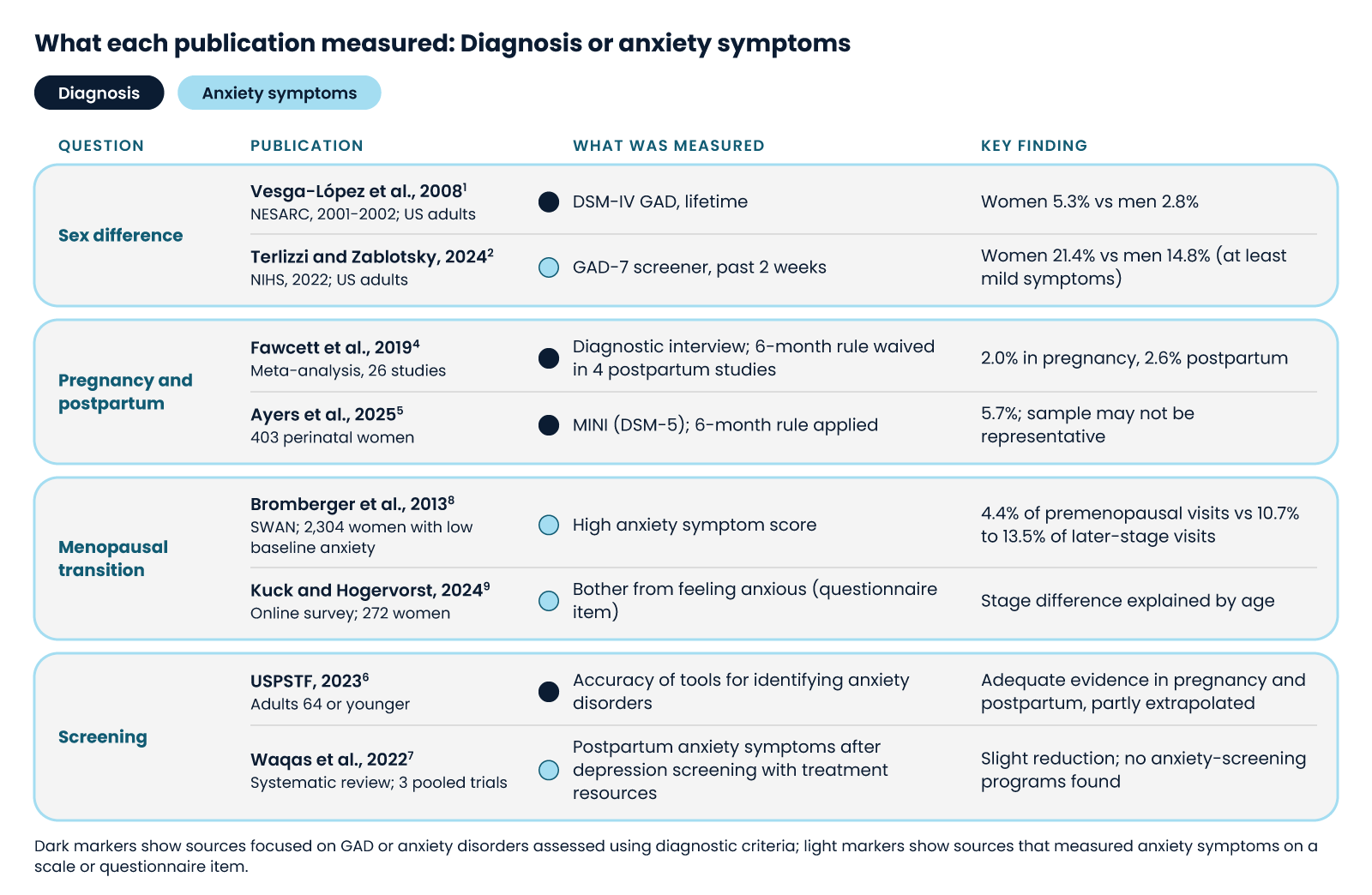
In a nationally representative US survey from 2001-2002 (National Epidemiologic Survey on Alcohol and Related Conditions [NESARC]), 5.3% of women and 2.8% of men met DSM-IV criteria for generalized anxiety disorder (GAD) at some point in their lives.1 The 2022 National Health Interview Survey (NHIS) used the GAD-7 screener to measure symptoms: 21.4% of women and 14.8% of men reported at least mild anxiety symptoms in the past 2 weeks.2 How GAD presents in women across the reproductive lifespan, especially around pregnancy and menopause, is not well established.
Perinatal GAD Is Hard to Identify, and Estimates Range From 2.0% to 5.7%
In NESARC, women with GAD reported fatigue, irritability, and muscle tension more often than men with GAD.1 Fatigue is also among the GAD symptoms that a review describes as hard to tell apart from normal changes in pregnancy and postpartum, along with insomnia and difficulty concentrating.3 Prevalence estimates also depend on how GAD is diagnosed. A meta-analysis of 26 diagnostic-interview studies in representative samples estimated GAD prevalence at 2.0% in pregnancy and 2.6% postpartum, with substantial variation between studies.4 In a different study, a 2025 UK diagnostic-interview study of 403 pregnant and postpartum women found a GAD prevalence of 5.7%, in a sample the authors said may not be representative.5 The DSM requires 6 months of symptoms for GAD. Four postpartum studies in the meta-analysis waived that rule, and the UK authors noted that the rule may have missed women whose GAD began in pregnancy or postpartum.4,5 Neither source measured how much the 6-month rule or sampling changed the estimates.
Perinatal Anxiety Screening Rests Partly on Indirect and Depression-Focused Evidence
Screening for anxiety during pregnancy and postpartum also has limitations. The US Preventive Services Task Force (USPSTF) recommends screening adults 64 years or younger for anxiety disorders, including pregnant and postpartum persons (grade B). It rated the net benefit as moderate, with moderate certainty, based on indirect evidence. The USPSTF also found adequate evidence that screening tools accurately identify anxiety disorders in pregnant and postpartum persons, partly by applying GAD-2 accuracy data from younger adults.6 A systematic review of perinatal screening programs found none designed specifically for anxiety.7 Across 3 pooled randomized trials, depression screening programs paired with treatment resources slightly reduced postpartum anxiety symptom severity versus usual care (standardized mean difference, −0.18; high-quality evidence), but none reported anxiety rates.7
Two Menopause Studies Assess Anxiety, Not GAD
The Study of Women’s Health Across the Nation (SWAN) followed 2,956 women for up to 10 years to ask whether anxiety symptoms rise during the menopausal transition. Among 2,304 women with low anxiety at the start, high anxiety symptoms occurred at 4.4% of premenopausal visits, 10.7% of early perimenopausal visits, 13.5% of late perimenopausal visits, and 12.7% of postmenopausal visits. Compared with premenopause, the adjusted odds ratio was 1.58 in early perimenopause, 1.61 in late perimenopause, and 1.56 in postmenopause.8 In a separate study, an online survey of 272 women aged 40 to 60 found that early perimenopausal women reported being more bothered by anxiety than postmenopausal women (mean scores, 5.2 vs 4.2 on an 8-point scale). The authors attributed the difference to age rather than the menopausal stage. The survey used a convenience sample, however, so the results should be interpreted with caution.9 Both studies measured anxiety symptoms rather than GAD diagnoses, so neither shows whether the transition is associated with GAD itself.8,9
Symptom Changes Around Pregnancy and Menopause May Not Reflect GAD
The evidence supports higher rates of GAD and anxiety symptoms in women. Around pregnancy and menopause, however, changes in anxiety symptoms do not necessarily mean that GAD itself has changed. During pregnancy and postpartum, overlapping symptoms and GAD’s required 6-month symptom duration can make the diagnosis harder to identify, particularly when symptoms are new-onset. More studies that measure GAD, rather than anxiety symptoms alone, are needed to determine whether pregnancy and menopause are associated with GAD.
References
- Vesga-López O, Schneier FR, Wang S, et al. Gender differences in generalized anxiety disorder: results from the National Epidemiologic Survey on Alcohol and Related Conditions (NESARC). J Clin Psychiatry. 2008;69(10):1606-1616. doi:10.4088/JCP.v69n1011
- Terlizzi EP, Zablotsky B. Symptoms of anxiety and depression among adults: United States, 2019 and 2022. Natl Health Stat Report. 2024;(213). doi:10.15620/cdc/64018
- Hantsoo L, Epperson CN. Anxiety disorders among women: a female lifespan approach. Focus (Am Psychiatr Publ). 2017;15(2):162-172. doi:10.1176/appi.focus.20160042
- Fawcett EJ, Fairbrother N, Cox ML, White IR, Fawcett JM. The prevalence of anxiety disorders during pregnancy and the postpartum period: a multivariate Bayesian meta-analysis. J Clin Psychiatry. 2019;80(4):18r12527. doi:10.4088/JCP.18r12527
- Ayers S, Sinesi A, Meade R, et al. Prevalence and treatment of perinatal anxiety: diagnostic interview study. BJPsych Open. 2025;11(1):e5. doi:10.1192/bjo.2024.823
- US Preventive Services Task Force. Screening for anxiety disorders in adults: US Preventive Services Task Force recommendation statement. JAMA. 2023;329(24):2163-2170. doi:10.1001/jama.2023.9301
- Waqas A, Koukab A, Meraj H, et al. Screening programs for common maternal mental health disorders among perinatal women: report of the systematic review of evidence. BMC Psychiatry. 2022;22(1):54. doi:10.1186/s12888-022-03694-9
- Bromberger JT, Kravitz HM, Chang Y, et al. Does risk for anxiety increase during the menopausal transition? Study of Women’s Health Across the Nation (SWAN). Menopause. 2013;20(5):488-495. doi:10.1097/GME.0b013e3182730599
- Kuck MJ, Hogervorst E. Stress, depression, and anxiety: psychological complaints across menopausal stages. Front Psychiatry. 2024;15:1323743. doi:10.3389/fpsyt.2024.1323743