Measuring Symptoms In GAD
Generalized anxiety disorder (GAD) is treated over long periods, and treatment decisions depend on whether symptoms are improving. Measurement-based care uses a validated outcome to standardize symptom-change measurement alongside clinical judgment.
A validated instrument for GAD
The GAD-7 is a seven-item self-report scale developed and validated in primary care.1 Among 2,739 participants, 965 completed a structured psychiatric interview; a cutoff of 10 or higher gave a sensitivity of 89% and a specificity of 82%. Internal consistency was 0.92 (Cronbach alpha) and test-retest reliability 0.83 (intraclass correlation). Scores of 5, 10, and 15 may be interpreted as mild, moderate, and severe. The researchers identified severity assessment and monitoring of change as intended uses, while noting that responsiveness to change remained untested.
Screening recommendations
In 2023, the US Preventive Services Task Force (USPSTF) recommended screening for anxiety disorders in adults aged 19 to 64 years, including pregnant and postpartum persons, a grade B recommendation for people without a diagnosed mental health disorder or recognized symptoms.2 For adults 65 and older, it issued an I statement, finding the evidence was insufficient to assess screening because data on screening-tool accuracy and on the benefits and harms of screening in older adults are lacking. The grade B recommendation relies on indirect evidence. Two small trials directly evaluating screening programs (n=918) showed no symptom difference at 13 to 22 weeks, so the recommendation instead links the accuracy of screening tools with the effectiveness of treatment for detected anxiety; thus, a positive screen requires confirmatory assessment. Potential harms include unnecessary referrals, overdiagnosis and treatment, labeling, and stigma, though no direct evidence on screening harms was found.
Guidelines recommendations for measurement frequency
Guidelines recommend repeating assessments without prescribing an instrument. The UK-based National Institute for Health and Care Excellence (NICE) issued “Generalised anxiety disorder and panic disorder in adults: management” (CG113) in 2011 and updated in 2019 with the recommendation that GAD care include identification, assessment, education, and active monitoring.3 It places drug treatment alongside high-intensity psychological therapy and recommends reviewing the effectiveness and side effects of drug treatment every two to four weeks for the first three months, but does not specify a rating scale. The Canadian clinical practice guidelines for anxiety disorders (2014) list eight first-line agents for GAD, and notes that the Clinical Global Impression scale is brief enough for use at each appointment and recommends therapy for at least 12 to 24 months for most patients.4
What the outcome evidence shows
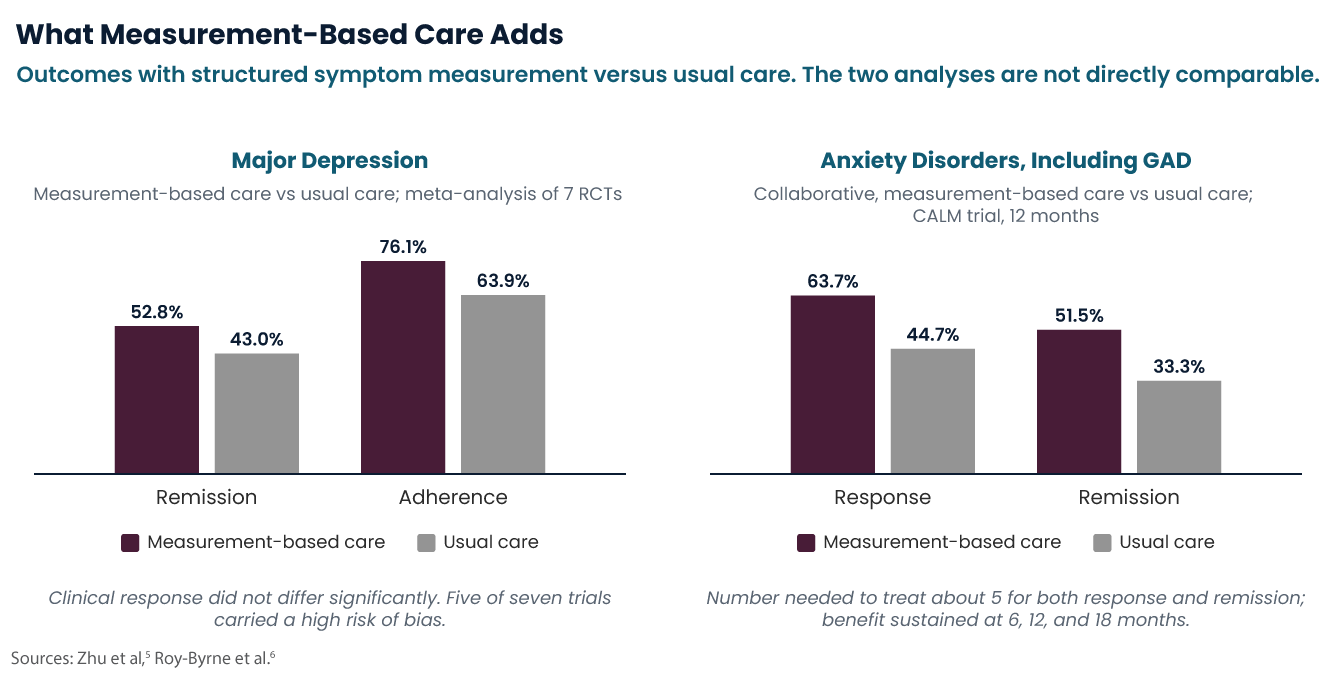
Controlled evidence for measurement-based care varies across mental health disorders. A meta-analysis of seven randomized trials found higher remission with measurement-based care than usual care in five trials (1,518 patients; 52.8% vs 43.0%; odds ratio [OR] 1.83, 95% confidence interval [CI] 1.12 to 2.97) and higher adherence (OR 1.68, 95% CI 1.22 to 2.30); response did not differ, but five of the seven trials carried a high risk of bias.5 In anxiety, CALM randomized 1,004 primary care patients, 75% of whom had GAD, to collaborative care built around web-based symptom tracking or usual care.6 On the primary outcome, the 12-item Brief Symptom Inventory, the intervention group had significantly lower anxiety symptoms than usual care at 6, 12, and 18 months (mean differences were -2.49, -2.63, and -1.63, respectively). Response and remission were also higher; at 12 months, response was 63.7% vs. 44.7% and remission was 51.5% vs. 33.3%. Importantly, the investigators stated that the tracking component cannot be isolated from the rest of the intervention.
Application to GAD
The GAD-7 is a validated, disorder-specific instrument for tracking GAD symptoms, and guidelines suggest specific re-assessment timepoints. The USPSTF recommendation addresses case findings in adults without a diagnosed disorder, not monitoring during treatment. What is still missing is a trial in GAD that isolates the effects of measurement itself, so the evidence for measurement-based care remains indirect rather than definitive.
References
- Spitzer RL, Kroenke K, Williams JBW, Lowe B. A brief measure for assessing generalized anxiety disorder: the GAD-7. Arch Intern Med. 2006;166:1092-1097.
- US Preventive Services Task Force. Screening for anxiety disorders in adults: US Preventive Services Task Force recommendation statement. Published June 20, 2023. Accessed September 2, 2026. https://www.uspreventiveservicestaskforce.org/uspstf/recommendation/anxiety-adults-screening
- National Institute for Health and Care Excellence. Generalised anxiety disorder and panic disorder in adults: management. Clinical guideline [CG113]. Published January 26, 2011; last updated July 15, 2019. Accessed September 2, 2026. https://www.nice.org.uk/guidance/cg113
- Katzman MA, Bleau P, Blier P, et al. Canadian clinical practice guidelines for the management of anxiety, posttraumatic stress and obsessive-compulsive disorders. BMC Psychiatry. 2014;14(Suppl 1):S1.
- Zhu M, Hong RH, Yang T, et al. The efficacy of measurement-based care for depressive disorders: a systematic review and meta-analysis of randomized controlled trials. J Clin Psychiatry. 2021;82(5):21r14034.
- Roy-Byrne P, Craske MG, Sullivan G, et al. Delivery of evidence-based treatment for multiple anxiety disorders in primary care: a randomized controlled trial. JAMA. 2010;303(19):1921-1928.