Pre-Dosing Safety and Risk Management
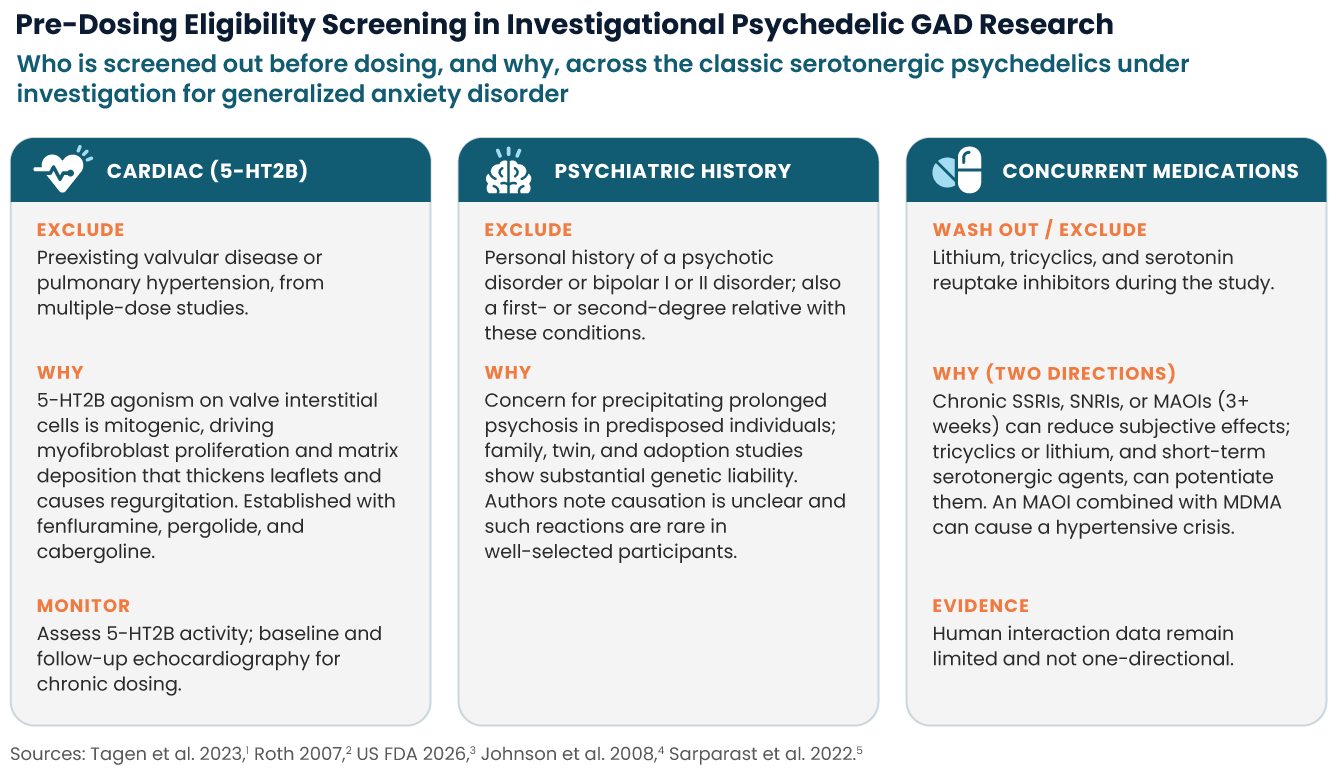
For the classic serotonergic psychedelics under investigation in generalized anxiety disorder (GAD), FDA guidance and published safety guidelines emphasize screening and exclusion before dosing.3,4 Safety considerations include cardiac risk associated with off-target 5-HT2B agonism, personal and family psychiatric history, and concurrent psychotropic medications that may require a washout period.
Cardiac risk and the 5-HT2B receptor
Agonism at 5-HT2B receptors, which are expressed in cardiac valve tissue, is mitogenic and drives myofibroblast proliferation and extracellular matrix deposition, thickening the valve leaflets and producing regurgitation.1 A 2007 perspective links this mechanism to fenfluramine, through its metabolite norfenfluramine, a potent 5-HT2B agonist, and to the dopamine agonists pergolide and cabergoline.2 Regurgitation was detected as early as three months into fenfluramine use, with the risk increasing over time.1 A 2023 review identified valvular disease as a potential risk with chronic microdosing. It addressed chronic microdosing, not trial dosing, and found no data on intermittent microdosing. It also noted that the LSD microdosing studies were too short and lacked echocardiography to assess this risk.1 FDA’s July 2026 guidance recommends sponsors assess 5-HT2B functional activity. For drugs with this activity, FDA currently recommends excluding participants with preexisting valvulopathy or pulmonary hypertension from multiple-dose studies, with baseline and follow-up echocardiography recommended for chronically administered drugs.3
Personal and family psychiatric history
Safety guidelines proposed in 2008 by Johns Hopkins investigators for healthy-volunteer studies exclude a current or past psychotic disorder or bipolar I or II disorder, and extend the exclusion to candidates with an affected first- or second-degree relative. The guidelines cite family, twin, and adoption studies showing substantial genetic liability for schizophrenia. The stated concern for exclusion is the potential for prolonged psychosis, though the authors note causation is unclear and such reactions are rare in well-selected participants.4
Concurrent medications and washout
Psychotropic medications can alter the effects of psychedelics, which is why trials specify washout periods. FDA’s interaction guidance covers both classic psychedelics and MDMA. SSRIs, SNRIs, or MAOIs taken for three weeks or more may reduce a psychedelic’s subjective effects. Tricyclics or lithium taken for three weeks or more, and SSRIs, SNRIs, or MAOIs taken for less than three weeks, may potentiate psychedelic effects. Additionally, MAOI treatment combined with MDMA can produce a life-threatening hypertensive crisis.3 The 2008 Johns Hopkins guidelines exclude participants on lithium, tricyclics, or serotonin reuptake inhibitors, identifying potentiation from chronic tricyclics and lithium and acute serotonin reuptake inhibitors as a safety concern, while reduced sensitivity from chronic reuptake inhibitors and MAOIs is treated as a scientific concern.4 A 2022 systematic review of MDMA and psilocybin interactions found the human evidence limited and not one-directional. SSRIs attenuated MDMA’s subjective effects, escitalopram pretreatment did not blunt psilocybin’s altered-states ratings though it reduced anxiety and adverse-effect ratings, and bupropion prolonged the positive mood effects of MDMA.5
Current Evidence and Its Limitations
These criteria come from early-phase research, expert guidelines, and regulatory guidance rather than confirmatory safety trials in GAD. The FDA guidance is nonbinding and does not otherwise address eligibility criteria. The classic serotonergic psychedelics under investigation in GAD are not approved for that indication or any other, and their safety and efficacy have not been established.
References
- Tagen M, Mantuani D, van Heerden L, Holstein A, Klumpers LE, Knowles R. The risk of chronic psychedelic and MDMA microdosing for valvular heart disease.I. 2023;37(9):876-890.
- Roth BL. Drugs and valvular heart disease. N Engl J Med. 2007;356(1):6-9.
- US Food and Drug Administration, Center for Drug Evaluation and Research. Psychedelic drugs: considerations for clinical investigations. Guidance for industry. July 2026.
- Johnson MW, Richards WA, Griffiths RR. Human hallucinogen research: guidelines for safety. J Psychopharmacol. 2008;22(6):603-620.
- Sarparast A, Thomas K, Malcolm B, Stauffer CS. Drug-drug interactions between psychiatric medications and MDMA or psilocybin: a systematic review. Psychopharmacology (Berl). 2022;239(6):1945-1976.