A Stringent Definition Puts Recovery at 13.5%
Recovery in schizophrenia is usually reported as a single number, which leaves unsaid what was assessed. A 2025 review separates three outcome types: symptom-, functional-, and appraisal-based. Appraisal-based recovery covers quality of life and personal recovery together, so quality of life is an appraisal-based outcome rather than a measure of functioning.2 A meta-analysis of 50 studies that applied one stringent investigator-rated definition found a median recovery proportion of 13.5% (interquartile range: 8.1% to 20.0%); the included studies were naturalistic, so no conclusion about treatment can be made.1 That definition required symptomatic and functional criteria to be met together, so no appraisal-based outcome entered the definition.1 Functional recovery and personal recovery are assessed from different perspectives, and improvement in one does not establish improvement in the other.
Functional and Personal Recovery Are Rated by Different People
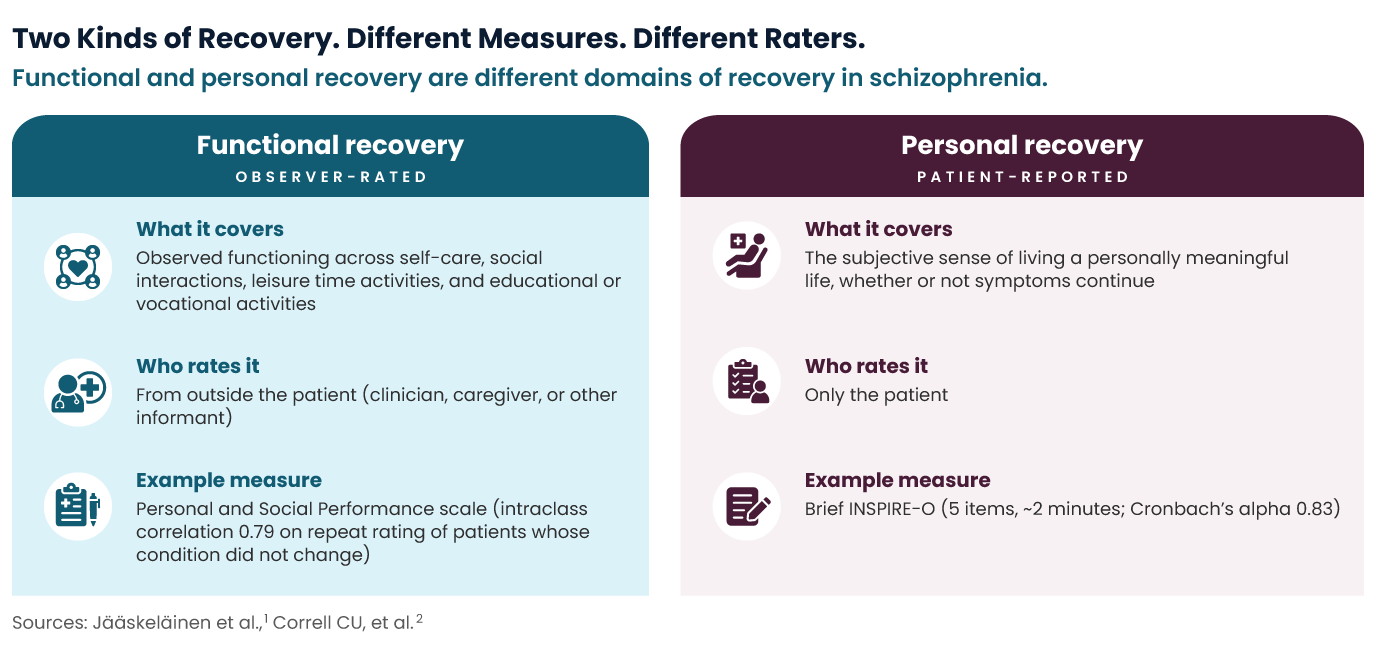
Functional recovery, observed functioning across self-care, social interactions, leisure time activities and educational or vocational activities, is rated from outside the patient, because self-reports converge only modestly with informant reports and observable milestones; the clinician-rated Personal and Social Performance scale showed an intraclass correlation of 0.79 on repeat rating of patients whose condition did not change.2 In contrast, personal recovery, the subjective sense of living a personally meaningful life whether or not symptoms continue, can come only from the patient; the five-item, patient-reported Brief INSPIRE-O takes two minutes and reports a Cronbach’s alpha of 0.83.2 The 2025 review treats functional and personal measures as complementary rather than interchangeable.2
Functional recovery and personal recovery are assessed from different perspectives, and improvement in one does not establish improvement in the other
Patient-Reported Scores Meet High Standards, With Limits
Weighing functional and personal measures together requires the patient-reported measures to meet high validation and replication standards, which a 2026 COSMIN and GRADE review set out to test for the Schizophrenia Quality of Life questionnaire. Across 14 studies it confirmed 84.5% of construct-validity and 89% of responsiveness hypotheses, with the 18-item version best balancing performance and feasibility.3 Those results should be read with caution, because ten of the 14 studies were French and cross-cultural certainty ranged from very low to moderate; floor and ceiling effects in the 18-item version reached 38% and 35.1% in some domains against a threshold of 15% to 20% for problematic score distribution.3 The instrument discriminated between groups differing in symptom severity, remission status, and functioning, though the authors caution against cross-national comparison. No threshold yet allows one patient’s change to be called clinically meaningful.
One Measure Does Not Predict Another
Among the functional milestones, competitive employment, independent living and marriage or equivalent correlate only weakly with one another, which the 2025 review interprets as evidence that averaging across them may not produce an accurate full-range functional assessment.2 The review also reports functional and personal recovery as empirically distinct constructs, and a personal recovery score does not closely track indicators outside itself, as evidenced by the Brief INSPIRE-O, which correlates only moderately with social contacts and self-reported general health.2 A gain on one measure does not establish a gain on another.
Recovery Estimates Depend on What Was Measured and Who Rated It
No single measure here is wrong. Each is partial. A recovery estimate determined from observable criteria and a patient-reported score answer different questions. Which outcome was measured, and who rated it, decides what a recovery estimate can be taken to mean.
Financial support was provided by Bristol Myers Squibb. Psychiatrist.com independently developed the content and maintained final editorial control.
References
- Jääskeläinen E, Juola P, Hirvonen N, et al. A systematic review and meta-analysis of recovery in schizophrenia. Schizophr Bull. 2013;39(6):1296-1306. doi:10.1093/schbul/sbs130
- Correll CU, Cortese S, Solmi M, et al. Beyond symptom improvement: transdiagnostic and disorder-specific ways to assess functional and quality of life outcomes across mental disorders in adults. World Psychiatry. 2025;24(3):296-318. doi:10.1002/wps.21338
- Rahmati M, Foiselle M, Fernandes S, et al. Quality of life assessment in individuals with schizophrenia: a COSMIN-based systematic review of S-QoL41 and S-QoL18 incorporating neurobiological support. eClinicalMedicine. 2026;99:104152. doi:10.1016/j.eclinm.2026.104152