The Persistence Problem In GAD
The burden in generalized anxiety disorder (GAD) is easy to picture as untreated illness. A large part of it is different: patients who improve with treatment and then, over months and years, do not stay well. GAD is a chronic and relapsing condition, and its course over time, not only the response to a first prescription, accounts for much of its burden.
A course measured in years
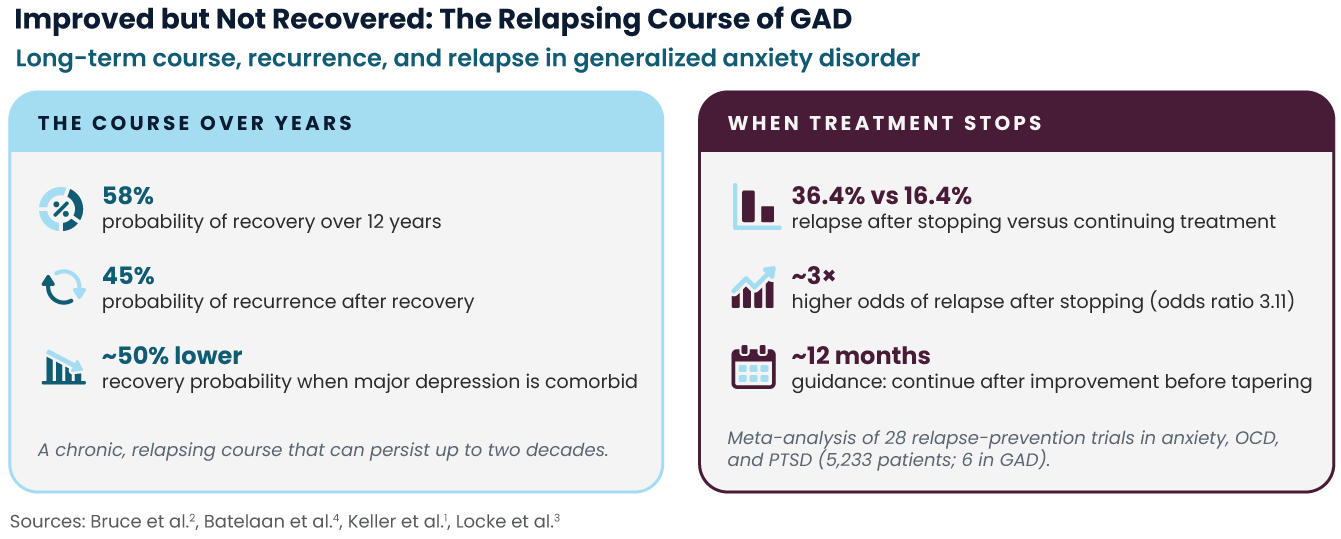
Over the first five years, prospective data show GAD following a chronic course of remission and relapse rather than resolving, and retrospective studies suggest this pattern can persist for as long as two decades.1 In a 12-year prospective study, the probability of recovering from GAD was 58%, and among patients who did recover, the probability of recurrence was 45%.2 GAD also rarely runs its course alone. It usually co-occurs with another mood, anxiety, or substance use disorder,3 and in the same cohort, comorbid major depression reduced the probability of recovering from GAD by roughly half.2 For many patients, the realistic expectation is not a single course of treatment followed by cure, but long-term management of an illness that remits and returns, all the more so when another psychiatric condition is present.
Relapse when treatment stops
The chronic course also shapes how treatment is used. Clinical guidance advises continuing medication for about 12 months after improvement before tapering, specifically to lower the risk of relapse.3 That caution is supported by relapse-prevention data. A meta-analysis of relapse-prevention trials, including six in GAD, examined antidepressant discontinuation across 28 trials (5,233 patients with anxiety disorders, obsessive-compulsive disorder, or PTSD). Stopping the antidepressant roughly tripled the odds of relapse compared with continuing (odds ratio 3.11), and over follow-up ranging from 8 to 52 weeks, relapse occurred in 36.4% of patients who discontinued versus 16.4% of those who continued.4 These data suggest that improvement does not necessarily persist after treatment is withdrawn.
The burden of an illness that persists
Because the course is long and relapsing, its burden accumulates. GAD is associated with substantial impairment in work and social functioning, reduced quality of life, and high direct and indirect costs.5 When symptoms recur or never fully clear, that impairment is not a single episode but a recurring feature of a patient’s life.
What it adds up to
Measured over years rather than weeks, GAD care is defined less by whether a patient responds than by whether that response persists. Patients may improve and then relapse, comorbidity can make recovery more difficult, and stopping treatment raises the risk of relapse. These data describe a chronic, relapsing condition that calls for long-term management rather than a single course of treatment.
References
- Keller MB. The long-term clinical course of generalized anxiety disorder. J Clin Psychiatry. 2002;63(Suppl 8):11-16.
- Bruce SE, Yonkers KA, Otto MW, Weisberg RB, Keller MB. Influence of psychiatric comorbidity on recovery and recurrence in generalized anxiety disorder, social phobia, and panic disorder: a 12-year prospective study. Am J Psychiatry. 2005;162(6):1179-1187.
- Locke AB, Kirst N, Shultz CG. Diagnosis and management of generalized anxiety disorder and panic disorder in adults. Am Fam Physician. 2015;91(9):617-624.
- Batelaan NM, Bosman RC, Muntingh A, Scholten WD, Huijbregts KM, van Balkom AJLM. Risk of relapse after antidepressant discontinuation in anxiety disorders, obsessive-compulsive disorder, and post-traumatic stress disorder: systematic review and meta-analysis of relapse prevention trials. BMJ. 2017;358:j3927.
- Hoffman DL, Dukes EM, Wittchen HU. Human and economic burden of generalized anxiety disorder. Depress Anxiety. 2008;25(1):72-90.