

This CME activity is expired. For more CME activities, visit CMEInstitute.com.
Find more articles on this and other psychiatry and CNS topics:
The Journal of Clinical Psychiatry
The Primary Care Companion for CNS Disorders
Article Abstract
Postpartum depression occurs in about 10% to 20% of childbearing women. When developing a treatment plan, clinicians need to balance the risks of untreated maternal depression, the benefits of breastfeeding, and the risks associated with infant exposure to medication in breast milk. Data on the short-term safety and long-term consequences of antidepressant use during breastfeeding are meager, but several commonly used antidepressants appear to transfer at low levels into breast milk and may or may not be detectable in infant serum. Few adverse events have been reported, and medication discontinuation has been associated with a reversal of those events. Therapeutic doses should be as low as possible, and infants (especially newborns) should be closely monitored for adverse events. Nonpharmacologic treatments should also be considered.

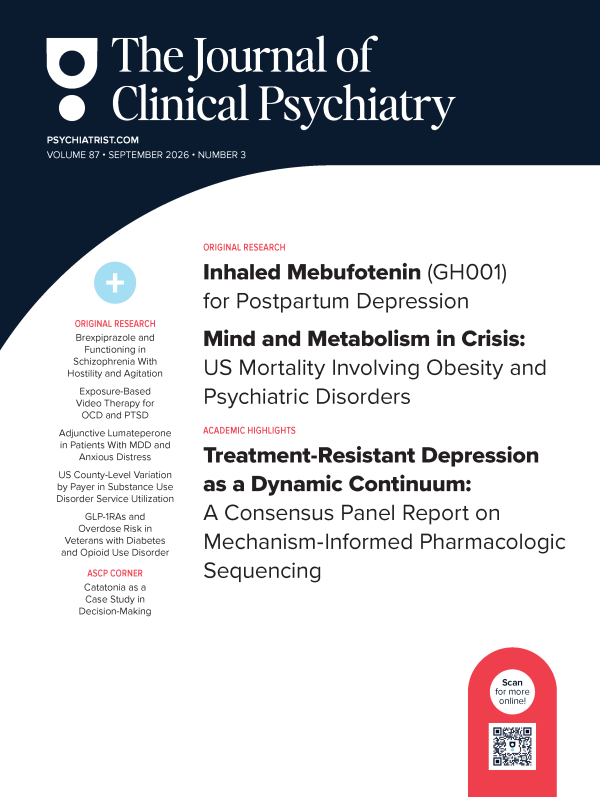
Vol 87 • 2026 • Number 3
Read the Current Issue
Original Research
Inhaled Mebufotenin (GH001) for Adult Patients with Postpartum Depression
Original Research
US Mortality Involving Obesity and Psychiatric Disorders
Academic Highlights
Treatment-Resistant Depression as a Dynamic Continuum: A Consensus Panel Report
Original Research
Effects of Brexpiprazole on Functioning in Patients with Schizophrenia Who Have Hostility and Agitation Symptoms
Original Research
Exposure-Based Video Therapy for OCD and PTSD
Original Research
Lumateperone as Adjunctive Therapy in Patients With Major Depressive Disorder and Anxious Distress
Insightful. Evidence-based. Human-centered.
Listen Now