
Psilocybin trials for depression and anxiety exclude frank bipolar disorder; case reports describe psilocybin-associated mania and hypomania, with about 5% incidence in clinical trials and up to around 20% in naturalistic studies.1 A PubMed search (“psilocybin” AND “bipolar” OR “mania” OR “cyclothymia”; English-language publications; no date limit) identified these reports but none describing worsened depression/anxiety without frank mania, and no reports in cyclothymia. Cyclothymic temperament—mood lability, unstable energy and self-esteem, and emotional reactivity—predisposes to antidepressant-and stimulant-induced mania/hypomania, is heritable, and is commonly missed even by psychiatrists using DSM-5 criteria, let alone lay facilitators.2 We report a patient with undiagnosed cyclothymic temperament, with a decade of depression, anxiety, and inattention, whose depression and anxiety were severely worsened by a high-dose, lay-administered psilocybin session.
Case Report
A 29-year-old man was evaluated for a second opinion after 8 years of psychiatric treatment abroad; identifying details, including exact dates, nationality, and clinicians, have been generalized to protect anonymity. He developed social anxiety and panic in adolescence and was diagnosed with social anxiety disorder in his late teens, then major depressive disorder the following year. Over subsequent years, he cycled through numerous antidepressants, each with partial benefit for months followed by relapse, often preceded by anxiety. Transcranial magnetic stimulation produced partial benefit without maintenance. He was later diagnosed with adult attention-deficit/hyperactivity disorder (ADHD); stimulants produced hypomanic episodes followed by worsening anxiety. About 2 months before evaluation, a brief fluvoxamine trial precipitated a week-long hypomanic episode (DSM-5-TR criteria) with euphoria, grandiosity, and reduced need for sleep, a pattern he said had recurred, more mildly, with prior stimulant and antidepressant trials. Two siblings had been diagnosed with bipolar II disorder and ADHD, respectively.
Four months before evaluation, he discontinued all medication and traveled abroad for a lay-administered psilocybin session (20 mg with no response increased to 60 mg) with a lay facilitator. The session produced acute panic, dissociation, and derealization, which the patient later managed with olanzapine. Over the following 2 months, he developed marked worsening of his baseline depression and anxiety, with complete inability to sustain attention or work, that was unresponsive to increased paroxetine and mirtazapine and unchanged 4 months later despite treatment with lithium, valproate, and quetiapine.
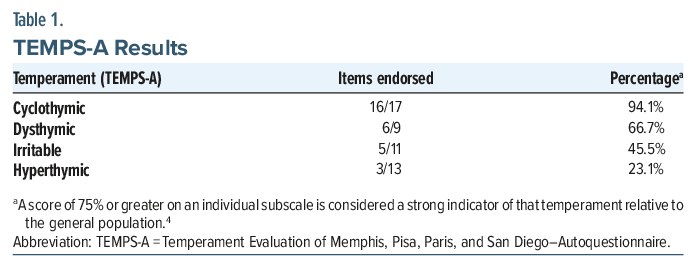
The Temperament Evaluation of Memphis, Pisa, Paris, and San Diego–Autoquestionnaire (TEMPS-A), a validated 50-item self-rated instrument,3 revealed a markedly elevated cyclothymic temperament, never previously assessed in 8 years of prior care (Table 1).
Discussion
Bipolar illness, defined as severe mania or clear hypomania, is excluded from psilocybin trials, but mood temperaments like cyclothymia are not addressed at all. Safety data in this population come chiefly from case reports and naturalistic surveys of psilocybin-associated mania, hypomania, and psychosis, with unsupervised use a specific risk factor.1-4 This case adds an underemphasized pattern: rather than frank mania, the dominant post-psilocybin course was worsening of baseline depression and anxiety, not mania, in a patient with cyclothymia. These patients are disproportionately labeled “treatment-resistant,” because standard interviews weight manic symptoms narrowly and depressive symptoms broadly and because features such as mood temperaments are ignored, and easily reframed as anxiety, personality style, or attentional dysfunction. Lay facilitators, unlike research clinicians, have no training or instruments such as the TEMPS-A to screen for this vulnerability; here, the facilitator attributed the presentation to antidepressant-induced “emotional unresponsiveness,” not an underlying mood temperament.
This single retrospective case relies on patient self-report, without collateral history or pre-exposure temperament data; causality cannot be established, and the decline may reflect the natural course of an evolving bipolar illness rather than a direct drug effect, a limitation shared by most published reports in this area.
As psilocybin use expands outside clinical oversight, clinicians should assess mood temperaments in patients considering hallucinogen use—a process a lay guide is unable to conduct due to inadequate clinical knowledge and training.
Article Information
Published Online: September 30, 2026. https://doi.org/10.4088/JCP.26cr16608
© 2026 Physicians Postgraduate Press, Inc.
J Clin Psychiatry 2026;87(4):26cr16608
Submitted: July 14, 2026; accepted July 30, 2026.
To Cite: Ghaemi SN. Worsening of depression and anxiety with psilocybin: a case report in cyclothymia. J Clin Psychiatry 2026;87(4):26cr16608.
Author Affiliation: Harvard Medical School, Boston, Massachusetts; Emory University, Atlanta, Georgia.
Corresponding Author: S. Nassir Ghaemi, MD, MPH, 875 Massachusetts Avenue, Suite 25, Cambridge, MA 02139 ([email protected]).
Financial Disclosure: The author is employed by Bristol Myers Squibb.
Funding/Support: This report received no funding.
Disclaimer: The views presented here are the author’s own and not those of his employers.
Use of AI-Assisted Technologies: In the writing of this manuscript, the author used Claude.ai Sonnet (Anthropic) for assistance in adapting clinical records to the case report format. The author has reviewed the content, revised it, and takes full responsibility for the content of the publication.
Patient Consent Statement: Written informed consent was obtained from the patient for publication of this case report. All identifying information, including exact dates, nationality, treating clinicians, and locations, has been generalized or omitted to protect patient anonymity.
References (4)

- Eskinazi M, Nasserdine R, Cusin RM, et al. Psychedelic-induced hypomania and mania: a systematic review and meta-analysis. Mol Psychiatry. 2026;31(10):5749–5763. PubMed CrossRef
- Akiskal HS, Placidi GF, Maremmani I, et al. TEMPS-I: delineating the most discriminant traits of the cyclothymic, depressive, hyperthymic and irritable temperaments in a nonpatient population. J Affect Disord. 1998;51(1):7–19. PubMed CrossRef
- Akiskal HS, Mendlowicz MV, Jean-Louis G, et al. TEMPS-A: validation of a short version of a self-rated instrument designed to measure variations in temperament. J Affect Disord. 2005 Mar;85(1-2):45–52. PubMed CrossRef
- Vohringer PA, Whitham EA, Thommi SB, et al. Affective temperaments in clinical practice: a validation study in mood disorders. J Affect Disord. 2012;136(3):577–580. PubMed CrossRef
This PDF is free for all visitors!