The Evolving Psychedelic Paradigm

The Weakened Brake: Circuit and Synaptic Biology in Generalized Anxiety Disorder

Beyond Persistent Worry

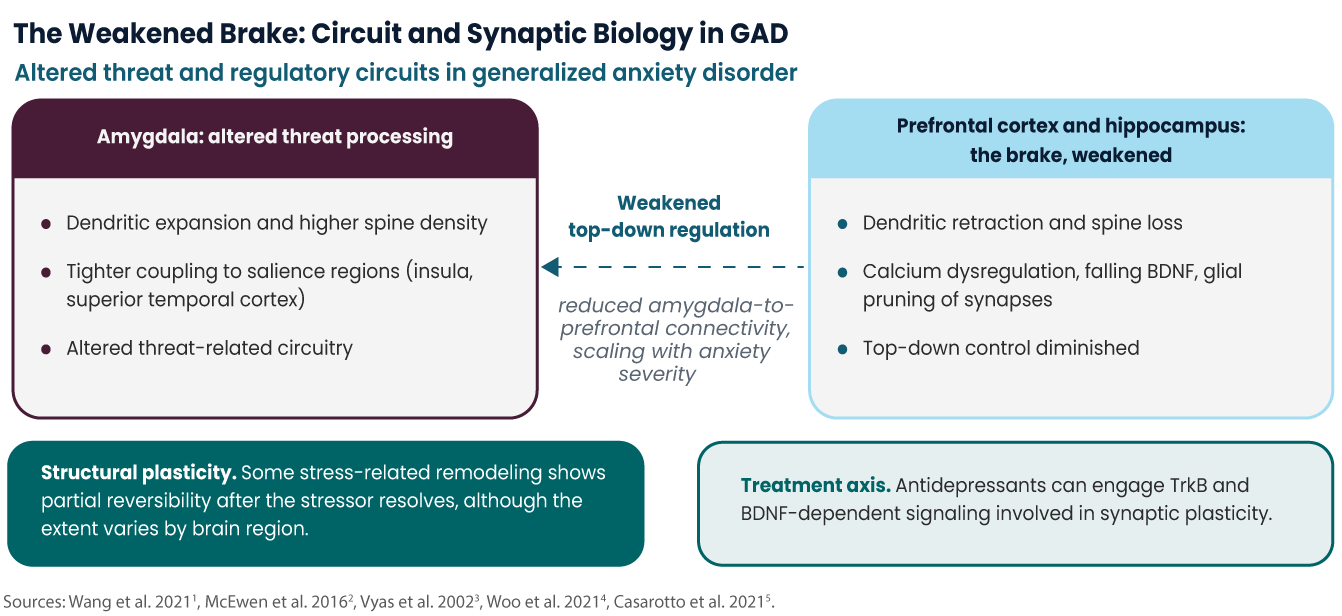
Generalized anxiety disorder is more than persistent worry. Evidence from neuroimaging and preclinical work increasingly describe it as a disorder of circuit regulation, in which the brain’s threat-detection system may be insufficiently regulated by the regions involved in controlling it. In particular, altered communication between the amygdala and prefrontal cortex may affect how the brain responds to perceived threats and regulates anxious states.

A circuit that loses its brake

In GAD, the balance between the amygdala and the prefrontal cortex appears to be altered. In drug-naive patients, resting-state imaging shows weaker functional connectivity between the left basolateral amygdala and the anterior cingulate and medial prefrontal cortex, with connectivity differences associated with state and trait anxiety.1 At the same time, the right basolateral amygdala  demonstrated increased functional connectivity with the left superior temporal gyrus and insula, and these connectivity differences were also associated with anxiety symptoms.1  The findings suggest altered communication between threat-processing and regulatory circuits, including differences in the connectivity of regions involved in vigilance and emotional regulation.

How chronic stress remodels the architecture

Animal models show that sustained stress can produce contrasting structural changes across brain regions. In the amygdala, chronic stress drives dendritic expansion, strengthening the threat circuitry. In the hippocampus and prefrontal cortex it does the opposite, producing dendritic retraction and spine loss.2,3 In the prefrontal cortex, chronic uncontrollable stress removes spines and dendrites through sustained calcium signaling, falling BDNF support, and the active pruning of synapses by glial cells, weakening the region that provides top-down regulation of thought, action, and emotion.4 In these animal models, chronic stress can increase amygdala reactivity while weakening prefrontal regulation. Whether the same structural sequence occurs in patients with generalized anxiety disorder has not been established.

Partial reversibility after stress

Glucocorticoid stress hormones are among the signals involved in stress-related structural remodeling.2 This may help explain how chronic stress affects the course of anxiety. A sensitized amygdala and a thinned prefrontal cortex form a self-reinforcing loop that can keep anxiety running and slow the pace of recovery. Stress-induced remodeling in the hippocampus and prefrontal cortex shows at least partial reversibility after the stressor resolves, while amygdala hypertrophy has been reported to persist.2 This raises the possibility that restoring synaptic architecture may be relevant to recovery, rather than only rebalancing chemistry.

Where standard treatment acts

First-line pharmacotherapy may act along this same axis. Beyond blocking monoamine reuptake, common antidepressants also bind the neurotrophin receptor TrkB and engage  BDNF-dependent signaling that supports synaptic plasticity.5 Because the affinity of these drugs for TrkB is in the micromolar range, brain concentrations sufficient to engage the receptor accumulate over weeks of treatment, which the authors propose as one contributor to the gradual onset of clinical effect.5 Seen this way, GAD is less a simple chemical imbalance than a disorder of maladaptive synaptic and circuit plasticity. That perspective links its altered prefrontal control, sensitized threat circuitry, slow treatment response, and relapsing course into a single picture, and it points toward restoring the regulatory connections that may be disrupted by chronic stress.
Infographic on synaptic changes in generalized anxiety disorder circuitry

References
  1. Wang M, Cao L, Li H, et al. Dysfunction of resting-state functional connectivity of amygdala subregions in drug-naive patients with generalized anxiety disorder. Front Psychiatry. 2021;12:758978.
  2. McEwen BS, Nasca C, Gray JD. Stress effects on neuronal structure: hippocampus, amygdala, and prefrontal cortex. Neuropsychopharmacology. 2016;41(1):3-23.
  3. Vyas A, Mitra R, Rao BSS, Chattarji S. Chronic stress induces contrasting patterns of dendritic remodeling in hippocampal and amygdaloid neurons. J Neurosci. 2002;22(15):6810-6818.
  4. Woo E, Sansing LH, Arnsten AFT, Datta D. Chronic stress weakens connectivity in the prefrontal cortex: architectural and molecular changes. Chronic Stress (Thousand Oaks). 2021;5:24705470211029254.
  5. Casarotto PC, Girych M, Fred SM, et al. Antidepressant drugs act by directly binding to TRKB neurotrophin receptors. Cell. 2021;184(5):1299-1313.

The Evolving Psychedelic Paradigm

Improved but Not Recovered: The Relapsing Course of Generalized Anxiety Disorder

The Persistence Problem In GAD

The burden in generalized anxiety disorder (GAD) is easy to picture as untreated illness. A large part of it is different: patients who improve with treatment and then, over months and years, do not stay well. GAD is a chronic and relapsing condition, and its course over time, not only the response to a first prescription, accounts for much of its burden.

A course measured in years

Over the first five years, prospective data show GAD following a chronic course of remission and relapse rather than resolving, and retrospective studies suggest this pattern can persist for as long as two decades.1 In a 12-year prospective study, the probability of recovering from GAD was 58%, and among patients who did recover, the probability of recurrence was 45%.2 GAD also rarely runs its course alone. It usually co-occurs with another mood, anxiety, or substance use disorder,3 and in the same cohort, comorbid major depression reduced the probability of recovering from GAD by roughly half.2 For many patients, the realistic expectation is not a single course of treatment followed by cure, but long-term management of an illness that remits and returns, all the more so when another psychiatric condition is present.

Relapse when treatment stops

The chronic course also shapes how treatment is used. Clinical guidance advises continuing medication for about 12 months after improvement before tapering, specifically to lower the risk of relapse.3 That caution is supported by relapse-prevention data. A meta-analysis of relapse-prevention trials, including six in GAD, examined antidepressant discontinuation across 28 trials (5,233 patients with anxiety disorders, obsessive-compulsive disorder, or PTSD). Stopping the antidepressant roughly tripled the odds of relapse compared with continuing (odds ratio 3.11), and over follow-up ranging from 8 to 52 weeks, relapse occurred in 36.4% of patients who discontinued versus 16.4% of those who continued.4 These data suggest that improvement does not necessarily persist after treatment is withdrawn.

The burden of an illness that persists

Because the course is long and relapsing, its burden accumulates. GAD is associated with substantial impairment in work and social functioning, reduced quality of life, and high direct and indirect costs.5 When symptoms recur or never fully clear, that impairment is not a single episode but a recurring feature of a patient’s life.

Infographic on relapse risk in generalized anxiety disorder over long-term course

What it adds up to

Measured over years rather than weeks, GAD care is defined less by whether a patient responds than by whether that response persists. Patients may improve and then relapse, comorbidity can make recovery more difficult, and stopping treatment raises the risk of relapse. These data describe a chronic, relapsing condition that calls for long-term management rather than a single course of treatment.

References
  1. Keller MB. The long-term clinical course of generalized anxiety disorder. J Clin Psychiatry. 2002;63(Suppl 8):11-16.
  2. Bruce SE, Yonkers KA, Otto MW, Weisberg RB, Keller MB. Influence of psychiatric comorbidity on recovery and recurrence in generalized anxiety disorder, social phobia, and panic disorder: a 12-year prospective study. Am J Psychiatry. 2005;162(6):1179-1187.
  3. Locke AB, Kirst N, Shultz CG. Diagnosis and management of generalized anxiety disorder and panic disorder in adults. Am Fam Physician. 2015;91(9):617-624.
  4. Batelaan NM, Bosman RC, Muntingh A, Scholten WD, Huijbregts KM, van Balkom AJLM. Risk of relapse after antidepressant discontinuation in anxiety disorders, obsessive-compulsive disorder, and post-traumatic stress disorder: systematic review and meta-analysis of relapse prevention trials. BMJ. 2017;358:j3927.
  5. Hoffman DL, Dukes EM, Wittchen HU. Human and economic burden of generalized anxiety disorder. Depress Anxiety. 2008;25(1):72-90.

The Evolving Psychedelic Paradigm

Generalized Anxiety Disorder: A Persistent Burden Despite Standard Treatments

Prevalence and Impact

Generalized anxiety disorder (GAD) ranks among the most prevalent psychiatric conditions. The Mental and Substance Use Disorders Prevalence Study, using clinician-administered interviews from 2020 to 2022, estimated a past-year GAD prevalence of 10.0% among US adults aged 18 to 65, representing approximately 20.2 million people.1 GAD is chronic and recurrent, and the functional toll is substantial, with impairment across work, social, and physical domains; reductions in quality of life comparable to those seen in major depression; and higher medical costs than in patients without the disorder.2 Comorbidity can further magnify the burden, with mood and other anxiety disorders frequently accompanying the diagnosis.3

Comorbidity and Cost Add to the Burden

GAD rarely occurs on its own. In the World Health Organization World Mental Health Surveys, 81.9% of people with GAD met criteria for another lifetime disorder, including a mood disorder in 63.0% and another anxiety disorder in 51.7%.3 GAD also carries higher healthcare costs than anxiety-free populations: pooled controlled cost-of-illness data found direct medical costs were 2.60 times higher (95% CI, 2.01-3.36).4

Standard Treatments With Incomplete Results

SSRIs and SNRIs remain the foundation of pharmacologic care, but their efficacy is less than ideal. In a network meta-analysis of double-blind randomized trials, first-line agents such as duloxetine, escitalopram, paroxetine, and venlafaxine roughly doubled the odds of remission compared with placebo, with odds ratios ranging from 1.7 to 2.3.5 Despite these odds, only about one-third of patients experience remission during acute first-line treatment, leaving most still symptomatic.6 Treatment options have also remained limited, with no pharmacotherapy carrying a new mechanism of action approved for GAD in the United States since 2007.7,8

Balancing Efficacy and Tolerability

Response is a more attainable target than remission, but it is not guaranteed. An estimated 30% to 60% of patients do not experience any response to first-line treatment,6 and among those who do respond, the benefit is modest. A 2025 Cochrane review of 37 randomized trials involving 12,226 adults with GAD found that antidepressants improved response compared with placebo (risk ratio, 1.41; 95% CI, 1.29-1.55), with a number needed to treat of 7.9 At the same time, discontinuation because of adverse effects was more than twice as likely as with placebo (risk ratio, 2.18; 95% CI, 1.81-2.61), corresponding to a number needed to harm of 17.9 Overall dropout rates were similar between the groups.

Where Standard Care Falls Short

Standard pharmacotherapy helps many patients but leaves many others symptomatic, and the absence of a mechanistically new approval for nearly two decades limits what clinicians can offer those who do not respond adequately. For a condition this common and this persistent, closing that gap remains an unmet need in GAD care.

Infographic on NNT vs NNH for antidepressants in GAD treatment

References
  1. Ringeisen H, Edlund M, Guyer H, et al. Mental and Substance Use Disorders Prevalence Study (MDPS): findings report. RTI International; 2023.
  2. Revicki DA, Travers K, Wyrwich KW, et al. Humanistic and economic burden of generalized anxiety disorder in North America and Europe. J Affect Disord. 2012;140(2):103-112.
  3. Ruscio AM, Hallion LS, Lim CCW, et al. Cross-sectional comparison of the epidemiology of DSM-5 generalized anxiety disorder across the globe. JAMA Psychiatry. 2017;74(5):465-475.
  4. Konnopka A, König H. Economic burden of anxiety disorders: a systematic review and meta-analysis. Pharmacoeconomics. 2020;38(1):25-37.
  5. Kong W, Deng H, Wan J, et al. Comparative remission rates and tolerability of drugs for generalised anxiety disorder: a systematic review and network meta-analysis of double-blind randomized controlled trials. Front Pharmacol. 2020;11:580858.
  6. Lu BY, Takeshita J, Huh J, Goebert D, Kang M. Treatment of generalized anxiety disorder: a comprehensive review of the literature for psychopharmacologic alternatives to newer antidepressants and benzodiazepines. Prim Care Companion CNS Disord. 2011;13(2):e1-e9.
  7. US Food and Drug Administration. FDA approves Cymbalta (duloxetine) for the treatment of generalized anxiety disorder [press release]. August 2007.
  8. Tadros E, Keerthana S, Padder S, et al. Anxiety disorders, PTSD and OCD: systematic review of approved psychiatric medications (2008-2024) and pipeline phase III medications. Drugs Context. 2025;14:2024-11-2.
  9. Kopcalic K, Arcaro J, Pinto A, et al. Antidepressants versus placebo for generalised anxiety disorder (GAD). Cochrane Database Syst Rev. 2025;1:CD012942.


The Evolving Psychedelic Paradigm

How Generalized Anxiety Disorder Presents, and Why It Is Often Missed

Recognizing GAD In Clinical Practice

Generalized anxiety disorder (GAD) is usually described through its diagnostic criteria and its prevalence, but diagnosing anxiety can be challenging. Many patients report trouble sleeping, muscle tension, fatigue, or pain, but the underlying worry may not be mentioned. How GAD presents in practice, how often it is missed, and its impact on a patient’s daily life are important factors for understanding the disorder.

How GAD Presents

The hallmark of GAD is persistent, hard-to-control worry, but patients often reach out to the clinician when their symptoms present in physical form. Somatic symptoms frequently serve as the presenting complaint, and GAD may be unrecognized or mistaken for a physical condition.1 Painful physical symptoms are especially common. In a study of 981 patients with GAD, 59.0% of those without comorbid depression and 78.0% of those with it reported painful physical symptoms, compared with 28.3% of controls.2 A patient who presents with headaches, back pain, or insomnia does not, at first glance, look like a patient with an anxiety disorder.

Why it goes unrecognized

GAD is common in primary care, where roughly 8% of patients meet criteria,3 yet it often goes undetected. In one primary care survey, GAD was correctly diagnosed in only 34% of the patients who had it, and just 20% were receiving treatment.4 Treatment is often delayed. Among people with GAD, an estimated 86.1% eventually reach treatment, but the median delay from the onset of the disorder to first contact is 9 years.5 The mismatch is between how patients describe their distress, often in terms of physical symptoms, and how the disorder’s diagnostic criteria. As a result, many patients go undiagnosed and undertreated for reasons that have little to do with how severe their anxiety is.

A burden the numbers understate

The impact of GAD on functioning is significant. In the Primary Care Anxiety Project, patients with GAD (n=128) showed worse psychosocial functioning than patients with type 2 diabetes, hypertension, recent myocardial infarction, or congestive heart failure.6 Among patients with pure GAD (n=20) who were free of any comorbid medical or psychiatric illness, 75% scored below the 25th percentile of the general population on mental functioning, so the burden could not be attributed to another condition.6 Physical symptoms resulted in poorer functioning. When patients had painful physical symptoms, disability scores were more than one and a half times worse.2 Everyday symptoms such as disrupted sleep, difficulty concentrating, irritability, and muscle tension can affect work and relationships in ways that a symptom count does not capture.

Recognition as the first intervention

For many patients, the unmet need in GAD begins before treatment does. GAD can present through physical symptoms and have a substantial impact on functioning, making recognition an important part of care. Identifying GAD in a patient who reports only physical complaints is an important first step towards better care.

Infographic on recognition and treatment delays in generalized anxiety disorder (GAD)

References
  1. Davidson JR, Feltner DE, Dugar A. Management of generalized anxiety disorder in primary care: identifying the challenges and unmet needs. Prim Care Companion J Clin Psychiatry. 2010;12(2):e1-e13.
  2. Romera I, Montejo AL, Caballero F, et al. Functional impairment related to painful physical symptoms in patients with generalized anxiety disorder with or without comorbid major depressive disorder: post hoc analysis of a cross-sectional study. BMC Psychiatry. 2011;11:69.
  3. Maier W, Gänsicke M, Freyberger HJ, Linz M, Heun R, Lecrubier Y. Generalized anxiety disorder (ICD-10) in primary care from a cross-cultural perspective: a valid diagnostic entity? Acta Psychiatr Scand. 2000;101(1):29-36.
  4. Wittchen HU, Kessler RC, Beesdo K, Krause P, Höfler M, Hoyer J. Generalized anxiety and depression in primary care: prevalence, recognition, and management. J Clin Psychiatry. 2002;63(suppl 8):24-34.
  5. Wang PS, Berglund P, Olfson M, Pincus HA, Wells KB, Kessler RC. Failure and delay in initial treatment contact after first onset of mental disorders in the National Comorbidity Survey Replication. Arch Gen Psychiatry. 2005;62(6):603-613.
  6. Culpepper L, Keller MB, Pagano ME, et al. Impairment and functioning in a sample of primary care patients with generalized anxiety disorder: results from the Primary Care Anxiety Project. Prim Care Companion CNS Disord. 2010;12(5):e1-e8.