Anxiety Screening Recommendations Do Not Extend Beyond 65
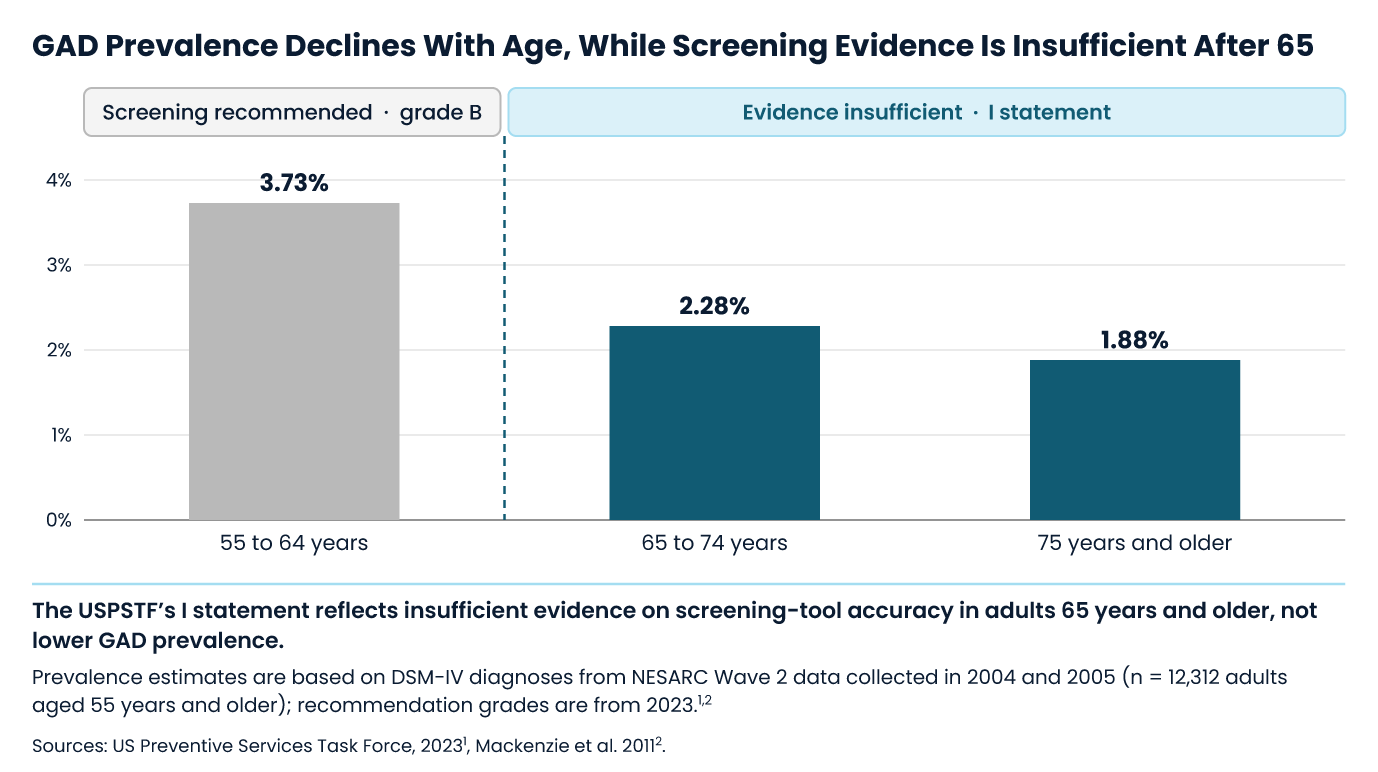
In 2023, the US Preventive Services Task Force recommended screening for anxiety disorders in adults, finding a moderate net benefit based on moderate-certainty evidence. For adults aged 65 years or older, the Task Force instead issued an “I” statement, concluding that the evidence was insufficient to assess the balance of benefits and harms. Specifically, the evidence was insufficient regarding the accuracy of screening tools, and on the benefits and harms of screening and treatment in older adults.1
Prevalence falls with age, but isolated cases are rare
A Wave 2 analysis of 12,312 adults aged 55 and older from the National Epidemiologic Survey on Alcohol and Related Conditions found a past-year GAD prevalence of 2.80%. The prevalence declined with age: 3.73% among adults aged 55 to 64 years, 2.28% among those aged 65 to 74 years, and 1.88% among those aged 75 years and older.2 Among adults aged 55 years and older with past-year GAD, only 0.53% had GAD without another Axis I or II disorder, so the diagnosis in later life is rarely isolated. Among those with past-year GAD and no comorbid Axis I disorder, only 18% sought professional help in the past year, compared with 28.3% of all past-year GAD cases.2 These DSM-IV diagnoses were based on data collected in 2004 and 2005, limiting their applicability to current practice.
Lower GAD Screening Cut Points in Older Adults
The Task Force review found that few studies reported the accuracy of anxiety screening tools in older adults.1 In a German population-based study of 438 community-dwelling adults aged 58 to 82, with a blinded structured clinical interview as the criterion standard, 6.2% (95% CI, 3.9%-8.2%) met DSM-IV criteria for current GAD. The optimal GAD-7 cut point in this sample was 5 or greater, with a sensitivity of 0.63 and a specificity of 0.90. The GAD-2 performed similarly at a cut point of 2 or greater with a sensitivity of 0.67, and a specificity of 0.90.3 The authors concluded that lower cut points may be appropriate in the general older population, although this conclusion was based on a single cohort.
Beers Criteria Recommend Avoiding Benzodiazepines After 65
The 2023 American Geriatrics Society Beers Criteria recommends avoiding benzodiazepines in adults 65 and older, based on moderate-quality evidence. The panel cites increased sensitivity, decreased metabolism of long-acting agents, physical dependence, and increased risk of cognitive impairment, delirium, falls, fractures, and motor vehicle crashes.4 For older adults with a history of falls or fractures, the criteria state shorter-acting agents are not safer than long-acting ones, and it lists severe generalized anxiety disorder among the circumstances in which these agents may be appropriate. The panel separately advises considering total anticholinergic burden during medication review because cumulative exposure is associated with increased risk of falls, delirium, and dementia.4
Treatment Evidence Is Limited After 65
The Task Force review identified the accuracy of GAD screening tools and the effectiveness of GAD treatment in older adults as research priorities. The review located only 7 randomized trials of psychological treatment in this population, enrolling 215 participants, with a pooled standardized mean difference of -0.66 (95% CI, -0.94 to -0.38).1 Taken together, the available evidence remains limited for both GAD screening and treatment in adults aged 65 and older.
References
- US Preventive Services Task Force. Screening for anxiety disorders in adults: US Preventive Services Task Force recommendation statement. JAMA. 2023;329(24):2163-2170. doi:10.1001/jama.2023.9301
- Mackenzie CS, Reynolds K, Chou KL, Pagura J, Sareen J. Prevalence and correlates of generalized anxiety disorder in a national sample of older adults. Am J Geriatr Psychiatry. 2011;19(4):305-315. doi:10.1097/JGP.0b013e318202bc62
- Wild B, Eckl A, Herzog W, et al. Assessing generalized anxiety disorder in elderly people using the GAD-7 and GAD-2 scales: results of a validation study. Am J Geriatr Psychiatry. 2014;22(10):1029-1038. doi:10.1016/j.jagp.2013.01.076
- 2023 American Geriatrics Society Beers Criteria Update Expert Panel. American Geriatrics Society 2023 updated AGS Beers Criteria for potentially inappropriate medication use in older adults. J Am Geriatr Soc. 2023;71(7):2052-2081. doi:10.1111/jgs.18372