One Label, Different Stages of Development
The phrase “psychedelic pipeline” groups compounds at very different stages of development, and important distinctions get lost in the shared label. What separates these agents is where each one stands. Some are approved for one condition, while others remain investigational. The supporting evidence also varies, ranging from published trials to company-reported results. For generalized anxiety disorder (GAD), the development has moved into later-stage trials for some agents, while others remain in earlier phases of clinical development.
Developmental Stages in GAD Treatment
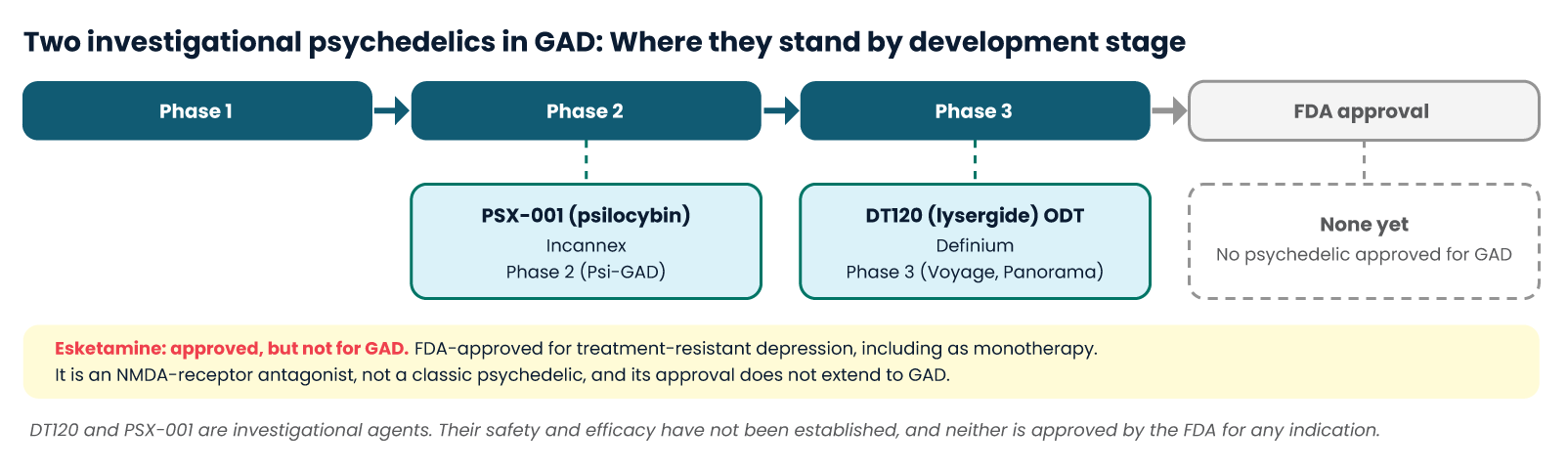
Two investigational psychedelic agents, DT120 and PSX-001, are now in GAD trials, at different stages of clinical development. DT120 (lysergide) ODT, the compound published as MM120, is being evaluated in Phase 3 trials for GAD,1 while psilocybin-assisted therapy PSX-001 (Psi-GAD) remains in Phase 2 development.2 The DT120 program includes randomized, placebo-controlled clinical studies, including the Phase 2b dose-finding study of MM120 published in JAMA.3 The PSX-001 program has been evaluated in a randomized, placebo-controlled trial with results reported by the study sponsor.2
Esketamine Is Approved for Depression, Not GAD
No psychedelic is approved for GAD, and the one approved agent in this group, esketamine, is indicated for depression. Esketamine is an NMDA-receptor antagonist rather than a classic serotonergic psychedelic and carries an FDA-approved indication for treatment-resistant depression, including use as monotherapy.4 Its approval does not extend to GAD.
Reading by Stage, Not by Label
Stage of development is an important distinction when assessing the psychedelic pipeline in GAD. The programs now span different phases, with DT120 in Phase 3 development and PSX-001 in Phase 2. The lysergide program’s two Phase 3 trials in GAD, Voyage (NCT06741228) and Panorama (NCT06809595), are at different points: Voyage has company-reported results and Panorama results are pending.1 PSX-001 has an open Investigational New Drug application with the FDA and is preparing to initiate a multi-jurisdiction Phase 2 trial.2 For GAD, the pipeline is real and growing, but its data are early, and no psychedelic is yet approved for anxiety.
A Developing Regulatory Framework
The regulatory framework for psychedelic development is also continuing to evolve. In July 2026, the FDA finalized guidance for sponsors conducting clinical investigations of psychedelic drugs, addressing considerations for developing these treatments and conducting clinical studies.5 These considerations are real. In the Phase 2b GAD study of MM120, approximately 85% of participants correctly identified their treatment assignment, a limitation relevant to interpreting trials of agents with perceptible acute effects.3 Regulatory decisions have also shaped the field. In 2024, the FDA declined to approve MDMA-assisted therapy for post-traumatic stress disorder, a different indication, citing unresolved questions about study conduct and durability of effect.6 For GAD, this evolving framework provides additional context as investigational approaches move through different stages of clinical development, while regulatory approval remains a separate milestone from advancing a compound into a later-stage trial.
References
- Definium Therapeutics. Definium Therapeutics announces positive topline results from Phase 3 Voyage study of DT120 ODT in generalized anxiety disorder [press release]. August 12, 2026.
- Incannex Healthcare. Incannex reports positive results from phase 2 clinical trial of PSX-001 (Psi-GAD) for generalised anxiety disorder [press release]. August 26, 2025.
- Robison R, Barrow R, Conant C, et al. Single treatment with MM120 (lysergide) in generalized anxiety disorder: a randomized clinical trial. JAMA. 2025;334(15):1358-1372.
- Janik A, Qiu X, Lane R, et al. Esketamine monotherapy in adults with treatment-resistant depression: a randomized clinical trial. JAMA Psychiatry. 2025. ClinicalTrials.gov identifier: NCT04599855.
- US Food and Drug Administration. Psychedelic Drugs: Considerations for Clinical Investigations. July 13, 2026.
- US Food and Drug Administration. Complete response letter, NDA 215455 (midomafetamine capsules). August 8, 2024.