The Emerging Safety Profile
For patients with generalized anxiety disorder (GAD) who ask about psychedelic-assisted treatments under investigation, the safety question spans a class rather than a single drug. Three investigational classic serotonergic psychedelics are now in GAD trials, lysergide, psilocybin, and a deuterated form of DMT, and their early safety data can be considered in the context of a common receptor mechanism and a supervised delivery model.
One class, multiple compounds
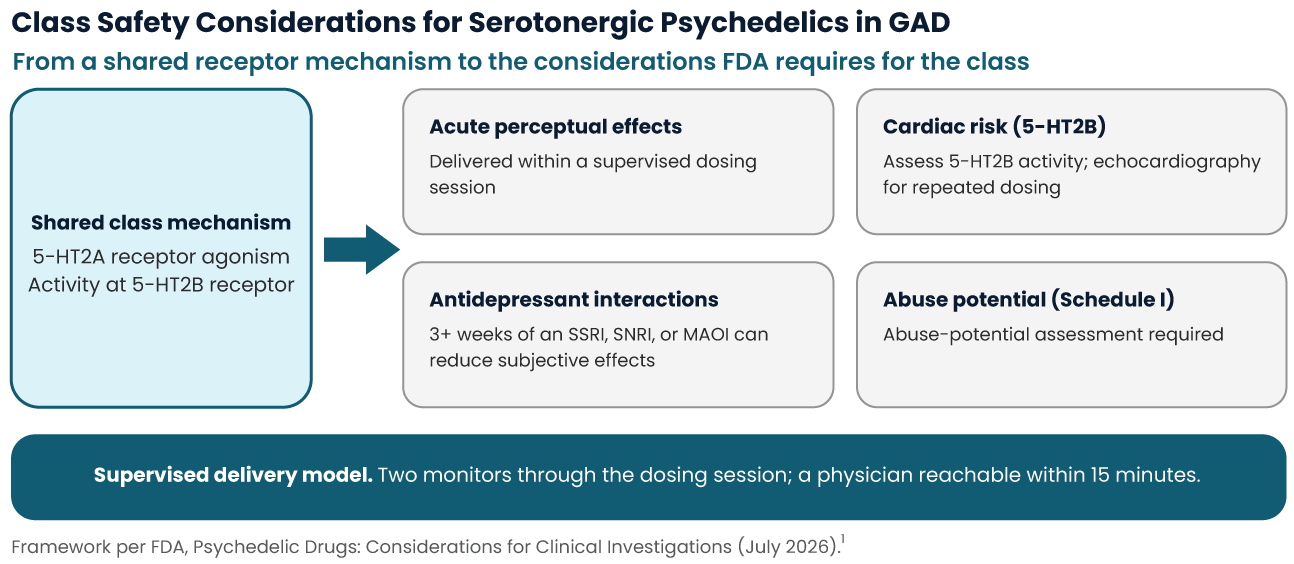
Classic serotonergic psychedelics act as agonists at the 5-HT2A receptor, and their safety considerations are linked to its known pharmacology. FDA’s 2026 guidance on psychedelic clinical investigations identifies considerations relevant across the class, including intense acute perceptual effects; mechanism-based cardiac risk tied to 5-HT2B activity and its association with cardiac valvulopathy; interactions with antidepressants, lithium, monoamine oxidase inhibitors and other concomitant medications; and abuse-potential assessment for Schedule I agents.1 It also describes a supervised delivery model, with two monitors through the dosing session, where the lead monitor does not hold medical credentials but an on-call licensed physician is able to reach the site within 15 minutes.1 None of these agents is approved; each is being studied under the FDA framework.
Lysergide (DT120)
The most developed GAD program, DT120 (lysergide) ODT, studied as MM120 in the published Phase 2b trial, is now in Phase 3. In a pooled analysis of four lysergide studies (three Phase 1 and one Phase 2b; 257 participants), treatment-emergent events were predominantly mild to moderate and occurred mostly on the dosing day, with no treatment-related serious adverse events, no hallucinogen persisting perception disorder, and no active or worsening suicidal ideation on the C-SSRS.2 In the Phase 2b GAD trial (n=80 across the relevant arms), one participant discontinued for an adverse event; one serious adverse event, a panic attack 97 days after dosing, was reported and adjudicated unrelated to treatment.3 The acute effects of a single 100-microgram dose were dose-related, with visual perceptual changes in 92.5% of patients, nausea in 40%, and headache in 35%, with these effects resolving by the end of the dosing session.3
Psilocybin (PSX-001)
Incannex has reported Phase 2 results for PSX-001, psilocybin-assisted psychotherapy delivered across two 25-milligram sessions in 73 patients with GAD. In company-reported results that have not been peer reviewed, no serious adverse events occurred, and the majority of treatment-emergent events were transient, mild to moderate, and consistent with the expected effects of psilocybin. One of 73 participants withdrew during the seven-week program, and there were no signs of increased suicidality, psychosis, or prolonged psychological distress.4 That trial, Psi-GAD-1, is registered on the Australian New Zealand Clinical Trials Registry.5
Deuterated DMT (HLP004)
HLP004, a deuterated form of DMT (N,N-dimethyltryptamine) developed as CYB004, is in Phase 2 for GAD, with the trial using two intramuscular doses three weeks apart.6 Its citable safety data so far come from Phase 1 studies in healthy volunteers. In company-reported Phase 1 results that have not been peer reviewed, the compound was well tolerated, with no serious adverse events, and a majority of adverse events that were mild to moderate and self-limiting. Its acute effects were short, persisting for roughly 40 minutes after an intravenous bolus.7 Detailed safety data from the GAD trial itself have not yet been reported.
Shared safety profiles despite different delivery approaches
Across the programs, the acute-safety picture shares similarities: 1) effects are predominantly mild to moderate, transient, and concentrated in the supervised session, and 2) no treatment-related serious adverse events in the lysergide and psilocybin GAD datasets (the single lysergide serious event was adjudicated unrelated). In those datasets, where these outcomes were assessed, there was no indication of persistent perceptual disorder or worsening suicidality; the deuterated DMT GAD trial has not yet reported safety data. The cardiac (5-HT2B) and abuse-potential questions that apply to the class are not directly addressed by the early clinical safety data reported here, and they remain open across the three programs.
The programs differ most in delivery. Lysergide is a single orally disintegrating tablet given in a session lasting several hours; psilocybin is administered in two oral dosing sessions paired with psychotherapy, and the deuterated DMT GAD trial uses two intramuscular doses approximately three weeks apart. Acute-effect duration by the intramuscular route has not been reported for HLP004. These are early-phase datasets, several are company topline results that have not yet peer reviewed, and the trials differ in design, dose, and population. The comparison is therefore qualitative rather than a head-to-head assessment of safety.
What it adds up to
Read together, the early data describe a class whose principal safety considerations are mechanism-based. FDA directs sponsors to address these considerations through eligibility screening, medication restrictions and washout, session monitoring, and abuse-potential assessment, and sets a high evidentiary bar for development. Acute risk concentrates in a supervised session, and interactions with concomitant psychotropic medication are a practical matter for GAD patients already on treatment.1 Whether these early profiles hold in larger, confirmatory trials is the open question.
DT120 (lysergide), PSX-001 (psilocybin), and HLP004 (deuterated DMT) are investigational agents. Their safety and efficacy have not been established. None are approved by the FDA for any indication.
References
- US Food and Drug Administration, Center for Drug Evaluation and Research. Psychedelic drugs: considerations for clinical investigations. Guidance for industry. July 2026.
- Malberg JE, Jacobsen PL, Karas SM, Jemison J, Srinivas N, Karlin DR. Lysergide tartrate (LSD; DT120) safety profile from phase 1 and phase 2 clinical studies. Poster W116 presented at: American Society of Clinical Psychopharmacology Annual Meeting; 2026.
- Robison R, Barrow R, Conant C, et al. Single treatment with MM120 (lysergide) in generalized anxiety disorder: a randomized clinical trial. JAMA. 2025;334(15):1358-1372.
- Incannex Healthcare. Positive results from a phase 2 clinical trial of PSX-001 (Psi-GAD) for generalised anxiety disorder [press release]. August 26, 2025.
- Psilocybin-assisted psychotherapy for generalised anxiety disorder (Psi-GAD-1). Australian New Zealand Clinical Trials Registry: ACTRN12621001358831.
- A study of an N,N-dimethyltryptamine (DMT) analog (CYB004) in participants with generalized anxiety disorder (GAD). ClinicalTrials.gov: NCT06051721.
- Cybin Inc. Positive topline data from phase 1 studies of proprietary deuterated DMT molecules CYB004 and SPL028 [press release]. January 8, 2024.