
Lessons Learned at the Interface of Medicine and Psychiatry
The Psychiatric Consultation Service at Massachusetts General Hospital sees medical and surgical inpatients with comorbid psychiatric symptoms and conditions. During their twice-weekly rounds, Dr Stern and other members of the Consultation Service discuss diagnosis and management of hospitalized patients with complex medical or surgical problems who also demonstrate psychiatric symptoms or conditions. These discussions have given rise to rounds reports that will prove useful for clinicians practicing at the interface of medicine and psychiatry.
Prim Care Companion CNS Disord 2026;28(5):26f04254
Author affiliations are listed at the end of this article.
From the Editors

Are you a healthcare provider?
Add your NPI to personalize your JCP experience.
Have you ever evaluated a patient with chronic abdominal pain, early satiety, nausea, vomiting, or weight loss and wondered whether an unrecognized psychiatric disorder might be contributing to the presentation? Have you seen patchy alopecia, broken hairs of uneven length, or repetitive grooming behaviors and been uncertain whether to ask about chewing or swallowing hair? Have you wondered how trichotillomania and trichophagia can culminate in gastric trichobezoar, with complications that include obstruction, perforation, malnutrition, and the need for surgical intervention, and when psychiatric treatment should be involved to reduce the risk of recurrence? If you have, the following case vignette and discussion should prove useful.
CASE VIGNETTE
Ms A, a 23-year-old woman with a history of trichotillomania, presented to the emergency department with 1 month of worsening abdominal pain, early satiety, nausea, and intermittent vomiting. She reported several prior evaluations for similar symptoms without a clear diagnosis. On examination, she appeared anxious and underweight. Abdominal palpation revealed a firm epigastric mass. Computed tomography demonstrated a large intragastric mass with internal air pockets and gastric distention. Upper endoscopy confirmed a trichobezoar extending beyond the pylorus, consistent with Rapunzel syndrome. Endoscopic removal was unsuccessful, and she underwent surgical extraction.
DISCUSSION
What Are Trichotillomania and Trichophagia, and How Are They Related to Trichobezoar Formation?
Trichotillomania, or hair-pulling disorder, is a psychiatric condition characterized by recurrent pulling of one’s own hair, leading to hair loss and clinically significant distress or impairment. It is classified in the Diagnostic and Statistical Manual of Mental Disorders, Fifth Edition, Text Revision (DSM-5-TR) under obsessive-compulsive and related disorders.1 Hair pulling most commonly involves the scalp, eyebrows, and eyelashes, though any hair-bearing region may be involved.1,2 The behavior often begins in childhood or adolescence and may occur in brief repetitive episodes throughout the day or in more sustained periods that last for hours.1,3,4
Trichophagia is the act of chewing or swallowing hair that has been pulled. Not everyone with trichotillomania engages in this behavior, and among those who do, only a subset go on to develop a bezoar, a retained mass of indigestible material within the gastrointestinal (GI) tract. In this setting, swallowed hair serves as the nidus for trichobezoar formation. Hair is indigestible and cannot be broken down by gastric enzymes or effectively propelled through the digestive tract by normal peristalsis. Instead, it becomes trapped within the gastric folds and mucosa, where it gradually accumulates. Over time, the hair becomes enmeshed with mucus, food particles, and other debris, forming a solid mass that conforms to the shape of the stomach. The smooth surface of hair shafts and their tendency to become entangled further impair gastric emptying, allowing the mass to enlarge progressively.5–7
Trichobezoars are therefore best understood as potentially life-threatening medical consequences of chronic, often undertreated body-focused repetitive behaviors, rather than surgical curiosities. The DSM-5-TR explicitly recognizes that swallowing hair may lead to trichobezoars, with subsequent anemia, abdominal pain, hematemesis, nausea, vomiting, bowel obstruction, and even bowel perforation.1 In more severe cases, the bezoar may form a tail that extends beyond the pylorus and into the small bowel, sometimes reaching as far as the ileocecal valve, a presentation known as Rapunzel syndrome.8–10 For consultation-liaison (C-L) psychiatrists, the central clinical point is that surgical extraction addresses the mechanical obstruction but not the underlying illness that produced it.7,10–12 Without recognition and treatment of trichotillomania and trichophagia, recurrence remains possible.2,12
Which Individuals Are Most at Risk for Developing Trichophagia and Trichobezoar?
Several populations are at increased risk for developing trichotillomania, including those with genetic vulnerability, specific demographic groups, and individuals with certain psychiatric comorbidities. Key psychiatric and behavioral contributors to trichobezoar formation are summarized in Table 1.
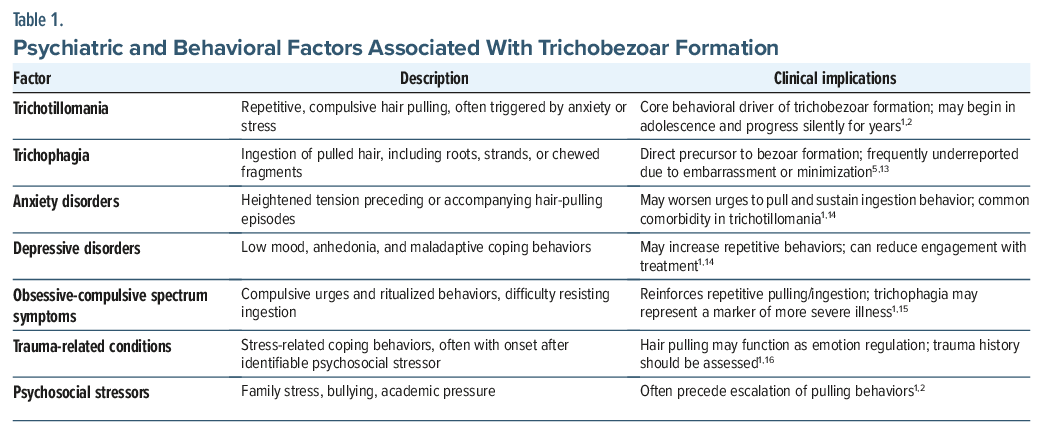
Genetic and familial risk is well established. Trichotillomania occurs more frequently in individuals with obsessive-compulsive disorder (OCD) and their first-degree relatives than in the general population.17 Twin studies demonstrate significant heritability, with monozygotic twin concordance rates of 38%–58% compared to 0%–20% in dizygotic twins, yielding heritability estimates of approximately 32%–76%.18,19 Family studies show that 25% of individuals with trichotillomania have a first-degree relative with the disorder, and 21% of those with both trichotillomania and excoriation disorder report a family history of trichotillomania.20 While genetic factors appear to play an important role, specific risk genes have not yet been identified.17
Age and developmental factors also play a key role. Trichotillomania most commonly begins before age 20, with peak onset between ages 11 and 15, often coinciding with or following puberty.1,2,21 The median age at first diagnosis is 25 years.14 In many patients, pulling is preceded by tension, anxiety, boredom, sensory discomfort, or emotional dysregulation and followed by relief, gratification, or a transient sense of control.1,2
Reported sex differences in trichotillomania differ across clinical and community samples. Earlier clinical samples suggested a strong female predominance (about 10:1), but more recent community-based studies show nearly equal rates between males and females (1.8% vs 1.7%).1,3 Still, among those who seek treatment, most are female (85%–90%).14 Females also tend to have an earlier average onset (14.8 years) compared to males (19.0 years).3 Moreover, a large systematic review found that males are more likely to present earlier in childhood and to make up a greater proportion of early-onset cases, pointing to possible neurodevelopmental factors.22
Psychiatric comorbidity is very common, and individuals with co-occurring psychiatric conditions are at higher risk, particularly those with anxiety disorders (65%), depressive disorders (48%), neurodevelopmental disorders such as attention-deficit/hyperactivity disorder (ADHD) (39%), OCD, and posttraumatic stress disorder (PTSD).14 Overall, roughly four-fifths (79%) of individuals with trichotillomania have at least 1 comorbid psychiatric diagnosis.14 Conditions such as anxiety, depression, trauma-related symptoms, obsessive-compulsive spectrum features, ADHD, and other body-focused repetitive behaviors frequently occur alongside hair-pulling disorder.1,2
Trauma exposure and psychosocial stressors may further increase vulnerability. Individuals with trichotillomania report significantly higher numbers of traumatic and negative childhood events compared to healthy controls, along with elevated posttraumatic stress symptoms.16 Psychosocial stressors, including bullying, family conflict, loneliness, academic strain, and chronic anxiety, may contribute to escalation from pulling alone to chewing and swallowing hair.1,2,8
Trichophagia may represent a more clinically severe subgroup. Prior work suggests that individuals with trichophagia often report greater hair-pulling severity than those who pull without ingesting hair.5 Trichophagia is also frequently underrecognized because many patients are never directly asked about it, and those who do ingest hair may feel embarrassed, secretive, or uncertain about how much of the behavior to disclose.5
Patients who develop trichobezoars are most often adolescents or young women, though cases occur across ages and in males. This pattern mirrors the demographics of trichotillomania. Within this broader pattern, a systematic review of 1,248 cases found that males, while less commonly affected overall, tend to present at younger ages and account for a greater proportion of early childhood cases.5 The behavior may continue privately for years before medical detection,22 and the mass itself can exist in the digestive tract for several years before becoming symptomatic. Some reports also note higher rates of emotional disturbance, depression, trauma exposure, or intellectual disability among patients who develop trichobezoars, although the psychiatric profiles are heterogeneous.1,6,10,23,24
How Does Trichotillomania Differ Across the Lifespan?
The clinical presentation of trichotillomania and its risk for trichophagia and trichobezoar formation differ meaningfully across developmental stages. In young children, particularly those younger than 5 years of age, hair pulling may represent a transient self-soothing behavior that does not fulfill DSM-5-TR criteria for trichotillomania and may remit spontaneously without formal intervention. Trichophagia is less common in this age group, and management often focuses on parental education, monitoring, and addressing environmental stressors rather than on intensive psychiatric treatment.
In school-age children and adolescents, trichotillomania is more likely to follow a chronic course and frequently co-occurs with anxiety disorders, ADHD, and other neurodevelopmental conditions. This developmental period also corresponds to the peak age at onset for clinically significant hair-pulling behavior. Assessment should include developmentally appropriate instruments, such as the Trichotillomania Scale for Children (TSC)25 and the Milwaukee Inventory for Styles of Trichotillomania-Child Version (MIST-C),26 which can help characterize symptom severity and treatment response (Table 2). Because family functioning and parental responses often influence symptom maintenance and treatment adherence, family-based behavioral interventions, particularly habit reversal therapy (HRT) with parental involvement, are frequently recommended.
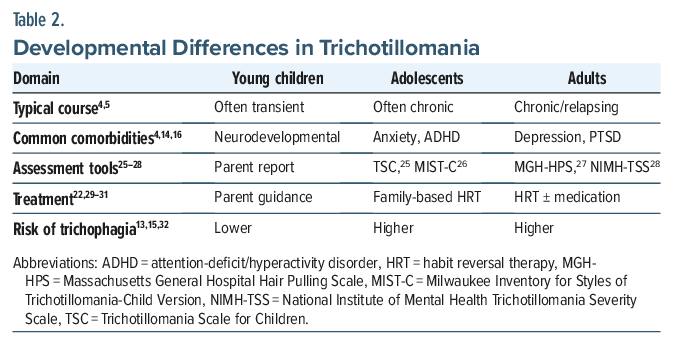
In adults, trichotillomania is often more chronic and refractory, with higher rates of comorbid depressive disorders, anxiety disorders, PTSD, and other body-focused repetitive behaviors. Hair pulling and trichophagia may persist for years before coming to clinical attention, and some individuals present only after developing significant medical complications such as trichobezoars. Assessment may be guided by validated adult measures including the Massachusetts General Hospital Hair Pulling Scale (MGH-HPS)27 and the National Institute of Mental Health Trichotillomania Severity Scale (NIMH-TSS).28 Treatment planning typically requires a broader psychiatric assessment and may incorporate pharmacologic augmentation when behavioral interventions alone are insufficient.
How Can Primary Care and Ambulatory Clinicians Identify Trichotillomania Before Medical Complications Develop?
Most individuals with trichotillomania are encountered in outpatient rather than inpatient settings, and only a small minority progress to trichophagia, bezoar formation, hospitalization, or surgery.1,6 Accordingly, primary care clinicians, pediatricians, dermatologists, nurse practitioners, and mental health professionals are often best positioned to identify the disorder before serious medical complications occur.33,34 Although trichotillomania is classified as a psychiatric diagnosis, many families initially present to a dermatologist or primary care provider for evaluation of hair loss.33
Recognition may begin with seemingly minor findings, such as patchy alopecia, broken hairs of varying lengths, repetitive manipulation of hair during an office visit, caregiver concerns about grooming behaviors, or reports of anxiety-associated pulling.1,34 Trichotillomania characteristically presents with irregularly shaped patches of nonscarring hair loss with broken hairs of different lengths and coexistent new hair growth, often with a negative pull test and sparing of the occiput.30,34 In ambiguous cases, trichoscopy may reveal distinctive features such as flame hairs, coiled hairs, and broken shafts of varying lengths.30,33 Because many patients experience shame and do not volunteer symptoms, individuals may attempt to conceal or camouflage hair loss using makeup, scarves, or wigs;1 nonjudgmental questioning is often necessary.
Simple questions such as “Do you ever find yourself pulling out your hair when stressed or bored?” and “Do you ever chew or swallow the hair after pulling it?” can uncover behaviors that otherwise remain undisclosed. Screening for trichophagia is particularly important, as approximately 20% of individuals with trichotillomania report current trichophagia, with an additional 13% engaging in the behavior episodically.13 Left unaddressed, trichophagia can lead to trichobezoar formation with subsequent anemia, abdominal pain, bowel obstruction, and even perforation.1,11
How Do Patients With Trichobezoars Typically Present?
The clinical presentation of trichobezoar is usually delayed and often nonspecific. Patients may report chronic or progressive abdominal pain, early satiety, bloating, nausea, vomiting, weight loss, constipation, reflux, or fatigue related to iron-deficiency anemia.7,35,36 Common clinical presentations and complications are summarized in Table 3. In a retrospective study of 21 pediatric patients with GI trichobezoars (drawn from pediatric surgical admissions at a single center in China), 90.5% presented with abdominal pain, 76.2% with vomiting, and 61.9% with a palpable mass.37 Some present only after repeated prior evaluations for unexplained GI symptoms. On physical examination, clinicians may detect a palpable epigastric or upper abdominal mass.7,36 In a series of 10 children with Rapunzel syndrome (identified through a tertiary pediatric referral center in China), the most common clinical symptoms were upper abdominal mass (90%), abdominal pain (80%), and nausea and vomiting (50%).15
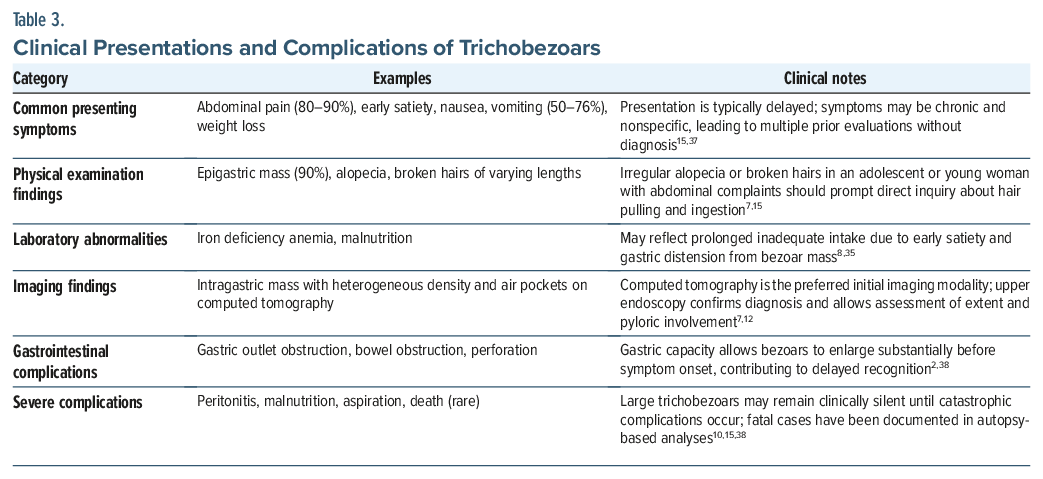
In more advanced cases, patients present with gastric outlet obstruction, bowel obstruction, perforation, bleeding, pancreatitis, malnutrition, peritonitis, or aspiration.2,7,37,38 In a pediatric series of 17 cases (from a pediatric surgical service in Pakistan), 41% developed complications secondary to the trichobezoar, including intussusception with gangrene, small bowel obstruction, gastric perforation with massive bleeding, and acute pancreatitis with hypertension; 1 patient succumbed postoperatively.38 Complications occurred in 60% of cases in another pediatric series, including small bowel obstruction, severe gastric dilatation, intestinal perforation, choledochodilation, and acute pancreatitis with cholecystitis.15
If left untreated, trichobezoar can progress to serious, potentially life-threatening complications, particularly with delayed presentation.39 GI obstruction is the most common serious complication. Small bowel obstruction occurs when fragments of the trichobezoar or the extending tail (in Rapunzel syndrome) migrate distally and cause mechanical blockage. In a pediatric series, 24% developed small bowel obstruction.38 Bezoars larger than 9 cm are significantly more likely to cause intestinal obstruction.40
Perforation of the stomach or intestine represents a potentially fatal complication. Gastric perforation can occur from pressure necrosis of the gastric wall by the enlarging mass, which carries significant mortality if not treated appropriately. Trichobezoars may cause mucosal erosion and ulceration through chronic mechanical irritation, with resulting GI bleeding that can present as hematemesis, melena, or, in severe cases, massive rectal bleeding. Gastric ulcers are found in approximately 60% of patients with bezoars on endoscopic examination.2
Nutritional and hematologic consequences include severe iron-deficiency anemia, malnutrition, and weight loss. These develop from chronic blood loss, malabsorption, and reduced oral intake due to early satiety and nausea. Rapunzel syndrome commonly presents with severe iron-deficiency anemia requiring supplementation. Pancreatitis and biliary complications can occur when the trichobezoar extends into or compresses the duodenum near the ampulla, causing acute pancreatitis or obstructive jaundice.
One reason diagnosis is often delayed is that the stomach can accommodate a large trichobezoar before symptoms become pronounced. Hair may accumulate silently over years. In some fatal cases, the diagnosis has only become clear after catastrophic deterioration, including perforation or severe peritonitis.10 A recent systematic review focusing on fatal cases of Rapunzel syndrome emphasized that misdiagnosis or delayed intervention can lead to fatalities that may raise questions in medico-legal investigations.10 These findings highlight the importance of asking about hair pulling and hair ingestion in patients with unexplained chronic GI complaints, particularly when alopecia, broken hairs of uneven length, or repetitive grooming behaviors are present.
How Should Clinicians Assess Trichophagia and Related Psychiatric Symptoms?
Assessment should be direct, specific, and nonjudgmental. Asking only about hair pulling is often not enough. Clinicians should also ask whether the patient plays with pulled hairs, rubs them on the lips, bites the hair root, chews the strand, or swallows any part of the hair. These questions are important because patients may endorse “playing with” or “chewing” hair long before they spontaneously disclose ingestion. Shame, minimization, and the private nature of the behavior frequently delay recognition.5,13
Psychiatric assessment should clarify the age at onset of pulling, anatomic sites involved, pulling frequency, degree of distress or impairment, presence of bald patches or concealment behaviors, and the emotional or sensory states that precede and follow pulling. It should also assess whether the behavior is more automatic or more focused, whether it worsens during anxiety or solitude, and whether it has escalated over time. Inquiry about comorbid anxiety, depression, OCD symptoms, trauma, ADHD, excoriation disorder, nail-biting, and suicidal ideation may uncover broader psychopathology that shapes both risk and treatment planning.1,27,37
Validated assessment instruments can facilitate systematic evaluation. The TSC is a validated self-report measure that can be completed by children and/or their parents, with 2 subscales assessing severity (5 items) and distress/impairment (7 items).25 The MIST-C assesses “automatic” and “focused” pulling styles in children and adolescents, which may inform treatment planning.26 For clinical trials and treatment monitoring, optimal cut points for determining treatment response have been established: a 45% reduction on the MGH-HPS, a 35% reduction on the NIMH-TSS, and a 25% reduction on the TSC child version.28
Collateral information from parents, partners, or other family members may be helpful, especially when ingestion is minimized or denied. In younger patients, caregivers may have noticed chewing behaviors, unexplained GI complaints, or progressive social withdrawal before the patient is willing to discuss them directly. It is also important to note that trichobezoars may be composed not only of human hair but also of hair from dolls, animals, blankets, and carpets, which may be especially relevant in pediatric cases.2,41
How Are Trichobezoars Diagnosed and Medically Managed?
Diagnosis usually begins with suspicion raised by GI symptoms, a palpable mass, alopecia, or a known history of trichotillomania or trichophagia. Laboratory studies are not diagnostic, but they may reveal iron-deficiency anemia, nutritional compromise, or other sequelae of chronic poor intake or mucosal irritation.8,35 Imaging and endoscopy are central to diagnosis. Computed tomography commonly reveals a well-defined intragastric mass with heterogeneous density and internal air pockets.7,12,36 Upper endoscopy confirms the diagnosis, defines the extent of the bezoar, and may determine whether endoscopic removal is feasible.7,12,36
Management depends largely on the size, density, and extent of the hair mass, as well as on whether complications are present. Small bezoars may occasionally be removed endoscopically, but success is limited because hair is often tightly matted and difficult to fragment or extract. A review of the literature found that endoscopic attempts to remove trichobezoars were successful in only 30.7% of cases.12 Success rates are even lower, and procedural risks higher, when the bezoar extends beyond the pylorus, as in Rapunzel syndrome.15 Although successful endoscopic removal has been reported using techniques such as fragmentation with a polypectomy snare and argon plasma coagulation, sometimes with adjunctive sodium bicarbonate injection to loosen the mass, these approaches are generally limited to carefully selected cases.21
Larger gastric trichobezoars, and especially those with extension beyond the pylorus, usually require surgical extraction through laparotomy or laparoscopic-assisted gastrotomy.1,2,7,36,37 In a pediatric series of 21 cases (all admitted to a pediatric surgery service at a single Chinese center), 20 patients underwent surgery, with 5 undergoing laparoscopic-assisted minilaparotomy (LAML) and the rest undergoing laparotomy.37 LAML has been described as a safe, feasible, and effective surgical method for treating trichobezoars.37 In a series of 7 patients (from a pediatric surgical service at a US academic medical center), all required exploratory laparotomy for definitive treatment, and 71% were found to have postpyloric extension of the trichobezoar, suggesting that postpyloric extension should be carefully considered in patients with large trichobezoars.35
Patients with obstruction, perforation, peritonitis, pancreatitis, severe malnutrition, or ongoing bleeding require urgent medical and surgical attention.2,35 From a medical standpoint, treatment includes not only removal of the bezoar but also correction of dehydration, electrolyte abnormalities, nutritional compromise, anemia, and other downstream effects. Gradual refeeding with supplementation of micronutrients allows adequate weight restoration with normalization of hematochemical nutritional parameters.8,35 However, removal of the mass does not by itself resolve recurrence risk. That distinction should be made clear to patients, families, and the treating team. Surgery is often definitive for the acute mechanical problem, but it is incomplete treatment if the behavioral drivers remain unaddressed.2,12
When Should Psychiatry Be Involved?
Psychiatry should be involved early in the care of patients with trichobezoars, ideally at diagnosis or during the perioperative period. Early consultation is especially important when the history of trichophagia is unclear, when hair ingestion is minimized or denied, when comorbid psychiatric symptoms are suspected, or when there are concerns about treatment adherence and recurrence risk. Because trichobezoar often represents the result of a chronic and underrecognized psychiatric process, psychiatric involvement should be considered a routine component of multidisciplinary care rather than an optional addition after surgical treatment.2,8
The central task of psychiatric consultation is to define the behavioral and psychiatric drivers of bezoar formation and to guide treatment beyond the acute surgical episode. A comprehensive evaluation should assess the severity and pattern of trichotillomania and trichophagia, the patient’s level of insight, barriers to treatment engagement, psychosocial stressors, and the presence of co-occurring psychiatric disorders. This is especially important because psychiatric comorbidity is common in trichotillomania: Approximately 79% of affected individuals have at least 1 comorbid diagnosis, including anxiety disorders in 65%, depressive disorders in 48%, and ADHD in 39%.14 Psychiatric consultation can also help the medical and surgical teams understand why patients may conceal ingestion, experience shame, or appear ambivalent about treatment despite significant medical complications.
Certain clinical features should heighten concern for treatment complexity and recurrence and therefore strengthen the case for early or sustained psychiatric involvement. These include prior treatment nonadherence, recurrent bezoar formation, severe psychiatric comorbidity, intellectual disability, and family conflict around care. Family history should also be assessed, given evidence that 25% of individuals with trichotillomania have a first-degree relative with the disorder and that heritability estimates range from 32% to 76%.20 In some cases, consultation reveals previously unrecognized depression, trauma-related symptoms, or broader compulsive or self-injurious behavior patterns that require treatment beyond simple advice to stop ingesting hair. Ongoing psychiatric follow-up is also important after medical stabilization, since recurrence has been reported even years after initial removal when the underlying condition remains untreated.2,12
Which Psychiatric Treatments Are Most Relevant After Acute Medical Stabilization?
Behavioral treatment remains the cornerstone of management for trichotillomania. HRT, often delivered within a cognitive-behavioral framework, has the strongest evidence base.22,23,42 A recent meta-analysis found strong support for the efficacy of 3 interventions: behavioral therapy with habit reversal, acceptance and commitment therapy–enhanced HRT, and N-acetylcysteine.29 Core elements of HRT include helping patients increase awareness of pulling urges and high-risk situations, identifying sensory and emotional triggers, and practicing competing responses that are incompatible with pulling.23,24,42 HRT is a 5-component behavioral intervention that aims to develop a competing response to a specific unwanted behavior.24 Additional work often focuses on shame reduction, stimulus control, relapse prevention, and development of more adaptive strategies for regulating distress.27,37 Recent evidence suggests that therapist-delivered HRT via video can be effective across the lifespan, with meaningful reductions in symptom severity that are sustained over time. This delivery format may help address barriers to accessing evidence-based care, particularly for patients and families who lack access to trained providers.23
Treatment planning should be guided by the function of hair pulling, since the behavior often serves different psychological purposes across patients. For some, hair pulling reduces tension; for others, it provides sensory gratification or functions as a response to boredom, loneliness, or trauma-related distress. Effective intervention should therefore target both the behavior itself and the broader emotional and psychiatric context in which it occurs. This broader focus is clinically important because depressive symptoms may contribute more to quality-of-life impairment in trichotillomania than hair-pulling severity alone. In randomized trials, cognitive-behavioral therapy (CBT) has produced greater and more sustained reductions in hair-pulling behavior than supportive therapy, and emerging approaches such as metacognitive therapy combined with HRT have also shown promising longer-term outcomes.23,42
For pediatric populations, behavioral interventions, particularly HRT, consistently demonstrate the greatest therapeutic benefit.30 Family involvement is critical in treating children and adolescents with trichotillomania. Family-based CBT incorporating HRT and function-based interventions has shown significant improvement in children as young as 8 years of age, underscoring the importance of parental involvement in treatment.32 Research on family functioning in pediatric trichotillomania reveals that family impairment is common, with higher levels of conflict and lower cohesion, expressiveness, and organization compared to healthy controls, highlighting the need for family-focused interventions.43
Pharmacotherapy may be considered as an adjunct to behavioral treatment, particularly when trichotillomania co-occurs with anxiety or depressive disorders or when behavioral therapy alone has been insufficient. The overall evidence for medication is mixed, and no agent has established itself as a consistently effective first-line treatment. Clomipramine has shown benefit in some studies and demonstrated superiority to placebo in one meta-analysis, although its adverse effect burden may limit tolerability.31,44 Selective serotonin reuptake inhibitors are commonly prescribed when comorbid anxiety or depression is present, but their efficacy for hair pulling itself remains inconsistent.44,45 N-acetylcysteine has shown promise in adults and may be appealing because of its favorable tolerability profile, although pediatric data remain limited and have not demonstrated clear benefit over placebo.30,31,44 Olanzapine has also shown benefit in a single randomized clinical trial, whereas more recent evidence has not consistently supported clonazepam.29 Taken together, these findings support an individualized approach in which medication is used mainly to augment, rather than replace, behavioral treatment.46
How Can Recurrence Be Prevented?
Recurrence prevention depends on structured discharge planning and continuity of psychiatric care after acute medical treatment. Because recurrent trichobezoar has been reported even years after successful removal, patients should leave the hospital with a concrete follow-up plan that addresses ongoing hair pulling, hair ingestion, and any comorbid psychiatric symptoms that may sustain the behavior.11,12 In practice, this should include referral to a clinician able to provide evidence-based treatment for body-focused repetitive behaviors, psychoeducation about the medical risks of recurrent ingestion, and explicit discussion of warning signs that should prompt earlier reassessment.
Family and caregiver involvement may further reduce recurrence risk, especially in children and dependent adults. When appropriate, family members can help monitor renewed pulling or ingestion, support treatment adherence, and reduce shame without turning observation into punishment.2 In selected cases, particularly those with early onset, multiple affected relatives, or complex psychosocial circumstances, family history and family functioning may also inform longer-term management. The goal is not simply to prevent another hospitalization but to ensure that the behavioral drivers of bezoar formation are recognized early enough to allow outpatient intervention before a new mass develops.
Why Is Early Recognition So Important for C-L Psychiatrists and Other Medical Clinicians?
Early recognition is important because trichophagia is often clinically occult until patients develop significant GI morbidity. Hair pulling may be recognized without any inquiry into ingestion, while chronic abdominal symptoms may be evaluated repeatedly without attention to the behavioral source of bezoar formation. This diagnostic separation can delay recognition until patients present with a large gastric mass, obstruction, perforation, bleeding, or other serious complications.8,10,35
For C-L psychiatrists, these cases underscore the importance of evaluating medical and psychiatric symptoms as potentially linked manifestations of the same disorder. Trichotillomania and trichophagia may first come to clinical attention through a surgical or gastroenterologic presentation rather than through psychiatric complaint. Accordingly, trichobezoar should be considered in patients with otherwise unexplained GI symptoms when patchy alopecia, broken hairs of uneven length, anxiety, depression, trauma-related symptoms, or other body-focused repetitive behaviors are also present. Timely recognition may reduce diagnostic delay and prevent progression to life-threatening complications.
Recognition should be especially vigilant in groups at elevated risk. These include adolescents, in whom trichotillomania most commonly begins between ages 11 and 15, patients with a family history of trichotillomania or OCD, and those with common psychiatric comorbidities, such as anxiety, depression, ADHD, or trauma-related symptoms. Although community prevalence appears similar across sexes, most treatment-seeking patients are female, and trichobezoar remains an important consideration in children and adolescents with known trichotillomania and trichophagia.1,8,35
Recognition outside the hospital is equally important because most patients with trichotillomania are encountered in ambulatory settings long before bezoar formation occurs. Accordingly, clinicians caring for patients with unexplained alopecia, body-focused repetitive behaviors, or common psychiatric comorbidities should maintain awareness of trichotillomania and trichophagia as potentially underrecognized contributors to later medical complications.
The natural history of trichotillomania remains incompletely characterized. Community-based studies estimate a prevalence of approximately 1%–2% in the general population, although many cases likely go unrecognized in primary care settings.3 Hair pulling that begins in infancy or early childhood often resolves spontaneously, whereas later-childhood, adolescent-, and adult-onset illness is more likely to follow a chronic course with waxing and waning symptom severity.1 Although approximately 25% of individuals may experience natural recovery without formal treatment, recurrence is common, and long-term remission rates remain poorly characterized.47 Trichophagia occurs in only a subset of patients with trichotillomania, with approximately 20% reporting current trichophagia and an additional 13% engaging in the behavior episodically.13 Only a minority of those individuals appear to progress to trichobezoar formation, hospitalization, or surgery. Precise estimates of progression are unavailable because most published data derive from surgical and gastroenterology populations and likely represent the most severe end of the clinical spectrum.5,6
What Happened to Ms A?
Following surgical recovery, psychiatry was consulted to evaluate the behavioral drivers of bezoar formation. Ms A described long-standing hair pulling beginning in adolescence, often triggered by anxiety, boredom, and periods of social isolation. She acknowledged recurrent hair ingestion but had previously minimized the behavior and had not engaged consistently in outpatient treatment.
Her presentation was conceptualized as trichotillomania with trichophagia, likely functioning as a maladaptive emotion regulation strategy. She denied psychosis or suicidal ideation but demonstrated limited insight into the medical risks of her behavior. During hospitalization, she received psychoeducation regarding the relationship among hair pulling, ingestion, and bezoar formation, as well as the risk of recurrence without treatment. A plan was developed for outpatient behavioral therapy focused on HRT and cognitive-behavioral approaches to body-focused repetitive behaviors.
At follow-up, she remained medically stable and reported increased insight into the connection between emotional distress and hair pulling and ingestion, and she expressed willingness to engage in ongoing psychiatric care.
CONCLUSION
Trichobezoars represent a rare but clinically significant intersection of GI pathology and psychiatric illness. As illustrated by our case, patients often present with nonspecific and delayed symptoms, while the underlying behaviors of trichotillomania and trichophagia remain unrecognized or underreported. Surgical management is frequently required to address the acute mechanical complication, but it does not treat the underlying psychiatric condition driving bezoar formation.
For primary care clinicians, pediatricians, dermatologists, C-L psychiatrists, and other medical clinicians, early recognition of hair-pulling and ingestion behaviors is essential. Direct, nonjudgmental assessment can facilitate earlier diagnosis, reduce morbidity, and prevent life-threatening complications. Effective care requires a multidisciplinary approach that integrates medical, surgical, and psychiatric treatment, with an emphasis on behavioral interventions, such as HRT and ongoing follow-up to reduce recurrence risk.
Ultimately, improving outcomes for patients with trichobezoars depends on bridging the gap between medical and psychiatric care, recognizing these presentations as manifestations of treatable psychiatric conditions, and intervening before serious complications develop.
Article Information
Published Online: October 20, 2026. https://doi.org/10.4088/PCC.26f04254
© 2026 Physicians Postgraduate Press, Inc.
Submitted: April 15, 2026; accepted July 9, 2026.
To Cite: Schwartz AC, Robbins-Welty G, Stern TA. When hair becomes hazardous: trichotillomania, trichophagia, and gastric trichobezoar. Prim Care Companion CNS Disord 2026;28(5):26f04254.
Author Affiliations: Department of Psychiatry and Behavioral Sciences, Emory University School of Medicine, Atlanta, Georgia (Schwartz, Robbins-Welty); Grady Memorial Hospital, Atlanta, Georgia (Schwartz, Robbins-Welty); Departments of Family and Preventive Medicine, Medicine, Emory University School of Medicine, Atlanta, Georgia (Robbins-Welty); Harvard Medical School, Boston, Massachusetts (Stern); Massachusetts General Hospital, Boston, Massachusetts (Stern).
Corresponding Author: Ann C. Schwartz, MD, 12 Executive Parkway, Ste 142, Atlanta, GA 30329 ([email protected]).
Schwartz and Robbins-Welty are co-first authors; Stern is the senior author.
Financial Disclosure: Dr Stern has received royalties from Elsevier for editing textbooks on psychiatry. Drs Schwartz and Robbins-Welty report no conflicts of interest.
Funding/Support: None.
Clinical Points
- Trichotillomania and trichophagia are key behavioral drivers of trichobezoar formation; direct questioning about hair ingestion is essential, as patients often minimize or do not spontaneously report this behavior.
- Patients with trichobezoars typically present with nonspecific GI symptoms (eg, abdominal pain, early satiety, nausea, vomiting), and diagnosis is often delayed due to fragmented care between medical and psychiatric settings.
- Physical findings (such as patchy alopecia, broken hairs of varying lengths, or a palpable abdominal mass) should prompt consideration of trichophagia and possible bezoar formation.
- Surgical removal addresses the mechanical complication but does not treat the underlying psychiatric condition; without psychiatric intervention, recurrence remains possible.
- Early psychiatric involvement is critical for assessing trichotillomania severity, identifying comorbid conditions, addressing shame and treatment avoidance, and initiating evidence-based behavioral interventions (eg, habit reversal therapy).
References (47)

- American Psychiatric Association. Diagnostic and Statistical Manual of Mental Disorders. 5th edition, Text Revision. American Psychiatric Association; 2022.
- Kwon HJ, Park J. Treatment of large gastric trichobezoar in children: two case reports and literature review. Med Baltim. 2023;102(16):e33589. PubMed CrossRef
- Grant JE, Dougherty DD, Chamberlain SR. Prevalence, gender correlates, and co-morbidity of trichotillomania. Psychiatry Res. 2020;288:112948. PubMed CrossRef
- Grant JE, Collins M, Chamberlain SR. Clinical characteristics of trichotillomania. Ann Clin Psychiatry. 2023;35(4):228–233. PubMed
- Snorrason I, Ricketts EJ, Stein AT, et al. Sex differences in age at onset and presentation of trichotillomania and trichobezoar: a 120-year systematic review of cases. Child Psychiatry Hum Dev. 2022;53(1):165–171. PubMed
- Sehgal VN, Srivastava G. Trichotillomania +/-trichobezoar: revisited. J Eur Acad Dermatol Venereol. 2006;20(8):911–915. PubMed
- Tarchouli M, Ait Idir B, Bouhabba N, et al. A huge abdominal mass revealing a depressive syndrome. Ann R Coll Surg Engl. 2021;103(3):e77–e80. PubMed
- Kim SC, Kim SH, Kim SJ. A Case Report: Large Trichobezoar Causing Rapunzel Syndrome. Medicine (Baltimore). 2016 May;95(22):e3745.
- Rabie ME, Arishi AR, Khan A, et al. Rapunzel syndrome: the unsuspected culprit. World J Gastroenterol. 2008;14(7):1141–1143. PubMed
- Sacco MA, Gualtieri S, Princi A, et al. Rapunzel syndrome: clinical, diagnostic and forensic aspects in related deaths-A review of the literature. J Clin Med. 2024;13(23):7464. CrossRef
- Kırpınar I, Kocacenk T, Koçer E, et al. Recurrent trichobezoar due to trichophagia: a case report. Gen Hosp Psychiatry. 2013;35(4):439–441. PubMed CrossRef
- Niţă AF, Hill CJ, Lindley RM, et al. Human and doll’s hair in a gastric trichobezoar, endoscopic retrieval hazards. J Pediatr Gastroenterol Nutr. 2020;71(2):163–170. CrossRef
- Grant JE, Odlaug BL. Clinical characteristics of trichotillomania with trichophagia. Compr Psychiatry. 2008;49(6):579–584. PubMed CrossRef
- Farhat LC, Isomura K, Fernández de la Cruz L, et al. Sociodemographic and clinical characteristics of 1,234 individuals diagnosed with trichotillomania in the Swedish National Patient Register. Sci Rep. 2025;15(1):10396. PubMed
- Liang Y, Huang L, Wang D, et al. Rapunzel syndrome in children: a retrospective review of ten cases combined with literature review in a tertiary referral center. Pediatr Surg Int. 2024;40(1):121. PubMed
- Özten E, Sayar GH, Eryılmaz G, et al. The relationship of psychological trauma with trichotillomania and skin picking. Neuropsychiatr Dis Treat. 2015;11:1203–1210. PubMed CrossRef
- Reid M, Lin A, Farhat LC, et al. The genetics of trichotillomania and excoriation disorder: a systematic review. Compr Psychiatry. 2024;130:152460. PubMed
- Novak CE, Keuthen NJ, Stewart SE, et al. A twin concordance study of trichotillomania. Am J Med Genet B Neuropsychiatr Genet. 2009;150B(7):944–949. PubMed
- Monzani B, Rijsdijk F, Harris J, et al. The structure of genetic and environmental risk factors for dimensional representations of DSM-5 obsessive-compulsive spectrum disorders. JAMA Psychiatry. 2014;71(2):182–189. PubMed CrossRef
- Chen D, Farhat LC, Lebowitz ER, et al. Investigating the familiality of trichotillomania and excoriation disorder. Psychiatry Res. 2025;350:116560. PubMed
- Zhao JL, Zhao WC, Wang YS. Endoscopic retrieval of gastric trichophytobezoar: Case report of a 12-year-old girl with trichophagia. Medicine (Baltimore). 2017 Jan;96(3):e5969. PubMed CrossRef
- DuBois MC, Feler BM, Flessner CA, et al. Trichotillomania and its treatment: an updated review and recommendations. Expert Rev Neurother. 2025;25(11):1335–1345. PubMed
- Shareh H. A preliminary investigation of metacognitive therapy and habit reversal as a treatment for trichotillomania. Behav Cogn Psychother. 2018;46(1):1–20. CrossRef
- Rahman SM, Jafferany M, Barkauskaite R. Habit-reversal training: a psychotherapeutic approach in treating body-focused repetitive behaviour disorders. Clin Exp Dermatol. 2023;48(12):1310–1316. CrossRef
- Tolin DF, Diefenbach GJ, Flessner CA, et al. The Trichotillomania Scale for Children: development and validation. Child Psychiatry Hum Dev. 2008;39(3):331–349.
- Flessner CA, Woods DW, Franklin ME, et al. The Milwaukee Inventory for Styles of Trichotillomania-Child version (MIST-C): initial development and psychometric properties. Behav Modif. 2007;31(6):896–918. PubMed CrossRef
- Jones G, Keuthen N, Greenberg E. Assessment and treatment of trichotillomania (hair pulling disorder) and excoriation (skin picking) disorder. Clin Dermatol. 2018;36(6):728–736. PubMed CrossRef
- Farhat LC, Olfson E, Levine JLS, et al. Measuring treatment response in pediatric trichotillomania: a meta-analysis of clinical trials. J Child Adolesc Psychopharmacol. 2020;30(5):306–315. CrossRef
- Fisak B, Shorb C, Patel D, et al. The efficacy of psychotherapeutic and pharmacological interventions for trichotillomania: a review and meta-analysis. J Psychiatr Res. 2026;197:264–274. CrossRef
- Sharifi S, Estill M, Tordjman L, et al. Treatment strategies for pediatric trichotillomania: state-of-the-art review on progress and persistent challenges. Pediatr Dermatol. 2026;43(1):3–10. CrossRef
- Farhat LC, Olfson E, Nasir M, et al. Pharmacological and behavioral treatment for trichotillomania: an updated systematic review with meta-analysis. Depress Anxiety. 2020;37(8):715–727. PubMed CrossRef
- Snorrason I, Walther MR, Elkin TD, et al. Treating trichotillomania (hair-pulling disorder) in a child. J Clin Psychol. 2016;72(11):1200–1208.
- Henkel ED, Jaquez SD, Diaz LZ. Pediatric trichotillomania: review of management. Pediatr Dermatol. 2019;36(6):803–807.
- Dakkak M, Forde KM, Lanney H. Hair loss: diagnosis and treatment. Am Fam Physician. 2024;110(3):260–270.
- Fallon SC, Slater BJ, Larimer EL, et al. The surgical management of Rapunzel syndrome: a case series and literature review. J Pediatr Surg. 2013;48(4):830–834. PubMed CrossRef
- Zella GC, Pourvaziri A, Greenberg EL, et al. Case 36-2024: a 16-year-old girl with abdominal pain. N Engl J Med. 2024;391(20):1937–1945.
- Wang L, Chen Y, Chen S, et al. Gastrointestinal trichobezoars in the pediatric population: a retrospective study. BMC Pediatr. 2024;24(1):124.
- Mirza MB, Talat N, Saleem M. Gastrointestinal trichobezoar: an experience with 17 cases. J Pediatr Surg. 2020;55(11):2504–2509.
- Williams RS. The fascinating history of bezoars. Med J Aust. 1986;145(11-12):613–614.
- Liu LN, Wang L, Jia SJ, et al. Clinical features, risk factors, and endoscopic treatment of bezoars: a retrospective analysis from a single center in Northern China. Med Sci Monit. 2020;26:e926539.
- Zmudzinski M, Hayashi A. Laparoscopic removal of massive pediatric gastric trichobezoars: a brief report. Am J Surg. 2020;219(5):810–812. PubMed CrossRef
- Toledo EL, De TME, Brito AM, et al. Group treatment for trichotillomania: cognitive-behavioral therapy versus supportive therapy. J Clin Psychiatry. 2015;76(4):447–455.
- Peris TS, Rozenman M, Gonzalez A, et al. Family functioning in pediatric trichotillomania, obsessive compulsive disorder, and healthy comparison youth. Psychiatry Res. 2019;281:112578. PubMed CrossRef
- Hoffman J, Williams T, Rothbart R, et al. Pharmacotherapy for trichotillomania. Cochrane Database Syst Rev. 2021;9:CD007662.
- Bloch MH, Landeros-Weisenberger A, Dombrowski P, et al. Systematic review: pharmacological and behavioral treatment for trichotillomania. Biol Psychiatry. 2007;62(8):839–846. PubMed CrossRef
- Baczynski C, Sharma V. Pharmacotherapy for trichotillomania in adults. Expert Opin Pharmacother. 2020;21(12):1455–1466.
- Grant JE, Chamberlain SR. Natural recovery in trichotillomania. Aust N Z J Psychiatry. 2022 Oct;56(10):1357–1362.
Please sign in or purchase this PDF for $40.