
Abstract
Objective: Greater severity of posttraumatic stress disorder (PTSD) symptoms has been linked to elevated C-reactive protein (CRP), a marker of systemic inflammation. The association between PTSD symptoms and CRP levels has been difficult to interpret due to confounding associations between CRP levels and medical comorbidities associated with PTSD and heterogeneity of trauma exposures and PTSD symptoms. The objective of this study was to characterize the relation between clinician-rated PTSD symptom dimensions, medical conditions, and CRP levels among individuals exposed to the World Trade Center (WTC) attacks. WTC rescue, recovery, and clean-up workers were recruited from the WTC Health Program General Responder Cohort.
Methods: Participants were assessed using the Clinician-Administered PTSD Scale, completed a questionnaire about medical conditions, and underwent a morning fasting blood draw. Two multivariable binary logistic regression analyses were conducted to identify correlates of elevated CRP levels (>3 mg/dL) and associations between specific PTSD symptom dimensions and elevated CRP levels.
Results: After adjusting for demographics, trauma exposure, and medical comorbidities, obesity (odds ratio [OR]=2.96; 95% CI [1.68, 5.21]), lower high-density lipoprotein cholesterol (OR=0.97; 95% CI [0.95, 0.99]), and greater severity of intrusive PTSD symptoms (OR=1.38; 95% CI [1.08, 1.75]) were associated with elevated CRP levels. Post hoc analyses revealed that, among intrusive symptoms, emotional reactivity to trauma cues was independently associated with elevated CRP levels (OR=1.50; 95% CI [1.15, 1.96]).
Conclusions: The results suggest that intrusive PTSD symptoms may contribute to systemic inflammation in WTC responders. This finding suggests that targeting both PTSD symptoms and obesity/dyslipidemia may help mitigate risk for elevated systemic inflammation.
Prim Care Companion CNS Disord 2026;28(5):25m04177
Author affiliations are listed at the end of this article.

Systemic inflammation has been widely implicated in the pathophysiology of psychiatric and medical conditions.1 Acutely, inflammation produced by the immune system is neuroprotective and promotes neuronal repair.2 However, chronic or excessively high inflammation can have downstream neural effects that increase risk for a range of illnesses.2
C-reactive protein (CRP) is an acute-phase protein released by the liver in response to systemic inflammation (eg, interleukin-6 secretion) and is a commonly measured marker of systemic inflammatory processes. Elevated CRP levels have been linked to posttraumatic stress disorder (PTSD) and major depressive disorder (MDD), with greater CRP levels associated with increased risk for these disorders.1 Further, exposure to trauma may increase circulating levels of CRP and other markers of peripheral immune activation.3 It is also well-established that PTSD is associated with adverse physical health outcomes including cardiovascular disease, immune dysfunction, and metabolic syndrome.4
To date, studies of the association between CRP levels and PTSD have yielded inconsistent findings. Some studies, including meta-analyses,5,6 have found such an association. This may be due in part to the heterogeneity of the PTSD phenotype and confounding factors such as inflammation related to physical injury and comorbid medical conditions that influence CRP levels.6 Increased CRP levels are linked to elevated cardiovascular risk4 and body fat percentage2 and may mediate the relationship between PTSD and cardiovascular disease risk.7 PTSD has also been associated with weight gain in women,8 which is independently related to elevated CRP levels.2 This complex picture highlights the importance of including key covariates in studies of inflammatory markers and PTSD.
Here, we recruited a sample of World Trade Center (WTC) rescue, recovery, and clean-up workers (“responders”), all of whom were exposed to the same traumatic event—the September 11, 2001 (9/11) WTC terrorist attacks and aftermath. The study aimed to address potentially confounding effects of heterogeneous index trauma on CRP levels in the existing literature and explore associations between symptom dimensions of PTSD with CRP levels. Participants had several risk factors for elevated CRP levels, including medical and psychiatric disorders. A recent study in survivors of the 9/11 WTC attacks found a significant association between elevated CRP levels and self-reported PTSD symptom severity, in particular re-experiencing/intrusion symptoms.9 In our study, we hypothesized that we would observe a similar association between re-experiencing/intrusion symptoms and CRP levels in WTC responders, using the gold-standard Clinician-Administered PTSD Scale (CAPS)10 to assess PTSD symptoms. We additionally examined the role of physical health variables, including obesity, lipid levels (high-density lipoprotein [HDL] cholesterol and triglycerides), body mass index (BMI), smoking status, and comorbid medical conditions. Including these covariates in our model, along with deep phenotyping resulting from clinician-rated (rather than self-reported) PTSD symptoms, is essential to elucidating the unique relation between PTSD symptoms and CRP.
METHODS
Participants
Participants were recruited from the WTC Health Program (WTC-HP), a consortium of 5 clinical centers of excellence (CCEs) in the greater New York City area providing health monitoring and treatment to WTC responders.11 We recruited WTC responders who had completed at least 3 health monitoring visits at 1 of 4 WTC-HP CCEs—Mount Sinai Medical Center, New York University, Northwell Health, and Rutgers/The State University of New Jersey—and provided consent to be contacted for future studies. Random sampling, stratified by PTSD symptom severity on the PTSD Checklist–Specific Version (PCL-S)12 administered during WTC-HP health monitoring visits, ensured that the sample included participants with PTSD symptom levels ranging from no/low symptoms to severe-and-chronic PTSD. Exclusion criteria included history of chronic psychotic symptoms or bipolar disorder I, substance abuse/dependence or alcohol dependence over the prior 3 months, current pregnancy, acute medical illness or exacerbation of chronic medical illness, history of significant head injury or cerebrovascular accident, changes in medications or dosages in the prior month, or current treatment with steroid medications.
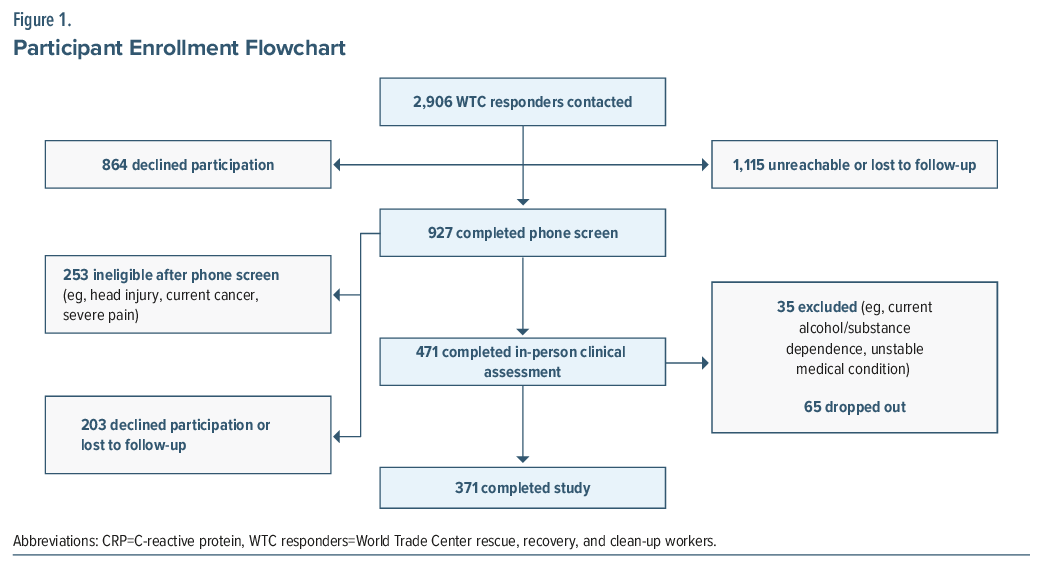
The study was approved by the Icahn School of Medicine at Mount Sinai Institutional Review Board, was conducted between April 2013 and September 2017, and all participants provided written informed consent. Of 471 WTC responders who participated in the in-person assessments at Mount Sinai, 371 (78.8%) met eligibility criteria and completed the study (Figure 1).
Measures
Participants completed an in-person clinical assessment visit on average 13.6 (SD=1.3) years after September 11, 2001. Trained Master’s/PhD-level clinical interviewers administered the Structured Clinical Interview for DSM-IV (SCID),13 assessing Axis I disorders, and the CAPS,10 assessing WTC-related PTSD symptoms. PTSD symptom dimensions were modeled using a 5-factor model comprising re-experiencing/intrusion, avoidance, emotional numbing, dysphoric arousal, and anxious arousal symptoms, which provides a better fit to PTSD symptom data than less refined structural models.14
Participants also completed the Childhood Trauma Questionnaire (CTQ),15 Traumatic Life Events Questionnaire (TLEQ),16 a checklist of 15 stressful life events experienced since 9/11 (eg, had debt, lost a job, divorced from spouse) adapted from the Diagnostic Interview Schedule Disaster Supplement, a checklist of medical conditions modified to also include common WTC-related health conditions (asthma or chronic respiratory condition, chronic rhinitis or sinusitis, sleep apnea, and acid reflux), and provided demographic characteristics. Additionally, data on 10 potentially traumatic WTC-related exposures (eg, exposure to human remains, knowing someone who died on 9/11) and toxin exposure at the WTC site were available from each participant’s first health monitoring visit to the WTC-HP, an average of 4.3 (SD=2.7) years after 9/11.11 In previous research, both WTC exposure severity and number of WTC-related health conditions were associated with the development of PTSD symptoms following this event.17
During a second study visit, on average 25 (SD=19) days after the clinical assessment visit, participants completed a history and physical examination, as well as a blood sample collection between 8:00 AM and 10:00 AM. Participants were asked to fast beginning at midnight the prior night. Blood tubes were allowed to clot at ambient temperature and then centrifuged at 1500 x g for 10 minutes within 1 hour of collection. Plasma was aliquoted into a minimum of 5 0.1 mL tubes, and high-sensitivity ELISA for CRP was run following guidance from Macy et al.18 CRP levels in plasma were measured with latex-enhanced immunoturbidimetry through LabCorp. Cholesterol and triglycerides were measured from plasma and processed by LabCorp.
Data Analysis
After excluding data from one participant whose CRP level was exceedingly high (88.1 mg/dL), data analyses proceeded in 3 steps. First, we conducted independent-samples t-tests and χ2 tests to compare demographic and clinical variables in participants with CRP >3 mg/dL relative to those with CRP ≤3 mg/dL. This cutoff was selected based on cutoffs for clinically significant inflammation in populations with PTSD7 and guidelines for inflammation associated with increased risk of cardiovascular disease.19 Second, we conducted a multivariable binary logistic regression analysis with Forward Wald estimation to identify independent correlates of CRP >3 mg/dL. We employed a more inclusive approach to selecting variables for this analysis, with variables associated with CRP >3 mg/dL at the p≤.10 level in bivariate analyses entered into this analysis. Third, we conducted a secondary multivariable binary logistic regression analysis to identify specific PTSD symptoms associated with CRP >3 mg/dL. Alpha was set to 0.01 for this analysis to reduce the likelihood of Type 1 error.
RESULTS
Demographic and Clinical Characteristics
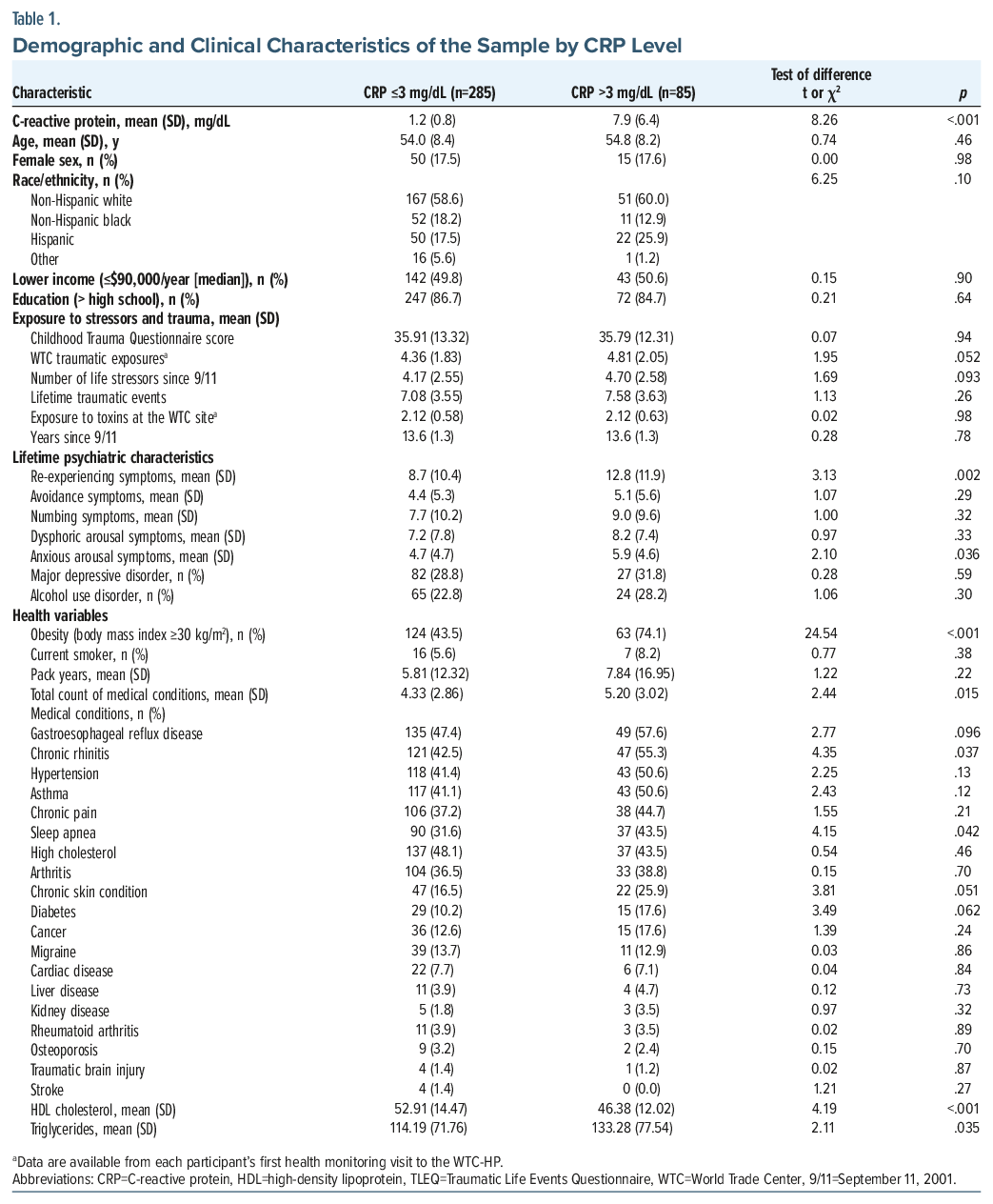
Table 1 presents demographic and clinical characteristics of the sample. Compared to WTC responders with CRP ≤3 mg/dL, those with CRP >3 mg/dL experienced greater severity of re-experiencing and anxious arousal symptoms, were more likely to be obese, had more medical diagnoses, and exhibited higher triglycerides and lower HDL cholesterol levels.
Multivariable Analysis
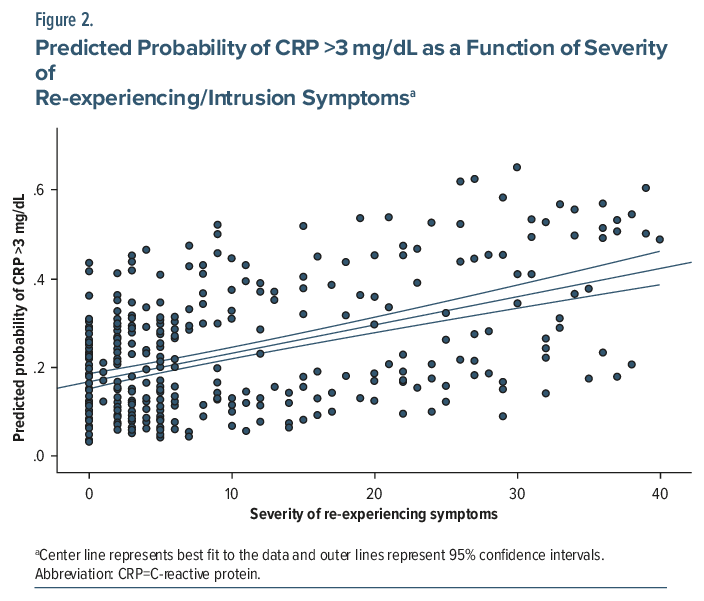
In a multivariable model that included all demographic and clinical characteristics shown in Table 1 associated with CRP >3 mg/dL at the p≤.10 level, obesity (odds ratio [OR]=2.96; 95% CI [1.68, 5.21]; Wald χ2 =14.04; p<.001), lower HDL cholesterol levels (OR=0.97; 95% CI [0.95, 0.99]; Wald χ2 =5.82; p=.016), and greater severity of re-experiencing/intrusion symptoms (OR=1.38; 95% CI [1.08, 1.75]; Wald χ2 =6.82; p=.009) emerged as significant correlates of CRP >3 mg/dL. No other variables were retained in this model (all Wald χ2 <0.69, all p’s>.40). Planned post-hoc analyses of individual re-experiencing/intrusion symptoms, as shown in Figure 2, revealed that greater emotional reactivity to trauma cues (OR= 1.50; 95% CI [1.15, 1.96]; Wald χ2 =8.80; p=.003) was independently associated with CRP >3 mg/dL; no other symptoms were significant (all Wald χ2 <0.40, all p’s>.52).
DISCUSSION
In our sample of individuals with a shared and well-characterized traumatic experience (WTC responders), we found that obesity, lower HDL cholesterol, and greater severity of re-experiencing/intrusion PTSD symptoms were associated with increased inflammation, as indexed by elevated CRP levels. For each SD unit increase in re-experiencing/intrusion symptom severity (approximately 10.9 points), the odds of having elevated CRP increased by 38%. The relation between re-experiencing/intrusion symptoms and elevated CRP was driven by emotional reactivity to trauma cues. Of note, the latter association was not due to differences in toxin exposure or in physical health, two important confounds of inflammation in trauma-exposed populations.3,4
Results of the current study replicate and extend findings from another study of WTC survivors, which similarly found elevated CRP to be associated with re-experiencing/intrusion PTSD symptoms and obesity.9 They provide further support for a relationship between emotional reactivity to trauma cues and markers of systemic inflammation9,20 and are consistent with previous studies demonstrating an association between elevated CRP and obesity in individuals exposed to trauma or diagnosed with PTSD.2,8,21 The association between elevated CRP and lower HDL cholesterol found in our sample, both independent predictors of cardiovascular disease, is also consistent with the previously identified link between elevated CRP and increased cardiovascular risk among individuals with PTSD.22
Notable strengths of the present study include a well-characterized sample of individuals who were all exposed to a shared index traumatic event and use of the CAPS, a gold-standard clinician-administered interview for PTSD, which contrasts with self-report PTSD symptom measures that have been utilized in prior studies. Further, inclusion of multiple comorbid medical conditions in our analyses suggests that the association between PTSD symptoms and CRP levels is robust to the effects of physical comorbidities.
While we found that re-experiencing/intrusive symptoms of PTSD were associated with elevated CRP levels, in addition to obesity and lower HDL cholesterol levels, the cross-sectional nature of this study precludes causal inferences. While there is some evidence that elevated CRP may be a pre-existing risk factor for the development of PTSD,5 persistent emotional reactivity to trauma cues might also function as a form of recurrent stress that maintains and worsens chronic inflammation.23 While our use of this well-characterized sample of individuals all exposed to a similar traumatic event can help disentangle some of the differences related to heterogeneity of trauma exposures in previous studies, WTC-related exposures do still vary considerably within this population. Additionally, our results may not generalize to other populations with PTSD related to other traumatic events.
Notwithstanding these limitations, this study identified a relationship between re-experiencing/intrusive PTSD symptoms (ie, emotional reactivity to trauma cues), obesity, dyslipidemia, and elevated CRP levels among WTC responders. Taken together, these results suggest the potential benefit of combining prevention and intervention approaches to target not only PTSD symptoms but also obesity and dyslipidemia to mitigate risk for elevated CRP levels and related physical morbidities. Treatments with known anti-inflammatory effects and combined treatments for PTSD and obesity/low HDL may be particularly advantageous in this population. Longitudinal studies are needed to characterize causal/directional associations between PTSD, physical comorbidities, and CRP levels, and to evaluate the efficacy of combined mental-physical health interventions in mitigating systemic inflammation in WTC responders and other trauma survivors.
Article Information
Published Online: September 1, 2026. https://doi.org/10.4088/PCC.25m04177
© 2026 Physicians Postgraduate Press, Inc.
Submitted: December 24, 2025; accepted March 25, 2026.
To Cite: Rutter SB, Collins AB, Kautz M, et al. Association of intrusive posttraumatic stress symptoms with elevated C-reactive protein levels in World Trade Center responders. Prim Care Companion CNS Disord 2026;28(5):25m04177.
Author Affiliations: Department of Psychiatry, Icahn School of Medicine at Mount Sinai, New York, New York (Rutter, Collins, Kautz, Cancelmo, Diab, Cahn, Aaronson, Schaffer, Cipriani, Bierer, Yehuda, Horn, Feder); Department of Family and Social Medicine, Albert Einstein College of Medicine, Bronx, New York (Schechter); Department of Psychiatry, James J. Peters Veterans Affairs Medical Center, Bronx, New York (Bierer, Yehuda); Department of Environmental Medicine and Public Health, Icahn School of Medicine at Mount Sinai, New York, New York (Crane); Department of Occupational Medicine, Epidemiology and Prevention, Zucker School of Medicine at Hofstra/Northwell, Great Neck, New York (Moline); Environmental and Occupational Health Sciences Institute, School of Public Health, Rutgers University, Piscataway, New Jersey (Udasin); Department of Medicine, Division of Pulmonary Critical Care and Sleep Medicine, New York University School of Medicine, New York, New York (Harrison); Department of Psychiatry, Yale School of Medicine, New Haven, Connecticut (Pietrzak); US Department of Veterans Affairs National Center for Posttraumatic Stress Disorder, VA Connecticut Healthcare System, West Haven, Connecticut (Pietrzak).
Pietrzak and Feder are senior authors.
Corresponding Author: Adriana Feder, MD, One Gustave L. Levy Place, Box 1230, New York, NY 10029 ([email protected]).
Financial Disclosure: Dr Feder is named coinventor on issued patents in the United States and outside the United States, filed by the Icahn School of Medicine at Mount Sinai (ISMMS), related to the use of ketamine for the treatment of PTSD. ISMMS has entered into a licensing agreement with Frontier Pharmaceuticals, Inc. to develop intranasal ketamine as a treatment for PTSD. As a part of this agreement, ISMMS will receive consideration in the form of royalties, milestones, payments, and equity. As a named coinventor, Dr Feder is entitled under ISMMS’s intellectual policy to a portion of any consideration received by ISMMS. The other authors have nothing to disclose.
Funding/Support: This work was supported by CDC/NIOSH [U01OH010986, 2015]; CDC/NIOSH [U01OH010407, 2012]; and also in part by the Clinical Neurosciences Division of the US Department of Veterans Affairs National Center for PTSD.
Role of the Sponsor: The sponsors had no role in study design, data collection, analysis, or manuscript publication.
Previous Presentation: Poster presented at the International Society for Traumatic Stress Studies Annual Meeting, November 2018, Washington, DC, and at the Anxiety and Depression Association of America Annual Meeting, March 2021, virtual.
Acknowledgments: The authors would like to thank the late Steven M. Southwick, MD, for his expertise and assistance throughout all aspects of this study and for his seminal contributions to traumatic stress research.
Clinical Points
- Among World Trade Center responders, obesity, lower high-density lipoprotein (HDL) cholesterol, and greater severity of posttraumatic stress disorder (PTSD) intrusion symptoms, particularly emotional reactivity to trauma reminders, were associated with elevated C-reactive protein (CRP), a marker of inflammation.
- When evaluating or treating patients with PTSD, clinicians should consider metabolic risk factors such as obesity and dyslipidemia, as these conditions may contribute to heightened inflammatory burden.
- Integrated approaches that address both PTSD symptoms, especially intrusive symptoms, and metabolic risk factors (eg, obesity and dyslipidemia) may help reduce systemic inflammation and potentially lower risk for inflammation-related medical conditions.
References (23)

- Michopoulos V, Powers A, Gillespie CF, et al. Inflammation in fear-and anxiety-based disorders: PTSD, GAD, and beyond. Neuropsychopharmacology. 2017;42(1):254–270. PubMed CrossRef
- Speer K, Upton D, Semple S, et al. Systemic low-grade inflammation in post-traumatic stress disorder: a systematic review. J Inflamm Res. 2018;11:111–121. PubMed CrossRef
- Tursich M, Neufeld RWJ, Frewen PA, et al. Association of trauma exposure with proinflammatory activity: a transdiagnostic meta-analysis. Transl Psychiatry. 2014;4(7):e413. PubMed CrossRef
- Hori H, Kim Y. Inflammation and post-traumatic stress disorder. Psychiatry Clin Neurosci. 2019;73(4):143–153. PubMed CrossRef
- Eraly SA, Nievergelt CM, Maihofer AX, et al. Assessment of plasma C-reactive protein as a biomarker of posttraumatic stress disorder risk. JAMA Psychiatry. 2014;71(4):423–431. PubMed CrossRef
- Yang J-J, Jiang W. Immune biomarkers alterations in post-traumatic stress disorder: a systematic review and meta-analysis. J Affect Disord. 2020;268:39–46. PubMed CrossRef
- Spitzer C, Barnow S, Völzke H, et al. Association of posttraumatic stress disorder with low-grade elevation of C-reactive protein: evidence from the general population. J Psychiatr Res. 2010;44(1):15–21. PubMed CrossRef
- Takemoto E, Van Oss KR, Chamany S, et al. Post-traumatic stress disorder and the association with overweight, obesity, and weight change among individuals exposed to the World Trade Center disaster, 2003-2016. Psychol Med. 2020:1–10. PubMed CrossRef
- Rosen RL, Levy-Carrick N, Reibman J, et al. Elevated C-reactive protein and posttraumatic stress pathology among survivors of the 9/11 World Trade Center attacks. J Psychiatr Res. 2017;89:14–21. PubMed CrossRef
- Blake D, Weathers F, Nagy L, et al. Clinician-Administered PTSD Scale (CAPS). Boston (Mass). 1990;7.
- Dasaro CR, Holden WL, Berman KD, et al. Cohort profile: World Trade Center health Program general responder cohort. Int J Epidemiol. 2017;46(2):e9. PubMed CrossRef
- Weathers FW, Litz B, Herman D, et al. PTSD Checklist-Specific version (PCL-S). J Anxiety Disord. 1994.
- First MB, Spitzer RL, Gibbon M, et al. Structured Clinical Interview for DSM-IV-TR Axis I Disorders, Research Version, Patient Edition. 2002.
- Pietrzak RH, Tsai J, Harpaz-Rotem I, et al. Support for a novel five-factor model of posttraumatic stress symptoms in three independent samples of Iraq/Afghanistan veterans: a confirmatory factor analytic study. J Psychiatr Res. 2012;46(3):317–322. PubMed CrossRef
- Bernstein DP, Stein JA, Newcomb MD, et al. Development and validation of a brief screening version of the Childhood Trauma Questionnaire. Child Abuse Neglect. 2003;27(2):169–190. PubMed CrossRef
- Kubany ES, Haynes SN, Leisen MB, et al. Development and preliminary validation of a brief broad-spectrum measure of trauma exposure: the Traumatic Life Events Questionnaire. Psychol Assess. 2000;12(2):210–224. PubMed CrossRef
- Pietrzak RH, Feder A, Singh R, et al. Trajectories of PTSD risk and resilience in World Trade Center responders: an 8-year prospective cohort study. Psychol Med. 2014;44(1):205–219. PubMed CrossRef
- Macy EM, Hayes TE, Tracy RP. Variability in the measurement of C-reactive protein in healthy subjects: implications for reference intervals and epidemiological applications. Clin Chem. 1997;43(1):52–58. PubMed
- Johns I, Moschonas KE, Medina J, et al. Risk classification in primary prevention of CVD according to QRISK2 and JBS3 “heart age,” and prevalence of elevated high-sensitivity C reactive protein in the UK cohort of the EURIKA study. Open Heart. 2018;5(2):e000849. PubMed CrossRef
- Katrinli S, Oliveira NC, Felger JC, et al. The role of the immune system in posttraumatic stress disorder. Transl Psychiatry. 2022;12(1):313. PubMed CrossRef
- Rosenbaum S, Stubbs B, Ward PB, et al. The prevalence and risk of metabolic syndrome and its components among people with posttraumatic stress disorder: a systematic review and meta-analysis. Metabolism. 2015;64(8):926–933. PubMed CrossRef
- Ridker PM, Glynn RJ, Hennekens CH. C-reactive protein adds to the predictive value of total and HDL cholesterol in determining risk of first myocardial infarction. Circulation. 1998;97(20):2007–2011. PubMed CrossRef
- Krystal JH, Abdallah CG, Averill LA, et al. Synaptic Loss and the pathophysiology of PTSD: implications for ketamine as a prototype novel therapeutic. Curr Psychiatry Rep. 2017;19(10):74. PubMed CrossRef
Please sign in or purchase this PDF for $40.