
Abstract
Objective: Alcohol dependence syndrome (ADS) carries a heavy global disease burden. Relief craving, the compulsion to drink to escape withdrawal distress, is among its most treatment-resistant features and a frequent trigger for relapse. Given the limited effectiveness of conventional therapies, there is growing interest in targeted neuromodulation of prefrontal circuits as an adjunct approach. The objective of this study was to examine whether bilateral transcranial direct-current stimulation (tDCS) targeting the dorsolateral prefrontal cortex (dlPFC) could attenuate relief craving in ADS in patients undergoing withdrawal and whether treatment gains varied with the severity of dependence.
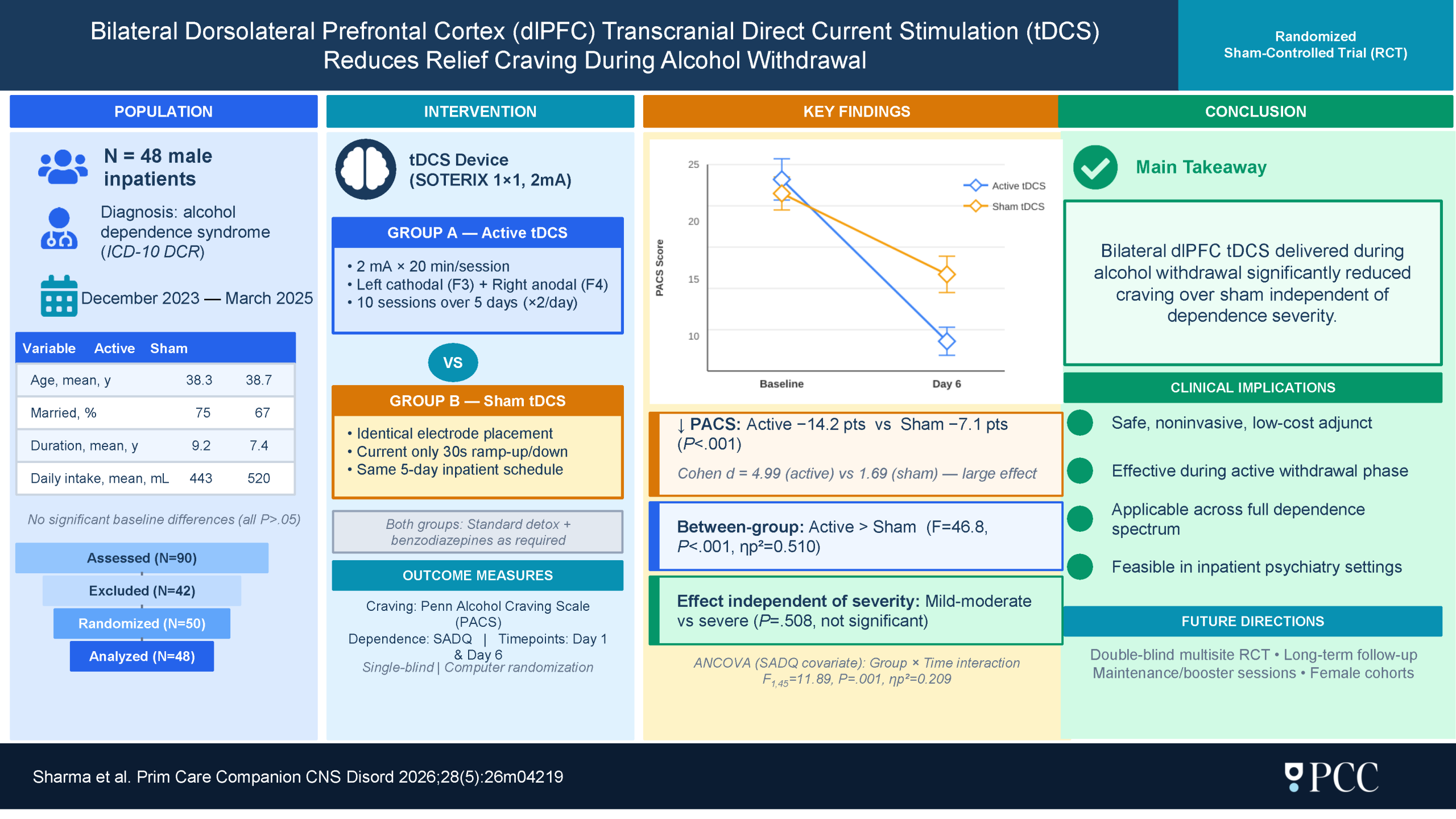
Methods: A single-blind (participant-blinded) study was conducted between March 2024 and March 2025 at a tertiary psychiatry center in Dehradun, Northern India. Fifty male inpatients meeting ICD-10 criteria for ADS were targeted; 48 completed the study and were included in the analysis. The participants had a mean age of 38.5 years and were allocated to either active tDCS (group A, n = 24; 2 mA for 20 min/session, left cathodal F3/right anodal F4) or sham tDCS (group B, n = 24) across 10 sessions over 5 days, initiated during the active withdrawal phase. Craving and dependence severity were rated with the Penn Alcohol Craving Scale (PACS) and Severity of Alcohol Dependence Questionnaire (SADQ) at baseline (day 1) and 24 hours postcompletion (day 6).
Results: PACS scores fell in both arms, but the active group’s reduction was nearly twice that of sham (14.17 vs. 7.08; P < .001). Repeated-measures analysis of covariance confirmed a group-by-time interaction independent of baseline dependence severity (F1,45 = 11.89, P = .001, ηp2 = 0.209; SADQ covariate: F1,45 = 1.20, P = .279). The anticraving effect held across both mild-to-moderate and severe dependence subgroups.
Conclusion: Bilateral dlPFC tDCS applied during the active withdrawal period produced a clinically meaningful and statistically robust reduction in relief craving that exceeded sham and was not modified by dependence severity. These findings position tDCS as an affordable, well-tolerated adjunct worthy of investigation in larger definitive trials.
Trial Registration: ISRCTN identifier: ISRCTN88255964.
Prim Care Companion CNS Disord 2026;28(5):26m04219
Author affiliations are listed at the end of this article.

Alcohol dependence syndrome (ADS) ranks among the leading contributors to preventable disability and premature mortality worldwide, with a disease profile shaped by an inability to control intake, compulsive use despite adverse consequences, and persistently high relapse rates after treatment.1,2 Craving occupies a central place in this picture. Formally recognized as a Diagnostic and Statistical Manual of Mental Disorders, Fifth Edition, diagnostic criterion, it reflects a breakdown of the cortical-subcortical regulatory axis; specifically, reduced activity within the prefrontal cortex and the consequent loss of top-down inhibition over subcortical limbic drives that fuel alcohol seeking.3–5 Standard pharmacologic and psychosocial interventions address this gap only partially; access is further constrained given that fewer than 1 in 10 individuals who would benefit actually receive pharmacotherapy, leaving a clear need for adjunctive strategies that can reach patients at the bedside.6,7
Among noninvasive brain stimulation approaches, transcranial direct-current stimulation (tDCS) has attracted particular interest. It delivers a low-intensity direct current (typically 1–2 mA) through scalp electrodes to shift neuronal membrane potential; the anodal pole increases cortical excitability while the cathodal pole dampens it.8,9 The dorsolateral prefrontal cortex (dlPFC) is the target of choice in addiction research. Neuroimaging work has consistently shown left dlPFC hypoactivity in alcohol-dependent individuals, a state that weakens inhibitory governance over craving-related neural drive.10 A bilateral montage pairing a right anodal electrode with a left cathodal electrode over the dlPFC, also termed “bipolar,” addresses this asymmetry from both hemispheres simultaneously with the cathodal pole attenuating left-hemispheric approach-motivational drive rather than correcting the regional hypoactivity itself, while the anodal pole augments right prefrontal inhibitory output. Meta-analytic evidence supports this configuration over unilateral designs.11,12 From a mechanistic standpoint, repeated sessions generate long-term potentiation (LTP)– and long-term depression–like changes in synaptic efficiency that persist beyond the stimulation window, which is an important feature for short, intensive inpatient protocols.9 Published trials of multisession bilateral dlPFC tDCS have demonstrated craving reductions and improved abstinence, including in Indian samples,12,13 while unilateral left-anodal stimulation was paradoxically associated with worsened relapse outcomes in some studies, lending further support to the bilateral approach.10
What remains largely unexamined is whether tDCS is effective when delivered before detoxification is complete during the acute withdrawal phase, which is the window in which prefrontal suppression and craving intensity are at their peak. Indian inpatient data on this question are particularly sparse. The present study was, therefore, designed to test whether bilateral dlPFC tDCS (right anodal/left cathodal) reduces relief craving more than sham over a 5-day withdrawal admission and whether any benefit is preserved across the full spectrum of dependence severity.
METHODS
Study Design and Setting
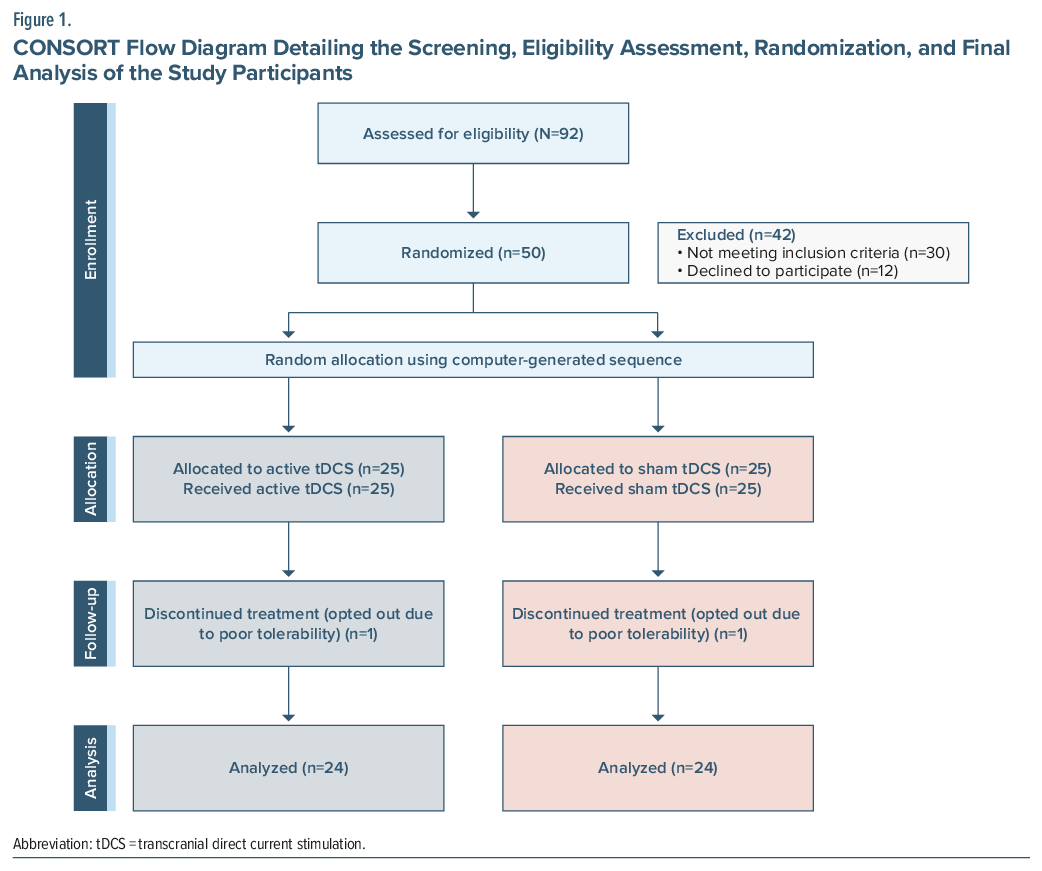
We conducted a single-blind (participant-blinded) study between March 2024 and March 2025 in the department of psychiatry of a tertiary referral hospital in Dehradun, Northern India. Ethical clearance was granted by the institutional ethics committee (SRHU/HIMS/ETHICS/2024/ 36), and written informed consent was obtained from every participant before enrollment. The trial was registered with the ISRCTN registry (ISRCTN88255964). Screening, enrollment, randomization, and analysis are detailed in the Consolidated Standards of Reporting Trials flow diagram (Figure 1).
Participants and Sampling
We targeted a total of 50 participants; 48 completed the study and were available for analysis. Sample size was computed a priori to yield 90% power at a 99% confidence level, yielding a minimum requirement of 48 participants divided equally between arms (n=24 per group). Participants were selected through purposive sampling from the ward’s available inpatient pool using prespecified eligibility criteria.
Inclusion criteria were (1) age 18–60 years (either sex); (2) confirmed International Classification of Diseases, Tenth Revision, Diagnostic Criteria for Research diagnosis of alcohol dependence syndrome14; and (3) current admission to the psychiatry inpatient ward.
Exclusion criteria comprised (1) co-occurring substance use disorder (nicotine dependence accepted), (2) any comorbid psychiatric diagnosis, (3) serious or uncontrolled medical/surgical condition, and (4) use of anticraving agents or psychotropic drugs (other than benzodiazepines for detoxification) in the preceding month.
Randomization and Blinding
After baseline assessment, each participant was assigned to group A (active tDCS) or group B (sham tDCS) using a computer-generated random allocation sequence. The treating investigator was aware of group assignments; however, participants were kept unaware of which condition they had received, constituting a single-blind design.
Intervention
Each participant received 10 stimulation sessions delivered across 5 consecutive days, comprising 2 sessions daily. Reflecting our pragmatic inpatient design, tDCS was started early in the admission during active alcohol withdrawal rather than after a minimum stabilization period. The precise timing of the first session (within hours to 1–2 days of admission) was guided by clinical readiness, and an attending physician determined that the participant was sufficiently stable to tolerate the procedure. Standard medically supervised detoxification, including benzodiazepines as required, continued alongside tDCS throughout. While this approach introduces some variability in withdrawal state at study entry, it represents a deliberate clinical choice that few prior tDCS studies have made, and its implications are explored in the limitations section.
- Group A (active tDCS): A constant direct current of 2 mA was delivered for 20 minutes per session. Electrodes were 35 cm2 rubber pads housed in saline-saturated sponge pouches and fixed to the scalp with elastic straps. The cathodal (inhibitory) electrode was positioned over the left dlPFC (electroencephalogram 10–20 site F3), and the anodal (excitatory) electrode was positioned over the right dlPFC (F4), forming a bilateral montage. Sponge hydration and electrode contact were checked before every session to maintain consistent impedance.
- Group B (sham tDCS): Electrode placement was identical to the active arm. Current was ramped up over 30 seconds at the start and ramped down over 30 seconds at the end of the 20-minute session, with no current delivered in between. This brief ramp-up replicates the tingling sensation of real tDCS and has been validated as an effective masking strategy.15
Assessments
Ratings were collected at 2 fixed time points: before the first session on day 1 (baseline) and on day 6 after the 10th session (postintervention). All assessments were conducted by the first author (T.S.), who was also the treating investigator and was therefore aware of group allocation. The following 3 instruments were used:
- Semistructured proforma: A locally developed schedule capturing sociodemographic information, alcohol use history, and family psychiatric and medical history.
- Severity of Alcohol Dependence Questionnaire (SADQ): A 20-item self-report tool yielding a total score of 0–60. Scores <16 indicate mild, 16–30 moderate, and >30 severe dependence.16
- Penn Alcohol Craving Scale (PACS): A validated 5-item measure that quantifies craving frequency, intensity, and duration; capacity to resist drinking; and overall urge in the preceding week. The PACS has well-established predictive validity for subsequent drinking behavior.17
Statistical Analysis
Raw data were entered in Microsoft Excel and transferred to SPSS version 22.0 for analysis. Continuous variables were summarized as mean ± SD and tested for normality using the Shapiro-Wilk test. Between-group comparisons of normally distributed variables used independent samples t-tests; within-group pre-to-post changes used paired t-tests. Non-normally distributed continuous variables (daily alcohol intake in mL) were compared with the Mann-Whitney U test. Categorical data were examined with χ2 or Fisher exact tests as appropriate. The primary analysis used a repeated-measures analysis of covariance (ANCOVA) with time (baseline, postintervention) as the within-subjects factor, treatment arm (active vs. sham) as the between-subjects factor, and baseline SADQ score as a covariate (type III sums of squares). Sphericity was not tested formally given only 2 time points. All hypothesis tests were 2-tailed with α set at 0.05, and the final dataset comprised only protocol completers (per-protocol analysis).
RESULTS
Participant Characteristics
Forty-eight participants completed the study: 24 in the active tDCS arm (group A) and 24 in the sham arm (group B). The cohort was entirely male, with a mean age of 38.5 years (group A: 38.33 ± 7.038 years; group B: 38.67 ± 9.154 years; Table 1).
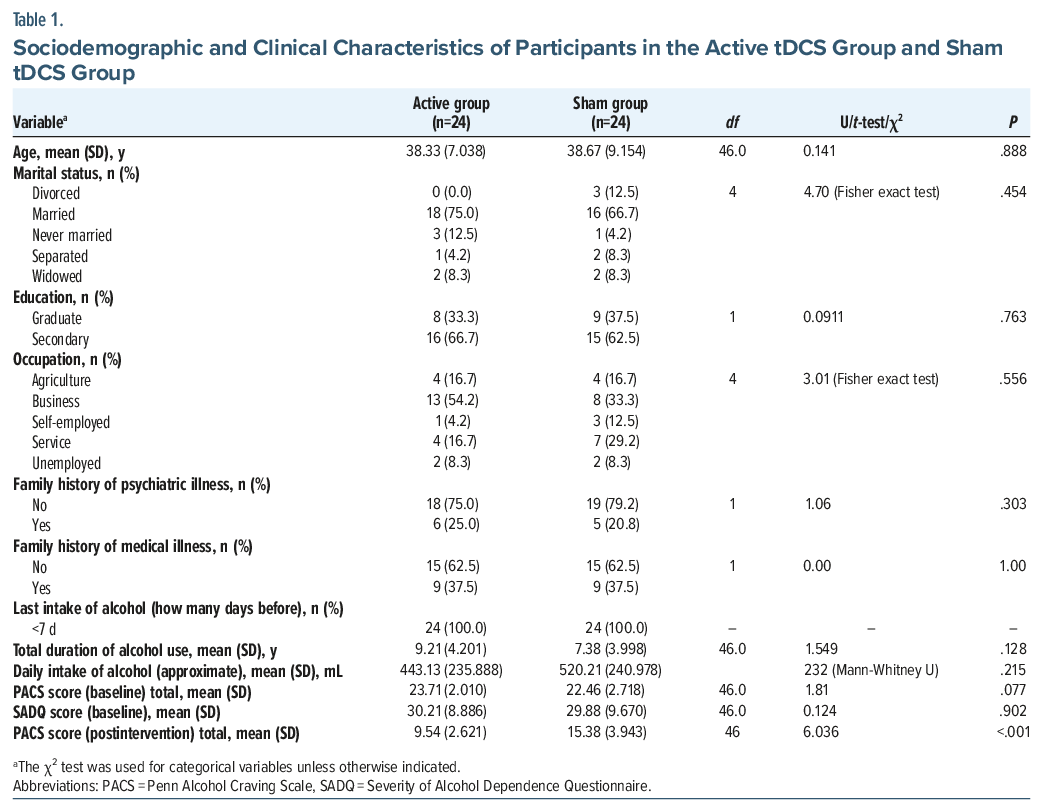
- Marital status: Three-quarters of group A participants (75.0%) and two-thirds of group B (66.7%) were married.
- Education: Secondary schooling was the modal educational level in both arms (group A: 66.7%; group B: 62.5%).
- Occupation: Business was the most frequent occupation in group A (54.2%). In group B, business (33.3%) and service (29.2%) were the 2 most common categories.
- Alcohol use history: Mean drinking duration was 9.21 years in group A and 7.38 years in group B. Estimated daily consumption was approximately 443 mL (group A) and 520 mL (group B). Every participant had drunk alcohol within the 7 days preceding admission.
- Family history: A family history of any psychiatric illness was recorded in approximately 23% of the overall sample; 37.5% reported a family history of physical illness.
- Baseline scores: Mean baseline PACS scores were 23.71 ± 2.010 (group A) and 22.46 ± 2.718 (group B). Mean baseline SADQ scores were 30.21 ± 8.886 (group A) and 29.88 ± 9.670 (group B). No statistically significant between-group differences were present at baseline on any measured variable.
Changes in Alcohol Craving (PACS scores)
Within-group changes. Group A (active tDCS): Mean total PACS scores fell from 23.71 at baseline to 9.54 at day 6, a reduction of 14.17 points that reached high significance (t = 24.449, P < .001). Group B (sham): A significant but smaller reduction was recorded in the sham group, from 22.46 to 15.38 (mean reduction of 7.08; t = 8.281, P < .001; Table 2).
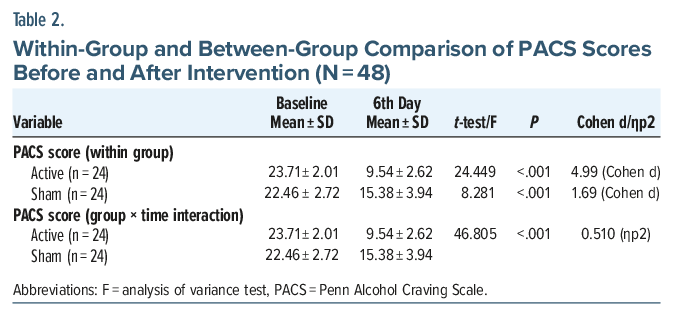
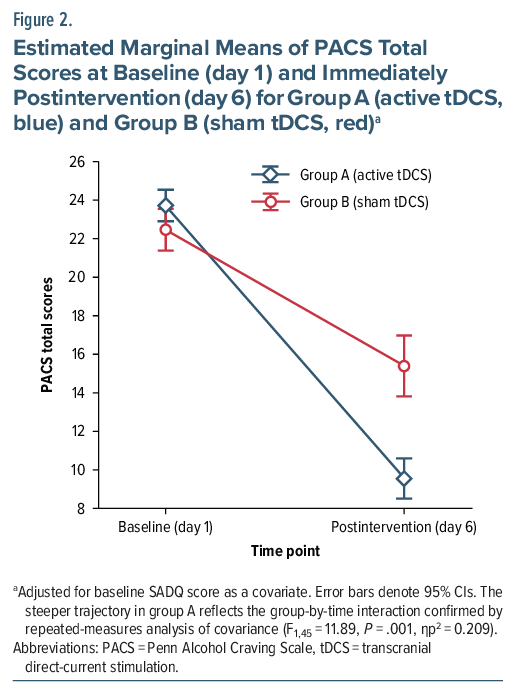
Between-group comparison. Table 2 presents the between-group contrast. The active tDCS arm achieved a mean PACS reduction of 14.17 compared to 7.08 in the sham arm, a difference of 7.09 points that was statistically significant (P < .001). To partition the treatment effect from background differences in dependence severity, we ran a repeated-measures analysis of covariance with arm (active vs. sham) as the between-subjects factor, time as the within-subjects factor, and baseline SADQ as the covariate (type III sums of squares). The active tDCS arm maintained significantly lower PACS trajectories across both time points after covariate adjustment (F1,45 = 11.89, P = .001, ηp2 = 0.209; Figure 2). Baseline SADQ did not reach significance as a covariate (F1,45=1.20, P=.279), indicating that tDCS efficacy was not moderated by initial dependence severity.
Craving Changes Based on Dependence Severity (SADQ)
Participants were stratified post hoc into “mild-moderate” (SADQ <30) and “severe” (SADQ ≥30) subgroups, a threshold selected for this analysis to divide the sample, rather than the conventional Stockwell band, to examine whether dependence severity moderated the craving response (Supplementary Table 1). Within group A, craving declined substantially in both the mild-moderate subgroup (n = 14; mean change of 14.5; P < .001) and the severe subgroup (n = 10; mean change of 13.7; P < .001). The intersubgroup difference in the magnitude of change was not significant (P = .508), indicating that efficacy was not attenuated at higher levels of dependence. group B showed significant within-group reductions in both subgroups (P < .001), but the absolute changes were smaller: 8.31 in the mild moderate and 5.64 in the severe category. When active and sham arms were compared within each severity stratum, group A consistently outperformed group B, with the active arm’s advantage reaching significance in both the mild-moderate and severe categories.
DISCUSSION
We set out to test whether 10 sessions of bilateral dlPFC tDCS delivered during the active withdrawal phase could reduce relief craving in hospitalized patients with ADS. Relief craving in this context arises from a neurobiologically distinct state: As the brain adapts to prolonged alcohol exposure and then loses its source abruptly, withdrawal generates aversive hyperexcitability (anxiety, autonomic arousal, and dysphoria), which the individual attempts to extinguish through resumed drinking. This form of craving can persist well past the resolution of acute withdrawal signs because sensitized limbic pathways remain responsive to aversive cues long after physiology normalizes. Our principal finding was that active tDCS produced approximately twice the PACS score reduction compared to sham over 5 days (14.17 vs 7.08 points), a difference that held after adjusting for baseline dependence severity, which positions bilateral dlPFC tDCS as a clinically promising add-on during the early inpatient phase.
Our craving outcome mirrors findings from several earlier trials. Klauss et al12 applied the same left cathodal/right anodal montage across 10 outpatient sessions following completed detoxification and found superior craving outcomes over sham. Boggio et al18 reported a reduction in craving after a single tDCS session in stabilized inpatients who had already completed detoxification. Astha et al13 similarly documented tDCS-associated craving reductions in an Indian inpatient sample using a multisession design. The present study extends these findings by demonstrating that the beneficial effect is achievable when stimulation is initiated during the acute withdrawal phase itself. The proposed mechanism is disruption of the imbalance between left-hemispheric approach motivation, which drives alcohol seeking, and right-hemispheric inhibitory control, which normally restrains it. Cathodal stimulation at left dlPFC attenuates limbic-linked craving drive; simultaneous anodal stimulation at right dlPFC reinforces inhibitory governance. This bilateral strategy is preferable to unilateral left anodal stimulation, which was associated in some trials with paradoxically worsened craving and relapse, an effect thought to reflect unopposed amplification of approach motivation.10 From a design perspective, this study extended previous work by using a multisession protocol, validated instruments (PACS and SADQ), rigorous sham masking, covariate adjusted analysis, and a severity-stratified secondary analysis, which is a combination rarely reported in the existing literature.19
The sham arm also showed a meaningful, though smaller, reduction in craving over the same period. Several nonspecific factors likely contributed to this result: structured ward routine, therapeutic interaction with staff and peers, ongoing benzodiazepine management, and the natural attenuation of craving that accompanies sobriety. Given that the active arm’s reduction was roughly twice as large, and remained superior after covariate adjustment, the argument can be made that a specific neurophysiological benefit was added by real stimulation over and above these general ward effects.
A secondary question was whether the response to tDCS depended on how severe the dependence was at baseline. It did not. The anticraving gains in group A were statistically indistinguishable between those classified as mild-to-moderate and those classified as severe (mean changes: 14.5 vs 13.7; P = .508). This breadth of effect is clinically useful: It means that tDCS could potentially be offered across the full severity range rather than being reserved for a selected subgroup. Replication in larger samples is needed before definitive conclusions are drawn.
The sample, which was exclusively male, mostly married, and predominantly educated to the secondary level, is consistent with the demographic profile of treatment-seeking alcohol use disorder in India, where male-to-female treatment ratios remain very high. Although this homogeneity strengthens internal consistency, it substantially limits generalizability to women and to populations with different educational or cultural backgrounds.
Several constraints should be weighed when interpreting these results. Study participants were recruited from a single center; the sample (n = 48) was adequate for the a priori power calculation but may not capture the heterogeneity of broader clinical populations. Single-blinding meant that the investigator administering assessments was not masked to group allocation, introducing a potential for measurement bias. The outcome window closed on day 6, immediately after the last session, so we cannot speak to whether craving benefits were sustained at weeks or months postdischarge, which is a critical clinical question. The absence of a standardized withdrawal-severity threshold for tDCS initiation (eg, a Clinical Institute Withdrawal Assessment for Alcohol, Revised [CIWA-Ar]20 ceiling) was a pragmatic but important design limitation. Participants entered active stimulation at varying withdrawal stages, and the neurophysiological state at the point of stimulation may influence tDCS response. We did not use a validated scale to document withdrawal severity at session 1, which would have allowed us to examine this interaction. Acknowledging the limitation, this design feature simultaneously gives the study a degree of novelty: Few prior trials have attempted to deliver tDCS during withdrawal itself rather than after a full detoxification stabilization, and the fact that benefit was achieved here suggests the approach is feasible and merits dedicated prospective investigation. A further note concerns psychometric validity, as the PACS and SADQ were administered with the assistance of a language intermediary but without a formal validated translation procedure, which may have introduced some item-level unreliability. Benzodiazepine administration was individualized rather than protocol driven, and cumulative dosing across the study period was not recorded; therefore, we were unable to test whether the active tDCS arm required less benzodiazepine supplementation, a question of both mechanistic and clinical interest that future trials should address prospectively. Finally, the equal exposure of both groups to standard inpatient care, including benzodiazepines, reduces but does not eliminate the possibility that nonstimulation factors contributed differentially to outcomes.
This study adds northern Indian inpatient data to the still-small body of evidence on tDCS for ADS. The craving reduction observed with active stimulation is consistent with the broader signal from the noninvasive brain stimulation literature in addiction, and the simplicity, low cost, and safety profile of tDCS lend practical weight to the findings.21
Future work should prioritize double-blind, multisite randomized controlled trials with follow-up periods of at least 3 to 6 months and relapse as a primary end point. Trials should also formally characterize withdrawal severity at the point of stimulation onset using the CIWA-Ar or equivalent to test whether neurophysiological state at stimulation entry moderates the tDCS response. Exploring alternative parameters (eg, high-definition tDCS, different current densities, or combined tDCS with cognitive or motivational therapies) could help optimize the intervention. Neuroimaging substudies would help map the cortical and subcortical correlates of tDCS-induced craving attenuation, which would strengthen mechanistic understanding and refine target selection in future trials. Finally, extending recruitment to female patients and other cultural settings is essential to establish the generalizability of these findings. Whether the inpatient gains achieved here can be extended through a transition to outpatient maintenance or intermittent tDCS (eg, weekly booster sessions after discharge) is a clinically compelling question. Such a stepped-care model is theoretically plausible given the LTP-like durability of multisession tDCS effects and the ongoing vulnerability to relapse after detoxification and should be evaluated in future work.
CONCLUSION
In this single-blind sham-controlled trial, 10 sessions of bilateral dlPFC tDCS (left cathodal/right anodal) delivered during the alcohol withdrawal phase produced a significantly greater reduction in relief craving than sham stimulation in male ADS inpatients. The treatment advantage was robust to covariate adjustment for baseline dependence severity and was present across both mild-to-moderate and severe dependence subgroups. These results support bilateral dlPFC tDCS as a safe, accessible, and promising adjunct for craving management in the early inpatient phase of ADS treatment, warranting investigation in adequately powered, double-blind trials with long-term follow-up.
Article Information
Published Online: September 17, 2026. https://doi.org/10.4088/PCC.26m04219
© 2026 Physicians Postgraduate Press, Inc.
Submitted: March 1, 2026; accepted May 7, 2026.
To Cite: Sharma T, Avinash PR, Victor R, et al. Bilateral transcranial direct-current stimulation over the dorsolateral prefrontal cortex significantly reduces relief craving during alcohol withdrawal: a randomized sham-controlled trial among inpatients with alcohol dependence syndrome in northern India. Prim Care Companion CNS Disord 2026;28(5):26m04219.
Author Affiliations: Department of Psychiatry, Himalayan Institute of Medical Sciences, Uttarakhand, India (Sharma, Avinash, Victor, Rikhari); Department of Psychiatry, Shri Guru Ram Rai University, Uttarakhand, India (Garg).
Corresponding Author: Shobit Garg, MD, DPM, Department of Psychiatry, Shri Guru Ram Rai Institute of Medical and Health Sciences, Shri Guru Ram Rai University, Dehradun, Uttarakhand, Pin code: 248001 India ([email protected]).
Financial Disclosure: None.
Funding/Support: None.
ORCID: Shobit Garg: https://orcid.org/0000-0001-5913-9021
Supplementary Material: Available at Psychiatrist.com.
Clinical Points
- Ten sessions of bilateral dorsolateral prefrontal cortex transcranial direct-current stimulation (tDCS) delivered during the acute alcohol withdrawal phase produced a craving reduction approximately twice that of sham stimulation, demonstrating that neuromodulation need not await the completion of detoxification to be effective.
- The anticraving benefit of bilateral tDCS was independent of baseline dependence severity, supporting its potential use across the full clinical spectrum of alcohol dependence rather than for a selected subgroup alone.
- tDCS is noninvasive, low cost, and well tolerated in medically supervised inpatient settings; clinicians managing alcohol withdrawal may consider it a feasible adjunct to standard pharmacologic detoxification for reducing craving during the early inpatient phase.
References (21)

- National Institute on Alcohol Abuse and Alcoholism. Global burden. https://www.niaaa.nih.gov/alcohols-effects-health/alcohol-topics/alcohol-facts-and-statistics/global-burden. Accessed July, 2025
- Kalivas PW, Volkow ND. The neural basis of addiction: a pathology of motivation and choice. Am J Psychiatry. 2005;162(8):1403–1413. PubMed
- Flannery BA, Roberts AJ, Cooney N, et al. The role of craving in alcohol use, dependence, and treatment. Alcohol Clin Exp Res. 2001;25(2):299–308. PubMed
- Weiss F. Neurobiology of craving, conditioned reward and relapse. Curr Opin Pharmacol. 2005;5(1):9–19. PubMed
- Koob GF, Volkow ND. Neurocircuitry of addiction. Neuropsychopharmacology. 2010;35(1):217–238. PubMed
- Miller PM, Book SW, Stewart SH. Medical treatment of alcohol dependence: a systematic review. Int J Psychiatry Med. 2011;42(3):227–266.
- Lohoff FW. Targeting unmet clinical needs in the treatment of alcohol use disorder. Front Psychiatry. 2022;13:767506. PubMed
- Lupi M, Martinotti G, Santacroce R, et al. Transcranial direct current stimulation in substance use disorders: a systematic review of scientific literature. J ECT. 2017;33(3):203–209. PubMed
- Nitsche MA, Cohen LG, Wassermann EM, et al. Transcranial direct current stimulation: state of the art 2008. Brain Stimul. 2008;1(3):206–223. PubMed
- da Silva MC, Conti CL, Klauss J, et al. Behavioral effects of transcranial direct current stimulation (tDCS) induced dorsolateral prefrontal cortex plasticity in alcohol dependence. J Physiol Paris. 2013;107(6):493–502. PubMed
- Kim HJ, Kang N. Bilateral transcranial direct current stimulation attenuated symptoms of alcohol use disorder: a systematic review and meta-analysis. Prog Neuropsychopharmacol Biol Psychiatry. 2021;108:110160. PubMed
- Klauss J, Anders QS, Felippe LV, et al. Multiple sessions of transcranial direct current stimulation (tDCS) reduced craving and relapses for alcohol use: a randomized placebo-controlled trial in alcohol use disorder. Front Pharmacol. 2018;9:716. PubMed CrossRef
- Astha PS, Patil NM, Tekkalaki B, et al. Efficacy of tDCS on craving in patients of alcohol dependence syndrome: a single-blind, sham-controlled trial. Indian J Psychiatry. 2024;66(1):98–105. PubMed
- World Health Organization. The ICD-10 Classification of Mental and Behavioral Disorders: Diagnostic Criteria for Research. World Health Organization; 1993.
- Fonteneau C, Mondino M, Arns M, et al. Sham tDCS: a hidden source of variability? Reflections for further blinded, controlled trials. Brain Stimul. 2019;12(3):668–673. PubMed
- Stockwell T, Murphy D, Hodgson R. The severity of alcohol dependence questionnaire: its use, reliability and validity. Br J Addict. 1983;78(2):145–155. PubMed
- Flannery BA, Volpicelli JR, Pettinati HM. Psychometric properties of the Penn alcohol craving scale. Alcohol Clin Exp Res. 1999;23(8):1289–1295. PubMed
- Boggio PS, Sultani N, Fecteau S, et al. Prefrontal cortex modulation using transcranial DC stimulation reduces alcohol craving: a double-blind, sham-controlled study. Drug Alcohol Depend. 2008;92(1-3):55–60. PubMed
- Chan YH, Chang HM, Lu ML, et al. Targeting cravings in substance addiction with transcranial direct current stimulation: insights from a meta-analysis of sham-controlled trials. Psychiatry Res. 2024;331:115621. PubMed
- Sullivan JT, Sykora K, Schneiderman J, et al. Assessment of alcohol withdrawal: the Revised Clinical Institute Withdrawal Assessment for Alcohol Scale (CIWA-Ar). Br J Addict. 1989;84(11):1353–7.
- Sreeraj VS, Arumugham SS, Venkatasubramanian G. Clinical practice guidelines for the use of transcranial direct current stimulation in psychiatry. Indian J Psychiatry. 2023;65(2):289–296. PubMed
Please sign in or purchase this PDF for $40.