
Abstract
Electroconvulsive therapy (ECT) is associated with early benefits and with high response and remission rates in patients with depression; recovery from depression may, in turn, carry short- and long-term benefits. This article examines observational data on short- and long-term all-cause mortality, nonsuicide mortality, and suicide mortality following treatment of depression with ECT. To frame the subject in its proper context, a very large meta-analysis found that, relative to nondepressed or general population controls, depression was associated with a doubled risk of all-cause mortality, a tenfold risk of suicide mortality, and an increased risk of mortality in the presence of a wide range of medical comorbidities. All-cause mortality risks were also higher in psychotic depression relative to nonpsychotic depression and in treatment-resistant depression relative to depression that was not treatment-resistant. Three meta-analyses on mortality risks following ECT were published in 2025; these had partially, but not fully, overlapping datasets. The overall impression from these meta-analyses was that ECT-treated depressed cohorts were at lower risk of all-cause mortality, nonsuicide mortality, and natural cause mortality relative to comparison cohorts receiving treatments other than ECT. The all-cause mortality benefit was evident early as well as during long-term follow up. ECT-treated cohorts were also at lower risk of suicide mortality, though this finding appeared to be limited to the initial months posttreatment. Possible explanations for the findings are considered. Confounding by indication and confounding by severity of indication may also play a role, though more against ECT than in favor of ECT. Although cause-effect relationships cannot be asserted from observational studies, these findings encourage the use of ECT in depressed subjects for whom ECT is indicated. However, these findings cannot be extrapolated to all depressed samples.
J Clin Psychiatry 2026;87(4):26f16659
Author affiliations are listed at the end of this article.

Electroconvulsive therapy (ECT), introduced in 1938, nearly a century ago, was the first meaningfully effective treatment to become available for major mental illness. This somatic intervention, with many methodological and technical improvements, remains relevant today as, arguably, a gold standard treatment for severe depression; however, its use is largely restricted to depressed patients who are very severely ill, suicidal, psychotic, catatonic, and/or treatment-refractory. In most patients, ECT tends to be a last resort treatment when other treatments fail; however, it is still recommended as a first-line intervention in treatment guidelines for very severe and/or life-threatening situations.1
ECT: Immediate and Long-term Benefits
ECT is associated with early antidepressant benefits; however, recovery from depression may carry (other) short- and long-term benefits. Recent observational studies have shown that ECT may be associated with a lower risk of short- and long-term all-cause mortality, nonsuicide mortality, and suicide mortality. This article provides a short review on the subject.
Depression: Mortality Risks
Population-based studies suggest that life expectancy in depressed cohorts is 4–8 years less than that in comparison cohorts.2,3 The excess mortality is due to an increased risk of suicide, but also due to medical comorbidities, including cardiovascular disease and cancer.3 In this context, Chan et al4 examined mortality risks in depression in a systematic review and meta-analysis of 268 cohort studies that included 10,842,094 subjects with depression and 2,837,933,536 controls. Almost all the studies had been conducted in North America or Europe.
Important findings from the meta-analysis4 are presented in Table 1. In summary, relative to nondepressed subjects or subjects in the general population, depression was associated with a doubled risk of all-cause mortality, a tenfold risk of suicide mortality, and an increased risk of mortality in the presence of a wide range of medical comorbidities. All-cause mortality risks were also higher in psychotic depression relative to nonpsychotic depression, and in treatment-resistant depression relative to depression that was not treatment-resistant.
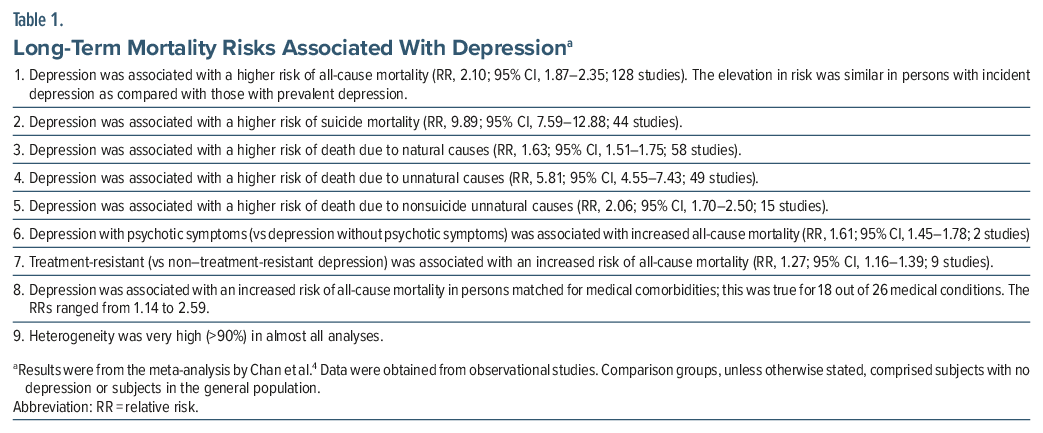
Although unstated, it is likely that many if not most of the patients in the depressed cohorts had been treated. The implication is that, despite treatment, depression is associated with increased mortality risks.
A limitation of these findings is that information was not provided about the median duration of cohort follow up in each analysis, so we do not know the time frame across which these risks apply. However, data from a very small number of studies (k=2–4) suggested increased risks during the first 6 months, at 6–12 months, and at 1–5 years after depression diagnosis; the risk was highest during the first 6 months.
Another limitation is that, in order to include as many studies as possible, the authors had to make many assumptions and compensations. For example, they used averages for standard errors and confidence intervals when these were not available in the source studies; they took odds ratios (ORs), relative risks (RRs), hazard ratios (HRs), incidence rate ratios, and standardized mortality risks (SMRs) as equivalent constructs and pooled all into a single estimate that they called relative risk; and they created comparison groups from census data, where required, when the SMR was used. Finally, almost all analyses were associated with marked (>90%) heterogeneity.
In the light of the above, the values that the authors4 presented as RRs (Table 1) are best viewed as impressions rather than as estimates. A reasonable impression is that depression is associated with increased suicide, nonsuicide, and all-cause mortality (the last, regardless of context). An unanswered question is whether this conclusion also applies to adequately treated, treatment-responsive, and treatment-adherent patients.
Meta-analysis 1: ECT and Mortality Risks4
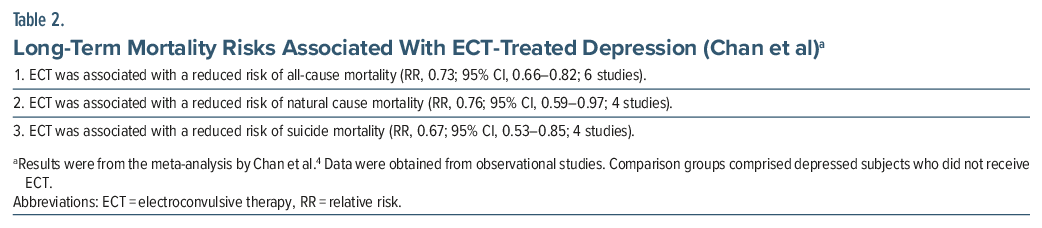
The meta-analysis by Chan et al4 also examined mortality associated with antidepressant-treated and ECT-treated depression (Table 2). In summary, ECT was associated with a reduced risk of all-cause mortality, natural cause mortality, and suicide mortality. Whereas these findings should be interpreted with the caveats expressed in the previous section, 2 observations are salient. First, antidepressant treatment was associated with a reduced risk of only all-cause mortality. Second, in the ECT analyses, many if not most of the “no ECT” controls would have received antidepressant treatment. These 2 observations provide indirect evidence that ECT may be superior to antidepressant treatment for the reduction of suicide mortality, natural cause mortality, and all-cause mortality associated with depression.
Meta-analysis 2: ECT and Mortality Risks5
In what is perhaps a combination of the largest and most recent meta-analysis on the subject, Rhee et al5 identified 1 randomized controlled trial and 16 cohort studies that followed unipolar depressed, bipolar depressed, or schizoaffective patients who had received ECT. Half of the studies had been conducted in the US. The pooled sample comprised 1,182,501 subjects of whom 40,867 had received ECT and 1,141,634 (control subjects) had received other interventions.
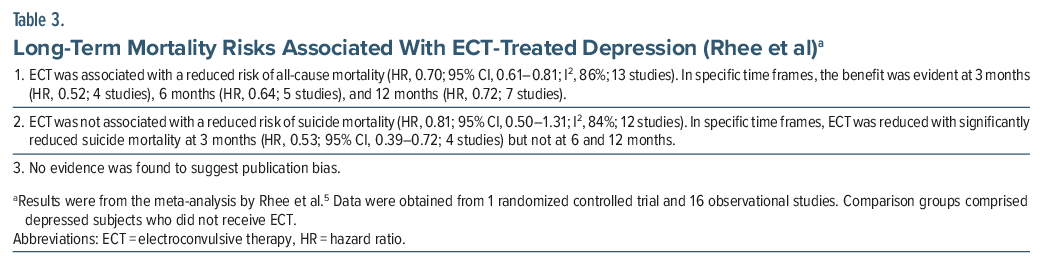
Important findings from this meta-analysis5 are presented in Table 3. In summary, ECT was associated with reduced suicide mortality, but only at a 3-month follow up. Notably, ECT was associated with reduced all-cause mortality, with the magnitude of benefit gradually reducing from 3 months through 6 months to 12 months. ECT was associated with a significant reduction in all-cause mortality but not of suicide mortality in end-of-study follow up analyses.
Limitations of this meta-analysis5 were that the authors treated ORs, RRs, and HRs as HRs even though these statistics have different meanings and derivations (fortunately, at least 10 studies provided HRs); they did not present median duration of follow up for the end-of study analyses (but the forest plots had the numbers 3 or 12 entered for “duration” with no explanation for what these numbers represented); and heterogeneity was very high.
Meta-analysis 3: ECT and Mortality Risks6
Another very recent meta-analysis,6 curiously, pooled results from only those studies that reported events for all 3 outcomes of interest: all-cause mortality, nonsuicide mortality, and suicide mortality. In consequence, this meta-analysis had far fewer studies than that of Rhee et al5; it is considered in this article only because it included 3 studies that had not been included by Rhee et al.5
Important findings from this small meta-analysis6 are presented in Table 4. In summary, ECT was associated with a reduced risk of all-cause mortality and nonsuicide mortality, but not of suicide mortality.
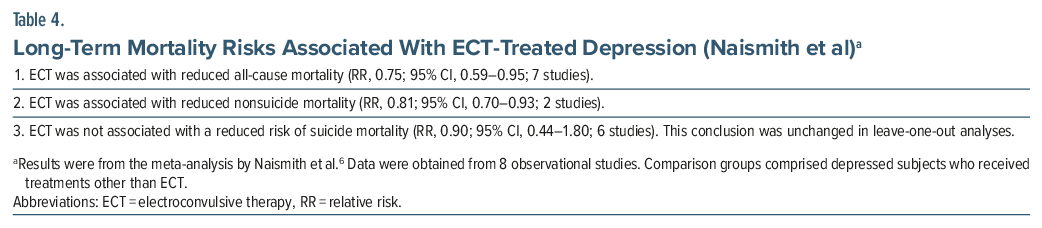
Limitations of this meta-analysis6 were that it did not include many eligible studies, the median duration of follow up for each analysis was not presented, and heterogeneity was high. Curiously, the authors presented their results as logRRs; these are nonintuitive, and so exponentiated values are presented in Table 4 for the benefit of readers. A further critique of this meta-analysis6 was provided by Kellner et al.7
Other Studies
There are probably other studies that the meta-analyses discussed in this article4–6 did not include. As an example, in a population-based cohort study that examined how ECT affects the risk of dementia, Kirov et al8 presented an additional finding: that ECT was associated with a reduced risk of mortality at an approximately 25-year follow up (HR, 0.81; 95% CI, 0.75–0.88).
Confounding
Almost all of the studies in the meta-analyses4–6 considered in this article were observational in design; that is, depressed subjects had not been randomized to ECT vs other treatments. As a result, variables that biased patients toward receiving ECT may have biased the study outcomes, as well.
As an example, patients have to be fit to receive anesthesia to be fit for ECT. So, patients who were contraindicated for anesthesia may not have received ECT, and their medical comorbidities may have predisposed to early mortality in the non-ECT groups. Whereas it is likely that comorbidities were adjusted for, it is very unlikely that information on severity of comorbidity would have been available for adjustment. Thus, the analyses may have been confounded by severity of (contra)indication.
In contrast, ECT is usually reserved for patients who are severely ill, those who are suicidal, and those who are treatment resistant.1 Whereas treatment resistance is likely to have been adjusted for in analyses, it is very unlikely that data on illness severity or presence of suicide risk would have been available for adjustment. Thus, the analyses may have been confounded by severity of indication. Given that this confounding is far more likely than the confounding considered above, and given that this confounding would prejudice outcomes against ECT, it is telling that, despite starting at a disadvantage, and despite the disadvantages not being adjusted for in analyses, ECT was associated with reduced risk of all-cause mortality, nonsuicide mortality, and early suicide mortality.
Posttreatment bias could also influence outcomes. As an example, ECT treatment may be followed by continuation and maintenance ECT, which is well-known to reduce relapse risk.9 Or, patients treated with ECT may be followed and treated more intensively. In both scenarios, outcomes could be expected to favor the ECT-treated cohorts.
Mechanisms
How might ECT-associated mortality reductions be explained? The early antisuicidal effect of ECT is beyond dispute, which is why ECT is preferentially indicated for patients at high suicide risk. This could be the reason for early reduction in suicide mortality in ECT-treated cohorts.5
Depression-related risk factors for higher morbidity and mortality (relative to nondepressed subjects) include poor adherence to healthy lifestyle (diet, exercise) behaviors, and poor adherence to recommended medical regimens. Given that ECT is associated with high response and remission rates, and with earlier remission relative to conventional antidepressant drugs, it is possible that better psychiatric outcomes with ECT better reduce mortality risk factors associated with depression. It is interesting that the benefits persist into the long term.
Summary
Despite treatment, depression (relative to nondepressed or general population controls) is associated with increased all-cause mortality, nonsuicide mortality, and suicide mortality. In observational studies, ECT-treated cohorts are at lower risk of all-cause mortality, nonsuicide mortality, and natural cause mortality relative to comparison cohorts receiving treatments other than ECT. The all-cause mortality benefit is evident early as well as during long-term follow up. ECT-treated cohorts are also at lower risk of suicide mortality, though this finding may be limited to the initial months posttreatment.
Although cause-effect relationships cannot be asserted from observational studies, these findings encourage the use of ECT in subjects for whom ECT is indicated. However, these findings cannot be extrapolated to all depressed samples.
Parting Notes
The meta-analyses discussed in this article presented RRs and HRs. However, they did not present absolute risks of mortality in ECT and comparator groups. So, we don’t have an idea about the absolute risk reduction at a specific endpoint, and we don’t have numbers needed to treat (NNT) outcomes.
In explanation, in cohort studies patients are followed for different durations, and drop out tends to be substantial. So, time-to-event analyses become necessary, and absolute risks and NNTs can’t be estimated. There is also the problem that, even if outcomes were assessed at, for example, 3 months or 1 year, absolute risks and NNTs would not be valid because they would not be adjusted for baseline confounds.
Article Information
Published Online: August 31, 2026. https://doi.org/10.4088/JCP.26f16659
© 2026 Physicians Postgraduate Press, Inc.
To Cite: Andrade C. Electroconvulsive therapy and all-cause mortality, nonsuicide mortality, and suicide mortality. J Clin Psychiatry 2026;87(4):26f16659.
Author Affiliations: Department of Clinical Psychopharmacology and Neurotoxicology, National Institute of Mental Health and Neurosciences, Bangalore, India; Department of Psychiatry, Kasturba Medical College, Manipal Academy of Higher Education, Manipal, India.
Corresponding Author: Chittaranjan Andrade, MD, Department of Clinical Psychopharmacology and Neurotoxicology, National Institute of Mental Health and Neurosciences, Bangalore 560029, India ([email protected]).
Relevant Financial Relationships: None.
Funding/Support: None.
 Each month in his online column, Dr Andrade considers theoretical and practical ideas in clinical psychopharmacology with a view to update the knowledge and skills of medical practitioners who treat patients with psychiatric conditions.
Department of Clinical Psychopharmacology and Neurotoxicology, National Institute of Mental Health and Neurosciences, Bangalore, India. Please contact Chittaranjan Andrade, MD, at Psychiatrist.com/contact/andrade.
References (9)

- Lam RW, Kennedy SH, Adams C, et al. Canadian Network for Mood and Anxiety Treatments (CANMAT) 2023 update on clinical guidelines for management of major depressive disorder in adults: réseau canadien pour les traitements de l’humeur et de l’anxiété (CANMAT) 2023 : mise à jour des lignes directrices cliniques pour la prise en charge du trouble dépressif majeur chez les adultes. Can J Psychiatry. 2024;69(9):641–687. PubMed CrossRef
- Bitter I, Szekeres G, Cai Q, et al. Mortality in patients with major depressive disorder: a nationwide population-based cohort study with 11-year follow-up. Eur Psychiatry. 2024;67(1):e63. PubMed CrossRef
- Lo HKY, Chan JKN, Wong CSM, et al. Excess mortality and life-years lost in people diagnosed with depression: a 20-year population-based cohort study of 126,573 depressed individuals followed for 1,139,073 persons-years. Eur Neuropsychopharmacol. 2025;91:1–8. PubMed CrossRef
- Chan JKN, Solmi M, Lo HKY, et al. All-cause and cause-specific mortality in people with depression: a large-scale systematic review and meta-analysis of relative risk and aggravating or attenuating factors, including antidepressant treatment. World Psychiatry. 2025;24(3):404–421. PubMed CrossRef
- Rhee TG, Shim S, Nasir M, et al. Longitudinal associations of electroconvulsive therapy with all-cause mortality and suicide deaths in severe unipolar or bipolar depression: a systematic review and meta-analysis. BMJ Ment Health. 2025;28(1):e302083. PubMed CrossRef
- Naismith H, Wilson J, Costello H, et al. Systematic review and meta-analysis of the effectiveness of ECT in reducing suicidal ideation, self-harm, suicide, and mortality. Psychol Med. 2025;55:e328. PubMed CrossRef
- Kellner CH, Espinoza RT, Gligorovic P, et al. Electroconvulsive therapy (ECT) reduces suicidal behavior and suicide deaths: response to Naismith et al. Psychol Med. 2025;55:e371. PubMed CrossRef
- Kirov G, Simmonds E, Kaster T, et al. Risk of dementia after electroconvulsive therapy: a cohort study on the population of Wales. Acta Psychiatr Scand. 2025;152(4):270–277. CrossRef
- Jørgensen A, Gronemann FH, Rozing MP, et al. Clinical outcomes of continuation and maintenance electroconvulsive therapy. JAMA Psychiatry. 2024;81(12):1207–1214. PubMed CrossRef
This PDF is free for all visitors!