
Abstract
Ketamine can be administered in more than a dozen different ways for on-label and off-label indications. Oral ketamine, administered as a liquid repurposed from ketamine for injection, is one way in which ketamine is used to treat depression and chronic pain. Such repurposing may seem unorthodox but has been reported for at least the past 3 decades from many countries, including Canada, England, India, Israel, Japan, New Zealand, and the United States. Oral ketamine, thus administered, is noninvasive, and a safe and inexpensive option for medical practitioners who treat severe, suicidal, and/or treatment-resistant depression. It is safe because, when administered as a liquid in a glass of water or fruit juice, it can be sipped across 20–30 min; treatment-emergent dissociative, neurological, and other psychophysiological effects are thereby minimized. It is inexpensive because there are no costs associated with patented formulations, hospitalization, monitoring facilities, and additional personnel. Because of its simplicity, safety, and inexpensiveness, oral ketamine represents an opportunity for low-resource settings, especially in low- and middle-income countries. This article is intended to be a teaching article. It presents a brief theoretical background to the use of ketamine in the treatment of depression, justifies oral ketamine as an alternative to intranasal and intravenous routes of administration, explains clinical contexts in which the intervention can be used, and presents a detailed protocol for the use of oral ketamine. Matters considered are fitness for oral ketamine, consenting, facilities required, instructions on how to conduct the session, dosing, monitoring, ending the session, scheduling future sessions, continuation and maintenance therapy, domiciliary use, and many others. Drug interactions and concurrent medications are also discussed. This article is therefore a prescriber’s guide to the use of oral racemic ketamine that could, it is hoped, make ketamine available in settings in which it is currently unavailable but needed.
J Clin Psychiatry 2026;87(3):26f16110
Author affiliations are listed at the end of this article.
From the Editors

Are you a healthcare provider?
Add your NPI to personalize your JCP experience.
A large body of research from many different countries supports the off-label use of ketamine, and the on-label use of intranasal esketamine, for patients with depression, especially treatment-resistant depression (TRD), and for suicidal ideation in depression.
Vision
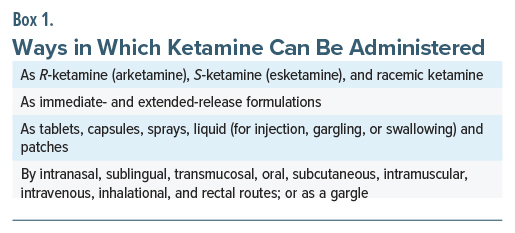
Ketamine can be administered in more than a dozen different ways (Box 1). The 2 most researched and most preferred ways are to administer racemic ketamine by the intravenous (iv) route and esketamine by the intranasal route. In low- and middle-income countries (LAMIC), iv ketamine is typically available and offered only in tertiary care settings, and usually in cities; that is, far from towns and villages, where a sizeable proportion of the population lives. Furthermore, in LAMIC settings, intranasal esketamine is either unavailable or unaffordable, especially in semi-urban and rural areas.
There is a large opportunity, especially in resource-constrained LAMIC settings, for oral racemic ketamine to be used as a simple and inexpensive option (cost, less than half a US dollar per session) to manage severe or difficult-to-treat depression, and crises associated with the depressive state.1 This article therefore presents a prescriber’s guide to the use of oral racemic ketamine that could, it is hoped, make ketamine available for depressed and suicidal patients in settings in which it is currently unavailable but needed, including in primary care. This article is best read along with the articles on this subject published earlier in this column.2,3
Target Audience
This article is intended to encourage and guide the responsible use of oral racemic ketamine by modern medicine practitioners who are licensed to diagnose and pharmacologically treat major mental illness. This article may educate but is not intended to empower other categories of individuals, including laypersons, wellness facilitators, and practitioners of alternative medicine.
Caveats
Ketamine is a restricted substance in nearly all if not all parts of the world. Ketamine is a misused drug as in, for example, date rape.4 Ketamine is an abused drug, either at an individual level or in rave parties.5 Long-term, high dose exposure to ketamine may be associated with adverse medical consequences, including potentially irreversible bladder disease.6 These, and country-specific laws regarding the availability and use of ketamine, are serious matters that oral ketamine prescribers must keep in mind.
The contents of this article may take many medical practitioners out of their comfort zone, especially those who live and work in litigation-prone countries and countries with rigid or insurance-driven healthcare systems. This article illustrates what is possible when need drives innovation and when circumstances permit such innovation. Readers may note that what is described here is a refinement of what has been and is being done in more than half a dozen countries across the world, dating back for 3 decades, and what is currently widely practiced in at least one country.
Preliminary Notes
The responsible use of ketamine to treat depression requires the prescriber to be well-informed about theory as well as practice. Whereas this article emphasizes practice (later sections of this article), principles are also considered and referenced (earlier sections of this article). Practitioners need to have an adequate knowledge base to understand and appropriately use the teaching in this article.
The contents of this article are based on published literature; on the author’s own (published; completed and under preparation for publication; and ongoing) research experience; and 10 years of clinical experience with treating patients with oral ketamine. This is a “teaching” article, based on workshops that the author conducts.
No attempt has been made to comprehensively review the use of ketamine in depression and neuropsychiatry. Information presented in this article is mostly need-to-know and is focused on and around oral ketamine.
Food for Thought
When a patient has a visible injury and is in pain, we offer immediate pain relief, and not a treatment that needs to be taken for 4–6 weeks before efficacy is evident, if indeed the treatment is effective. When a patient is depressed, the injury is not visible, but the patient nevertheless suffers and may even be at risk of suicide. Electroconvulsive therapy (ECT) may be offered, such as when illness is severe or associated with high risk of suicide. Oral ketamine is far less heroic an intervention than ECT and has the advantage of not being associated with anterograde and retrograde amnesia. Oral ketamine is therefore a potentially useful noninvasive intervention to rapidly reduce suicidal ideation, relieve suffering, and return the severely depressed patient to a functional state in personal, social, family, and work domains. Given its simplicity, there may not be a need to reserve its use for TRD.7
In the light of the above, knowing how to use ketamine, especially oral ketamine, has the potential to change the way we manage depression. Knowing how to use ketamine may also become a need in psychiatric training, much as training in ECT and psychotherapy is a need.8
Ketamine Is Not Just an Anesthetic Drug
Ketamine was developed as a phencyclidine congener in 1962. It was introduced as an anesthetic drug in 1965. By 1970, its use in anesthesia was already well described.9–12 However, particularly in subanesthetic doses, ketamine is now used for many indications beyond anesthesia.
Carbamazepine is used as a treatment for epilepsy, trigeminal neuralgia, and bipolar disorder. Valproate is used as a treatment for epilepsy, bipolar disorder, and migraine. Thus, carbamazepine and valproate are not merely antiepileptic drugs; what they are depends on what they are used for. Readers will immediately appreciate that antidepressants, benzodiazepines, antipsychotics, and even general medical drugs such as aspirin are used in multiple diagnostic contexts. Therefore, to the questions “Why are you using an anesthetic drug to treat depression?” and “Why aren’t you including an anesthesiologist in a supervisory capacity during the session?”, the answers are straightforward. Ketamine, in subanesthetic doses, produces drowsiness or modest sedation; it does not produce anesthesia. And, in these doses, it has demonstrated efficacy against depression. That is, when used to treat depression it is an antidepressant drug and not an anesthetic drug.
As a side note, when ketamine is used as an induction agent in anesthesia, it is administered as an iv bolus dosed at 2–3 mg/kg. In contrast, when iv ketamine is used to treat depression, the dose is only 0.5–0.8 mg/kg, administered not as a bolus but as an infusion that typically stretches across 40 min; the patient may experience drowsiness but not anesthesia.13 It is not possible for orally administered ketamine, sipped across 20–30 min (as recommended in this article), to produce anesthesia.
Psychiatrists need to be aware of these challenges and of responses that they can provide to such challenges because, to date, only intranasal esketamine and iv ketamine have been approved for depression and postsurgical pain, respectively (so, off-label use may raise questions among the uninformed).
Ketamine: Approvals
Racemic ketamine, which is a 1:1 mixture of R– and S-ketamine,14 was originally approved, over half a century ago, as a “safe” anesthetic drug; it did not suppress respiration or cardiovascular parameters.
As a side note, in testimony to its safety in careful hands, a prospective study 15 reported the uneventful use of ketamine in 401 consecutive emergency cesarean section operations. In this study, because no anesthesiologist was available, ketamine was administered as anesthesia by 54 trained healthcare providers who did not have a qualification in anesthesiology and who received a mere 5 days of training. This example is provided not to endorse the use of ketamine as anesthesia by non-anesthesiologists but to propose the safety of subanesthetic dosing, under carefully constructed protocols, by psychiatrists.
Subsequently, approvals were obtained for subanesthetic dosing. In 2019, intranasal esketamine was approved in the US as an adjunct to antidepressant drugs for TRD in adults; and, in 2020, it was approved for suicidality associated with depression in adults. In 2025, intranasal esketamine was approved in the US as monotherapy for TRD in adults, and iv ketamine was approved for postsurgical pain management. And, in 2026, iv ketamine was approved in France for the treatment of severe suicidal crisis in adults.16,17
Ketamine: On-and Off-label Uses of Subanesthetic Doses
In subanesthetic doses, ketamine has demonstrated efficacy in adult as well as in pediatric practice for many on-and off-label indications. The strongest evidence is for treating depression and suicidality associated with depression.18,19 Ketamine may also be useful, in combination with psychotherapy, for treating alcohol use disorder20 and cocaine dependence.21 Ketamine has been investigated for other psychiatric conditions, as well, including generalized anxiety disorder, social anxiety disorder, obsessive-compulsive disorder, and posttraumatic stress disorder, but results have been equivocal or disappointing.
Intramuscular (im) ketamine has been used to treat agitation and violence in preemergency as well as emergency room settings.22–24 Ketamine has long been used for procedural sedation in children and adults for dental and radiological procedures and in the emergency room25–29; children even below age 3 years have thus received ketamine.30,31
As a special note here, in 7 randomized controlled trials (RCTs) describing the use of oral ketamine for procedural sedation in children, doses used were 5–10 mg/kg.31 For a 60 kg adult, this amounts to 300–600 mg of ketamine per dose. In contrast, antidepressant doses of oral ketamine recommended in this article are in the 150–200 mg range in adults; and the oral ketamine so administered (in solution) is intended to be sipped across 20–30 min, not gulped down. This indirectly supports the safety of the protocols described in this article.
Ketamine has a history of use in pain management dating back for at least 5 decades. It was used during the Vietnam War as a buddy drug on the battlefield; soldiers injected wounded companions with ketamine to manage pain until medical assistance arrived.16 Ketamine has been used to treat pain of various natures and in various settings, from post-intubation sore throat and refractory headache to cancer pain, post-operative pain, and pain associated with trauma.32–36
Finally, ketamine has been used to treat bronchial asthma37 and status epilepticus38 but is not an established agent for either condition.
Clearly, ketamine is much more than just an anesthetic drug.39
Ketamine for Depression: The Rise of Intravenous Treatment
Between 1970 and 2019, ketamine had only anesthesia as an on-label indication. As a result, it was marketed only in injectable form because its use in anesthesia required administration by the iv route. Although ketamine for injection could also be administered by im and subcutaneous (sc) routes, the iv route was largely favored for study in non-anesthesia contexts because ketamine effects were variable in onset and character when the treatment was administered im or sc.
In 1994, a crossover RCT40 found that iv ketamine, dosed at 0.5 mg/kg and infused across 40 min, elicited positive, negative, dissociative, cognitive, and other symptoms in healthy volunteers whereas a similarly administered 0.1 mg/kg infusion had only small effects. In 2000, a small crossover RCT41 found that ketamine had marked antidepressant effects within 72 h of infusion in adults experiencing a major depressive episode; these authors also infused ketamine at 0.5 mg/kg across 40 min. In 2006, another small crossover RCT42 used the same dosing formula to demonstrate the antidepressant effects of ketamine at 1 and 7 days postdosing in adults with TRD.
Subsequently, a large number of clinical trials confirmed the acute antidepressant and also antisuicidal properties of ketamine; most studies dosed ketamine using the “follow the leader” formula: 0.5 mg/kg infused across 40 min.43 Regrettably, the door to regulatory approval research initiatives addressing other dosing strategies was shut because racemic ketamine is an out-of-patent drug.44 So, although oral dosing of ketamine is simple, convenient, and “dirt-cheap” (less than half a US dollar per session, at cost), it was relatively neglected in research.
In adult psychiatry, we mostly administer drugs orally, and we mostly administer fixed doses; we do not dose drugs variably, per kg body weight; if oral bioavailability is poor (as for drugs such as propranolol, agomelatine, ramelteon, and lurasidone), we administer appropriately higher doses. So, why not do likewise with ketamine? Arguments in favor of oral racemic ketamine, especially for use in LAMIC settings, are presented elsewhere and are not repeated here.1,43,44 Interested readers are strongly encouraged to consult these articles.
Ketamine for Depression: Efficacy
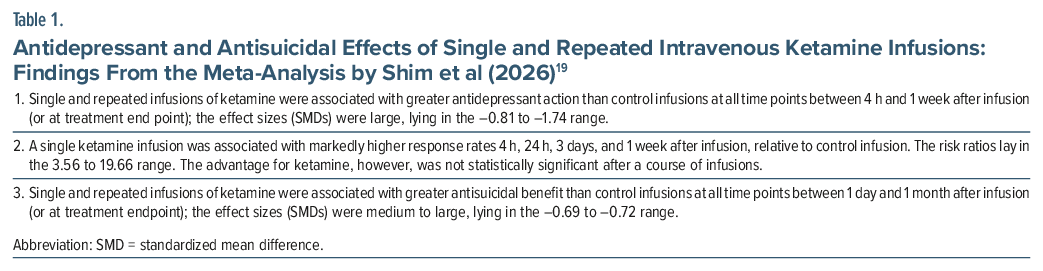
Single and repeated infusions of iv ketamine have demonstrated robust antidepressant and antisuicidal effects. These were illustrated in a recent meta-analysis of 26 RCTs (pooled N = 1,166) conducted in patients experiencing a major depressive episode.19 The findings of the meta-analysis are summarized in Table 1. The meta-analysis found that iv ketamine, relative to control treatment, reduced depression and suicidality with large effect sizes, and increased the response rate with large risk ratios, but did not carry an advantage for remission rates.
Readers may note that ketamine may have dramatically rapid antidepressant and antisuicidal effects, but it is not a magical drug; everybody does not respond or remit, and the effect is short-lasting and tends to wear off in approximately a week unless maintained by other means, such as repeated dosing.
One RCT compared 7 alternate day sessions of oral (150 mg sipped across 15 min) and iv (0.5 mg/kg infused across 40 min) ketamine in 61 adult outpatients with TRD.45 Oral and iv ketamine groups did not differ significantly in depression rating improvements and in response and remission rates on days 14 and 30. Oral ketamine was associated with a lower dropout rate than iv ketamine (26.7% vs 54.8%). Headache (56.7% vs 74.2%) and drowsiness (0.0% vs 22.6%) occurred less frequently with oral than with iv ketamine.
Other clinical trials of oral ketamine, dosed as described later in this article, found that the treatment rapidly reduced depression and suicidal ideation.46,47
Ketamine for Depression: Adverse Effects
The adverse effects of ketamine are well documented in literature.48,49 These depend on the dose administered, on the route of administration, and on the speed of administration; with oral ketamine, patients who sip the dose more slowly experience fewer adverse effects46 than those who either sip faster47 or gulp down the entire dose.
Tolerance develops to many of the adverse effects of ketamine50; adverse effects are fewer in the last session of a course than in the first session. In patients who are on long-term maintenance therapy with oral ketamine, dissociative and other psychophysiological effects may be few and mild even if the ketamine is gulped down.
Ketamine does transiently increase heart rate and blood pressure,48 but, to provide a sense of perspective, the magnitude and duration of increase are well within the increases associated with recommended programs of cardiorespiratory and muscle-strengthening exercise.3 The increases are small with oral dosing, especially when sipping duration is prolonged. As an example, a study that dosed oral ketamine at 150 mg, sipped across 10–15 min, found that the median (maximum) increase in heart rate was 2 bpm, and the median (maximum) increases in systolic and diastolic blood pressure were 10 mm Hg each.46
Patients are usually awake all through the ketamine session. However, if patients sip the ketamine dose quickly, such as in <10–15 min, they may wish to end the session with a nap that is typically 30 min in duration.
During iv ketamine sessions, blood levels are well below those associated with ketamine anesthesia, and below levels associated with awaking from anesthesia. Oxygen saturation is normal, and respiration is normal.13
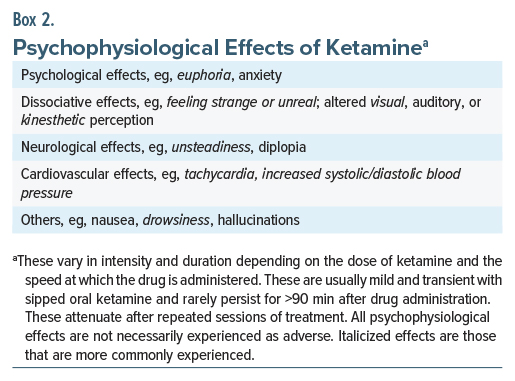
Commonly reported psychophysiological effects, many of which are not necessarily experienced as adverse, are presented in Box 2. These psychophysiological effects usually wear off within 1 h of drug administration, and almost always completely wear off within 2 h.
Ketamine-induced uropathy is well-known in persons who misuse the drug in high doses and for long periods. Ketamine-induced uropathy is very unlikely with ketamine administered in therapeutic contexts because dosing is low and infrequent. This has been discussed in detail elsewhere.6
Laryngospasm may uncommonly occur with parenteral ketamine in the context of anesthesia but is very unlikely with oral ketamine because the dose is low, is slowly sipped, and is slowly absorbed; and because there is no airway manipulation to irritate the respiratory passages.
Ketamine for Depression: Indications and Contexts
An indication is a clinical diagnosis for which a treatment is meant. A context is a situation within that diagnosis. Most of the research on ketamine for depression has been conducted in patients with major depressive disorder as the indication; whereas studies do suggest that ketamine is effective in bipolar depression as well,51 the evidence in support is small, comprising mostly observational and uncontrolled studies, where some of the uncontrolled data suggest that efficacy is poor52 or not maintained.53 One early meta-analysis suggested that benefits with ketamine wore off sooner in patients with bipolar depression than in those with unipolar depression.54
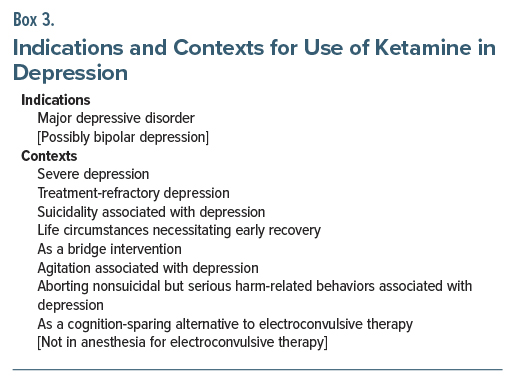
Within the diagnosis of major depressive disorder, and possibly bipolar depression, there are several contexts in which the use of ketamine may be considered (Box 3).7 The first is when depression is treatment-resistant, the context in which most of the studies on ketamine have been conducted. Next is when depression is severe, whether treatment-resistant or not; the use of ketamine can bring about early relief and help the patient quickly return to a functional state. Third is when depression is associated with risk of suicide; the immediate use of ketamine can save lives.
In all these contexts, ECT is also indicated, but oral ketamine carries several advantages: its simplicity and safety allow it to be immediately offered to almost all patients; it does not require special pre-investigations, equipment, personnel, and suite; it can be performed as an outpatient procedure; and it does not produce anterograde and retrograde amnesia.
Fourth is when patients need to recover quickly in order to cope with life circumstances. Thus, oral ketamine can be offered to depressed patients who do not have the luxury of obtaining medical leave from work; patients who are appearing for examinations; patients who have an upcoming event (an interview, a public performance, a major family celebration); etc.1,55
Fifth is when an intervention is required as a bridge treatment, such as while waiting for ECT clearance or while tapering a classical antidepressant before starting a classical monoamine oxidase inhibitor (MAOI).1,56
As an important caveat here, much prudence should be exercised when considering the use of ketamine in persons with a history of substance use, substance misuse, or substance dependence.
Contexts: Special Notes
An earlier section of this article referenced the use of im ketamine to treat agitation in the community. Agitation is transdiagnostic and can occur in depression, as well. Agitated depressed patients are at risk of suicide. Severely depressed patients may also display non-suicidal harm-related behaviors, such as heavy drinking or use of illicit drugs. Oral ketamine, administered by trained caregivers, is a valuable emergency resource in such contexts, in clinical departments that have domiciliary treatment protocols in place. Domiciliary treatment is discussed in a later section.
Ketamine, which spares cognition, may be useful as a step in the treatment hierarchy ahead of ECT. In one RCT, iv ketamine was noninferior to right unilateral (RUL) ECT in antidepressant efficacy and was associated with better cognitive outcomes.57,58 However, another RCT, which also administered RUL ECT, found a higher remission rate with ECT than with iv ketamine (63% vs 46%, respectively).59 A meta-analysis found that response and remission rates were higher with ECT than with ketamine.60 Whereas the efficacy of ketamine may approximate that of RUL ECT, bilateral ECT is likely to be more effective. Decision-making should therefore consider whether the higher chances of benefit with (bilateral) ECT outweigh the higher risk of cognitive adverse effects with ECT.
Might the use of ketamine as anesthesia improve antidepressant outcomes with ECT? In a systematic review and network meta-analysis, ketamine-assisted ECT was not associated with higher response (relative risk [RR], 1.07; 95% CI, 0.82–1.39) and remission (RR, 1.45; 95% CI, 0.95–2.19) rates but did worsen cognitive outcomes (standardized mean difference, -0.18; 95% CI, -0.28 to -0.09) relative to propofol anesthesia.61 Ketamine in ECT anesthesia is unlikely to meaningfully improve outcomes with what is already a gold standard treatment .62
Oral Ketamine: Formulations
Oral ketamine is not available as a marketed formulation. It has been studied in RCTs as specially compounded or formulated capsules,63 extended-release tablets,64 and prolonged-release tablets.65 It has also been studied in RCTs with dosing in liquid form.45
Oral Ketamine Liquid: Repurposing of Ketamine for Injection
Liquid ketamine for oral administration is obtained from ketamine that is marketed (in ampules or vials) for use in anesthesia as liquid for injection. It is reasonable to consider that a product that is safe for iv use is also safe for oral administration. Readers are reminded that the pharmacokinetics and safety of oral ketamine have been described, as reviewed in earlier articles.2,3,49
The repurposing of ketamine for injection for oral use has been practiced for at least 3 decades and in many different parts of the world, including the UK,66 Japan,67 Israel,68 India,45–47 Canada,69 New Zealand,70 and the US.71 Such use of oral ketamine to treat depression is widely practiced in India.72
The large advantage of oral ketamine over parenteral ketamine is that oral ketamine is noninvasive, and that dissociative, neurological, perceptual, and other psychophysiological effects can be minimized by slowing sipping speed. As will be seen from the sections that follow, oral dosing with ketamine repurposed from liquid for injection is the easiest way to treat patients with ketamine. This is especially true for outpatient treatment, emergency treatment, repeated dosing, and domiciliary treatment.
Fitness to Receive Oral Ketamine
Treating patients with oral ketamine in solution produces only mild and transient dissociative and neurological symptoms, and mild and transient drowsiness, when the solution is slowly sipped as described in a later section of this article. Such a procedure is a bit more complex than treating patients with z-drugs such as zolpidem and eszopiclone, but surely safer than allowing people to take alcohol or cannabis in large quantities, unsupervised.
It is important to understand that the few and mild psychophysiological symptoms experienced during a carefully conducted oral ketamine session make it a treatment for which there are almost no contraindications. If a patient can walk unassisted into the clinic, that patient is almost certainly fit to receive oral ketamine. Thus, oral ketamine can be administered, if indicated, to young as well as elderly patients, and to patients with medical as well as neurological comorbidities.
For crisis intervention, such as for severely depressed, agitated, and/or suicidal patients, oral ketamine can even be offered immediately because the risk-benefit ratio favors the use of the treatment. The need to obtain pre-treatment investigations and medical clearance depends more on local regulatory requirements and litigation risks than on medical need.
Consent
The administration of ketamine in the clinic is a medical procedure, and so written informed consent should be obtained, as with any other medical procedure. A special note during consenting should include details about domiciliary treatment with ketamine, if this is advised or envisaged. The consenting process should follow local regulations.
During consenting, the entire procedure should be explained, including what the patient can expect to experience and what the outcome is expected to be. A simplified sample transcript was provided in an earlier article.3 Readers may note that protocols have evolved, and that what is recommended in this article differs in some regards from what was recommended in the earlier article.
Facilities
The ketamine session is ideally conducted in a quiet room with privacy ensured, and not in a noisy room, or in a room through which people enter and leave. The session should not be conducted in a space that is populated by other patients or medical personnel. The patient should have the opportunity to experience the session with positivity and not with the experience of repeated interruptions and disturbances. Cell phones should be muted.
Seating arrangements should be available for the patient, a companion, and the medical personnel who will supervise the session. There should also be a sofa or bed available, should the patient wish to sleep later during the session. There should be a washbasin with tap in the unlikely event that patient experiences nausea and wishes to throw up.
When the ketamine session is a scheduled session, or if opportunity permits, the patient should be advised to take an antiemetic such as ondansetron (4 mg) 30–60 min before the start of the session. This will reduce the likelihood of the patient experiencing nausea during the session. If the session is unplanned or is an emergency session, oral ketamine can be administered straightaway because nausea is an uncommon adverse effect.
An attached bathroom (washroom, restroom) is ideal, though not essential. Regardless of whether a nearby bathroom is available, patients should be advised to empty their bladder before the session. This is because patients are likely to experience some dizziness and ataxia during the session; this will not disturb them much if they are sitting or lying down, with eyes shut, but will be distressing if the patient has to walk to a toilet.
Fasting vs Nonfasting States
Although pharmacokinetics have not been studied separately in fasting and nonfasting states, there is probably no need for the patient to fast before a ketamine session. If the patient is fasting, absorption of the dose will be quicker, leading to higher peak blood levels and greater risk of adverse events. Patients who have not eaten during the past 2–3 h should therefore be instructed to sip the ketamine more slowly, such as across 30 min. Other patients can sip the ketamine across 20–30 min.
Accompanying Person
In the absence of extraordinary circumstances, ketamine sessions should always be conducted in the presence of a companion, ideally a caring family member or trusted friend. The companion participates in the ketamine session (see below), alerts the psychiatrist in case the patient experiences a distressing symptom, and escorts the patient home safely. The last requirement is for medicolegal purposes even though patients are fully recovered at the defined end of the session.
The companion should be instructed to chat with the patient as the patient sips the ketamine. Topics for conversations could include past memories, current events, and future plans, as long as the chat evokes positive emotions in the patient’s mind. Although this is not a topic that has been researched, bringing positivity into the ketamine session reduces the likelihood that the patient will recall unhappy memories and experience heightened anxiety or a catastrophic reaction (both of which are possible) during the session. There is also the possible but unresearched concern that patients whose session experience is negative will respond less well to the intervention.
Suggestions offered could be “Recall nostalgic events,” “Play cheerful music,” “Watch funny videos,” “Look at photographs that make you feel happy,” and, most important of all, “Don’t be afraid” and “Enjoy the experience.”
If for any reason the patient does not have a companion and the session is necessary, an empathetic member of the medical team should sit with the patient for the entire session, playing the role described above. Under no circumstances should the patient be left alone with their thoughts; it is all too easy for negative thoughts to emerge and be amplified during the dissociative state if there is no companion to keep the patient distracted.
Instructions on How to Experience the Session
Patients who are told that ketamine may make them feel strange or different, that they may feel as though they are floating or flying, that they may experience differences in the way in which they see and hear what’s happening around them, etc, will not feel frightened if they understand that these are indications that the “treatment is working” and that they are allowed to “enjoy the novelty of what is happening.” Patients can also be gently discouraged from entertaining anxious thoughts and regarding what is happening as adverse events.
Dosing
In the average adult (body weight, 60 kg and above), the first session dose is ideally 150 mg diluted in a full glass (at least 200 mL) of water. In persons of lower body weight (eg, 40–50 kg), the starting dose could be 100–150 mg, also diluted in at least 200 mL of water.
This starting dose is a trial of sorts that determines how the patient experiences the dose. In patients who tolerate the dose well, subsequent sessions could be dosed at 175–200 mg to improve the efficacy potential of the treatment. In patients who experience prominent dissociative and neurological symptoms (Box 2) at 150 mg, the dose can be lowered to 100–125 mg in subsequent sessions. It may be noted here that a lower dose may be less effective, and so a better way to deal with adverse events could be to slow the sipping time (see a later section).
If the efficacy is disappointing even after 3 sessions at 175–200 mg, the dose can be raised to 250 mg or, subsequently, to even 300 mg.
Readers may note that the doses suggested here are within the range of what has been studied for oral ketamine. Glue et al64 administered 180 mg doses, Walter et al65 administered 240 mg doses, and Al-Shirawi et al73 administered up to 300 mg doses. In all these studies, ketamine was self-administered at home.
Diluent
Ketamine has an unpleasant taste and is sometimes diluted in fruit juice or a cola beverage to make sipping more palatable. However, because patients tend to equate medicines that taste unpleasant with therapeutic potency, administration of ketamine diluted in water may usefully recruit nonspecific factors in psychopharmacology that increase the likelihood of benefit with the treatment.3 Additionally, the unpleasant taste may condition patients to regard ketamine as a medicine rather than as a recreational substance. Ketamine can also be administered in other beverages, such as black tea.74
In lighter vein, people enjoy eating ripe cheese and drinking bitter beer; the ketamine experience is surely no worse in comparison. In this author’s experience, no patient has ever refused ketamine because of the taste. Nevertheless, there is no harm in offering patients the option of taking the ketamine with fruit juice. Note that ketamine should not be given with grapefruit juice because of the risk of a future food-drug interaction (discussed in a later section).
Sipping Speed
As already explained, sipping time can be 20–30 min if the subject has eaten food within the past 2 h, and 30 min if the patient is fasting. In patients who experience prominent dissociative and neurological symptoms (Box 2) at 150 mg, the sipping time could be slowed to even 45–60 min.
A simple way to effect slow sipping is to ask the patient to start the stopwatch on their cell phone and to then take the first sip. Subsequently, sips can be taken every 1–2 min so that, at “half-time,” the glass is half empty. If sips are accidentally large, a longer interval can be advised between sips. The patient’s companion is a convenient resource person for the supervision of sipping.
In subsequent sessions, patients can be offered the option to slow or speed up sipping, based on their previous session experiences and preferences. However, sipping too rapidly is strongly discouraged because, especially in the earlier sessions, sipping the dose in <10 min is likely to elicit psychophysiological effects that are likely to be perceived as adverse. Sipping too rapidly can also heighten adverse perceptual experiences and increase the risk of visual, multimodal, synesthetic, and other hallucinations. Ketamine-naïve patients should not gulp down the ketamine or even sip in <5 min because the risk of marked dissociative, neurological, perceptual, and other disturbances is likely to be high.
Should patients have distressing dissociative and perceptual experiences, the simplest course of action is to hold the patient’s hand as a form of grounding, speak in a calm voice, reassure the patient that the experience will be transient, and encourage the patient to close their eyes and lie down and try to sleep. The symptoms are self-limiting and will usually abate in <1 h. Should there (very rarely, if at all) be cause for alarm and need for rapid relief, intravenous lorazepam or intramuscular haloperidol could help.
If the sessions are well tolerated, in later sessions sipping speed can be accelerated by a few minutes each session, depending on the individual patient’s tolerance to the psychophysiological effects. In patients who have been receiving ketamine as maintenance therapy, the ketamine can often be sipped in <5 min with low risk of psychophysiological adverse experiences.
Sipping speed should always be individualized, session by session.
The Need to Experience Psychophysiological Symptoms
The experience of psychophysiological symptoms during a ketamine session can be helpful to recruit nonspecific factors in psychopharmacology. A mild degree of dissociation can be helpful if ketamine-associated psychotherapy is planned. Positivity generated during caregiver conversations during the ketamine session can be enhanced by dissociative experiences, perhaps in the same manner in which suggestion helps during hypnotherapy.
As a side note here, psychotherapy during a ketamine session is not something that has been well studied and standardized. It is necessary to determine the characteristics of safe and effective psychotherapy in this context.
The experience of dissociative and other psychophysiological symptoms is not essential for ketamine to be therapeutic. In explanation, as stated in the previous section, tolerance develops to the psychophysiological effects but not to the therapeutic effects of ketamine; so, the psychophysiological effects are clearly not an essential part of the mechanism of action of the treatment. Additionally, extended-release and prolonged-release ketamine are effective64,65 even though they do not produce the psychophysiological effects of, for example, iv ketamine.
Experiences Reported During a Typical Session
When sipping is slow (eg, across 20–30 min), psychophysiological symptoms typically begin appearing between 15 and 20 min after patients start sipping. Patients initially feel a little strange or unreal and, later, a little lightheaded or dizzy; if asked to stand, they may feel slightly unsteady. These symptoms typically increase across the next 10–20 min. By the 30 min mark, some patients also experience mild perceptual changes in kinesthetic and visual modalities; for example, they may feel as though they are floating or flying, and objects in their environment may appear larger or smaller, or brighter, than expected.
A few patients experience mood changes, such as feelings of well-being or euphoria, and sometimes of anxiety (if the latter occur, reassurance should be urgently provided). By this time, many patients also feel a little drowsy; they can then be encouraged to lie down with their eyes shut and, if they can, to sleep. Patients who are asleep are unlikely to be disturbed by mood or psychophysiological changes.
The Role of the Psychiatrist During the Session
It is not absolutely necessary for the psychiatrist to sit with the patient all through the oral ketamine session, nor is it necessary to monitor vital parameters during a session during which sipping speed is slow. This is because the patient has a caregiver to keep them company, because psychophysiological experiences in such situations are few and mild, and because patients have been educated about them beforehand. Nevertheless, it is important for the psychiatrist to be quickly available in case there is an unanticipated adverse effect or the patient has any experience that is distressing.
Ideally, the psychiatrist should sit with the patient for at least the initial 2–3 sips to ensure that sipping is correctly done, and intervals between sips are correctly timed. During these initial minutes, the psychiatrist should also set a cheerful and reassuring atmosphere in place.
It is good practice for the psychiatrist to be available nearby, such as in the next room, and for the psychiatrist to visit the patient every 5 minutes to ask about experiences, ensure that all is going well, and offer continued reassurance and psychological support.
Although ketamine sessions are ideally conducted by a qualified psychiatrist who is aware about the challenges associated with treating depression, in resource-constrained settings general medical practitioners can be trained for the purpose.
Monitoring
During sessions, more for documentation and reassurance than for actual need, psychophysiological symptoms experienced, pulse, and blood pressure should ideally be recorded every 15 min from start to end of the session.
Clinical ratings using appropriate rating scales, if considered necessary, should be obtained at baseline and, afterward, once weekly. It goes without saying that medical records should be updated after every session.
End of the Session
The session ends when all psychophysiological symptoms have ended, and when the patient is awake, alert, able to stand confidently with eyes shut, and able to walk forwards and backwards without unsteadiness. This endpoint should be assessed and declared by a medically qualified member of the treating team. For medicolegal reasons, patients should be advised not to drive or perform any other motor activity (that could endanger their safety) until the next day.
Although ketamine-associated uropathy has not been described with the therapeutic use of oral ketamine in patients with depression, it would be prudent to advise patients to drink plenty of water for several hours after the ketamine session and to frequently void urine. This would ensure dilution of ketamine and its metabolites in the bladder, and minimize the exposure of the urothelium to ketamine and its metabolites.6
Patients seldom notice improvement at the end of the session. They can be told that they could expect to feel a little better by nighttime, and that they may be noticeably better during the next 1–2 days. However, clear and sustained improvement is best assessed by comparing mood and functional status week by week.
If only 1 session is planned, patients should be told that benefits (if any) commonly start wearing off from approximately the third day onward, and that by 1 week, benefits are substantially lost. Patients should also know that not everybody responds to ketamine.
One-Off Sessions
One-off sessions are typically offered as crisis intervention, or for contextual need. As an example, if a depressed patient needs to attend an interview 5 days later, and if the patient knows that they will not be able to handle the interview given their current mood status, they can be called for a ketamine session approximately 48 h before the interview. This offers the best chance for them to be at their best at the time of the interview.
Speculatively, there is scope to offer ketamine to all severely depressed patients regardless of contextual need. This is to determine whether or not they respond to the treatment, and to determine the time course of onset and offset of benefits. The experience could then guide the use of ketamine later during the episode, or in later episodes, should the patient have an urgent need to recover in time for an event. The assumption here is that responsiveness is trait-dependent; this requires empirical validation.
Frequency and Number of Sessions
When not one-off, ketamine treatment is typically scheduled as a course, with sessions conducted on alternate days, thrice a week, for 2 or more weeks, as with ECT. As already stated, the dose in the first session is typically 150 mg and, in subsequent sessions, 175–200 mg. From the second week onward, dosing can be raised to 250 or even 300 mg should patients show poor response to the first week sessions. Should response continue to be poor during and especially at the end of the second week, it may be better to abandon the treatment and consider, for example, an MAOI or ECT.
If patients improve and continue to improve, the treatment course should continue until full remission, or to the point at which the patient plateaus and improves no further. The latter can be operationalized as negligible additional improvement for 3 consecutive sessions subject to a minimum of 5–6 sessions. Some patients may need up to 10 or more sessions to reach treatment endpoint.
If the treatment course has been a failure, it can be abruptly discontinued. If it was a success, treatment is best tapered to 2 sessions per week for 1–2 weeks, then 1 session per week for 1–2 weeks, and then either maintained at weekly sessions or discontinued altogether. Other tapering schedules have also been described.72 Discontinuation of treatment is contingent upon the expectation that the concurrent antidepressant medication(s) will take over the maintenance of remission.
Daily dosing with oral ketamine has also been described in the treatment of depression.64
Drug Interactions
Ketamine is administered as an “occasional” treatment rather than as a daily treatment for prolonged periods. So, even though ketamine has mild inhibitory action on, for example, CYP3A4, its effects on the pharmacokinetics of other drugs are unlikely to be clinically significant.75
Ketamine is predominantly metabolized by CYP3A4; other enzymes, such as CYP2B6 and CYP2A6, play only a minor role in its breakdown.75,76 Therefore, the dose should be appropriately reduced if the patient is receiving a 3A4 inhibitor (this includes patients who drink grapefruit juice regularly) and appropriately increased if the patient is receiving a 3A4 inducer. What is “appropriate” is difficult to confidently state. It is generally recommended that doses be “halved” in the presence of strong inhibitors and “doubled” in the presence of strong inducers, but this recommendation assumes that the inhibitor or inducer is administered in “full” doses. Therefore, in individual patients, titrating the ketamine dose to the elicitation of its psychophysiological effects is a reasonable strategy. This requires the ketamine provider to have experience with the treatment.
There is no adverse drug interaction between classical MAOIs and ketamine.1,56
Concurrent Medications
Patients who take antidepressant drugs require to stay medicated for many months, often years, as continuation and maintenance therapy. It is expected that patients treated with ketamine will eventually be taken off ketamine and maintained on conventional antidepressant drugs. Therefore, because there is no adverse drug interaction between conventional antidepressants and ketamine, conventional antidepressants should be started as early as possible, even during the ketamine course, so that patients are stabilized on these antidepressants earlier rather than later, allowing ketamine to be tapered and withdrawn earlier rather than later.
A very small body of literature suggests that ketamine can be given to patients with psychotic depression, and perhaps even to patients with psychosis and associated depression.77–79 Such patients should ideally also receive antipsychotic medication, especially if the primary diagnosis is psychosis. Such patients should be carefully monitored for psychotic symptoms and effects of dissociation during the session as well as in the days that follow.
Many studies suggest that the concurrent use of benzodiazepines may decrease treatment benefits with ketamine80,81; the literature on lamotrigine is mixed.80–82 Lithium does not adversely affect the antidepressant action of ketamine.81
Continuation and Maintenance Therapy
Some patients require continuation and maintenance therapy with ECT because their conventional antidepressant medication provides insufficient protection against relapse and recurrence. Likewise, some patients will require continuation and maintenance treatment with ketamine. This author has experience of the safe use and continued efficacy of maintenance treatment with oral ketamine for approximately 9 years (and counting) in a young woman with severe, harm-associated TRD and polysubstance-related psychosis. Whereas psychophysiological symptoms have been negligible for years, and ketamine is gulped down rather than sipped, efficacy has been maintained with her dosing stable at 175–200 mg per occasion at 5–7 day intervals.
Continuation therapy with ketamine (including by the oral route) has also been described in children and adolescents.83 Oral ketamine has been administered for a maximum duration of up to 12 years to patients with chronic pain.84
Oral Ketamine: Domiciliary Use
Daily oral ketamine for home use, including ketamine repurposed from liquid for injection, has been described in patients with chronic pain85,86 and depression.87 The safety of repeated domiciliary dosing (at night, before bedtime) with oral ketamine has been described at up to 300 mg per occasion for up to 2 years for treating depression.73 Domiciliary oral ketamine has also been administered for up to 3 years to patients with TRD and posttraumatic stress disorder.88 Domiciliary ketamine has also been found safe in RCTs.65,68
Domiciliary treatment should be considered only if there is a responsible caregiver who has learnt how to safely administer oral ketamine under supervision in a medical setting. The caregiver should undertake to keep the ketamine in safe custody at home and should take responsibility for engaging the patient with positivity during the ketamine session. Poorly conducted domiciliary sessions may otherwise be anxiogenic, especially if the domestic environment is strongly associated with depressed affect; classical conditioning may interfere with the benefits of ketamine as a nonspecific factor in psychopharmacology.
Parting Notes
There are no useful predictors of response to ketamine.89,90 It is likely, though, that when depression is strongly reactive to concurrent life stressors, the stressors need to be dealt with; ketamine is unlikely to be of help.91 An analogy is that if there is a thorn in the foot, painkillers are unlikely to help if the thorn is not removed.
Although the safety of ketamine during pregnancy is a poorly studied matter, there is reason to consider that ketamine may adversely influence fetal development and longer term neurodevelopmental outcomes.92 Ideally, therefore, pregnancy testing should be implemented in women of childbearing potential, and the use of effective contraception recommended throughout the ketamine course. Judging from the limited data available, ketamine treatment may be safe during breastfeeding.93 These matters need to be discussed with women at risk who receive the treatment.
It is hoped that this article will be found useful by medical practitioners who seek to develop competence in the principles and practice of using repurposed ketamine for injection as an orally administered intervention for depressed patients in specified contexts.
Article Information
Published Online: August 26, 2026. https://doi.org/10.4088/JCP.26f16110
© 2026 Physicians Postgraduate Press, Inc.
To Cite: Andrade C. The prescriber’s guide to oral ketamine for patients with major depressive illness: principles and practice. J Clin Psychiatry 2026;87(3):26f16110.
Author Affiliations: Department of Clinical Psychopharmacology and Neurotoxicology, National Institute of Mental Health and Neurosciences, Bangalore, India; Department of Psychiatry, Kasturba Medical College, Manipal Academy of Higher Education, Manipal, India.
Corresponding Author: Chittaranjan Andrade, MD, Department of Clinical Psychopharmacology and Neurotoxicology, National Institute of Mental Health and Neurosciences, Bangalore 560029, India ([email protected]).
Relevant Financial Relationships: None.
Funding/Support: None.
 Each month in his online column, Dr Andrade considers theoretical and practical ideas in clinical psychopharmacology with a view to update the knowledge and skills of medical practitioners who treat patients with psychiatric conditions.
Department of Clinical Psychopharmacology and Neurotoxicology, National Institute of Mental Health and Neurosciences, Bangalore, India. Please contact Chittaranjan Andrade, MD, at Psychiatrist.com/contact/andrade.
References (93)

- Andrade C. Ketamine for depression-knowns, unknowns, possibilities, barriers, and opportunities. JAMA Psychiatry. 2023;80(12):1189–1190. PubMed
- Andrade C. Oral ketamine for depression, 1: pharmacologic considerations and clinical evidence. J Clin Psychiatry. 2019;80(2):19f12820.
- Andrade C. Oral ketamine for depression, 2: practical considerations. J Clin Psychiatry. 2019;80(2):19f12838.
- Meyers JE, Almirall JR. A study of the effectiveness of commercially available drink test coasters for the detection of "date rape" drugs in beverages. J Anal Toxicol. 2004;28(8):685–688. PubMed CrossRef
- Reardon S. Rave drug tested against depression. Nature. 2015;517(7533):130–131.
- Andrade C. Ketamine-associated uropathy during therapeutic and nontherapeutic use: prevalence, clinical features, mechanisms, and strategies for risk reduction. J Clin Psychiatry. 2025;86(4):25f16083.
- Andrade C. Ketamine for depression, 2: diagnostic and contextual indications. J Clin Psychiatry. 2017;78(5):e555–e558. CrossRef
- Sathyanarayana Rao TS, Andrade C. A possible role for ketamine in suicide prevention in emergency and mainstream psychiatry. Indian J Psychiatry. 2017;59(3):259–261. PubMed CrossRef
- Domino EF, Chodoff P, Corssen G. Pharmacologic effects of CI-581, a new dissociative anesthetic, in man. Clin Pharmacol Ther. 1965;6:279–291. CrossRef
- Phillips LA, Seruvatu SG, Rika PN, et al. Anaesthesia for the surgeon-anaesthetist in difficult situations: the use of intramuscular 2(O-chlorophenyl)-2 methylamino cyclohexanone HCl (Parke Davis CI-581, Ketamine). Anaesthesia. 1970;25(1):36–45. PubMed CrossRef
- Brown TC, Cole WH, Murray GH. Ketamine: a new anaesthetic agent. Aust N Z J Surg. 1970;39(3):305–310.
- Arditti J, Spadari M, de Haro L, et al. Ketamine - reves et realites. Acta Clin Belg. 2002;57(Suppl 1):31–33.
- Sanacora G, Frye MA, McDonald W, et al. American Psychiatric Association (APA) Council of Research Task Force on Novel Biomarkers and Treatments. A consensus statement on the use of ketamine in the treatment of mood disorders. JAMA Psychiatry. 2017;74(4):399–405. PubMed
- Andrade C. Ketamine for depression, 3: does chirality matter?. J Clin Psychiatry. 2017;78(6):e674–e677. PubMed
- Burke TF, Mantena S, Opondo K, et al. A ketamine package for use in emergency cesarean delivery when no anesthetist is available: an analysis of 401 consecutive operations. Int J Gynaecol Obstet. 2022;158(2):377–384. PubMed
- Nutt DJ, Morgan C, Erritzoe D, et al. A long, strange trip: ketamine treatment in psychiatry. J Psychopharmacol. 2025;39(10):1039–1044. CrossRef
- Jollant F, Abbar M, Ait Tayeb AEK. Suicidal crisis: first regulatory approval of IV racemic ketamine. Lancet. 2026;407(10537):1421. CrossRef
- Patarroyo-Rodriguez L, Pazdernik VK, Vande Voort JL, et al. Ketamine reduces suicidality-associated emergency department utilization in patients with treatment-resistant depression: a 6-month mirror-image study. J Clin Psychiatry. 2025;86(4):25m15941. PubMed
- Shim SR, Jeong HS, Bommersbach TJ, et al. Ketamine infusions and rapid reduction of suicidal and depressive symptoms in major depressive episode: a systematic review and meta-analysis. JAMA Psychiatry. 2026;83(7):714–731. CrossRef
- Grabski M, McAndrew A, Lawn W, et al. Adjunctive ketamine with relapse prevention-based psychological therapy in the treatment of alcohol use disorder. Am J Psychiatry. 2022;179(2):152–162. PubMed
- Dakwar E, Nunes EV, Hart CL, et al. A single ketamine infusion combined with mindfulness-based behavioral modification to treat cocaine dependence: a randomized clinical trial. Am J Psychiatry. 2019;176(11):923–930. CrossRef
- Mankowitz SL, Regenberg P, Kaldan J, et al. Ketamine for rapid sedation of agitated patients in the prehospital and emergency department settings: a systematic review and proportional meta-analysis. J Emerg Med. 2018;55(5):670–681. PubMed
- Kwong JL, Verbeek PR, Leong YC, et al. Paramedic use of ketamine for severe agitation and violence. CJEM. 2025 Aug;27(8):653–660. CrossRef
- Barbic D, Andolfatto G, Grunau B, et al. Rapid agitation control with ketamine in the emergency department: a blinded, randomized controlled trial. Ann Emerg Med. 2021;78(6):788–795. PubMed
- Oh S, Kingsley K. Efficacy of ketamine in pediatric sedation dentistry: a systematic review. Compend Contin Educ Dent. 2018;39(5):e1–e4.
- Bommineni M, Nguyen M, Ahmad A, et al. Safety of ketamine sedation for interventional radiology procedures: experience in 900 consecutive patients. J Vasc Interv Radiol. 2026;37(3):107970. PubMed CrossRef
- Khan MT, Ishaq A, Rohail S, et al. Evaluating the safety of procedural sedation in emergency department settings among the pediatric population: a systematic review and meta-analysis of randomized controlled trials. CJEM. 2025;27(3):178–190. PubMed
- Newton A, Fitton L. Intravenous ketamine for adult procedural sedation in the emergency department: a prospective cohort study. Emerg Med J. 2008;25(8):498–501. PubMed CrossRef
- Green SM, Roback MG, Kennedy RM, et al. Clinical practice guideline for emergency department ketamine dissociative sedation: 2011 update. Ann Emerg Med. 2011;57(5):449–461. PubMed CrossRef
- Lee JL, Tham LP. Incidence and predictors of respiratory adverse events in children undergoing procedural sedation with intramuscular ketamine in a paediatric emergency department. Singapore Med J. 2022;63(1):28–34. PubMed
- Mirfazaelian H, Erfan Fazel A, Azizi N, et al. Non-injectable ketamine for pediatric sedation in the emergency department: a systematic review. Acad Emerg Med. 2025;32(12):1344–1355. PubMed
- Rudra A, Ray S, Chatterjee S, et al. Gargling with ketamine attenuates the postoperative sore throat. Indian J Anaesth. 2009;53(1):40–43. PubMed
- Schwenk ES, Dayan AC, Rangavajjula A, et al. Ketamine for refractory headache: a retrospective analysis. Reg Anesth Pain Med. 2018;43(8):875–879. PubMed
- Jiao J, Fan J, Zhang Y, et al. Efficacy and safety of ketamine to treat cancer pain in adult patients: a systematic review. J Pain Symptom Manage. 2024;67(3):e185–e210. CrossRef
- Edinoff AN, Askins D, Bobo E, et al. The emerging role of ketamine in acute postoperative pain management. Curr Pain Headache Rep. 2023;27(9):387–397. PubMed
- Le Cornec C, Le Pottier M, Broch H, et al. Ketamine compared with morphine for out-of-hospital analgesia for patients with traumatic pain: a randomized clinical trial. JAMA Netw Open. 2024;7(1):e2352844. PubMed
- Abdelgadir IS, Mudawi K, Hamud A, et al. Second-line treatment option for children aged 18 years and under with an acute severe asthma exacerbation: a systematic review and meta-analysis of randomised controlled trials. Arch Dis Child. 2025;110(12):948–954. PubMed CrossRef
- Lele AV, Raquer A, Mejia-Mantilla J, et al. Efficacy of IV ketamine in refractory/super-refractory status epilepticus: a systematic review and meta-analysis. Neurol Clin Pract. 2026;16(2):e200584. PubMed
- Richards ND, Howell SJ, Bellamy MC, et al. The diverse effects of ketamine, jack-of-all-trades: a narrative review. Br J Anaesth. 2025;134(3):649–661. PubMed
- Krystal JH, Karper LP, Seibyl JP, et al. Subanesthetic effects of the noncompetitive NMDA antagonist, ketamine, in humans. Psychotomimetic, perceptual, cognitive, and neuroendocrine responses. Arch Gen Psychiatry. 1994;51(3):199–214. PubMed CrossRef
- Berman RM, Cappiello A, Anand A, et al. Antidepressant effects of ketamine in depressed patients. Biol Psychiatry. 2000;47(4):351–354. PubMed CrossRef
- Zarate CA Jr, Singh JB, Carlson PJ, et al. A randomized trial of an N-methyl-D-aspartate antagonist in treatment-resistant major depression. Arch Gen Psychiatry. 2006;63(8):856–864. PubMed CrossRef
- Andrade C. The not so little matter of how to dose ketamine in patients with depression. Acta Psychiatr Scand. 2023;148(4):313–315. PubMed CrossRef
- Andrade C. Oral racemic ketamine for common clinical contexts in patients with major depressive disorder: an important intervention that treatment guidelines May never include. Bipolar Disord. 2022;24(2):113–114. PubMed
- Kumar PS, Menon V, Andrade C. A randomised, open-label, pragmatic pilot comparison of oral and intravenous ketamine in treatment-resistant depression. Asian J Psychiatr. 2024;99:104171. PubMed
- Kaur S, Parmar C, Gaur V, et al. The efficacy of oral ketamine in severely depressed patients at high risk of suicide. Asian J Psychiatr. 2023;86:103678. PubMed
- Seraj A, Reyazuddin M, Gaur RK, et al. Oral ketamine for rapid reduction of suicidal ideation in major depressive disorder: a midazolam-controlled randomized clinical trial. Asian J Psychiatr. 2025;106:104413. PubMed CrossRef
- Wan LB, Levitch CF, Perez AM, et al. Ketamine safety and tolerability in clinical trials for treatment-resistant depression. J Clin Psychiatry. 2015;76(3):247–252. PubMed CrossRef
- Novaretti N, Pessoa RMP, Hallak JEC, et al. Safety and tolerance of oral ketamine: a systematic review. Psychiatry Clin Neurosci. 2026 May 30. Epub ahead of print. doi:10.1111/pcn.70091. CrossRef
- Quintero JM, Bustos RH, Lechtig-Wassermann S, et al. Ketamine in clinical practice: transitioning from anesthetic agent to psychiatric therapeutic. CNS Spectr. 2025;30(1):e51. CrossRef
- Fancy F, Haikazian S, Johnson DE, et al. Ketamine for bipolar depression: an updated systematic review. Ther Adv Psychopharmacol. 2023;13:20451253231202723. CrossRef
- Santucci MC, Ansari M, Nikayin S, et al. Efficacy and safety of ketamine/esketamine in bipolar depression in a clinical setting. J Clin Psychiatry. 2024;85(4):24m15376. PubMed
- Zhuo C, Ji F, Tian H, et al. Transient effects of multi-infusion ketamine augmentation on treatment-resistant depressive symptoms in patients with treatment-resistant bipolar depression - an open-label three-week pilot study. Brain Behav. 2020;10(8):e01674. PubMed CrossRef
- Romeo B, Choucha W, Fossati P, et al. Meta-analysis of short-and mid-term efficacy of ketamine in unipolar and bipolar depression. Psychiatry Res. 2015;230(2):682–688. PubMed CrossRef
- Menon V, Kale A, Balasubramanian I, et al. Repeated dosing with oral racemic ketamine as a successful rescue intervention for coping with life events in recurrent major depressive disorder. Asian J Psychiatr. 2024 Apr;94:103973. CrossRef
- Berk M, Van den Eynde V, Ganapathy K, et al. An expert roundtable discussion on the use of classic monoamine oxidase inhibitors in the treatment of depression – part two. Psychiatr Ann. 2023;53(8):364–369. CrossRef
- Anand A, Mathew SJ, Sanacora G, et al. Ketamine versus ECT for nonpsychotic treatment-resistant major depression. N Engl J Med. 2023;388(25):2315–2325. PubMed
- Kumpf KT, Wilkinson ST, Hu B, et al. Comparing the cognitive effects of repeated intravenous ketamine and electroconvulsive therapy in patients with treatment-resistant depression: a secondary analysis of the ELEKT-D trial. J Clin Psychiatry. 2025;86(4):25m15781.
- Ekstrand J, Fattah C, Persson M, et al. Racemic ketamine as an alternative to electroconvulsive therapy for unipolar depression: a randomized, open-label, non-inferiority trial (KetECT). Int J Neuropsychopharmacol. 2022;25(5):339–349. PubMed
- Menon V, Varadharajan N, Faheem A, et al. Ketamine vs electroconvulsive therapy for major depressive episode: a systematic review and meta-analysis. JAMA Psychiatry. 2023;80(6):639–642. PubMed
- Rhee TG, Shim SR, Popp JH, et al. Efficacy and safety of ketamine-assisted electroconvulsive therapy in major depressive episode: a systematic review and network meta-analysis. Mol Psychiatry. 2024;29(3):750–759. PubMed
- Andrade C. Ketamine as anaesthesia for ECT: is there room to improve a gold standard treatment?. Br J Psychiatry. 2018;212(3):129–130. PubMed CrossRef
- Jafarinia M, Afarideh M, Tafakhori A, et al. Efficacy and safety of oral ketamine versus diclofenac to alleviate mild to moderate depression in chronic pain patients: a double-blind, randomized, controlled trial. J Affect Disord. 2016;204:1–8. PubMed CrossRef
- Glue P, Loo C, Fam J, et al. BEDROC study investigators. Extended-release ketamine tablets for treatment-resistant depression: a randomized placebo-controlled phase 2 trial. Nat Med. 2024;30(7):2004–2009. PubMed
- Walter M, Zu Eulenburg C, Damyanova A, et al. Oral prolonged-release ketamine for treatment-resistant depression: two randomized clinical trials. JAMA Netw Open. 2026;9(6):e2619121.
- Broadley KE, Kurowska A, Tookman A. Ketamine injection used orally. Palliat Med. 1996;10(3):247–250. PubMed
- Kubota R, Komiyama T, Miwa Y, et al. Pharmacokinetics of ketamine and norketamine after oral administration of a liquid formulation of ketamine. J Curr Surg. 2013;3(2):82–86.
- Domany Y, Bleich-Cohen M, Tarrasch R, et al. Repeated oral ketamine for out-patient treatment of resistant depression: randomised, double-blind, placebo-controlled, proof-of-concept study. Br J Psychiatry. 2019;214(1):20–26. PubMed CrossRef
- Dinsmore M, Nijs K, Plitman E, et al. Oral Ketamine for Acute Postoperative Analgesia (OKAPA) trial: a randomized controlled, single center pilot study. J Clin Anesth. 2025;100:111690. PubMed
- Beaglehole B, Glue P, Neehoff S, et al. Six weeks open-label oral ketamine for patients with treatment-resistant depression, post-traumatic stress disorder, or obsessive-compulsive disorder. J Psychopharmacol. 2025 Jun;39(6):571–576. CrossRef
- Hetrick M, Casey E, Radcliff J, et al. Characterization of oral ketamine use: a retrospective review. J Pain Palliat Care Pharmacother. 2025;39(1):132–138. PubMed
- Iyer M. Ketamine a quick and low-cost fix for people with suicidal thoughts. 41. Bengaluru; 2024:8.The Times India222
- Al SMI, Kennedy SH, Ho KT, et al. Oral ketamine in treatment-resistant depression: a clinical effectiveness case series. J Clin Psychopharmacol. 2017 Aug;37(4):464–467.
- Sanalkumar SP, Andrade E. Black tea as a possible vehicle for administration of oral ketamine. Indian J Psychiatry. 2025;67(11):1116–1117. PubMed
- Andrade C. Ketamine for depression, 5: potential pharmacokinetic and pharmacodynamic drug interactions. J Clin Psychiatry. 2017;78(7):e858–e861. PubMed CrossRef
- Dinis-Oliveira RJ. Metabolism and metabolomics of ketamine: a toxicological approach. Forensic Sci Res. 2017;2(1):2–10. PubMed CrossRef
- Veraart JKE, Smith-Apeldoorn SY, Spijker J, et al. Ketamine treatment for depression in patients with a history of psychosis or current psychotic symptoms: a systematic review. J Clin Psychiatry. 2021;82(4):20r13459. PubMed
- Gałuszko-Wȩgielnik M, Jakuszkowiak-Wojten K, Wiglusz MS, et al. Central nervous system-related safety and tolerability of add-on ketamine to standard of care treatment in treatment-resistant psychotic depression in patients with major depressive disorder and bipolar disorder. Front Neurosci. 2023;17:1214972. PubMed
- Diendorfer CM, Bum C, Weidenauer A, et al. Ketamine for negative and depressive symptoms in schizophrenia: the evidence so far. Front Psychiatry. 2026;17:1766485. PubMed
- Veraart JKE, Smith-Apeldoorn SY, Bakker IM, et al. Pharmacodynamic interactions between ketamine and psychiatric medications used in the treatment of depression: a systematic review. Int J Neuropsychopharmacol. 2021;24(10):808–831. PubMed
- Atidio JP, Delfino RS, Garios IS, et al. Role of concomitant benzodiazepines, lithium, and lamotrigine in modulating the antidepressant effects of subcutaneous esketamine in patients with treatment-resistant depressive episodes: a retrospective naturalistic study. J Affect Disord. 2026;406:121721. PubMed
- Santucci MC, Katz RB, Pittman B, et al. Lamotrigine is not associated with differential clinical outcomes in a real-world sample of patients with unipolar depression receiving ketamine or esketamine. Psychopharmacol Berl. 2026;243(6):1427–1435. CrossRef
- James L, James IG, Wakefield J. The safety of repeated ketamine dosing in paediatrics: a systematic review. J Psychopharmacol. 2023;37(8):757–763. PubMed CrossRef
- Al Mukhaizeem S, Nasa A, Waldron D, et al Investigating the effectiveness of oral ketamine on pain, mood and quality of life in treatment resistant chronic pain. Front Pain Res (Lausanne). 2023;4:1268985. PubMed
- Blonk MI, Koder BG, van den Bemt PM, et al Use of oral ketamine in chronic pain management: a review. Eur J Pain. 2010;14(5):466–472. PubMed CrossRef
- Marchetti F, Coutaux A, Bellanger A, et al Efficacy and safety of oral ketamine for the relief of intractable chronic pain: a retrospective 5-year study of 51 patients. Eur J Pain. 2015;19(7):984–993. PubMed CrossRef
- Surai T, Purohith Narasimhan A, Sharma M, et al Safe and effective use of domiciliary oral ketamine for recurrent agitated depression in an older adult: a case report. Asian J Psychiatr. 2026;117:104868. PubMed
- Hartberg J, Garrett-Walcott S, De Gioannis A. Impact of oral ketamine augmentation on hospital admissions in treatment-resistant depression and PTSD: a retrospective study. Psychopharmacol Berl. 2018;235(2):393–398. PubMed CrossRef
- Lima Constantino J, Godschalk M, van Dalfsen JH, et al Demographic and clinical predictors of response and remission in the treatment of major depressive disorder with ketamine and esketamine: a systematic review. Psychiatry Res. 2025;345:116355. PubMed
- Kiani I, Cattarinussi G, Sambataro F, et al. Predictors of responsiveness to ketamine: an updated systematic review of neuroimaging findings. J Affect Disord. 2026;405:121521. PubMed
- Chattopadhyay D, Kale A, Menon V, et al. Oral ketamine for treatment-refractory major depressive disorder and the complicating role of concurrent stressors: implications for research and practice. Indian J Psychol Med. 2026 Jan;11:02537176251409363. Epub ahead of print. doi:10.1177/02537176251409363. CrossRef
- Pacilio RM, Lopez JF, Parikh SV, et al. Safe ketamine use and pregnancy: a nationwide survey and retrospective review of informed consent, counseling, and testing practices. J Clin Psychiatry. 2024;85(3):24m15293.
- Andrade C. The relative infant dose for maternal use of drugs during breastfeeding: nuances in derivation, interpretation, and application. J Clin Psychiatry. 2026;87(3):26f16563.
This PDF is free for all visitors!