
Abstract
Medications used by lactating mothers appear in breast milk to varying extents and are ingested by the breastfed infant. The degree of exposure of infants to maternal medication is therefore a matter of concern. Key clinical considerations are the absolute exposure of the infant to the drug, the infant’s age and capacity to metabolize the drug, and the possible effects of drug exposure in the infant. In this context, the relative infant dose (RID) is a useful construct that helps predict infant exposure without requiring infant blood sampling. By definition, the RID estimates the dose of drug that a breastfed infant ingests per day relative to the dose that the mother receives per day; dosing is standardized per kg body weight, and breast milk intake is standardized at 150 mL/kg/d. A drug with an RID that is <10% is conventionally considered to be compatible with breastfeeding; however, this interpretation is nuanced. This article explains the RID using a worked example. Clinically important issues in the derivation, interpretation, and application of the RID are discussed. Matters considered include how maternal weight and infant weight influence the estimated RID, the need to consider active metabolites, and study-related issues such as sample size and breast milk sampling. Special situations examined include intermittent drug dosing and rescue dosing, dosing with drugs that have long half-lives, use of prodrugs or long-acting injections, and use of drugs that may be problematic regardless of dose. Examples of the RID are provided for ketamine and its active metabolite norketamine, lurasidone, and viloxazine. Readers need to be aware that there is more to the RID than just the arbitrary 10% cutoff.
J Clin Psychiatry 2026;87(3):26f16563
Author affiliations are listed at the end of this article.
From the Editors

Are you a healthcare provider?
Add your NPI to personalize your JCP experience.
The relative infant dose (RID) in breastfed infants is a well-known construct.1,2 In its simplest form, it addresses the question, “What dose of drug does a breastfed infant ingest per day relative to the dose that the mother receives per day”? For both infant and mother, dosing is standardized per kg body weight because an infant is very much smaller than its mother; absolute doses therefore need to be understood in the context of physical size. A rule of thumb is that an RID that is <10% is likely to be compatible with breastfeeding. This cutoff indicates that, after adjusting for body weight, the breastfed infant is receiving <10% of the dose that the mother is receiving.
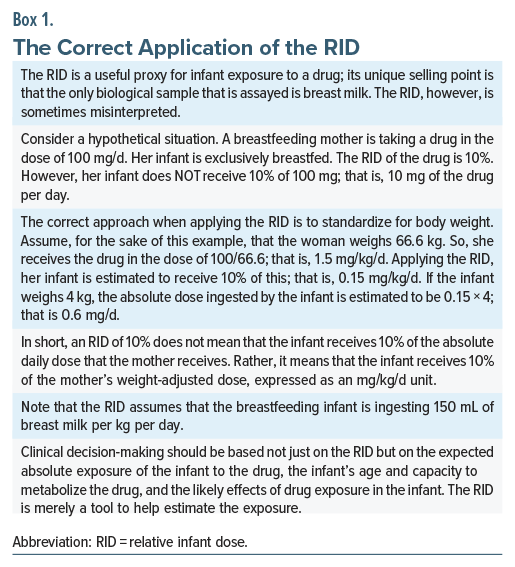
An explanation of how the RID is applied is presented in Box 1. Although the RID is easy to understand and use, it is considerably nuanced with regard to how it is estimated in studies, interpreted, and applied in clinical practice. This article therefore explains the nuances and provides examples of the use of the RID for a few psychotropic drugs.
Infant Exposure to a Drug
Pharmacokinetic studies based on blood samples obtained from breastfed infants are the gold standard pharmacokinetic measure of infant exposure when mothers have been taking the drug of interest for more than 5 half-lives of the drug; that is, when drug levels are at steady state. However, repeated blood sampling from an infant is ethically and practically problematic. So, the RID becomes a useful proxy for infant exposure to a drug; the only biological sample that needs to be assayed is breast milk.
The Relative Infant Dose: A Worked Example
Here is a worked example that explains the RID for a single breastfeeding mother-infant pair. Imagine that a woman whose body weight is 70 kg has been taking a drug in the dose of 140 mg/d. She is therefore taking the drug in the dose of 140/70, or 2.0 mg/kg/d.
The half-life of the drug is 1 day. She has been taking the drug for a week; that is, for more than 5 half-lives of the drug. The drug has therefore reached steady-state levels in her body; that is, each day the quantity of the drug metabolized and excreted is approximately the same as the quantity ingested, and so average blood levels during a day will remain reasonably consistent from day to day. At steady state, it is reasonable to expect that the average transfer of the drug into breast milk during a day will also remain reasonably consistent from day to day.
The woman provides samples of breast milk at the time of administration of the drug and, again, 2, 4, 6, 8, 12, 18, and 24 hours later. Using pharmacokinetic modeling (area under the curve), the mean concentration of the drug in breast milk is estimated. Let us assume, for the sake of this exercise, that the mean concentration in breast milk is 0.1 mg per 100 mL.
For the RID, breast milk ingestion is standardized at 150 mL/kg/d. Assume that the infant weighs 3 kg. So, the infant would ingest 450 mL of milk per day, or 0.45 mg of the drug per day. For the 3 kg infant, this translates to a dose of 0.15 mg/kg/d. We now have all the information necessary to calculate the RID. The formula for the RID is as follows:
RID =(infant exposure in mg/kg/d) / (maternal exposure in mg/kg/d), expressed as a percentage.
Substituting, we get 0.15/2.0; that is, 0.075, or 7.5%. In principle, because 7.5% is lower than the arbitrary safety cutoff of 10%, we may conclude that infant exposure to the drug is small and that maternal use of the drug could be compatible with breastfeeding.
RID: The Irrelevance of Infant Weight
Readers are encouraged to repeat the above exercise with all information unchanged except for infant weight. Whether the infant weight is 3 kg, 5 kg, or 8 kg (or anything else), the RID remains the same: 7.5%. This is because the RID is standardized per kg body weight.
Readers will now appreciate why the RID is a pragmatic index that can be interpreted independent of infant weight, under the standard assumption of milk intake of 150 mL/kg/day.
Relative Dose or Absolute Dose?
When calculating the RID, the numerator in the formula is infant exposure per kg per day. Why bother to estimate this and then estimate the RID? Why not just look at infant exposure per day, assuming that milk intake is 150 mL/kg/day? Isn’t it easier to form impressions about exposure-related risks based on the absolute dose that the infant receives?
The answer is yes, it is easier to understand the clinical risks associated with infant exposure to a drug when exposure is reckoned in absolute terms (mg/day) rather than in relative terms (RID). However, in the clinical setting, without an RID, there is no way of calculating the absolute dose for a given infant because the absolute dose will depend on the concentration of the drug in breast milk, and that, in turn, will depend on the dose of the drug that the mother is receiving.
It is not easy to conduct RID studies on small samples of breastfeeding women who are taking a given drug in different doses. It would be very hard to conduct adequately powered studies to provide normative data for drug concentration in breast milk for a range of maternal doses of that drug.
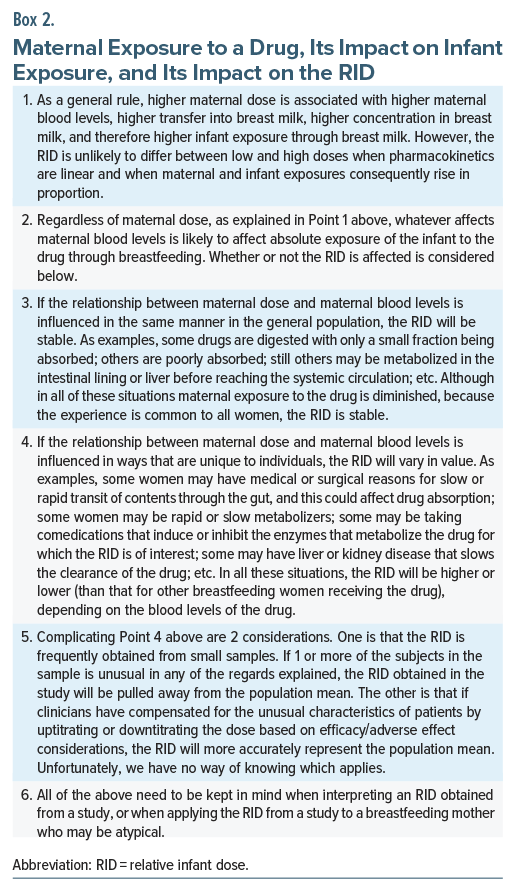
As a relevant side note here, maternal dose does not bias the RID when pharmacokinetics are linear; that is, when the association between increase in dose and increase in blood concentration (and hence increase in milk concentration) can be modeled as a straight line. Situations in which maternal dose may or may not bias infant exposure through breast milk are considered in Box 2.
Returning to the absolute infant dose, another limitation of the absolute dose is that it is hard to form impressions about clinical risks without knowing infant weight. This is why pediatric dosing is expressed as well as understood in units that are standardized by body weight.
Estimating the Absolute Dose From the RID
The absolute dose that an infant is expected to receive can be easily calculated if the maternal dose, the RID, maternal weight, and infant weight are known. In the worked example provided earlier, the maternal dose was 140 mg/d, the RID for the drug was 7.5%, maternal weight was 70 kg, and infant weight was 3 kg.
From these data, we observe that the maternal dose is 2 mg/kg/d. With an RID of 7.5%, we estimate that the infant receives 7.5% of 2 mg per kg per day; that is, 0.15 mg/kg/d. The absolute dose received by the 3 kg infant is therefore 0.15×3; that is, 0.45 mg/d. A built-in assumption in this calculation is that the infant ingests 150 mL/kg of breast milk per day.
Readers may note that whatever the RID, the absolute infant dose is proportionate to the absolute maternal dose (Box 2).
Dealing With Active Metabolites
Some drugs, such as fluoxetine, have an active metabolite. Some drugs, such as cariprazine, have more than one active metabolite. How might one calculate the RID for active metabolites given that we do not have information for the denominator in the RID formula; that is, the maternal dose of the metabolite in mg per kg per day? Authors commonly deal with this by using the maternal dose of the parent drug as the denominator; this may be pragmatic but is not pharmacologically rigorous.
Also problematic is how the results are presented. Some authors present the RID for only the parent drug. This is clearly unsatisfactory when the action of the metabolite(s) is clinically significant. Some authors present the RIDs separately for parent drug and metabolite(s). This is problematic because clinicians want to know the safety of the combined moiety and not that of drug and metabolite(s) separately. Finally, some authors add the values for the drug and metabolites in the numerator and present a single, combined value (this is the same as adding the RIDs of drug and metabolite(s) because the denominators are the same); a limitation of this approach is that it assumes that drug and metabolite(s) have identical potency for effects and adverse effects.
So, readers who are presented with an RID for a drug that has active metabolites need to know how the RID addresses the contributions of the active metabolites.
Study-Related Issues: Sample Size
In the worked example provided earlier in this article, the RID was derived using information obtained from a single breastfeeding mother. However, results from a single subject cannot be generalized to the population. So, as in all research, the research design needs to be appropriate, and the sample size needs to be adequate.
Problematically, RID tends to be estimated in convenience samples with irregular and insufficient milk sampling during dosing intervals (considered in a later section); and even more problematically, sample sizes tend to be very small, usually in single digits. Readers will appreciate that an RID for a drug obtained from, say, 4 mother-infant pairs cannot be generalized to all breastfeeding mothers, across the world, who use that drug.
There is no agreed-upon sample size for RID studies; rather, the number should be based on expected variability in milk concentration and the desired precision of the estimate. Single-digit sample sizes are unlikely to inspire confidence.
Study-Related Issues: Breast Milk Sampling
Breast milk needs to be sampled during the entire range of the (maternal) dosing interval. This is because maternal blood levels and hence transfer into breast milk peak soon after dosing, and drop at varying rates to a trough, thereafter. Breast milk sampling should therefore be sufficiently frequent to capture the initial peak and fall, and then the slower decline to trough until the next dosing interval.
It is not necessary for all mothers in a sample to provide breast milk at the same time points provided that the general principle above is not violated. So, readers who are presented with an RID for a drug need to know whether breast milk samples were obtained in accordance with the assay requirements.
Study-Related Issues: Maternal Body Weight
Dosing in adults is seldom based on body weight. Thus, mothers who are lean may receive the same dose of a drug as mothers who are overweight or obese. If we repeat the calculations in the worked example provided earlier in this article, using a maternal body weight of 50 kg instead of 70 kg and keeping all else unchanged, we will obtain an RID of 5.4%. So, if blood levels reflect drug dose rather than body weight, the RID can be biased towards greater safety if the study sample was largely lean, and toward poorer safety if the study sample was overweight or obese. Readers who are presented with an RID for a drug therefore need to know whether or not the mean body weight of the study sample was reasonably representative of lactating women.
Other Issues
The dose received by the breastfeeding infant is likely to be higher in the few hours after maternal dosing, associated with peak drug levels in the mother. The dose received by the infant is likely to be lower in the hours immediately before the next dose of drug is due, associated with trough drug levels in the mother. The dose received by the infant will be lower if the infant is receiving formula feeds and is therefore only partly breastfed. The risks associated with the ingested dose are likely to decrease as the infant grows older, drinks less breast milk, and is better able to metabolize the ingested drug.
Special Situations: Intermittently Dosed Drugs
If drugs are not taken daily, steady-state RID values will overestimate infant exposure; an example is a benzodiazepine that is taken as a rescue medication rather than as a daily treatment. With medications, such as triptans, that are solely used as rescue interventions, there is no steady state at which the RID is estimated. Drugs such as zaleplon and zolpidem have very short half-lives, and so there is again no steady state for RID estimation. Finally, drugs such as ketamine and esketamine may be dosed on alternate days or less frequently; yet again, steady-state RIDs are not applicable. In all these situations, RIDs estimated from single dose studies would suffice.
Special Situations: Drugs With Long Half-Lives
Some drugs, such as brexpiprazole, have long half-lives; others, such as fluoxetine, aripiprazole, and cariprazine, have long half-lives, and active metabolites with even longer half-lives. When conducting studies to estimate the RID, it is necessary to wait for 5 half-lives of not only the parent drug but also that of the active metabolite(s). And, when applying the RID to breastfed infants of mothers who are initiating these drugs, it should be recognized that infant exposure will be lower than predicted until steady state has been attained. This means that infant response to drug exposure in breast milk will need to be reassessed at steady state.
Special Situations: Use of Prodrugs and Long-Acting Injections
What if the mother is taking a prodrug, such as codeine or tramadol, or a long-acting injection (LAI), such as aripiprazole LAI or paliperidone LAI? There are many scientific approaches to dealing with these situations, but a clinical shortcut could be to examine the published RID value of the oral formulation of the active metabolite, or of the oral formulation of the LAI.
For prodrugs, a limitation of this approach is that even if an RID were to be available, it would ignore the efficiency of conversion of the prodrug to the metabolite in the mother, and the presence of the prodrug and hence conversion of the prodrug to the active metabolite in the infant. For LAIs, a limitation of this approach is that it ignores variations in drug concentrations within the LAI dosing interval.
Other Special Situations
Regardless of the RID, if a drug is potentially toxic or is associated with special risks, it may not be compatible with breastfeeding. Drugs used in cancer chemotherapy are typical examples. Clozapine is also a drug of potential concern.
Psychedelics are of special interest. As an example, an inhalational formulation of synthetic mebufotenin was trialed in 10 women with severe peripartum depression; up to 3 escalating doses were administered on the first day of the study. All women experienced remission on Day 1, itself, and this remission was sustained at study end point, on Day 8. Four women were lactating; in all women, breast milk levels of mebufotenin and its metabolites were stated to be below the level of quantification by about 8 hours after dosing (this assertion is questionable because the levels reported were quantified) and unquantifiable at Day 8.3
Luvesilocin (RE104) is a psychedelic prodrug that is subcutaneously administered. It is under development for postpartum depression. Unpublished data, as communicated by the manufacturer, suggest that the total quantity of RE104 metabolites in breast milk represent <0.1% of the maternal dose.4 Published data indicate that RE104 has a half-life of about 30 min, and its active metabolite, a half-life of 3–4 h5; washout could be expected to be complete by 1 day.
Lactating women who receive a psychedelic drug should interrupt breastfeeding until drug and metabolites are washed out of the body; intervening breast milk should be pumped and dumped so that infant exposure is as close to nil as possible.
Recent Studies of RID of Psychotropic Agents
Some recent studies of the RID of psychotropic agents are presented here, as examples to the reader.
Brexanolone6 and zuranolone7 are approved treatments for postpartum depression; however, ketamine may be used, off-label, as well.8 One study9 found that the RID for ketamine ranged from 0.34% to 0.57%, and that for norketamine ranged from 0.29 to 0.95%. Another study10 found the RID range for ketamine to be 0.65% to 0.77%. In each study, the sample comprised just 4 mother-infant pairs. The findings, however, do suggest that because the RIDs are well below 10%, maternal treatment with ketamine is likely to be compatible with breastfeeding; this is especially likely because whatever little ketamine is present in breast milk will undergo first-pass metabolism in the infant before reaching the infant’s systemic circulation.
One study of lurasidone,11 conducted in 9 breastfeeding mother-infant pairs, found that the mean RID was 1.2% for a lurasidone dose standardized to 40 mg/d; at the highest individual concentration in breast milk, the RID was 3.0%. No infant had adverse effects that might have been attributed to lurasidone ingestion.
In a study of 15 breastfeeding mother-infant pairs,12 the mean RID for viloxazine was 1.5%. The authors presented neither individual RIDs nor the range of RIDs, so the worst-case scenario is unknown.
General Notes
The safety cutoff for the RID is conventionally considered to be 10%. Lower cutoffs (5%) have been suggested, as also classification of exposure as minimal (<2%), small (2–5%), moderate (5–10%), and high (>10%).1 Other approaches have also been proposed.13 All are arbitrary. The real decision that the mother and the clinical team need to take is whether, given the anticipated biological actions of the drug under consideration, the risk-benefit ratio associated with the RID is favorable or not. This decision needs to be individualized to include maternal and infant characteristics.
Different studies of the same drug will surely yield different RID values; so, which RID should be considered? The ideal approach is to look at how each study was done and to select the RID estimated in the best study. Alternately, the highest value of the RID can be considered as the worst-case scenario.
If only 1 study is available and the number of subjects is small, it could be prudent to consider the highest individual RID in that sample.
Resources
LactMed is an excellent, up-to-date online resource that provides readers with a summary of available research on the safety of drugs during breastfeeding. RID values are provided, where available.
Parting Notes
Readers are reminded that clinical decision-making should be based not on the RID but on the expected absolute exposure of the infant to the drug, the infant’s age and capacity to metabolize the drug, and the likely effects of drug exposure in the infant. The RID is merely a tool to help estimate the exposure.
In this context, if a mother does need to use a drug and if the mother does choose to breastfeed, infant blood level monitoring is advisable in high-risk situations. Examples of such situations are the use of a drug with RID>10%; the use of high doses of the drug; when maternal blood levels are high (the mother has drug-related adverse effects, the mother is a known poor metabolizer, the mother is using comedication that inhibits the metabolism of the drug of interest); when the drug has a narrow therapeutic index (eg, lithium, certain other mood stabilizers); when the infant is vulnerable because of prematurity or medical conditions; and when the infant experiences unexplained symptoms such as excessive sedation, poor feeding.
The RID may be misunderstood (Box 1); yet, it is a simple and useful construct. Nevertheless, there are many nuances in its derivation and application that readers should be aware of if the construct is to be responsibly applied in clinical contexts.
Article Information
Published Online: August 10, 2026. https://doi.org/10.4088/JCP.26f16563
© 2026 Physicians Postgraduate Press, Inc.
To Cite: Andrade C. The relative infant dose for maternal use of drugs during breastfeeding: nuances in derivation, interpretation, and application. J Clin Psychiatry 2026;87(3):26f16563.
Author Affiliations: Department of Clinical Psychopharmacology and Neurotoxicology, National Institute of Mental Health and Neurosciences, Bangalore, India; Department of Psychiatry, Kasturba Medical College, Manipal Academy of Higher Education, Manipal, India.
Corresponding Author: Chittaranjan Andrade, MD, Department of Clinical Psychopharmacology and Neurotoxicology, National Institute of Mental Health and Neurosciences, Bangalore 560029, India ([email protected]).
Relevant Financial Relationships: None.
Funding/Support: None.
 Each month in his online column, Dr Andrade considers theoretical and practical ideas in clinical psychopharmacology with a view to update the knowledge and skills of medical practitioners who treat patients with psychiatric conditions.
Department of Clinical Psychopharmacology and Neurotoxicology, National Institute of Mental Health and Neurosciences, Bangalore, India. Please contact Chittaranjan Andrade, MD, at Psychiatrist.com/contact/andrade.
References (13)

- Spigset O. Using relative infant dose to assess drug exposure in breastfed infants. Basic Clin Pharmacol Toxicol. 2025;137(4):e70116. PubMed CrossRef
- Verstegen RHJ, Anderson PO, Ito S. Infant drug exposure via breast milk. Br J Clin Pharmacol. 2022;88(10):4311–4327. PubMed
- Johnson M, Aceves Baldo P, Arbe E, et al. Inhaled mebufotenin (GH001) for adult patients with postpartum depression: a phase 2a open-label clinical trial. J Clin Psychiatry. 2026;87(3):25m16284. PubMed CrossRef
- Reunion Neuroscience. Reunion Neuroscience Announces Positive Topline Results from RECONNECT Phase 2 Clinical Trial of RE104 for the Treatment of Postpartum Depression (PPD). 2025. Accessed July 10, 2026. https://reunionneuro.com/2025/08/18/reunion-neuroscience-announces-positive-topline-results-from-reconnect-phase-2-clinical-trial-of-re104-for-the-treatment-of-postpartum-depression-ppd/.
- Ludbrook G, Bryson N, Taylor B, et al. Safety, tolerability, pharmacokinetics, and pharmacodynamics of subcutaneous RE104: a double-blind, randomized, single ascending dose placebo-controlled study. J Clin Psychopharmacol. 2025;45(5):441–453. PubMed
- Kozik R, Patterson R, Andersen E, et al. Temporal dynamics of antidepressant response following brexanolone treatment in postpartum depression. J Clin Psychiatry. 2026;87(2):25m16144. PubMed CrossRef
- Price MZ, Price RL. Zuranolone for postpartum depression in real-world clinical practice. J Clin Psychiatry. 2025;86(3):25cr15876. PubMed
- Guay É, Brouillette MJ, Drury J, et al. Rapid improvement of post-partum depression with subanesthetic racemic ketamine. J Clin Psychopharmacol. 2024;44(2):196–198. PubMed
- Majdinasab E, Datta P, Krutsch K, et al. Pharmacokinetics of ketamine transfer into human milk. J Clin Psychopharmacol. 2023;43(5):407–410. PubMed
- Wolfson P, Cole R, Lynch K, et al. The pharmacokinetics of ketamine in the breast milk of lactating women: quantification of ketamine and metabolites. J Psychoactive Drugs. 2023;55(3):354–358. PubMed CrossRef
- Campbell LS, Datta P, Krutsch K. Balancing mental health and breastfeeding: evaluating the transfer of lurasidone into human milk. J Clin Psychiatry. 2025;86(4):25m15955. PubMed CrossRef
- Cai Y, Wang Z, Alleyne N, et al. Pharmacokinetics of viloxazine ER (viloxazine extended-release capsules) in breast milk of healthy lactating women. J Clin Psychiatry. 2026;87(3):25m16169.
- Uguz F. A new safety scoring system for the use of psychotropic drugs during lactation. Am J Ther. 2021;28(1):e118–e126. PubMed
This PDF is free for all visitors!