
Lessons Learned at the Interface of Medicine and Psychiatry
The Psychiatric Consultation Service at Massachusetts General Hospital sees medical and surgical inpatients with comorbid psychiatric symptoms and conditions. During their twice-weekly rounds, Dr Stern and other members of the Consultation Service discuss diagnosis and management of hospitalized patients with complex medical or surgical problems who also demonstrate psychiatric symptoms or conditions. These discussions have given rise to rounds reports that will prove useful for clinicians practicing at the interface of medicine and psychiatry.
Prim Care Companion CNS Disord 2026;28(6):26f04269
Author affiliations are listed at the end of this article.
From the Editors

Are you a healthcare provider?
Add your NPI to personalize your JCP experience.
Have you ever cared for a patient with recurrent infections, unusual wound cultures, or tissue injury of unclear etiology and wondered whether a psychiatric condition might be driving the presentation? Have you encountered subcutaneous abscesses that contained foreign material, skin findings that were inconsistent with known dermatologic diseases, or bacteremia with organisms in anatomically implausible locations and been uncertain about how to proceed? Have you wondered how factitious disorder imposed on self (FDIS), and the compulsion to inject foreign substances into one’s body, can produce life-threatening medical complications that masquerade as spontaneous illness? If you have, the following case vignette and discussion should prove useful.
CASE VIGNETTE
Mr B, a 34-year-old man with no previously documented psychiatric history, presented to the emergency department (ED) with fever, chills, malaise, and progressive swelling and erythema of both arms. He said that he had worked as a medical technician in a clinical laboratory, and he attributed his symptoms to an occupational exposure. On examination, he was febrile and tachycardic, with multiple firm subcutaneous nodules, areas of fluctuance, and malodorous drainage along his forearms and upper arms. Several lesions appeared to be at different stages of healing.
Initial laboratory studies showed leukocytosis and elevated inflammatory markers. Blood cultures grew multiple enteric organisms, including Escherichia coli and Bacteroides fragilis. Cross-sectional imaging demonstrated multiple subcutaneous abscesses, several of which contained heterogeneous material not typical of a simple bacterial abscess. Surgical debridement was performed, and cultures from the wounds again grew mixed enteric flora. The pattern of infection, the presence of gut organisms in peripheral soft tissue sites, and the recurrent lesions in accessible areas raised concern for exogenous inoculation.
Mr B denied injecting any materials into his body, and he reiterated his concern that he had been infected through laboratory work. He appeared medically knowledgeable, asked detailed questions about culture results and antibiotic selection, and seemed remarkably calm despite the severity of his infections. Review of outside records revealed several prior ED visits over the preceding year for unexplained cellulitis, transient bacteremia, and soft tissue lesions in different sites. The consultation-liaison (C-L) psychiatry service was consulted to assist with diagnostic assessment, communication strategies, and an evaluation of FDIS.
DISCUSSION
What Is FDIS?
FDIS, historically known as Munchausen syndrome in its most severe form, is a psychiatric condition in which individuals deliberately feign, falsify, or induce physical or psychological symptoms in themselves, in the absence of obvious external incentives (eg, financial gain or avoidance of legal consequences).1 It is classified in the Diagnostic and Statistical Manual of Mental Disorders, Fifth Edition, Text Revision (DSM-5-TR) and distinguished from malingering, in which there is a clear and identifiable external motivation.1 The hallmark of FDIS is the intentional production of symptoms accompanied by deceptive behavior and adoption of the patient role. Common methods include tampering with laboratory specimens, exaggerating symptoms, self-administering medications, and injecting foreign material into one’s body.1,2
FDIS should also be distinguished from other disorders that may present with medically unexplained symptoms. Unlike malingering, individuals with FDIS intentionally falsify or induce symptoms without obvious external incentives. In contrast, patients with somatic symptom disorder experience genuinely distressing physical symptoms accompanied by excessive thoughts, feelings, or behaviors related to those symptoms, without intentional deception. Similarly, patients with conversion disorder (functional neurological symptom disorder) develop neurological symptoms that are not consciously produced. Distinguishing among these disorders is essential because the underlying psychopathology, diagnostic approach, and treatment differ substantially.1
Self-injection of unusual substances represents a particularly severe and medically dangerous subset of FDIS. The central clinical challenge is not simply identifying the behavior but managing its sequelae without reinforcing them. Patients often present with unexplained abscesses, bacteremia, sepsis, tissue necrosis, or embolic phenomena that are initially attributed to spontaneous disease. The range of substances reported in the literature highlights the extraordinary lengths to which individuals may go to induce or maintain illness.3–7
When Should Clinicians Suspect Self-Injection in Patients With Recurrent, Unexplained, or Atypical Medical Presentations?
Clinicians should suspect self-injection when a patient presents with recurrent or persistent medical problems that remain unexplained despite an appropriate evaluation, particularly when the clinical course deviates from expected patterns.2,8 Suspicion should arise not from any single feature but from converging inconsistencies across clinical domains.
These inconsistencies generally fall into 5 domains: (1) microbiologic mismatch (eg, enteric or oral flora at anatomically improbable sites), (2) anatomic implausibility (eg, lesions confined to readily accessible areas), (3) an atypical clinical course (eg, recurrence despite appropriate therapy or improvement only under observation), (4) laboratory discordance (eg, hypoglycemia with suppressed C-peptide levels or unexplained coagulopathy), and (5) behavioral features (eg, medical sophistication, fragmented care, or resistance to psychiatric framing). While none of these findings is diagnostic in isolation, their convergence should prompt consideration of FDIS. A central feature across presentations is discordance between reported history and objective findings, between the severity of illness and observed affect, or between clinical progression and response to treatment.2,9 Suspicion should be heightened when symptoms repeatedly recur despite appropriate treatment, particularly when patients experience multiple hospitalizations, rapid relapse after discharge, or persistent diagnostic discordance despite extensive evaluation.2,8–10 Patients who undergo extensive diagnostic workups with nondiagnostic results yet continue to present with new or evolving symptoms also warrant careful reconsideration of the underlying etiology.8,9 These temporal patterns are often more informative than any single clinical or laboratory abnormality.
Behavioral and contextual features may further support suspicion, including extensive medical knowledge, inconsistent histories across providers, resistance to psychiatric consultation, and patterns of care seeking across multiple institutions (historically termed peregrination).2,11,12 Health care workers are overrepresented among individuals with factitious disorder, and many patients exhibit multiple characteristic behaviors simultaneously.2,11 While none of these features is diagnostic in isolation, their presence, particularly when combined with discordant clinical findings, should raise suspicion for self-injection and FDIS.1,8
How Do Patients With Factitious Self-Injection Typically Present?
Recognition of the clinical presentation of FDIS involving self-injection is often delayed because clinicians initially and appropriately evaluate symptoms as being manifestations of spontaneous disease. However, several features, particularly when they coexist, should raise suspicion.
Recurrent infections with unusual or polymicrobial organisms at anatomically improbable sites are common. Enteric organisms in peripheral abscesses or oral flora in wounds without a clear source suggest exogenous inoculation.3,13 Infections that fail to respond to appropriate antibiotics should further heighten concern for a factitious etiology.
Wounds that are inconsistent with known dermatologic or vascular processes may also indicate self-manipulation. Suggestive findings include sharply demarcated or geometric lesions, linear excoriations, clustered puncture marks, unexplained bruising, nonhealing wounds, or recurrent abscesses in areas easily reached by the patient. Lesions may appear at different stages of healing and may recur or worsen despite appropriate antimicrobial or wound care. Distribution can be revealing. Lesions on the face, anterior trunk, arms, thighs, or other accessible surfaces may be more suspicious than lesions in areas the patient cannot easily reach. Dermatitis artefacta, the dermatologic manifestation of factitious disorder, often presents with bizarre, angulated, or atypical lesions that do not conform to recognized inflammatory, infectious, vascular, or autoimmune disease patterns. Careful documentation of lesion morphology, distribution, recurrence, and microbiologic findings can help clinicians distinguish self-induced injury from spontaneous dermatologic disease without relying on accusation or direct proof of intent.14,15
Laboratory findings may provide another clue when abnormalities are difficult to reconcile with the apparent clinical picture. Examples include unexplained coagulopathy, laboratory evidence of exogenous medication administration, or medication levels inconsistent with the prescribed regimen.16,17 The temporal pattern may be as informative as any single laboratory abnormality, particularly when symptoms improve under observation.9
What Substances Have Been Self-Injected, and What Are the Clinical Consequences?
Reported cases of unusual self-injection span a wide spectrum of biological materials, pharmacologic agents, toxic substances, food products, and even air. Although the specific clinical manifestations vary according to the injected material, the diagnostic approach is similar. Clinicians should recognize patterns of illness that are inconsistent with spontaneous disease and consider whether the microbiologic, laboratory, or radiographic findings are compatible with exogenous inoculation. Representative substances, their expected syndromes, key diagnostic clues, and common diagnostic pitfalls are summarized in Table 1.
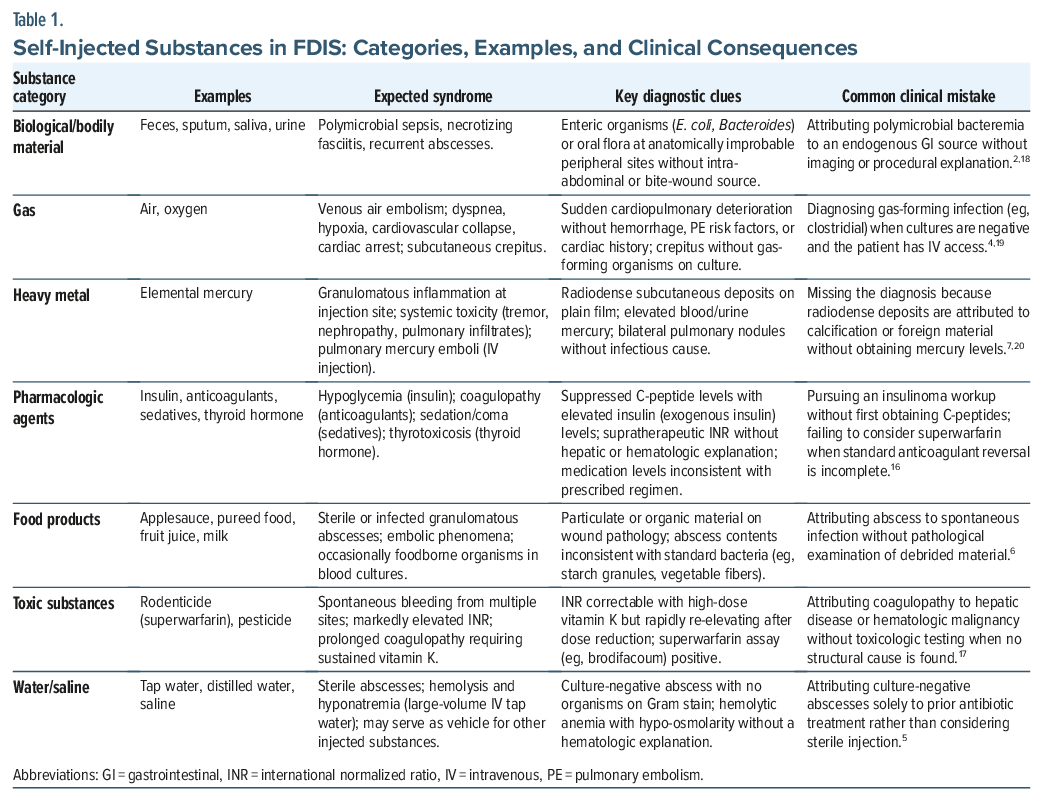
Feces and fecal-derived material are among the most dangerous substances reported in FDIS. Subcutaneous or intravenous (IV) injection introduces polymicrobial enteric organisms into sterile tissue, producing recurrent abscesses, bacteremia, necrotizing soft tissue infection, septic shock, and multiorgan dysfunction. The DSM-5-TR specifically identifies fecal injection as a recognized method of illness induction, and published reports demonstrate progression from localized infection to overwhelming sepsis.1,3,18 Clinicians should be particularly suspicious when enteric organisms are recovered from peripheral soft tissue or blood cultures without an identifiable gastrointestinal source.
Sputum and saliva have also been used to induce illness, typically producing soft tissue infections due to oral flora, including Streptococcal species, Staphylococcus aureus, and anaerobes. Recovery of oral organisms from wounds in the absence of bite injuries or another plausible explanation should prompt consideration of exogenous inoculation.5
Air injection represents a life-threatening variant. IV injection of air causes venous air embolism, which may manifest as dyspnea, chest pain, hypoxia, cardiovascular collapse, and, in fatal cases, cardiac arrest from air lock in the right heart outflow tract.4,19 Subcutaneous injection may produce emphysematous changes and crepitus that can be mistaken for gas-forming infection. Recognition depends on identifying a mismatch between these dramatic findings and the absence of an infectious or thrombotic explanation.
Mercury self-injection is most often reported in the context of suicide attempts, but cases have also been described in factitious disorder and certain subcultural practices (eg, folk medicine, bodybuilding practices).21 When injected subcutaneously or IV, elemental mercury can cause local granulomatous inflammation, systemic toxicity involving the nervous system, kidneys, and lungs, and radiodense deposits that are visible on plain radiographs.7,20 Pulmonary mercury emboli may also be seen following IV injection. Unexplained radiodense soft tissue deposits should prompt consideration of heavy metal injection.
Insulin and other pharmacologic agents are self-injected by individuals with FDIS to produce clinically convincing hypoglycemia, cardiac arrhythmias, or other medication effects. Factitious hypoglycemia caused by exogenous insulin injection can be identified by suppressed C-peptide levels in the setting of elevated plasma insulin levels, distinguishing it from endogenous hyperinsulinemia (eg, insulinoma).16 The DSM-5-TR notes that insulin, warfarin, and other medications may be used to intentionally induce illness or abnormal laboratory results.1
Food substances, including pureed foods, fruit juice, and applesauce, have also been injected subcutaneously or IV, producing granulomatous reactions, abscesses, and embolic or septic complications. Rodenticide and pesticide self-injection may produce severe coagulopathy with spontaneous bleeding and abnormal coagulation studies, particularly when coagulation abnormalities improve with vitamin K administration, suggesting superwarfarin exposure. Water or saline injection, while less immediately toxic, may result in sterile abscesses, hemolysis, or electrolyte disturbances and may serve as a vehicle for other substances.5,6,17 Unexpected particulate material, unexplained coagulopathy, or culture-negative abscesses without an alternative explanation should raise suspicion for injected nonbiological substances.
Factitious gastrointestinal (GI) bleeding represents another important mechanism of factitious illness induction, in which patients feign or induce GI hemorrhage by drinking or injecting blood or otherwise inducing bleeding, often leading to multiple endoscopic and surgical procedures before the factitious nature is recognized.22 Patients may create the appearance of GI bleeding by introducing blood into stool or emesis specimens, contaminating rectal or nasogastric output, ingesting blood or anticoagulants, or causing mucosal trauma to produce overt bleeding. As with other forms of FDIS, persistent discordance between reported symptoms and objective findings should prompt consideration of self-induced illness.
How Should Clinicians Assess for Factitious Disorder and Self-Injection?
Assessment should be thorough, systematic, and organized around 2 simultaneous tasks: excluding spontaneous medical disease and determining whether the pattern of findings is best explained by intentional illness induction. Because direct admission of self-injection is uncommon, the diagnosis often rests on converging clinical evidence rather than on a single confirmatory finding.2,9,23
A detailed medical and psychiatric history should be obtained, with attention paid to symptom onset and recurrence, prior hospitalizations, treatment responses, access to injection equipment or biological material, and familiarity with medical systems. The psychiatric history should assess depressive and anxiety disorders, trauma-related symptoms, dissociation, personality pathology, substance use, prior self-harm, and suicidality while also exploring the patient’s relationship to illness, caregiving, dependency, and the medical system.1,2 Discrepancies between reported history, medical records, and objective findings should be carefully documented, as diagnosis is often based on converging indirect evidence rather than direct proof.9 Collateral information is essential, including outside records, pharmacy data, prior microbiology results, procedural history, and communication with prior treating clinicians. When appropriate, and with patient consent, family or other supports may clarify patterns of illness, care-seeking, and psychosocial stressors.
Laboratory evaluation should be guided by the suspected mechanism of illness induction. For suspected self-injection, blood cultures, wound cultures, Gram stain, anaerobic cultures, and culture of drained material may reveal enteric, oral, environmental, or polymicrobial organisms inconsistent with the reported exposure.2,24 Pathology or foreign-body analysis of debrided tissue may identify particulate matter, food material, granulomatous inflammation, or other evidence of introduced substances.24,25 Toxicologic testing should be considered when coagulopathy, hypoglycemia, heavy metal exposure, or unexplained medication effects are present.26 Examples include insulin and C-peptide testing for suspected exogenous insulin use,27 coagulation studies and superwarfarin assays for unexplained bleeding, mercury levels and radiographs for suspected mercury injection, and medication levels when prescribed or nonprescribed drug exposure is suspected.
Early psychiatric consultation, even before the diagnosis has been established, can help the team avoid accusatory or fragmented communication, coordinate medical and psychiatric evaluation, and plan any eventual disclosure. A unified multidisciplinary approach is especially important because inconsistent messaging may reinforce denial, splitting, or repeated care-seeking across services.
When and How Should Clinicians Approach Disclosure When Self-Injection or Factitious Disorder Is Suspected?
Disclosure of a suspected factitious disorder diagnosis requires careful timing, a unified team approach, and attention to the patient’s safety. Three tensions shape every disclosure conversation: premature confrontation risks denial and flight, but indefinite avoidance allows continued self-injury; insisting on confession is counterproductive, but naming the concern openly is therapeutically necessary; and preserving the relationship is essential, yet a relationship that never addresses the behavior cannot protect the patient.
Before disclosure, clinicians should complete an appropriate medical evaluation, gather objective evidence, consult with a C-L psychiatrist, and ensure that the multidisciplinary team has a shared understanding of the formulation and plan. The message should be delivered consistently by the team and paired with an offer of continued care. Disagreement among clinicians, or fragmented communication across services, may reinforce avoidance and make engagement more difficult.
Disclosure should be supportive and nonaccusatory, emphasizing patient safety and psychological distress rather than requiring admission of intent. A more therapeutic approach is to acknowledge the patient’s suffering, name the team’s concern that psychological distress may be contributing to serious medical harm, and emphasize that both the infection or injury and the underlying distress deserve treatment.1,2 Stepwise supportive confrontation has been recommended, allowing the patient to relinquish the sick role without unnecessary humiliation or loss of dignity.8
After disclosure, denial and disengagement are common and should be anticipated rather than interpreted as treatment failure. Continued medical care, psychiatric access, harm-reduction planning, and clear limits around unnecessary procedures may reduce morbidity even when the patient does not initially accept the diagnosis. Only a minority of patients acknowledge self-induced illness after confrontation, and relatively few agree to engage in psychiatric treatment, underscoring the importance of maintaining a therapeutic pathway even when insight is limited.
What Management Strategies Are Most Effective for Treatment of Medical Complications, Psychiatric Care, and Harm Reduction?
Research is limited by diagnostic concealment, treatment refusal, and fragmented care, resulting in a reliance on case reports and expert consensus. A systematic review found no clear evidence that any specific intervention is reliably effective, including confrontational versus nonconfrontational approaches or psychotherapy versus no psychotherapy.28 Accordingly, treatment focuses on minimizing unnecessary medical interventions, addressing comorbid psychiatric illness, maintaining longitudinal engagement, and incorporating harm reduction when needed.
When patients engage in psychotherapy, early treatment should, in general, be supportive, empathic, and practical rather than confrontational or heavily insight-oriented. Therapy may focus on reducing reliance on the sick role, identifying triggers for illness-inducing behavior, addressing trauma or attachment disruption, and developing safer ways to seek care or communicate distress.23 Treatment of comorbid depression, anxiety, trauma-related symptoms, substance use, and personality pathology should be incorporated into the plan. When borderline personality disorder or prominent emotional dysregulation is present, dialectical behavior therapy may be useful, although it has not been specifically studied in FDIS; its evidence base for reducing self-harm supports consideration in patients with comorbid borderline features.29
Care coordination is often as important as individual psychotherapy. A shared care plan involving medical and psychiatric clinicians can reduce unnecessary procedures, clarify thresholds for hospitalization or invasive testing, and limit fragmented care that inadvertently reinforces illness behavior. Harm reduction may also be appropriate when complete cessation of self-injection is not immediately achievable, including close outpatient follow-up, wound care planning, supervised treatment when feasible, and clear pathways for urgent evaluation that do not require escalation through recurrent self-injury. Coordinated care plans across medical and psychiatric teams are essential to reduce unnecessary procedures, limit iatrogenic harm, and provide consistent responses to recurrent presentations. One model developed by Lemogne and Airagnes30 suggests that reconceptualizing factitious behavior as being akin to addictive behavior (eg, patients becoming increasingly “dependent” on health care) can destigmatize the illness and provide a framework for management. Like previously described models for the management of illness anxiety disorder, this model suggests that scheduling predictable, interdisciplinary encounters with a limited scope and workup may minimize the potential for iatrogenic harm and reinforcement of illness behaviors.30
What Ethical and Legal Considerations Are Relevant?
The central ethical problem is not whether to treat (as treatment of real medical injuries is nonnegotiable) but how to do so without reinforcing the behavior that produced it. Treating a wound that the patient inflicted is straightforward medicine; deciding whether to escalate care in ways that may enable future harm is considerably more complex. Decisions about invasive or escalating interventions must weigh immediate clinical benefit against the risk of enabling future self-harm. Standard bioethical principles provide only partial guidance.
Beneficence requires treating the infection; it does not obligate providing interventions that may facilitate its recurrence. Nonmaleficence prohibits causing harm; it must also account for the potential harms of both action and inaction, including withholding care in a patient in sepsis. Autonomy matters, but its application is complicated when decision-making occurs in the context of severe psychological distress, impaired insight, or ongoing self-injury.31 In some cases, more directive limits on medically unnecessary interventions may be ethically justified as part of responsible care, particularly when continued intervention would expose the patient to substantial risk without expected benefit.8,32
Requests for procedures, admissions, antibiotics, opioids, central venous access, or other interventions require careful scrutiny when the presentation is suspected to be factitious. The key ethical question is not simply whether an intervention is possible but whether it is clinically justified and consistent with minimizing harm. The ethical concern centers on whether the requested intervention may deepen the cycle of illness, increase iatrogenic risk, or provide new means for self-harm. Clinicians should distinguish the treatment of medical complications from interventions that lack a sound medical indication. When a requested intervention is unlikely to benefit the patient or may worsen the overall pattern of harm, the team should explain the medical reasoning, offer safer alternatives, and provide care without escalating to nonbeneficial or potentially harmful procedures.8
Documentation in the medical record can be challenging. Clear, factual documentation of objective findings, clinical observations, microbiologic data, collateral information, and the reasoning underlying the diagnostic formulation is important for care continuity and future risk reduction. Documentation should also avoid use of pejorative language or unsupported claims of intent. Phrases such as “findings concerning for self-induced illness” or “pattern raises concern for factitious disorder imposed on self” are preferable to accusatory formulations that may stigmatize the patient or compromise the therapeutic relationship. When recurrent presentations occur across multiple clinicians or institutions, documentation should also include any agreed-upon safety or behavioral care plan, including recommended thresholds for admission, indications for invasive testing or procedures, limits on nonbeneficial interventions, and preferred pathways for psychiatric consultation and follow-up. Consistent documentation across settings is particularly important to reduce fragmented care and inadvertent reinforcement of illness behavior.2,8
These care plans are particularly important when patients decline psychiatric treatment or continue to self-injure. In such cases, the ethical obligation is to reduce harm while preserving a pathway back to care. This may include coordinated outpatient follow-up, clear thresholds for emergency evaluation, wound care planning, avoidance of unnecessary invasive devices, communication across treating teams, and realistic limits on repeated diagnostic or procedural escalation. The goal is not to eliminate risk entirely but to create a consistent clinical response that treats acute complications while reducing opportunities for further injury.2,8
Some cases require additional institutional guidance because the ethical questions extend beyond the bedside team. Ethics consultation can help clarify disagreements about beneficial treatment, autonomy, safety, and appropriate limits of care. Risk management or legal counsel may be warranted when self-injection involves substances obtained through illicit means, diversion of medical supplies, risk to vulnerable populations, occupational exposure concerns, or uncertainty about mandatory reporting requirements. These consultations should support a coherent care plan rather than substitute for ongoing medical and psychiatric engagement.1,2,10 In FDIS, clinicians are often treating both the consequence and the mechanism of harm simultaneously, without being able to fully separate the two, a tension that underlies many of the ethical challenges described above.
What Are the Psychological Underpinnings and Risk Factors for FDIS?
Many patients exhibit a deep and often unconscious psychological investment in the sick role. Society more readily accepts physical illness as a legitimated social status than psychological distress, which may partly explain the preference for somatic symptom induction over direct help-seeking.2 Developmental factors are prominent. In one study, 60% of patients with FDIS had suffered a childhood illness and more than half had experienced a childhood loss, and insecure attachment was overrepresented, supporting a developmental model of the disorder.2,33 In one cohort, 100% of patients with FDIS had an identifiable family dynamic issue, including abuse, parental divorce, enmeshment, or significant-other conflict, and 69% had a history of trauma.11 These developmental and interpersonal factors may help explain the persistence of illness-inducing behaviors despite substantial medical risk and limited insight.
Several demographic and clinical patterns have also emerged (Table 2). FDIS most commonly presents in young to middle adulthood, with a mean age at presentation ranging from 34.2 to 38.4 years, and 82% of patients in one cohort were younger than 40 years.9,11,34 Women comprise approximately two-thirds of reported cases, although Munchausen syndrome, the more severe and persistent subtype of FDIS, appears to occur more frequently in men.1,2,9,34 Health care workers are disproportionately represented, likely reflecting greater access to medical knowledge, injection equipment, and biological materials.2,11,34 In the largest systematic review of 455 cases, health care or laboratory professions were the most commonly reported occupations,34 and one cohort found that 67% of patients had health care training, 67% had direct IV access, and 31% possessed equipment consistent with self-induction of symptoms.11
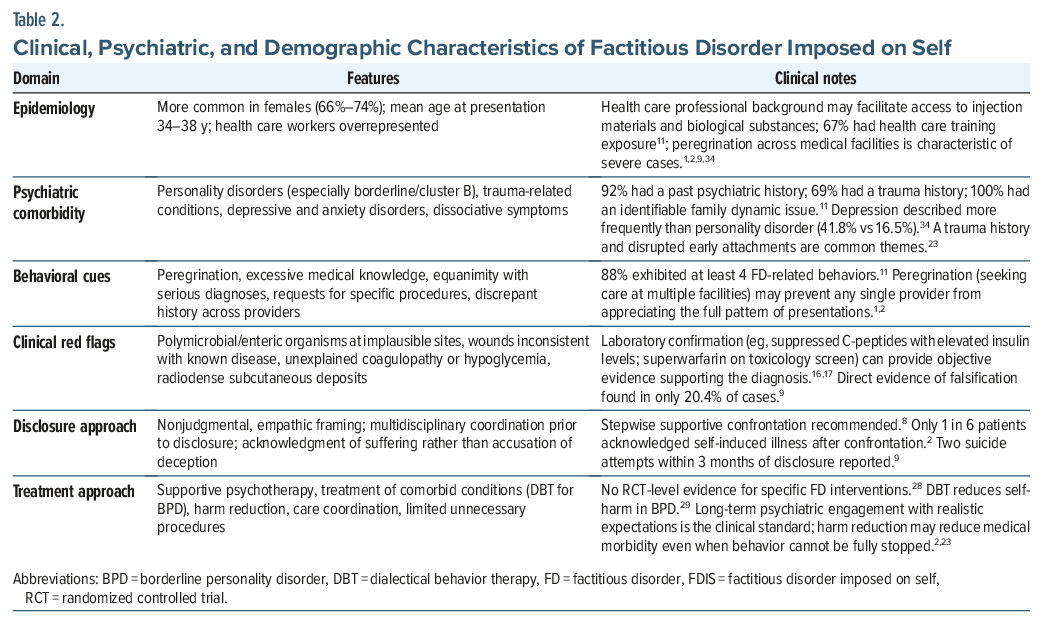
Psychiatric disorders commonly co-occur with FDIS and may contribute to patients’ distress and illness-inducing behaviors. In one cohort, 92% of patients had a prior psychiatric history, 78% had a family psychiatric history, and 69% had experienced trauma.11 Depression was reported more frequently than personality disorders (41.8% versus 16.5%) in the largest systematic review,34 although borderline personality disorder, anxiety disorders, trauma-related disorders, and dissociative symptoms are also commonly encountered.3,23,35 Recognition of these comorbid conditions is important because they often represent treatable conditions that contribute to the patient’s distress, even when the factitious behaviors themselves persist.
Engagement with treatment remains one of the greatest clinical challenges. Confrontation frequently results in denial, treatment refusal, or premature departure from care.1,2 In one series, only 1 in 6 patients acknowledged self-induced illness after disclosure, and only 12% agreed to psychiatric treatment,2 while another cohort reported that no patients admitted intentional symptom production, and 2 attempted suicide within 3 months of disclosure.9 Pathological lying, recurrent deception, and self-injurious behaviors can evoke frustration, helplessness, and other forms of negative countertransference that complicate the therapeutic relationship.10 Accordingly, a supportive, nonjudgmental, multidisciplinary approach that acknowledges psychological suffering without demanding confession is generally recommended, although high-quality evidence supporting any single management strategy remains limited.8,28
What Happened to Mr B?
Following stabilization with antibiotics, debridement, and treatment of sepsis, a C-L psychiatrist conducted a comprehensive evaluation. Mr B initially denied self-injection; however, after several days of supportive engagement, Mr B disclosed a 4-year history of injecting feces into his extremities and abdomen. He described a history of interpersonal trauma and a longstanding pattern of seeking care during periods of distress, although his account remained incomplete and at times inconsistent.
His presentation was formulated as FDIS with features consistent with borderline personality disorder and complex trauma. He received psychoeducation but declined psychiatric follow-up at discharge; a coordinated outpatient plan was established to limit unnecessary procedures and maintain psychiatric access.
Three months later, he re-presented with a new soft tissue infection. He remained ambivalent about the diagnosis and initially declined further psychiatric evaluation, although he did not leave against medical advice. After several days of speaking with a C-L psychiatrist and with the support of a family member who had become aware of the prior disclosure, Mr B agreed to a voluntary psychiatric admission and was stabilized medically. He was discharged with a coordinated outpatient care plan, including scheduled psychiatric follow-up and explicit limits on invasive diagnostic procedures in the absence of new clinical indications.
At the 6-month follow-up, he had attended several outpatient appointments but remained guarded about the self-injection history. No further emergency presentations had occurred, although the absence of ED presentations did not confirm cessation of harmful behaviors. His engagement fluctuated over time, with periods of openness alternating with guardedness and partial disengagement from care.
CONCLUSION
Unusual self-injection is a high-risk manifestation of factitious disorder that requires simultaneous medical stabilization, diagnostic humility, psychiatric formulation, and carefully staged disclosure. Patients often present with recurrent infections, unusual wound cultures, or systemic complications that are initially attributed to spontaneous disease. The range of injected substances reported in the literature (from feces, sputum, air, mercury, food products, and rodenticide) underscores the breadth of mechanisms through which illness may be intentionally produced.
For C-L psychiatrists and other medical clinicians, early recognition requires a high index of suspicion, careful attention to patterns of illness that are inconsistent with known disease processes, and a nonjudgmental clinical stance that preserves the therapeutic relationship. Effective management requires multidisciplinary coordination, thoughtful diagnostic disclosure, and a long-term commitment to psychiatric engagement even in the face of patient denial or ambivalence.2,8,36
In practice, the goal is not diagnostic certainty but a consistent and safe clinical response that treats acute complications while limiting iatrogenic harm and reducing opportunities for further self-injury.
Article Information
Published Online: November 17, 2026. https://doi.org/10.4088/PCC.26f04269
© 2026 Physicians Postgraduate Press, Inc.
Submitted: May 7, 2026; accepted July 16, 2026.
To Cite: Schwartz AC, Robbins-Welty G, Stiles C, et al. When the syringe holds the unexpected: unusual self-injected substances and factitious disorder. Prim Care Companion CNS Disord 2026;28(6):26f04269.
Author Affiliations: Department of Psychiatry and Behavioral Sciences, Emory University School of Medicine, Atlanta, Georgia (Schwartz, Stiles); Grady Memorial Hospital, Atlanta, Georgia (Schwartz, Robbins-Welty); Departments of Family and Preventive Medicine,
Medicine, and Psychiatry and Behavioral Sciences, Emory University School of Medicine,
Atlanta, Georgia (Robbins-Welty); Harvard Medical School, Boston, Massachusetts (Stern);
Massachusetts General Hospital, Boston, Massachusetts (Stern).
Corresponding Author: Ann C. Schwartz, MD, 12 Executive Parkway, Suite 142, Atlanta, GA 30329 ([email protected]).
Schwartz, Robbins-Welty, and Stiles are co-first authors; Stern is the senior author.
Financial Disclosure: Dr Stern has received royalties from Elsevier for editing textbooks on psychiatry. Drs Robbins-Welty, Stiles, and Schwartz report no conflicts of interest.
Funding/Support: None.
Clinical Points
- Factitious disorder imposed on self (FDIS) should be suspected when recurrent illness is accompanied by persistent diagnostic discordance, particularly unusual microbiology, anatomically implausible lesions, unexplained laboratory abnormalities, or recurrence despite appropriate therapy.
- The range of substances self-injected in the setting of FDIS includes feces, sputum, air, mercury, food products (including applesauce), rodenticide, and pharmacologic agents; each carries distinct pathophysiologic risks ranging from polymicrobial sepsis to embolic phenomena, heavy metal toxicity, and coagulopathy.
- Health care workers are overrepresented among individuals with FDIS and may have easier access to injection equipment and biological materials; occupational exposure should not automatically be accepted as an explanation for unusual microbiologic findings. In the largest systematic review, a health care or laboratory profession was the most frequently reported occupation among 455 cases.34
- Premature confrontation about factitious behavior frequently leads to patient denial, anger, and disengagement from care; a nonjudgmental, empathic approach that frames the diagnosis in terms of psychological suffering rather than deception is more likely to preserve the therapeutic relationship.2,8
- Early consultation-liaison psychiatry consultation, thorough psychiatric assessment, care coordination across specialties, and harm reduction strategies are essential components of management; evidence-based treatment for comorbid borderline personality disorder and trauma-related conditions should be incorporated into the long-term care plan.29
- Diagnosis relies on patterns of discordance rather than direct evidence; consistency of clinical response is more important than certainty of attribution.
References (36)

- American Psychiatric Association. Diagnostic and Statistical Manual of Mental Disorders. 5th Edition, Text Revision. Washington, DC: American Psychiatric Association; 2022.
- Bass C, Halligan P. Factitious disorders and malingering: challenges for clinical assessment and management. Lancet. 2014;383(9926):1422–1432. PubMed CrossRef
- Aduan RP, Fauci AS, Dale DC, et al. Factitious fever and self-induced infection: a report of 32 cases and review of the literature. Ann Intern Med. 1979;90(2):230–242. PubMed CrossRef
- Mirski MA, Lele AV, Fitzsimmons L, et al. Diagnosis and treatment of vascular air embolism. Anesthesiology. 2007;106(1):164–177. PubMed
- Folks DG. Munchausen’s syndrome and other factitious disorders. Neurol Clin. 1995;13(2):267–281. PubMed
- Freyberger H, Nordmeyer JP, Freyberger HJ, et al. Patients suffering from factitious disorders in the clinico-psychosomatic consultation liaison service: psychodynamic processes, psychotherapeutic initial care and clinico-interdisciplinary cooperation. Psychother Psychosom. 1994;62(1-2):108–122. PubMed CrossRef
- Torres AD, Rai AN, Hardiek ML. Mercury intoxication and arterial hypertension: report of two patients and review of the literature. Pediatrics. 2000;105(3):e34. PubMed CrossRef
- Hausteiner-Wiehle C, Hungerer S. Factitious disorders in everyday clinical practice. Dtsch Arztebl Int. 2020;117(26):452–459.
- Bérar A, Bouzillé G, Jego P, et al. A descriptive, retrospective case series of patients with factitious disorder imposed on self. BMC Psychiatry. 2021;21(1):588. PubMed CrossRef
- Margolis M, Wong TL, Shmuts R, et al. Consultation-liaison case conference: a case of factitious disorder imposed on self. J Acad Consult Liaison Psychiatry. 2023;64(6):562–570. PubMed CrossRef
- Jimenez XF, Nkanginieme N, Dhand N, et al. Clinical, demographic, psychological, and behavioral features of factitious disorder: a retrospective analysis. Gen Hosp Psychiatry. 2020;62:93–95. PubMed CrossRef
- Fink P, Jensen J. Clinical characteristics of the Munchausen syndrome. A review and 3 new case histories. Psychother Psychosom. 1989;52(1-3):164–171. PubMed CrossRef
- Green SL, Read BP. Factitious polymicrobial bacteremia: a case report. J Urol. 1981;125(2):263–264. PubMed
- Gupta MA, Gupta AK. Self-induced dermatoses: a great imitator. Clin Dermatol. 2019;37(3):268–277.
- Lavery MJ, Stull C, McCaw I, et al. Dermatitis artefacta. Clin Dermatol. 2018;36(6):719–722. PubMed
- Marks V, Teale JD. Factitious hypoglycemia. Endocrinol Metab Clin North Am. 1999;28(3):579–601. PubMed
- Spahr JE, Maul JS, Rodgers GM. Superwarfarin poisoning: a report of two cases and review of the literature. Am J Hematol. 2007;82(7):656–660. PubMed CrossRef
- Blumenstein M, Boekstegers P, Fraunberger P, et al. Cytokine production precedes the expansion of CD14+CD16+ monocytes in human sepsis: a case report of a patient with self-induced septicemia. Shock. 1997;8(1):73–75. PubMed CrossRef
- McCarthy CJ, Behravesh S, Naidu SG, et al. Air embolism: practical tips for prevention and treatment. J Clin Med. 2016;5(11):93. PubMed
- McFee RB, Caraccio TR. Intravenous mercury injection and ingestion: clinical manifestations and management. J Toxicol Clin Toxicol. 2001;39(7):733–738.
- Prasad VL. Subcutaneous injection of mercury: warding off evil. Environ Health Perspect. 2004;112(13):1326–1328.
- Mullarkey M, Wilcox CM, Edwards AL. Factitious gastrointestinal bleeding: a case series and review. Am J Med Sci. 2021;362(5):516–521. PubMed CrossRef
- Krahn LE, Li H, O’Connor MK. Patients who strive to be ill: factitious disorder with physical symptoms. Am J Psychiatry. 2003;160(6):1163–1168.
- Kwon Y, Koene RJ, Cross C, et al. Fatal non-thrombotic pulmonary embolization in a patient with undiagnosed factitious disorder. BMC Res Notes. 2015;8:302. PubMed CrossRef
- Jackson RM, Tucker SB, Abraham JL, et al. Factitial cutaneous ulcers and nodules: the use of electron-probe microanalysis in diagnosis. J Am Acad Dermatol. 1984;11(6):1065–1069. PubMed CrossRef
- Kinns H, Housley D, Freedman DB. Munchausen syndrome and factitious disorder: the role of the laboratory in its detection and diagnosis. Ann Clin Biochem. 2013;50(Pt 3):194–203. PubMed CrossRef
- Scarlett JA, Mako ME, Rubenstein AH, et al. Factitious hypoglycemia. Diagnosis by measurement of serum C-peptide immunoreactivity and insulin-binding antibodies. N Engl J Med. 1977;297(19):1029–1032. PubMed CrossRef
- Eastwood S, Bisson JI. Management of factitious disorders: a systematic review. Psychother Psychosom. 2008;77(4):209–218.
- Storebø OJ, Stoffers-Winterling JM, Völlm BA, et al. Psychological therapies for people with borderline personality disorder. Cochrane Database Syst Rev. 2020;5(5):CD012955.
- Lemogne C, Airagnes G. Reframing factitious disorder through an addiction-informed lens: harm reduction first. J Psychosom Res. 2026;206:112676. Advance online publication. https://doi.org/10.1016/j.jpsychores.2026.112676 PubMed CrossRef
- Robbins-Welty GA. Give Her what She Wants: an ethical exploration of factitious illness and disagreement between inpatient and outpatient providers. J Hosp Ethics. 2024;10(1):48–56.
- Fry C, Gergel T. Paternalism and factitious disorder: a question of autonomy. J Med Ethics. 2016;42(1):49–52.
- Bass C, Glaser D. Early recognition and management of fabricated or induced illness in children. Lancet. 2014;383(9926):1412–1421. PubMed CrossRef
- Yates GP, Feldman MD. Factitious disorder: a systematic review of 455 cases in the professional literature. Gen Hosp Psychiatry. 2016;41:20–28. PubMed CrossRef
- Comacchio C, Misca DM, Bortoletto R, et al. Prevalence and risk factors for depression in factitious disorder: a systematic review. Front Psychiatry. 2024;15:1355243. PubMed CrossRef
- Prabhu A, Abaid B, Sarai S, et al. Munchausen syndrome. South Med J. 2020;113(4):198–200.
Please sign in or purchase this PDF for $40.