
Abstract
Objective: Once-monthly paliperidone palmitate (PP1M) extended-release injectable suspension is approved for the treatment of adults with schizophrenia or schizoaffective disorder. A 351 mg dose of PP1M (LY03010 [brand name Erzofri]) became available in the US in April 2025 and is approved as a single initiation injection followed by recommended monthly maintenance doses up to 234 mg. The objective of this study was to investigate steady-state paliperidone exposure following administration of 351 mg as a maintenance dose at different dosing intervals using population pharmacokinetic (popPK) analysis.
Methods: A popPK model was developed using Nonlinear Mixed Effects Modeling (NONMEM) based on the paliperidone concentration data from 2 phase 1 studies for LY03010. Plasma paliperidone exposures based on model simulations were summarized.
Results: Simulated plasma concentration-time profiles demonstrated that LY03010 351 mg every 4 weeks (Q4W) produced steady-state paliperidone exposure comparable to 234 mg every 3 weeks (Q3W) based on analysis of Cmax,ss and Ctrough,ss. Simulated data indicated that administration of LY03010 351 mg every 6 weeks (Q6W) provided similar paliperidone exposure to 234 mg PP1M Q4W at steady state. Simulation of LY03010 351 mg every 8 weeks (Q8W) showed that Cmax,ss of paliperidone fell in-between that of 234 mg Q4W and 156 mg Q4W while Ctrough,ss was comparable to that of 117 mg Q4W.
Conclusions: PopPK simulations suggest that LY03010 351 mg may provide alternative treatment options as a maintenance dose at different dosing intervals. Currently, there are no clinical data to support the alternative dosing regimens.
Trial Registration: ClinicalTrials.gov identifiers: NCT04572685 and NCT04922593.
J Clin Psychiatry 2026;87(4):26m16416
Author affiliations are listed at the end of this article.
From the Editors

Are you a healthcare provider?
Add your NPI to personalize your JCP experience.
Schizophrenia is a chronic and severe psychiatric disorder that affects approximately 23 million people worldwide.1 Although the exact etiology of schizophrenia remains complex and multifactorial, dopamine dysregulation has been implicated as a crucial pathway in the development of psychosis associated with schizophrenia.2,3 Medication adherence has been a recognized challenge in schizophrenia treatment, with a reported primary nonadherence rate of approximately 32% to any prescribed antipsychotic.4 Importantly, nonadherence is a leading cause of relapse, hospitalization, and potentially long-term institutionalization. The use of long-acting injectable (LAI) antipsychotics has been shown to be an effective pharmacologic approach for improving treatment adherence in patients with schizophrenia.5 Data from the recently published DECIDE survey regarding preferences when selecting and initiating LAIs for patients with schizophrenia, which involved 380 psychiatric clinicians in the US, showed that more than 60% of clinicians reported a preference for a dosing regimen given once monthly (or every 4 weeks) or less frequently.6 Patients may also have specific preferences to decrease the number of injections they would receive over the same amount of time.7
Paliperidone, the 9-hydroxy active metabolite of risperidone,8 is approved in oral and LAI forms for treatment of schizophrenia and schizoaffective disorder. The injection intervals of current US Food and Drug Administration (FDA)–approved paliperidone palmitate LAIs vary from once every 4 weeks (PP1M) to once every 3 or 6 months, the latter for patients who have received at least 4 months of PP1M. In some clinical situations, there may be patient or clinician preference for every 6-or 8-week dosing in lieu of a 3-month schedule, for example, if clinicians prefer to evaluate their patient’s status more frequently than once every 3 months. Introducing additional intermediate dosing intervals would address an important unmet medical need associated with paliperidone palmitate LAIs by optimizing patient convenience and treatment adherence while improving health care resource utilization and maintaining favorable clinical outcomes.
In practice, higher-than-recommended maintenance doses or shorter-than-recommended dosing intervals of PP1M are sometimes used off-label to achieve paliperidone exposure exceeding that from the recommended dosing regimens, especially in patients with inadequate response to the maximum approved doses and intervals. Data indicate that paliperidone exposure obtained with 273 mg and over every 28 days, which is higher than the maximally recommended 234 mg every 4 weeks dosage of PP1M, and/or with shorter time, such as 234 mg every 3 weeks between injections, may benefit some patients with residual positive symptoms without causing pronounced side effects.9,10
LY03010 (brand name Erzofri), developed by Luye Innomind Pharma Shijiazhuang Co., Ltd., is a once-monthly paliperidone palmitate LAI antipsychotic approved by the FDA in 2024 that became available in the US in April 2025 for the treatment of schizophrenia and schizoaffective disorder in adults. LY03010 is a pharmaceutical equivalent to PP1M marketed as Invega Sustenna (IS), but with a different initial dosing regimen (IDR). The approved dosing regimen for LY03010 is an IDR of 351 mg administered in the deltoid muscle on day 1, followed by monthly maintenance doses (234 mg, 156 mg, 117 mg, 78 mg, and 39 mg) administered in either the deltoid or gluteal muscle starting from 4 weeks after the first injection.11 The median apparent half-life of paliperidone following LY03010 single-dose administration at 156 mg is approximately 27 days.11
This article presents comprehensive population pharmacokinetic (popPK) model-based simulations to evaluate paliperidone exposure with alternative dosing regimens using 351 mg LY03010 as maintenance doses once every 4 weeks (Q4W) which may be suitable for patients for whom 234 mg Q4W of PP1M is insufficient, as well as every 6 weeks (Q6W) or every 8 weeks (Q8W), if additional extended injection intervals would be preferred.
METHODS
Clinical Study Design and Population PK Model Development
The popPK model was based on paliperidone pharmacokinetic data from 2 phase 1 studies, Study 102 (Protocol: LY03010/CT-USA-102, NCT04572685) and Study 103 (Protocol: LY03010/CT-USA-103, NCT04922593), conducted in patients with schizophrenia or schizoaffective disorder. The studies were conducted in accordance with the Declaration of Helsinki (1964). Each study protocol was reviewed and approved by independent institutional review boards. Written informed consent was obtained from all participants prior to the initiation of study procedures.
Study 102 was a randomized, open-label, parallel group, single-dose study designed to evaluate the PK and safety of 2 product candidates (P1 and P2) of LY03010 after a single injection of 156 mg in the deltoid muscle in stable patients with schizophrenia or schizoaffective disorder. The relative bioavailability of LY03010 to IS was assessed. A total of 37 patients were randomized: 12 patients in each of the 2 LY03010 groups and 13 patients in the IS group. The P2 formulation is the formulation of LY03010 used in Study 103 and the marketed product. The Study 102 data included in the popPK analysis were from patients who received administration of LY03010 P2 formulation or IS.
Study 103 was a randomized, multiple-dose, open-label, parallel-group study to evaluate the pharmacokinetic profiles and safety of LY03010 after multiple doses and the relative bioavailability at steady state of LY03010 versus IS in patients with schizophrenia or schizoaffective disorder. A total of 141 patients were randomized to receive 351 mg LY03010 on Day 1 by injection in the deltoid muscle, followed by 5 monthly doses of 156 mg LY03010 by injection in the gluteal muscle. A total of 140 patients were randomized to receive the first dose of 234 mg IS on Day 1 and a second dose of 156 mg IS on Day 8 by injection in the deltoid muscle, followed by 5 monthly doses of 156 mg IS by injection in the gluteal muscle.
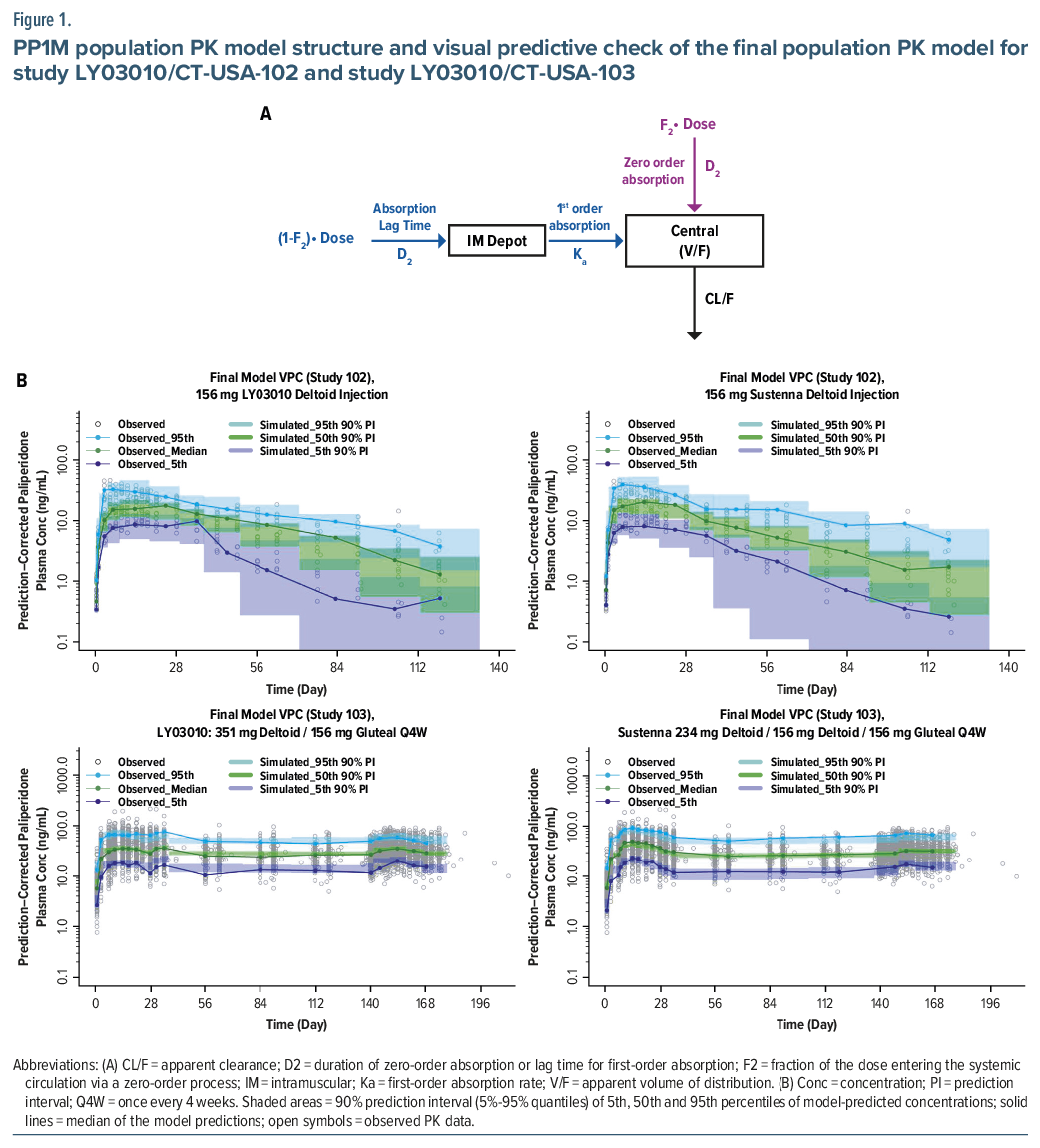
The established popPK model for both LY03010 and IS is a 1-compartment open model, with sequential zero-order and first-order absorption processes, which is the same structure model to describe the PK characteristics of IS.12,13 The parameter estimates and covariates were updated by fitting paliperidone plasma concentration data collected at the predefined time points (Supplementary Table 1) from patients receiving the final marketed formulation of both LY03010 and IS doses in Study 102 and Study 103. Visual predictive check was performed to compare the distributions of simulated concentrations to the actual concentration distributions. The 95% confidence interval of each parameter was obtained by bootstrap analysis.
Simulations
Various treatment scenarios for LY03010 and IS were simulated. For LY03010 treatment, the IDR was carried out according to the US Prescribing Information, ie, 351 mg injection in the deltoid muscle on Day 1,11 followed by the maintenance doses of LY03010 351 mg in either deltoid muscle or gluteal muscle, starting from 4 weeks post-IDR, given Q4W, Q6W, or Q8W, respectively. Additional scenarios were also simulated where LY03010 maintenance doses started 6 weeks after the first dose as ongoing Q6W injections and 8 weeks after the first dose as ongoing Q8W injections in either deltoid muscle or gluteal muscle, respectively.
For IS, the treatment was also carried out as IDR according to the US Prescribing Information, ie, a 234 mg injection in the deltoid muscle on Day 1 followed by a 156 mg injection in the deltoid muscle on Day 8,14 which was then continued with maintenance dose options of 234 mg given Q4W or once every 3 weeks (Q3W), 156 mg Q4W, or 117 mg Q4W, respectively, in deltoid muscle. Of note, for IS treatment, deltoid muscle was the only injection site used in simulations, because it was demonstrated that after multiple injections of PP1M and at steady state, the difference in paliperidone exposure between gluteal and deltoid muscle injection sites was minimal, and the two injection sites were interchangeable.12,15
For each simulation scenario, a dataset consisting of 1,000 virtual patients was created by randomly selecting patients (with replacement) from the fitting dataset, where actual creatine clearance (a covariate for apparent clearance of drug) associated with each patient was retained. Using the final parameters of the established popPK model, simulations (with values of PK model parameters and associated intersubject variability fixed) were conducted to generate the paliperidone plasma concentration-time profiles. Using these concentration profiles, the following PK parameters reflecting paliperidone systemic exposure were calculated: the average concentration at steady state (Cavg,ss), steady-state maximum concentration (Cmax,ss), and steady-state trough concentration (Ctrough,ss). For each PK exposure parameter, the median with 5%–95% prediction quantiles (ie, 90% prediction intervals [90% PI]) were summarized.
Software
The popPK model development was conducted with Nonlinear Mixed Effects Modeling (NONMEM, version 7.4.4, ICON Development Solutions, LLC). Dataset preparation, model-based simulations, data summary, and plotting were conducted with R (version 4.3.3, The R Foundation for Statistical Computing) and associated packages RxODE2 and tidyverse.
RESULTS
Population PK Model Performance Evaluation
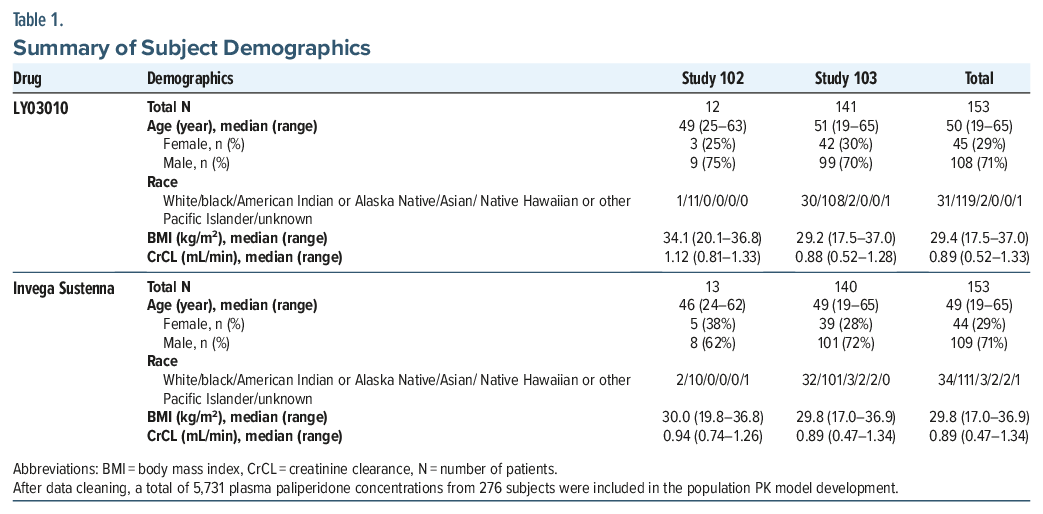
The popPK model development was based on 5,731 plasma paliperidone concentrations in 276 subjects from study LY03010/CT-USA-102 and study LY03010/CT-USA-103. Patient demographic characteristics at baseline are shown in Table 1.
The structure model for the popPK analysis is shown in Figure 1A, which is a 1-compartment open model, with sequential zero-order and first-order absorption processes consistent with the published model.12 The popPK parameters and the relative standard errors (RSE%) are shown in Supplementary Table 2, with the typical values estimated by the popPK model in good agreement with the 95% CI derived from bootstrap analysis. The visual predictive check shows good consistency between model predictions and observed concentrations (Figure 1B), where for both LY03010 and IS in each time period, the 5th, 50th, and 95th percentiles of the model simulated data match well with the corresponding percentiles of the observations from both Study 102 and Study 103. The diagnostic plots (Supplementary Figure 1) also indicated that the popPK model adequately described the observed data in the clinical studies and was unbiased.
Comparison of Simulated Treatment Scenarios
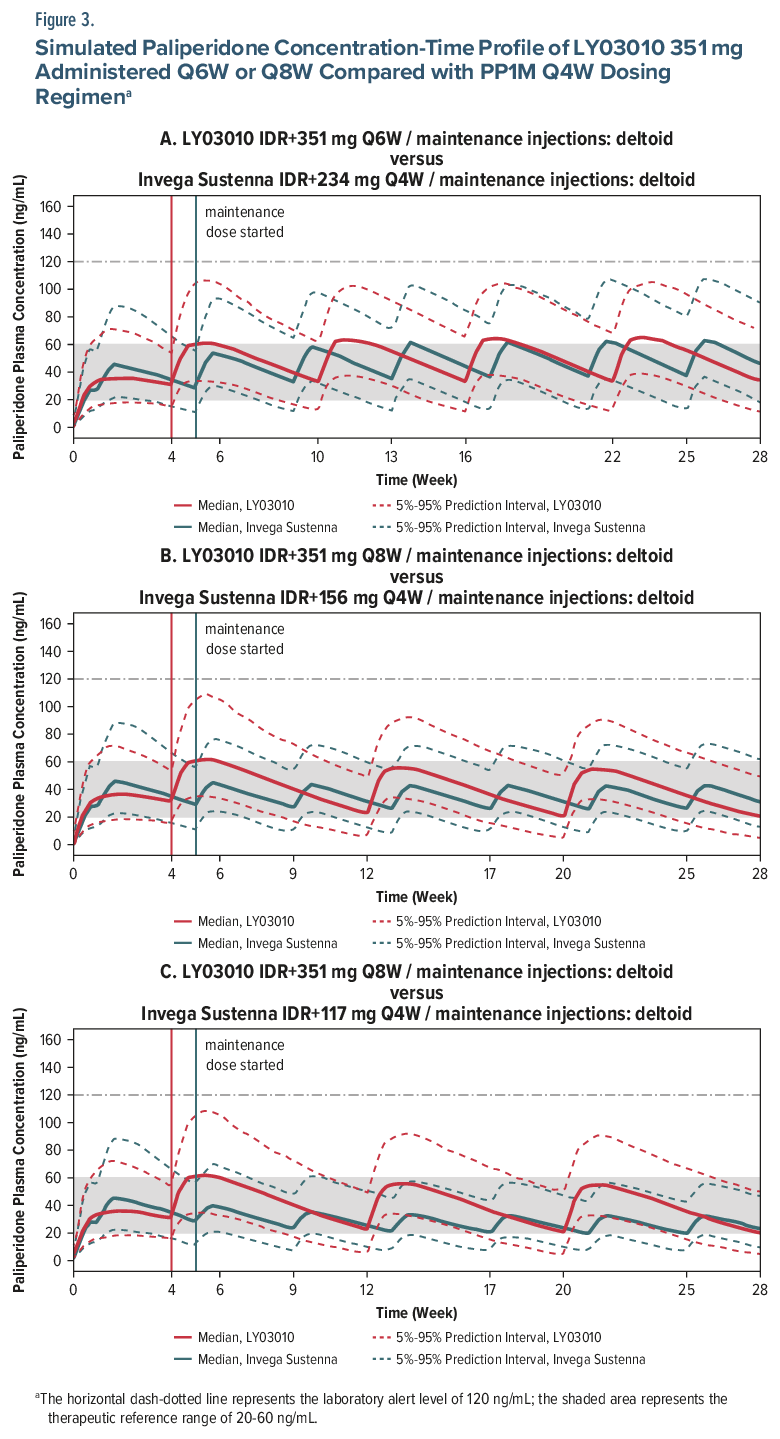
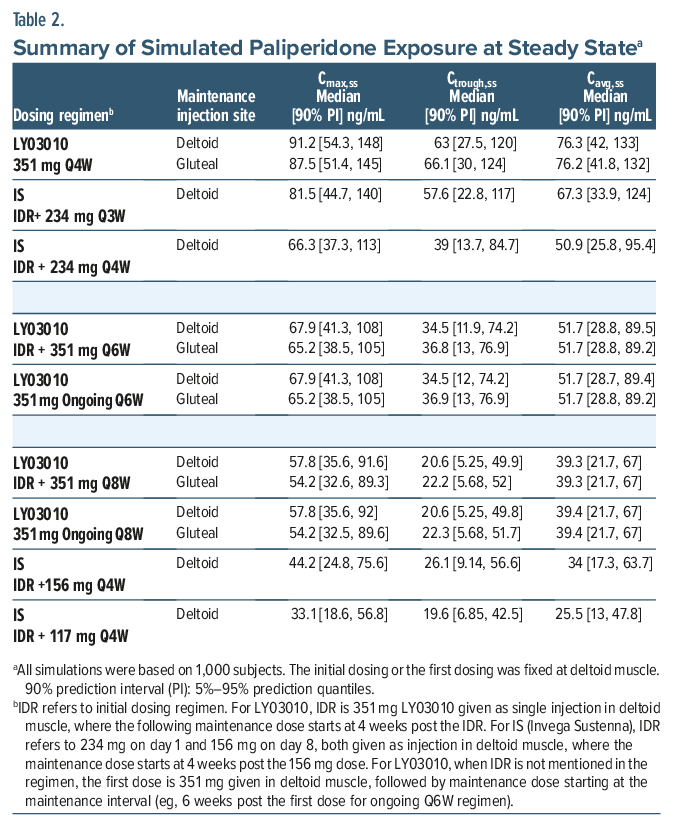
Key PK parameters indicating paliperidone systemic exposure at steady state across all simulation scenarios are summarized in Table 2. Graphical comparisons of paliperidone plasma concentration versus time profiles between standard IS treatment options and typical LY03010 treatment scenarios via deltoid injections are shown in Figure 2 (LY03010 351 mg Q4W) and Figure 3 (LY03010 351 mg Q6W and Q8W), respectively. Additional graphical comparisons between standard IS treatment options and LY03010 treatments via gluteal injections are included in Supplementary Materials.
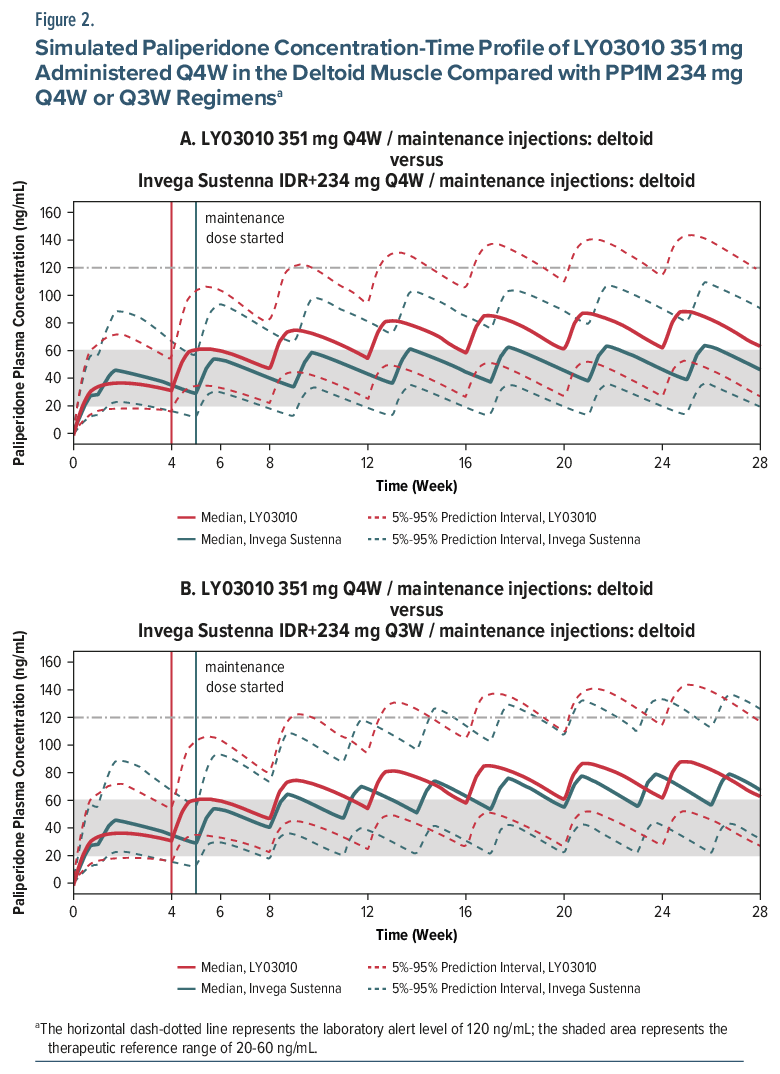
Comparison between LY03010 351 mg Q4W and IS 234 mg Q4W or Q3W. After repeated LY03010 351 mg Q4W maintenance injections in deltoid muscle or in gluteal muscle, the steady-state plasma paliperidone exposure from LY03010 was higher than that from IS 234 mg Q4W deltoid maintenance injections (Figure 2A, Supplementary Figure 2A) while similar to that of 234 mg Q3W deltoid maintenance injections (Figure 2B, Supplementary Figure 2B).
As summarized in Table 2, the simulated median [90% PI] of plasma paliperidone steady-state average concentration (Cavg,ss) was 76.3 [42, 133] ng/mL from LY03010 351 mg Q4W deltoid maintenance injections, which were approximately 50% higher than the 50.9 [25.8, 95.4] ng/mL Cavg,ss from 234 mg IS Q4W injections, while comparable to the 67.3 [33.9, 124] ng/mL Cavg,ss from 234 mg IS Q3W injections. When comparing steady-state peak concentrations (Cmax,ss) or trough concentrations (Ctrough,ss), those from LY03010 351 mg Q4W deltoid maintenance injections were approximately 38%–62% higher than those from 234 mg IS Q4W, while comparable to 234 mg IS Q3W deltoid injections, respectively. There was no noticeable difference in the steady-state plasma paliperidone exposure for LY03010 351 mg Q4W maintenance dosing between the deltoid or gluteal muscle injections.
A plasma concentration of 120 ng/mL is generally considered to be the laboratory alert level for paliperidone even though this level was arbitrarily set as twice the upper limit of the therapeutic concentration.16 The percentages of subjects with simulated Cmax,ss exceeding 120 ng/mL were evaluated. The simulated results showed that approximately 18.5% and 16.2% of subjects had Cmax,ss exceeding 120 ng/mL after receiving 351 mg LY03010 Q4W maintenance dosing at the deltoid or gluteal muscle, respectively, as compared to 12.6% of subjects with Cmax,ss exceeding 120 ng/mL after receiving 234 mg Q3W maintenance dosing at the deltoid muscle.
Comparison between 351 mg LY03010 Q6W and IS 234 mg Q4W. Simulated plasma concentration-time profiles indicated that the LY03010 351 mg IDR with repeated Q6W maintenance dosing at deltoid muscle provided similar paliperidone exposure as 234 mg Q4W injections in deltoid muscles at steady state (Figure 3A). Statistical summary showed that median [90% PI] Cmax,ss, Ctrough,ss, and Cavg,ss for LY03010 351 mg IDR + Q6W were 67.9 [41.3, 108], 34.5 [11.9, 74.2], and 51.7 [28.8, 89.5] ng/mL, respectively, as compared with those for IS 234 mg Q4W of 66.3 [37.3, 113], 39 [13.7, 84.7], and 50.9 [25.8, 95.4] ng/mL, respectively (Table 2).
Similarly, administration of LY03010 351 mg IDR with Q6W gluteal maintenance dosing also yielded comparable exposure of paliperidone after Q4W injections with PP1M 234 mg in deltoid muscles at steady state (Supplementary Figure 3A, Table 2).
Ongoing Q6W of LY03010 351 mg maintenance doses at the deltoid or gluteal muscles starting from 6 weeks after the initial deltoid dosing were also simulated (Supplementary Figure 3B–C). Regardless of the injection site, the steady-state paliperidone plasma exposure was like that of PP1M 234 mg Q4W maintenance dosing at the deltoid muscle (Table 2).
Comparison between LY03010 351 mg Q8W and IS 234 mg, 156 mg, or 117 mg Q4W. As shown in Table 2, Figure 3B, and Figure 3C, 351 mg LY03010 IDR with Q8W deltoid maintenance dosing had paliperidone Cmax,ss and Cavg,ss (57.8 [35.6, 91.6] and 39.3 [21.7, 67] ng/mL) fall in-between that of maintenance dosing at 234 mg IS Q4W (66.3 [37.3, 113] and 50.9 [25.8, 95.4] ng/mL) and 156 mg IS Q4W (44.2 [24.8, 75.6] and 34 [17.3, 63.7] ng/mL), respectively, whereas the resulting paliperidone Ctrough,ss (20.6 [5.25, 49.9] ng/mL) of LY03010 was comparable to that of 117 mg IS Q4W (19.6 [6.85, 42.5] ng/mL).
In addition, simulation results (Table 2, Supplementary Figure 4, and Supplementary Figure 5) indicated that paliperidone systemic exposure at steady state was similar among all 4 LY03010 351 mg Q8W regimens, ie, 351 mg IDR with Q8W deltoid maintenance dosing, 351 mg IDR with Q8W gluteal maintenance dosing, ongoing 351 mg Q8W deltoid maintenance dosing, and ongoing 351 mg Q8W gluteal maintenance dosing, regardless of the injection site (deltoid or gluteal muscle injections) and regardless of whether the maintenance dose started at 4 weeks post-initial dose (ie, IDR+Q8W) or at 8 weeks post-initial dose (ongoing Q8W).
DISCUSSION
This study simulated paliperidone plasma exposure for LY03010 351 mg as a maintenance dose given Q4W, Q6W, and Q8W using an established popPK model. According to the US Prescribing Information, 234 mg Q4W is the highest LY03010 maintenance dose approved. The simulation of 351 mg Q4W dosing was prompted by the observation that the use of higher-than-recommended maintenance doses or shorter-than-recommended dosing intervals of paliperidone palmitate (PP) has been reported in patients with schizophrenia. A prospective observational study investigated the use of higher-than-recommended doses of PP (ranged from 273 mg to 624 mg per 28 days) in 30 patients with severe schizophrenia over a 36-month period and demonstrated both effectiveness and good tolerability.10 The average PP dose during the study was 357 mg per 28 days. Significant improvements in clinical severity and functioning from baseline were observed at month 6 and sustained through 3 years of treatment, as measured by Clinical Global Impression-Severity scale, the WHO Disability Assessment Schedule, the Camberwell Assessment of Need, and the Medication Adherence Rating Scale scores. These improvements were accompanied by increased medication adherence, fewer hospital admissions, reduced use of concomitant antipsychotics and other psychiatric medications, and a 90% treatment retention rate at 36 months. Collectively, these findings suggest that higher-than-recommended doses of PP may represent a viable therapeutic option for some patients with schizophrenia. Another study reported 2 cases in which patients with schizophrenia were treated with PP 234 mg every 21 days, resulting in paliperidone concentrations of 102 ng/mL and 260 ng/mL after 1 and 2 years of treatment, respectively, without major adverse effects reported.9 The simulated data in our study demonstrated that 351 mg Q4W maintenance dosing regimen produced paliperidone exposure comparable to that achieved with 234 mg Q3W regimen, implying that LY03010 351 mg administered Q4W may offer an alternative treatment option to PP 234 mg Q3W for patients with schizophrenia or schizoaffective disorder who exhibit an inadequate response to the standard 234 mg Q4W regimen. Close monitoring is advised when administering higher doses of PP1M treatment for potential side effects, including extrapyramidal symptoms and prolactin levels.
While Q4W administration of 351 mg achieved simulated levels above that seen with the approved PP1M 234 mg dosing schedule, a maintenance dose of 351 mg Q6W resulted in a median [90% PI] paliperidone Ctrough,ss of 34.5 [11.9, 74.2] ng/mL, with exposure comparable to that of 234 mg monthly maintenance dose (39 [13.7, 84.7] ng/mL). Although numerically slightly lower, this is not expected to result in a clinically meaningful difference. The simulated median steady-state Ctrough,ss following administration of 351 mg Q8W was also comparable to that of a 117 mg monthly maintenance PP1M dose with the 5th percentiles (5.25 ng/mL for deltoid or 5.68 ng/mL for gluteal administration) slightly lower than that of 117 mg (6.85 ng/mL for deltoid administration; Table 2). Although these simulated 5th percentiles of the Ctrough,ss were below 7.5 ng/mL, corresponding to approximately 60% striatal D2 receptor occupancy and considered a threshold for clinical efficacy,17–19 these exposure levels may still be clinically effective. This is supported by a positron emission tomography study20 demonstrating that the Positive and Negative Syndrome Scale scores decreased or remained stable in patients with schizophrenia treated with paliperidone oral extended-release tables, even when striatal D2 receptor occupancy was below 60%.
Lastly, simulations with maintenance injections at the deltoid muscle and at the gluteal muscle resulted in similar paliperidone exposure. This is consistent with previous reports that maintenance injection sites at the deltoid or gluteal muscle produced similar paliperidone exposure at steady state.12,15 In addition, initiating the first maintenance dose 4 weeks after the first injection (IDR+Q6W or IDR+Q8W) or maintaining an ongoing dosing interval from the initiation of 351 mg at Q6W or Q8W resulted in similar paliperidone exposure at steady state under the same dosing intervals.
In summary, the popPK analysis suggests that administration of LY03010 351 mg as maintenance doses at different dosing intervals may offer additional treatment options for clinical use. It should be noted that no controlled clinical data are currently available to support the alternative dosing regimens. Therefore, caution is warranted when considering any off-label use of PP.
Article Information
Published Online: September 16, 2026. https://doi.org/10.4088/JCP.26m16416
© 2026 Physicians Postgraduate Press, Inc.
Submitted: March 11, 2026; accepted July 10, 2026.
To Cite: Chen Y, Hu L, Meyer JM, et al. Population pharmacokinetics and dosing simulations for paliperidone palmitate 351 mg as alternative maintenance doses in patients with schizophrenia or schizoaffective disorder. J Clin Psychiatry 2026;87(4):26m16416.
Author Affiliations: Luye Pharma (USA), Ltd., Princeton, New Jersey (Chen, Dong); JP Global Pharma LLC, Rockville, Maryland (Hu, Yang); University of California San Diego, La Jolla, California (Meyer); New York Medical College, Valhalla, New York (Citrome); Luye Pharmaceutical Research & Development Center, Luye Pharma Group, Ltd., Yantai, Shandong, China (Song, Wang, Liu).
Corresponding Author: Ying Dong, MD, PhD, Luye Pharma (USA), Ltd., 502 Carnegie Center, Suite 100, Princeton, NJ 08540 ([email protected]).
Drs Chen and Hu contributed equally to this work.
Financial Disclosures: Drs Chen, Wang, and Dong; Mr Song; and Ms Liu are current employees of Luye Pharma. Drs Hu and Yang are employees of JP Global Pharma LLC., which has received funding from Luye Pharma for population PK analysis in relation to this project. Dr Meyer has received honoraria for speaking or advising from 4M Therapeutics, AbbVie, Alkermes, Autobahn, Axsome, BMS, JNJ, Neurocrine, Supernus, Teva, Clinical Care Options (Decera), Medscape, NEI and Psych Congress; has received royalties from Cambridge University Press; and has stock options in 4M Therapeutics. Dr Citrome has served as a consultant for AbbVie, Acadia, Adheretech, Altus, Alumis, Axsome, Alkermes, Arc, Auritec, Autobahn, Avant Healthcare Solutions, Biogen, BioXcel, Bristol-Myers Squibb/Karuna, Boehringer Ingelheim, Cadent, Cerevel, Clario/Medavante/Prophase, Clinilabs, Compass, Corcept, Definium, Delpor, Eisai, Enteris BioPharma, Health Wellness Partners, HLS, Idorsia, INmune Bio, Intra-Cellular, Johnson & Johnson/Janssen, Little Bear, Lundbeck, Luye, Lyndra, MapLight, Marvin, Mindmed, Neurelis, Neushen, Neumora, Neurocrine, Noema, Novartis, Noven, Orexo, Otsuka, Ovid, Pontifax/Draig, Praxis, PSL, Real Chemistry, Relmada, Renew Research, Response, Reviva, Sage, Seaport, Sumitomo/Sunovion, Supernus, Teva, University of Arizona, Vanda, Wells Fargo, and one-off ad hoc consulting for individuals/entities conducting marketing, commercial, or scientific scoping research; speaker for AbbVie, Acadia, Alkermes, Bristol-Myers Squibb, Eisai, Idorsia, Intra-Cellular, Johnson & Johnson/Janssen, Lundbeck, Luye, Neurocrine, Neopharm, Noven, Otsuka, Recordati, Takeda, Teva, Vanda, and CME activities organized by medical education companies such as Decera Clinical Education/Clinical Education Alliance/Clinical Care Options, CME Institute, CMEology, HMP/Psych Congress, Medscape/WebMD, MultiMedia Medical LLC, Neuroscience Education Institute, NEI, Paradigm, Real Psychiatry/Efficient, Real World CE, Rockpointe, Total CME, Vindico, and Universities, Professional Organizations/Societies and Advocacy Associations (MHA); owns small amounts of health-related shares of common stock in multiple companies in a portfolio managed externally, and stock options in Reviva; and earns royalties/publishing income from Taylor & Francis (Editor-in-Chief, Current Medical Research and Opinion, 2022-date), UpToDate (reviewer), Springer Healthcare (book), Elsevier (Topic Editor, Psychiatry, Clinical Therapeutics, through Spring 2025).
Funding/Support: Funded by Luye Innomind Pharma Shijiazhuang Co., Ltd.
Role of the Sponsor: The sponsor was involved in the design and conduct of the studies, as well as in the collection, management, analysis, and interpretation of the data used in this simulation analysis. The sponsor also provided funding for the preparation of the manuscript. All authors met the criteria for authorship, participated in reviewing and approving the manuscript, and contributed to the decision to submit it for publication.
Previous Presentation: Part of this work was previously presented at Psych Congress; September 17–21, 2025; San Diego, California, and at NEI Congress, November 6–9, 2025; Colorado Springs, Colorado.
Data Sharing Statement: The information for LY03010 clinical studies is available on ClinicalTrials.gov (NCT04572685 and NCT04922593). The datasets generated and analyzed during the current study are available from the corresponding author on reasonable request.
Acknowledgment: The authors thank Yuanchao Zhang, PhD, from Alavanda Regulatory & Drug Development Consulting, Inc., Fulton, Maryland for his regulatory perspective contributions to this project. Dr Zhang is currently a consultant to Luye Pharma.
Supplementary Material: Available at Psychiatrist.com.
Clinical Points
- Paliperidone palmitate has proven effective for the treatment of individuals living with schizophrenia and schizoaffective disorder. Alternative maintenance dosing strategies provide options that may improve effectiveness or treatment adherence.
- For patients with inadequate response to the maximum approved dose of PP1M, 351 mg every 4 weeks is a viable consideration.
- Dosing with 351 mg every 6 weeks or every 8 weeks can offer greater flexibility for maintenance treatment planning.
References (20)

- Schizophrenia. World Health Organization. Accessed March 9, 2026. https://www.who.int/news-room/fact-sheets/detail/schizophrenia
- Howes OD, Kapur S. The dopamine hypothesis of schizophrenia: version III-the final common pathway. Schizophr Bull. 2009;35(3):549–562. PubMed CrossRef
- Howes OD, Onwordi EC. The synaptic hypothesis of schizophrenia version III: a master mechanism. Mol Psychiatry. 2023;28(5):1843–1856. PubMed CrossRef
- Lieslehto J, Tiihonen J, Lähteenvuo M, et al. Primary nonadherence to antipsychotic treatment among persons with schizophrenia. Schizophr Bull. 2022;48(3):655–663. PubMed CrossRef
- Correll CU, Citrome L, Haddad PM, et al. The use of long-acting injectable antipsychotics in schizophrenia: evaluating the evidence. J Clin Psychiatry. 2016;77(suppl 3):1–24. PubMed CrossRef
- Velligan D, Salinas GD, Belcher E, et al. Preferences for selecting and initiating long-acting injectable antipsychotic agents for the treatment of patients with schizophrenia: results from the US DECIDE Survey. Schizophr Bull Open. 2025;6(1):sgaf001. PubMed CrossRef
- Citrome L. Long-acting injectable antipsychotics update: lengthening the dosing interval and expanding the diagnostic indications. Expert Rev Neurother. 2017;17(10):1029–1043. PubMed CrossRef
- Citrome L. Paliperidone: quo vadis?. Int J Clin Pract. 2007;61(4):653–662. PubMed CrossRef
- Cohen JY, Dumoulin-Charette A, Meraabi N, et al. Serum concentration of paliperidone palmitate administered every 3 weeks. Psychopharmacol Bull. 2019;49(2):57–62. PubMed
- Fernández-Miranda JJ, Díaz-Fernández S. Tolerability of effective high doses of paliperidone palmitate in patients with severe resistant schizophrenia. Int Clin Psychopharmacol. 2017;32(1):6–12. PubMed CrossRef
- ERZOFRI (Paliperidone Palmitate). US prescribing information. Revised January 2025. https://www.accessdata.fda.gov/drugsatfda_docs/label/2025/216352s001lbl.pdf
- Samtani MN, Vermeulen A, Stuyckens K. Population pharmacokinetics of intramuscular paliperidone palmitate in patients with schizophrenia: a novel once-monthly, long-acting formulation of an atypical antipsychotic. Clin Pharmacokinet. 2009;48(9):585–600. PubMed CrossRef
- FDA clinical pharmacology review summary of the initial submission of INVEGA SUSTENNA. Accessed March 9, 2026. https://www.accessdata.fda.gov/drugsatfda_docs/nda/2009/022264s000clinpharmr.pdf
- Invega Sustenna (Paliperidone Palmitate). US prescribing information. Revised January 2025. https://www.accessdata.fda.gov/drugsatfda_docs/label/2025/021999Orig1s040,%20s041;%20022264Orig1s038;%20207946Orig1s01lbl.pdf
- Hough D, Lindenmayer JP, Gopal S, et al. Safety and tolerability of deltoid and gluteal injections of paliperidone palmitate in schizophrenia. Prog Neuropsychopharmacol Biol Psychiatry. 2009;33(6):1022–1031. PubMed CrossRef
- Hiemke C, Bergemann N, Clement HW, et al. Consensus guidelines for therapeutic drug monitoring in neuropsychopharmacology: update 2017. Pharmacopsychiatry. 2018;51(1-02):9–62. PubMed CrossRef
- Coppola D, Liu Y, Gopal S, et al. A one-year prospective study of the safety, tolerability and pharmacokinetics of the highest available dose of paliperidone palmitate in patients with schizophrenia. BMC Psychiatry. 2012;12:26. PubMed CrossRef
- Samtani MN, Gopal S, Gassmann-Mayer C, et al. Dosing and switching strategies for paliperidone palmitate: based on population pharmacokinetic modelling and clinical trial data. CNS Drugs. 2011;25(10):829–845. PubMed CrossRef
- Karlsson P, Dencker E, Nyberg S, et al. Pharmacokinetics and dopamine D2 and serotonin 5-HT2A receptor occupancy of paliperidone in healthy subjects: two open-label single-dose studies. (PIII-57) [Abstract]. Clin Pharmacol Ther. 2006;79(2):P74. CrossRef
- Arakawa R, Ito H, Takano A, et al. Dose-finding study of paliperidone ER based on striatal and extrastriatal dopamine D2 receptor occupancy in patients with schizophrenia. Psychopharmacol Berl. 2008;197(2):229–235. PubMed CrossRef
This PDF is free for all visitors!