
Abstract
Objective: To adapt the Borderline Symptom List 23 (BSL-23) to Brazilian Portuguese and evaluate its psychometric properties in a large nonclinical sample.
Methods: A total of 2,682 participants completed an online questionnaire between December 2021 and January 2022. Participants had a mean age of 26.64 years; most were female (78.2%) and had completed higher education. The adaptation process followed established guidelines, including translation, back-translation, expert evaluation, and target-population review. In addition to the BSL-23, participants completed the Depression, Anxiety and Stress Scale–21 Items (DASS-21), Difficulties in Emotion Regulation Scale (DERS), Barratt Impulsiveness Scale, and Childhood Trauma Questionnaire. Statistical analyses included exploratory and confirmatory factor analyses, internal consistency assessment, and tests of concurrent validity and measurement invariance.
Results: The BSL-23 maintained a unidimensional structure and demonstrated excellent internal consistency (Cronbach α=0.95). Exploratory factor analysis indicated high factor loadings for most items, while confirmatory factor analysis required minor adjustments due to collinearity between certain item pairs. Measurement invariance analyses showed small but statistically significant gender differences with minimal practical impact. Concurrent validity was supported by strong correlations with DASS-21 stress and depression subscales and moderate correlations with DERS dimensions.
Conclusion: The Brazilian Portuguese version of the BSL-23 demonstrated robust psychometric properties, confirming its validity for use in Brazilian samples. Future studies should include clinical populations and assess test-retest reliability to strengthen evidence of temporal stability.
Prim Care Companion CNS Disord 2026;28(4):26m04184
Author affiliations are listed at the end of this article.

Borderline personality disorder (BPD) is characterized by pervasive instability in affect regulation, self-image, and interpersonal relationships, frequently accompanied by impulsivity and intense emotional suffering. Individuals with BPD commonly experience rapid mood shifts, chronic feelings of emptiness, difficulties in maintaining stable relationships, and recurrent maladaptive behaviors, resulting in significant functional impairment and high utilization of mental health services.1 For many years, the assessment of BPD relied predominantly on structured interviews and diagnostic checklists designed to establish categorical diagnoses.2–6 While these instruments contributed substantially to diagnostic reliability, they offered limited information regarding symptom severity and short-term symptom fluctuations. In response to this limitation, Bohus and colleagues7 developed the Borderline Symptom List 95 (BSL-95), a self-report instrument designed to provide a quantitative assessment of borderline symptomatology over the previous week, grounded in Diagnostic and Statistical Manual of Mental Disorders, Fourth Edition (DSM-IV) criteria and clinical descriptions derived from patients’ subjective experiences.
Subsequent psychometric investigations supported the reliability and validity of the BSL-95, demonstrating high internal consistency and sensitivity to clinical change.8 However, the length of the original scale limited its feasibility for routine clinical use and large-scale research. To address this concern, a short form—the BSL-23—was developed through empirical item selection procedures that prioritized discriminative capacity, sensitivity to change, and content representativeness.9 The BSL-23 retained the core conceptual structure of the original instrument while substantially reducing respondent burden.
Evidence from validation studies conducted in different cultural contexts has consistently supported the unidimensional structure, high internal consistency, and strong associations with related constructs such as emotional dysregulation, depression, and stress.10–12 Nevertheless, psychometric investigations have varied considerably in methodological rigor, particularly with respect to dimensionality assessment, reliability estimation, and cross-validation procedures. Moreover, despite the growing international use of the BSL-23, no comprehensive validation study had been conducted for the Brazilian population at the time of this research.
The present study aimed to address this gap by conducting a cross-cultural adaptation of the BSL-23 into Brazilian Portuguese and by evaluating its psychometric properties in a large nonclinical sample. Specifically, we examined the scale’s dimensionality, internal consistency, factor structure, measurement invariance across gender, discriminative capacity across severity levels, and concurrent validity with theoretically related constructs. By employing contemporary psychometric methods and internal cross-validation, this study seeks to provide robust evidence supporting the use of the Brazilian Portuguese version of the BSL-23 in research and clinical contexts.
METHODS
Sample
The sample consisted of 2,682 participants who completed an online survey. The mean age was 26.64 years (SD=6.99), and most participants identified as female (78.2%), followed by male (16.8%), nonbinary (3.4%), transgender (0.1%), and other gender identities (1.4%). Regarding education, the majority had completed secondary education (48.7%) or held an undergraduate degree (48.9%). Despite the high educational level, over half of the sample (51.8%) reported a monthly income below the Brazilian minimum wage.
Participants were recruited from all regions of Brazil, with higher representation from the states of São Paulo, Minas Gerais, Rio Grande do Sul, Rio de Janeiro, and Paraná. For analytical purposes, the full sample was randomly divided into 3 subsamples of comparable size. These subsamples did not differ meaningfully in age or gender distribution. The rationale for sample splitting is described in the Data Analysis section.
Instruments
The BSL-23 is a 23-item self-report measure designed to assess borderline-typical symptomatology in adults. Items refer to experiences during the previous week and are rated on a 5-point Likert scale ranging from 0 (“not at all”) to 4 (“very strong”). The instrument was originally developed based on DSM-IV criteria and the Diagnostic Interview for Borderline Disorders,13 with strong evidence of internal consistency and sensitivity to clinical change reported in prior studies. In the present study, only the 23 symptom items were used for psychometric analyses. The visual analog scale and supplementary behavior items included in the original instrument were not analyzed.
Concurrent validity has been assessed using Depression, Anxiety and Stress Scale–21 Items (DASS-21),14 Difficulties in Emotion Regulation Scale (DERS),15 Barratt Impulsiveness Scale (BIS),16 and Childhood Trauma Questionnaire (CTQ).17 A detailed description of these additional instruments is provided in the Supplementary Material.
Procedures
This study is part of a broader research project investigating maladaptive daydreaming and emotion dysregulation in the Brazilian population. Prior to data collection, authorization to translate and adapt the BSL-23 was obtained from one of the original authors of the instrument.
The cross-cultural adaptation followed established guidelines for the translation of self-report measures.18 Four independent translations into Brazilian Portuguese were produced by native speakers. These versions were reviewed and synthesized into a preliminary version, which was subsequently evaluated by a committee composed of researchers and external consultants with expertise in clinical practice and psychometric assessment. The committee reviewed semantic, conceptual, and cultural equivalence and resolved discrepancies by consensus.
The preliminary version was then tested with a group of individuals who self-identified as having received a diagnosis of BPD. Participants evaluated item clarity, comprehensibility, and age appropriateness and were invited to suggest modifications when necessary. Content validity indices indicated adequate item performance, and minor adjustments were made to improve clarity.
Following this stage, the revised version underwent back-translation by a native English speaker. The back-translated version was reviewed by a Brazilian clinical expert in BPD and by one of the original authors of the BSL-23, as well as by a specialist in translation studies. Feedback from this review resulted in minor semantic refinements, leading to the final Brazilian Portuguese version of the BSL-23.
The finalized instrument was administered alongside a sociodemographic questionnaire and additional measures through an online survey platform. Recruitment was conducted via social media advertisements. Data collection occurred between December 2021 and January 2022.
Data Analysis
To examine the psychometric properties of the Brazilian BSL-23, the full sample was randomly divided into 3 subsamples. This approach reduced statistical overpower in large-sample confirmatory factor analysis (CFA) models and allowed internal cross-validation. Sample 1 was used for dimensionality and exploratory factor analysis (EFA), sample 2 for CFA, and sample 3 for additional dimensionality checks. Analyses requiring maximum statistical power—measurement invariance, discrimination, and concurrent validity—relied on the full sample.
Dimensionality was assessed through polychoric correlation matrices, parallel analysis, and the acceleration factor method as recommended by Raiche et al.19 This combination provides a robust evaluation of dominant factor structure. Internal consistency was estimated using both Cronbach α and McDonald ω, following recommendations for congeneric measurement models.20
EFA was conducted on sample 1 using principal axis factoring and polychoric correlations, which are more appropriate for ordinal data. We reported loadings, communalities, and 95% CIs, adopting 0.30 as the minimum threshold for interpretation. This allowed for evaluation of item performance while preserving comparability with earlier validation studies of the BSL family.
CFA was performed in sample 2 using the lavaan package.21 All items were treated as ordinal, and models were estimated with weighted least squares mean and variance adjusted (WLSMV), the recommended estimator for ordinal CFA models.22 Model adequacy was evaluated through multiple indices (χ2/df, comparative fit index [CFI], Tucker-Lewis Index [TLI], and root-mean square error of approximation [RMSEA]). Given χ2 sensitivity to sample size,23 interpretation relied on incremental and residual-based indices. Modification indices were inspected to identify local dependencies or possible sources of model misfit, but item removal was deliberately avoided to maintain structural comparability with the original version of the scale.
Measurement invariance across gender was evaluated using multiple-group CFA (MG-CFA), following the sequential procedure of testing configural, metric, scalar, and strict invariance.24 We inspected differences in χ2, CFI, and RMSEA to determine whether increasingly constrained models significantly worsened fit. When scalar invariance showed partial misfit, we conducted item-level Wald tests to identify parameters responsible for noninvariance. To complement MG-CFA, we also estimated a multiple indicators multiple causes (MIMIC) model,25 which allowed for assessment of the direct influence of gender on both the latent factor and individual items while maintaining the full sample size.
To examine the discriminative capacity of the BSL-23, participants scoring at or below the 25th percentile and at or above the 75th percentile were compared using Welch t-test, providing a classical effect size–based evaluation of score differentiation. To capture more complex symptom patterns, we also conducted psychometric network (PN) analyses using EBICglasso.26 Network models estimate associations among symptoms through regularized partial correlations, allowing examination of symptom network density across severity levels, an expectation consistent with network theory and clinical conceptualizations of symptom activation. We computed centrality metrics (betweenness, closeness, strength, and expected influence) following Bringmann et al27 to assess each item’s contribution to overall network behavior.
Finally, concurrent validity was examined by correlating BSL-23 total scores with external measures known to be associated with borderline symptomatology, including the DASS-21, DERS, BIS, and CTQ (description of scales provided in the Supplementary Material). Pearson correlations and CIs were reported for all variables, allowing direct comparison with previous studies and providing evidence for convergent and discriminant validity.
RESULTS
Dimensionality
Dimensionality was examined across the 3 subsamples. Using polychoric correlation matrices, we obtained sample eigenvalues, parallel-analysis random eigenvalues, and acceleration factors. In all subsamples, the first 3 sample eigenvalues were greater than 1.00, and 2 dimensions exceeded the simulated eigenvalues; however, the acceleration factor consistently indicated a single dominant factor. Factor 1 explained 56.6% of the variance in sample 1, 56.8% in sample 2, and 55.5% in sample 3 (Table 1), supporting a stable unidimensional structure of the BSL-23 in Brazilian participants.
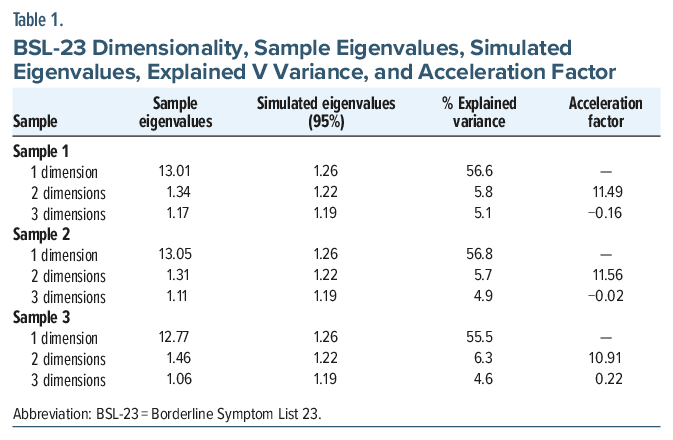
We then evaluated internal consistency under this 1-factor solution. Across the 3 subsamples, Cronbach α and McDonald ω were identical and high (α= ω=0.95; 95% CI, 0.95–0.96), and no item-rest correlation fell below 0.40, indicating adequate item contribution.
Exploratory Factor Analysis
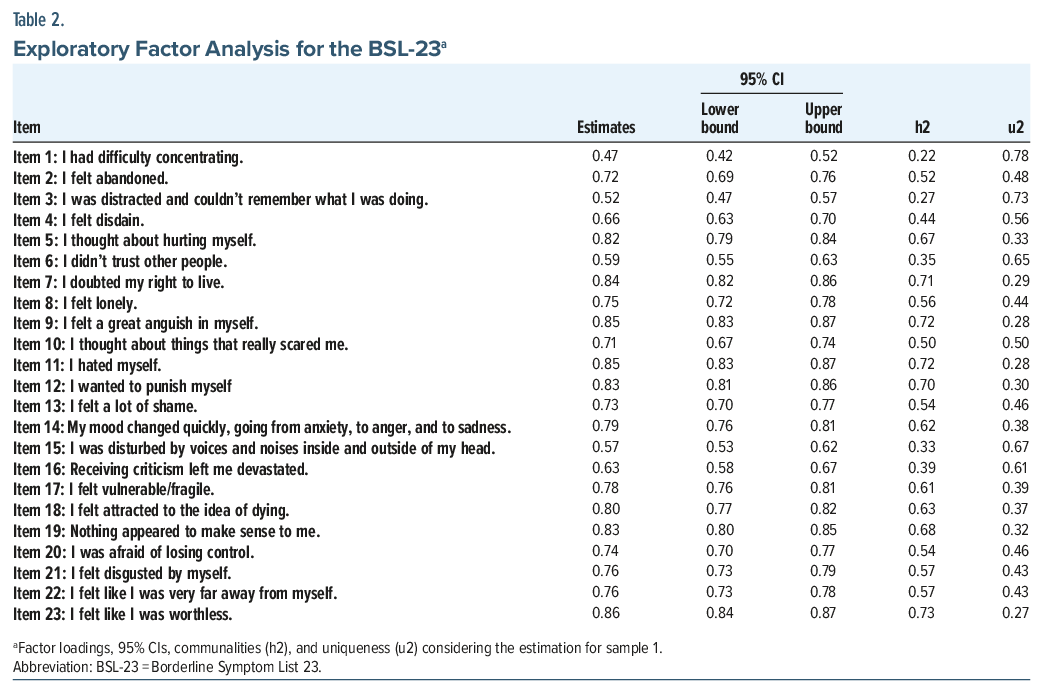
EFA was conducted in sample 1 using principal axis factoring on a polychoric correlation matrix. All items showed substantial loadings, and the 95% CIs confirmed their stability. Communalities were satisfactory, with only items 01 and 03 at the lower bound of the acceptable range (above 0.30). No item presented a factor loading below 0.40, even when considering the lower CI limits. The highest loadings were observed for items 23, 9, and 11 (Table 2).
Confirmatory Factor Analysis
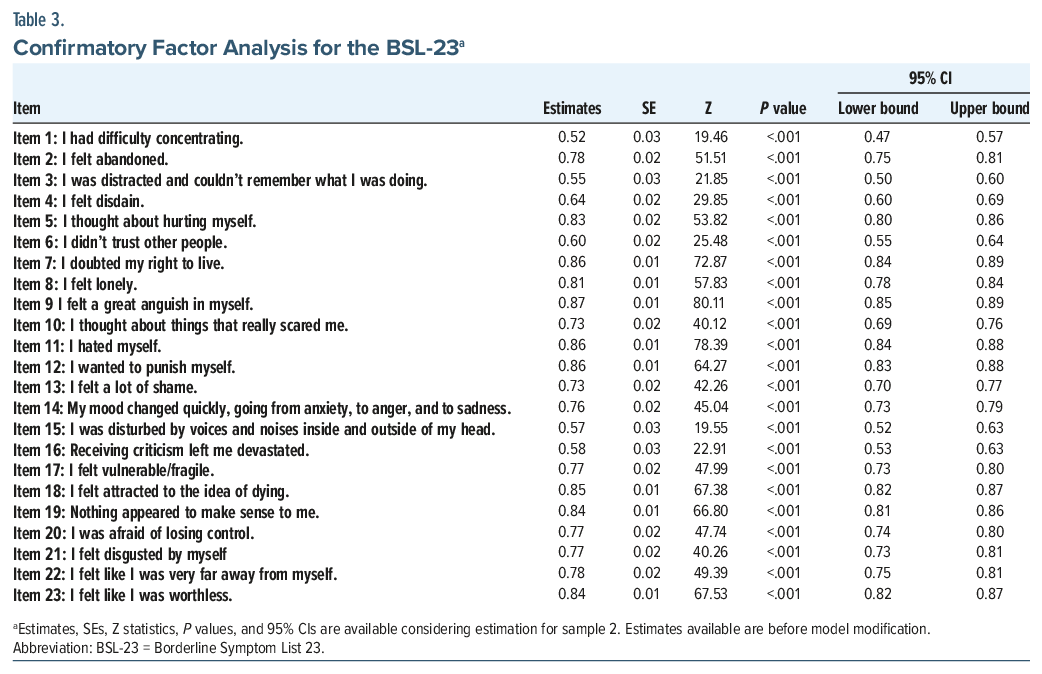
CFA was conducted in sample 2 using WLSMV estimation with all items treated as ordinal. The initial model showed acceptable but imperfect fit, with high factor loadings but evidence of local dependencies. Modification indices indicated 2 inflated error correlations—between items 02 and 08 (r = 0.62, P < .001) and items 01 and 03 (r = 0.53, P < .001). Allowing these correlations significantly improved fit (Δχ22 = 368.32, P < .001, yielding χ2228 = 1,715.96, χ2/df = 7.52, CFI = 0.95, TLI = 0.95, and RMSEA = 0.088 [90% CI, 0.084–0.091]). Table 3 reports the original factor loadings prior to freeing parameters.
Measurement Invariance
Measurement invariance across genders was examined using the full sample to ensure adequate statistical power. We tested the sequence of configural, metric, scalar, and strict models. Configural and metric models demonstrated adequate fit, whereas the scalar model showed a significant χ2 difference; however, changes in CFI and RMSEA remained within acceptable thresholds (Table 4), suggesting only mild violations of scalar invariance.
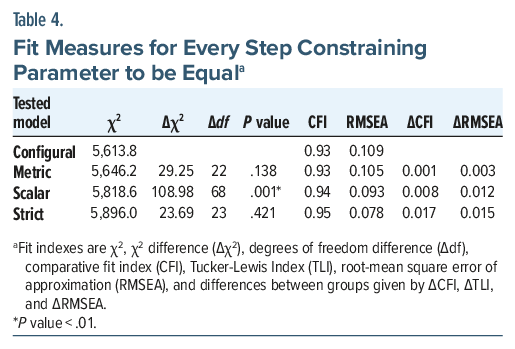
To identify the source of misfit, we conducted partial invariance tests using Wald χ2. Several items displayed significant differential functioning: item 03 (Wald χ2 = 18.32, P < .001), item 12 (χ2 = 7.85, P = .049), item 14 (χ2 = 16.13, P < .001), item 16 (χ2 = 15.21, P = .002), item 17 (χ2 = 9.15, P = .027), item 20 (χ2 = 8.60, P = .035), item 22 (χ2 = 10.80, P = .012), and item 23 (χ2 = 9.85, P = .020). Although statistically significant, these differences were small and did not materially compromise overall model stability.
A MIMIC model was then estimated to further evaluate gender effects. Gender had a small but significant influence on the latent factor (λ = –0.07, P < .001), indicating slightly lower expected scores among men. Item-level effects were also small, with the largest observed for items 14 (λ = –0.12, P < .001), 16 (λ = –0.11, P < .001), and 17 (λ = –0.11, P < .001). Mean-level differences were statistically significant, t5280 = 130.98, P < .001, but the effect size was small (Cohen d = –0.18). Taken together, these findings indicate that the BSL-23 exhibits adequate invariance across gender, with minimal practical bias.
Network Discrimination
To evaluate the discriminative capacity of the BSL-23, we compared participants at the ≤25th and ≥75th percentiles of the total score. The groups differed substantially, Welch t1336.8 = 74.94, P < .001, with a very large effect size (Cohen d = 6.54; 95% CI, 6.17–6.91). Mean scores were 32.31 (SD = 4.28) for the lower group and 88.54 (SD = 11.33) for the higher group, indicating clear separation in symptom severity.
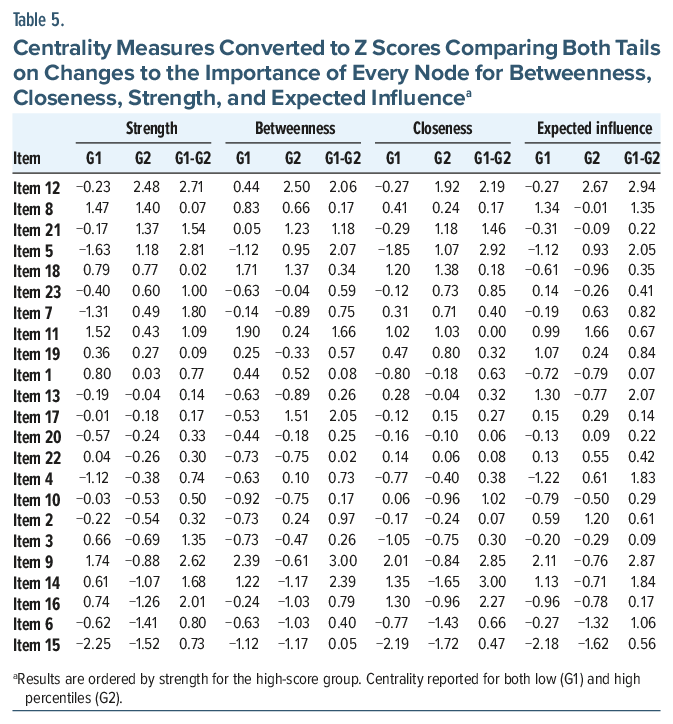
PN models revealed marked differences in structural connectivity across severity levels. The low-symptom network contained 37 nonzero edges, whereas the high-symptom network contained 90, indicating a 2.43-fold increase in interconnectedness among individuals with higher dysregulation. Node clustering also differed: In the low-symptom group, several items appeared weakly embedded or isolated (eg, item 15), while in the high-symptom group, most nodes were densely integrated.
Centrality indices (Table 5) showed that items related to self-harm and self-directed negativity were the most influential in the high-symptom network. Item 12 (“I wanted to punish myself”) consistently emerged as the central node, connecting closely with other items reflecting self-hate and intrusive, fear-related cognitions. In contrast, in the low-symptom group, item 08 (“I was lonely”) was the most central, primarily linking to item 02 (“I felt helpless”). Differences in activation were most pronounced for items 12, 09, 13, 05, and 14, with elevated activation in the high-severity subgroup. These findings support the discriminative capacity of the BSL-23 across severity levels.
Concurrent Validity
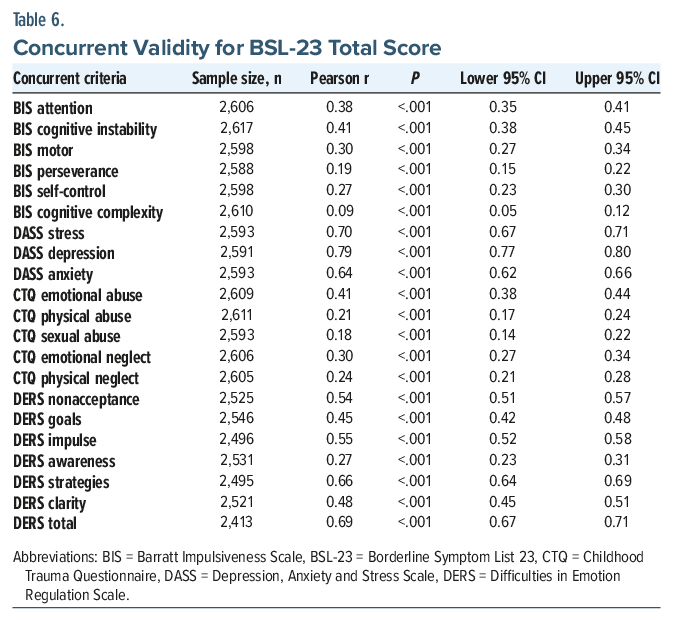
Concurrent validity analyses produced correlation patterns consistent with previous BSL-23 research. The total score showed strong associations with the DASS-21 stress (r=0.70, P<.001) and depression (r=0.79, P<.001) subscales. High correlations were also observed with the DERS strategies dimension (r=0.66, P<.001) and the DERS total score (r=0.69, P<.001). For the CTQ, emotional abuse demonstrated the strongest association with BSL-23 scores (r=0.41, P <.001). Correlations with impulsivity (BIS) were statistically significant but small, aligning with the expectation that BSL-23 primarily captures emotional dysregulation rather than executive impulsivity. CIs and statistics are available in Table 6.
DISCUSSION
This study presents the cross-cultural adaptation of the BSL-23 into Brazilian Portuguese and provides comprehensive evidence of its psychometric properties in a large nonclinical Brazilian sample. Overall, the findings support the validity, reliability, and structural stability of the Brazilian version of the BSL-23, extending previous international evidence and addressing an important gap in the Brazilian context.
Consistent with prior validation studies, dimensionality analyses supported a predominantly unidimensional structure of the BSL-23. While secondary dimensions emerged when relying on traditional eigenvalue-based criteria, more robust methods, such as parallel analysis and the acceleration factor, consistently indicated a single dominant factor. This pattern aligns with previous research showing that additional factors typically account for limited incremental variance and do not meaningfully improve interpretability. Internal consistency estimates were excellent across subsamples, with Cronbach α and McDonald ω yielding identical and high values, supporting the reliability of the total score under a congeneric measurement framework.
EFA demonstrated stable and substantial item loadings, reinforcing the coherence of the scale. CFA initially indicated local misfit, reflected in elevated χ2 and RMSEA values, which improved after allowing correlated residuals between specific item pairs. These correlations may reflect clinically meaningful overlap, such as between feelings of helplessness and loneliness or between absent-mindedness and concentration difficulties, rather than redundancy. Nevertheless, we do not recommend modifying the scale structure without further evidence, as preserving comparability with the original instrument remains a priority.
Measurement invariance analyses suggested that the BSL-23 functions adequately across gender groups. Although some items exhibited statistically significant differential functioning, the magnitude of these effects was small and unlikely to compromise substantive interpretation. Mean-level gender differences were also modest, consistent with previous literature indicating slightly higher symptom endorsement among women. Taken together, these findings support the use of the BSL-23 for gender comparisons in Brazilian samples, with minimal practical bias.
The discriminative capacity of the BSL-23 was strongly supported. Individuals at higher levels of symptom severity showed markedly higher total scores and a more densely connected symptom network. Network analyses indicated that self-directed negativity and self-harm–related items occupied central positions among highly symptomatic participants, whereas loneliness and helplessness were more central at lower symptom levels. These results suggest that increasing symptom severity may be associated with greater integration and mutual reinforcement of dysregulated experiences, consistent with network-based conceptualizations of psychopathology. However, these findings should be interpreted cautiously, as network centrality does not imply symptom frequency or causal primacy.
Evidence for concurrent validity was robust. BSL-23 scores were strongly associated with measures of depression, stress, and emotion regulation difficulties and more moderately related to childhood emotional abuse. Associations with impulsivity were statistically significant but small, supporting the interpretation that the BSL-23 primarily captures emotional dysregulation rather than executive impulsiveness per se. These patterns closely mirror findings from previous international validations.
The Brazilian version of the BSL-23 appears to hold clinically meaningful value as a brief measure of borderline-specific symptomatology, particularly in contexts where a rapid appraisal of current symptom burden is required. Although it was not originally conceived as a stand-alone screening instrument, the available evidence suggests that it can usefully contribute to case finding when embedded within a broader assessment framework.10–12
Another particularly well-substantiated clinical application of the BSL-23 resides in the longitudinal appraisal of symptom change throughout treatment.28 Such utility was not incidental to the measure’s later use, but rather integral to its construction, insofar as the short form was derived in part from items exhibiting pronounced sensitivity to change. Consistent with this, the original psychometric study demonstrated detectable pre-post change over 3 months of dialectical behavior therapy, with the BSL-23 showing numerically greater responsiveness than the longer BSL-95.9
Subsequent treatment studies and later reviews have continued to enlist the BSL-23 as an outcome measure in psychotherapy trials for BPD, further cementing its place as a practical instrument for repeated administration across treatment and follow-up.28 Under this view, the Brazilian Portuguese version may prove especially valuable less as a stand-alone basis for categorical diagnosis than as a clinically serviceable means of tracing symptom trajectories, appraising treatment response, and informing routine outcome monitoring alongside expert judgment.
Given the enduring social inequities, restricted access to general mental health care, and virtual absence of specialized outpatient services for BPD in Brazil, the clinical relevance of the BSL-23 comes into sharper focus. Its availability stands to be especially consequential where professional training in assessment and intervention remains disproportionate, equipping clinicians with a concise and psychometrically robust instrument for appraising symptom burden and following its course over time.
A few relevant limitations merit acknowledgment. The study’s primary limitation is that reliance on a nonclinical sample precludes stronger inferences about diagnostic accuracy and the derivation of clinically meaningful cutoff scores, which should be addressed in future research conducted with clinical populations. Furthermore, test-retest reliability was not examined, although this is especially pertinent for instruments designed to monitor symptom change over time and was assessed in the original BSL-23 study.9 It also bears noting that the applicability to Portuguese-speaking populations in other countries should not be presumed, given potential differences in idiomatic usage, sociocultural context, and clinical meaning. Future investigations should, therefore, draw on clinical samples, longitudinal designs, and external clinical assessments to further strengthen the body of validity evidence.
Overall, the present findings suggest that the Brazilian Portuguese version of the BSL-23 rests on solid psychometric grounds, with consistent evidence for structural validity, reliability, measurement invariance, discriminative performance, and concurrent validity. As such, it offers a brief yet dependable means of assessing borderline symptom severity across Brazilian research and clinical contexts.
Article Information
Published Online: July 21, 2026. https://doi.org/10.4088/PCC.26m04184
© 2026 Physicians Postgraduate Press, Inc.
Submitted: January 9, 2026; accepted April 3, 2026.
To Cite: Catelan RF, Bastos VB, Dornelles VG, et al. Psychometric properties of the Borderline Symptoms List 23 for Brazilian Portuguese in a nonclinical sample. Prim Care Companion CNS Disord 2026;28(4):26m04184.
Author Affiliations: Center for Emotion and Cognition Processes Research, Institute of Psychiatry, Federal University of Rio de Janeiro, Brazil (Catelan, Bastos); Sínteses – Center for Evidence-Based Psychology, Porto Alegre, Brazil (Catelan); Laboratory of Contextual Therapies, Federal University of Rio de Janeiro, Brazil (Pires); Research Department, DBT Brasil, São Paulo, Brazil (Dornelles); Department of Psychosomatic Medicine and Psychotherapy, Central Institute of Mental Health, Medical Faculty Mannheim, Heidelberg University, Germany (Kleindienst, Mocarz-Kleindienst); Department of Translation Studies and Slavic Languages, The John Paul II Catholic University of Lublin, Poland (Mocarz-Kleindienst); Laboratory of Panic and Respiration, Institute of Psychiatry, Federal University of Rio de Janeiro, Rio de Janeiro, Brazil (Nardi).
Corresponding Author: Ramiro Figueiredo Catelan, PhD , Venceslau Brás Avenue, 71-Botafogo, Rio de Janeiro, Brazil 22290-140 ([email protected]).
Financial Disclosure: Dr Catelan has received a postdoctoral grant from the National Council for Scientific and Technological Development. The other authors have nothing to disclose.
Funding/Support: None.
Supplementary Material: Available at Psychiatrist.com.
Clinical Points
- A validated Brazilian Portuguese Borderline Symptom List 23 (BSL-23) expands access to the assessment of borderline symptoms in Brazil.
- The BSL-23 can support case identification when used alongside comprehensive clinical evaluation.
- The BSL-23 may be useful for monitoring symptom change and treatment response over time.
References (28)

- Gunderson JG, Herpertz SC, Skodol AE, et al. Borderline personality disorder. Nat Rev Dis Primers. 2018;4:18029. PubMed CrossRef
- Kernberg O. The structural diagnosis of borderline personality organization. In: Hartcollis P, ed. Borderline Personality Disorders. New York: International University Press; 1977:78–121.
- Conte HR, Plutchik R, Karasu TB, et al. A self-report borderline scale: discriminative validity and preliminary norms. J Nerv Ment Dis. 1980;168(7):428–435.
- Baron M. Schedule for Interviewing Borderlines. New York State Psychiatric Institute; 1981.
- Perry J. The Borderline Personality Disorder Scale (BPD Scale). Cambridge Hospital; 1982.
- Leichsenring F. Borderline Persönlichkeitsinventar. Hogrefe; 1997.
- Bohus M, Limberger MF, Frank U, et al. Entwicklung der Borderline-Symptom-Liste [Development of the Borderline Symptom List]. Psychother Psychosom Med Psychol. 2001;51(5):201–211. PubMed CrossRef
- Bohus M, Limberger MF, Frank U, et al. Psychometric properties of the Borderline Symptom List (BSL). Psychopathology. 2007;40(2):126–132. PubMed CrossRef
- Bohus M, Kleindienst N, Limberger MF, et al. The short version of the Borderline Symptom List (BSL-23): development and initial data on psychometric properties. Psychopathology. 2009;42(1):32–39. PubMed CrossRef
- Soler J, Vega D, Feliu-Soler A, et al. Validation of the Spanish version of the Borderline Symptom List, short form (BSL-23). BMC Psychiatry. 2013;13:139. PubMed CrossRef
- Nicastro R, Prada P, Kung AL, et al. Psychometric properties of the French Borderline Symptom List, short form (BSL-23). Borderline Personal Disord Emot Dysregul. 2016;3:4. PubMed CrossRef
- Yang H, Lei X, Zhong M, et al. Psychometric properties of the Chinese version of the Brief Borderline Symptom List in undergraduate students and clinical patients. Front Psychol. 2018;9:605. PubMed CrossRef
- Zanarini MC, Gunderson JG, Frankenburg FR, et al. The revised Diagnostic Interview for Borderlines: discriminating BPD from other axis II disorders. J Pers Disord. 1989;3(1):10–18. CrossRef
- Lovibond PF, Lovibond SH. The structure of negative emotional states: comparison of the Depression Anxiety Stress Scales (DASS) with the Beck Depression and Anxiety Inventories. Behav Res Ther. 1995;33(3):335–343. PubMed CrossRef
- Gratz KL, Roemer L. Multidimensional assessment of emotion regulation and dysregulation: development, factor structure, and initial validation of the Difficulties in Emotion Regulation Scale. J Psychopathol Behav Assess. 2004;26(1):41–54. CrossRef
- Patton JH, Stanford MS, Barratt ES. Factor structure of the Barratt Impulsiveness Scale. J Clin Psychol. 1995;51(6):768–774. CrossRef
- Bernstein DP, Fink L. Childhood Trauma Questionnaire: a retrospective self-report manual. The Psychological Corporation; 1998.
- Beaton DE, Bombardier C, Guillemin F, et al. Guidelines for the process of cross-cultural adaptation of self-report measures. Spine. 2000;25(24):3186–3191. PubMed CrossRef
- Raiche G, Magis D, Raiche MG. Package ‘nFactors’. Repository CRAN; 2020:1–58.
- Revelle W, Zinbarg RE. Coefficients alpha, beta, omega, and the glb: comments on Sijtsma. Psychometrika. 2009;74:145–154. https://doi.org/10.1007/s11336-008-9102-z CrossRef
- Rosseel Y, Oberski DL, Byrnes J, et al. Lavaan: Latent Variable Analysis. Software; 2017.
- Brown TA. Confirmatory Factor Analysis for Applied Research. Guilford Publications; 2015.
- Hair JF, Black WC, Babin BJ, et al. Multivariate Data Analysis. 8th ed. Cengage Learning; 2018.
- Hirschfeld G, Von Brachel R. Improving multiple-group confirmatory factor analysis in R: a tutorial in measurement invariance with continuous and ordinal indicators. Pract Assess Res Eval. 2014;19(1):7.
- Damasio BF, Valentini F, Núñes-Rodriguez SI, et al. Is the General Self-Efficacy Scale a reliable measure to be used in cross-cultural studies? Results from Brazil, Germany and Colombia. Span J Psychol. 2016;19:E29. PubMed CrossRef
- Epskamp S, Fried EI. A tutorial on regularized partial correlation networks. Psychol Methods. 2018;23(4):617–634. PubMed CrossRef
- Bringmann LF, Elmer T, Epskamp S, et al. What do centrality measures measure in psychological networks?. J Abnorm Psychol. 2019;128(8):892–903. PubMed CrossRef
- Wolak M, Firth J, Blake-Holmes K, et al. A systematic review on the applications of Borderline-Symptom List (BSL-23): a self-report measure for adults with borderline personality disorder. Clin Psychol. 2026.
This PDF is free for all visitors!