Abstract
Objective: Internet gaming disorder (IGD) has gained increasing global recognition, yet little is known about how health care providers perceive and manage this condition in clinical practice. The objective of this study was to assess health care providers’ IGD-related beliefs, familiarity with diagnostic criteria, confidence in diagnosis and management, and perceived training needs.
Methods:A cross-sectional online survey of internal medicine and psychiatry health care providers was conducted between September and October 2025 at a large academic medical center, assessing IGD-related beliefs, familiarity with diagnostic criteria, confidence in diagnosis and management, and perceived training needs.
Results: Among 67 respondents, most participants endorsed IGD as a clinically significant condition (84%) that contributes to psychiatric comorbidities (87%). However, fewer than half of providers reported confidence diagnosing (44%) or managing IGD (29%), and only 37% were familiar with currently proposed Diagnostic and Statistical Manual of Mental Disorders criteria. Psychiatric health care providers reported greater confidence and familiarity with IGD than their internal medicine counterparts, particularly in diagnosis, management, and identification of diagnostic criteria during clinical encounters. Overall, 81% of participants indicated that they would benefit from additional IGD-related education.
Conclusion: Despite broad recognition of IGD’s clinical significance, substantial gaps remain in provider confidence and familiarity with diagnostic and management approaches, particularly outside of psychiatry. These findings identify actionable gaps in provider preparedness and highlight the need for targeted educational efforts to support effective clinical management of IGD across medical specialties.
Prim Care Companion CNS Disord 2026;28(4):26m04192
Author affiliations are listed at the end of this article.
From the Editors

Are you a healthcare provider?
Add your NPI to personalize your JCP experience.
Internet gaming disorder (IGD), recognized by the World Health Organization as gaming disorder and listed in section 3 of the Diagnostic and Statistical Manual of Mental Disorders, Fifth Edition (DSM-5) as a condition for further study, has become an increasing public health concern. IGD risk and severity appeared to intensify during the COVID-19 pandemic, as disrupted routines, heightened stress, and prolonged social isolation contributed to elevated gaming behaviors, particularly among vulnerable populations including children, adolescents, and individuals with comorbid psychiatric conditions.1–3 Treatment centers in Germany, Switzerland, Japan, and the United Kingdom have reported a rising demand for IGD-related services that outpaces available resources, highlighting growing societal strain associated with increasing IGD prevalence.1 Excessive gaming has also been linked with elevated levels of anxiety, depression, and stress, further straining already limited mental health services globally.4,5
Despite growing recognition of IGD, little research has examined health care providers’ preparedness to address it in routine clinical practice. This study assessed providers’ confidence and familiarity with diagnosing and managing IGD, as well as perceived barriers to care that shape clinical management of problematic gaming behaviors. This is among the first US-based studies, to our knowledge, to systematically examine IGD-related confidence, diagnostic familiarity, and training needs across both psychiatry and internal medicine providers.
METHODS
Study Design and Participants
We conducted a cross-sectional online survey of health care providers in the psychiatry and internal medicine departments at a large medical academic center, distributed via departmental listservs between September and October 2025. Eligible participants included MD/DO physicians, nurse practitioners, and physician assistants aged ≥18 years who were currently providing clinical care within internal medicine or psychiatry. Individuals not engaged in clinical practice or who did not complete any survey items were excluded.
Survey Instrument and Measures
The questionnaire collected demographic information, including age, gender, provider type, years in training or practice, and specialty, as well as IGD-related clinical exposure, defined as the frequency of encountering patients with problematic gaming behaviors. Attitudinal items assessed beliefs about IGD’s clinical significance, familiarity with diagnostic criteria, confidence in diagnosing and managing IGD, perceived barriers to care, perceived effectiveness of available strategies, and training needs. All attitudinal responses used 7-point Likert scales from “strongly disagree” to “strongly agree.”
Outcomes
Four primary outcomes assessed IGD-related clinical self-efficacy and knowledge: (1) confidence in diagnosing IGD, (2) confidence in IGD management, (3) familiarity with diagnostic criteria, and (4) perceived need for further training. Secondary outcomes included clinician attitudes toward IGD, including beliefs about its clinical significance, contribution to psychiatric comorbidities, benefits of early recognition, treatment strategy effectiveness, barriers to care integration, and the role of family involvement.
Data Handling and Statistical Analysis
Likert scale responses were categorized as “agree” (strongly, moderately, or slightly agree) versus “neutral/ disagree.” Primary analyses compared differences by specialty (psychiatry vs internal medicine) and by frequency of encountering patients with problematic gaming behaviors (“rarely” vs “a few times per month to daily”). Additional comparisons examined age (<35 vs ≥35 years), gender, and frequency of family interactions. Group differences were evaluated using χ2 or Fisher exact tests (when expected cell counts <5). All statistical tests were 2-tailed with a significance threshold of α=0.05. A sensitivity analysis using full 7-point Likert scores with Wilcoxon rank-sum tests yielded consistent results (not reported). Given the exploratory, hypothesis-generating nature of this study, analyses were descriptive and intended to inform future training and implementation efforts. P values were therefore interpreted descriptively, and no adjustments were made for multiple comparisons.
RESULTS
Sample Characteristics and IGD Exposure
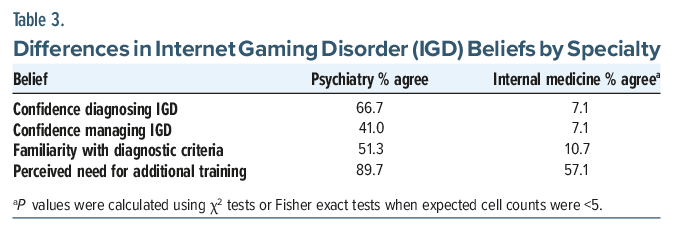
Of 71 respondents, 67 completed at least 1 survey item and were included in the final analysis; 4 were excluded due to incomplete responses. Participant demographic characteristics are summarized in Table 1. Most participants were aged 25–44 years (77.6%), with psychiatrists comprising over half of survey respondents (58.2%). The sample included 55.2% women and 44.8% men. Clinical exposure to IGD among participants was limited, with 67.2% rarely encountering patients affected by IGD and the same proportion rarely interacting with concerned family members. Only 18% of participants saw IGD cases several times per week or more, and most respondents (88.1%) reported rarely referring families to IGD-related support services.
Overall Attitudes Toward IGD
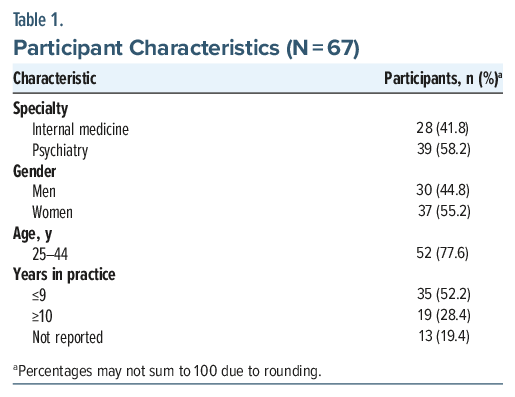
Overall attitudes and preparedness regarding IGD are summarized in Table 2. Across the full sample, most health care providers viewed IGD as clinically meaningful, with 84% endorsing its clinical significance, 87% believing it can worsen psychiatric comorbidities, and 79% agreeing that early recognition improves patient outcomes. A similar proportion of providers (79%) felt that IGD treatment would benefit from active family involvement. Despite this recognition, perceived readiness was limited: Only 44% felt confident recognizing IGD, 29% felt confident managing it, and 37% reported familiarity with diagnostic criteria. Additional gaps were noted, with 43% uncertain about treatment efficacy, 51% perceiving barriers to integrating IGD care, and 81% endorsing a need for further training.
Differences by Specialty
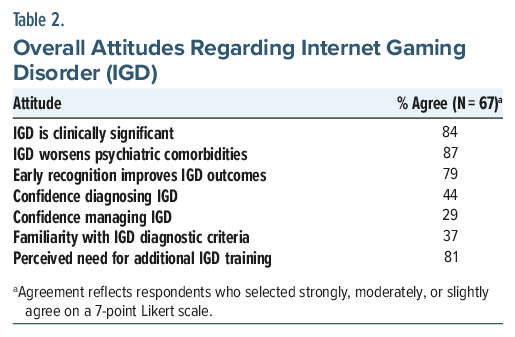
Differences in IGD-related confidence, familiarity, and training needs by specialty are shown in Table 3. Psychiatric providers reported greater IGD-related confidence and familiarity than internal medicine providers. They were significantly more likely to agree they could recognize and diagnose IGD (66.7% vs 7.1%, P<.001), could manage IGD (41.0% vs 7.1%, P=.002), and were more familiar with diagnostic criteria (51.3% vs 10.7%, P<.001). Psychiatrists were also more likely to believe that IGD exacerbates psychiatric comorbidities (92.3% vs 67.9%, P=.01) and that early recognition improves patient outcomes (87.2% vs 57.1%, P=.005). Training needs were high across both groups (89.7% vs 57.1%, P=.002).
Differences by Frequency of IGD Exposure
Health care providers with more frequent IGD exposure (“a few times per month to daily”) consistently reported greater confidence, familiarity with diagnostic criteria, and stronger belief in IGD’s clinical relevance. Compared with providers who rarely encountered IGD, those with more frequent exposure were more likely to agree that IGD is clinically significant (95.5% vs 71.1%, P=.025), felt confident recognizing IGD (72.7% vs 26.7%, P<.001) and managing it (50.0% vs 15.6%, P=.003), and reported familiarity with diagnostic criteria (63.6% vs 20.0%, P<.001). Providers with more frequent exposure to IGD were also more likely to endorse a need for additional training (95.5% vs 66.7%, P=.009).
Differences by Frequency of Family Interaction
Health care providers who interacted with concerned family members more often (“occasionally to regularly”) were significantly more likely to be psychiatrists (P<.001). This group also reported higher confidence recognizing (68.2% vs 28.9%, P=.002) and managing IGD (45.5% vs 17.8%, P=.016) and greater familiarity with diagnostic criteria (59.1% vs 22.2%, P=.003) compared with providers who rarely interacted with families. Compared with providers who rarely interacted with families, those who had greater family frequency were more likely to endorse a need for additional training (90.9% vs 68.9%, P=.047).
Differences by Age and Gender
Attitudes were largely consistent across age and gender. The only significant age-related difference was that younger clinicians (<35 years) were more likely to agree that early recognition improves IGD outcomes compared with older clinicians (86.7% vs 64.9%, P=.041). No meaningful differences in IGD-related attitudes, confidence, or familiarity were observed by gender.
DISCUSSION
Summary of Findings and Distribution by Specialty
In this exploratory study of internal medicine and psychiatric health care providers, respondents widely recognized IGD as a clinically meaningful condition but reported low confidence and limited familiarity with its diagnostic criteria and management. Most respondents agreed that IGD is disruptive and linked to psychiatric comorbidities; however, fewer than half felt capable of recognizing or managing it, and only one-third reported familiarity with the proposed DSM diagnostic criteria. This disconnect between perceived clinical significance and provider readiness reflects the challenges of integrating an emerging behavioral addiction into routine clinical practice.
Specialty differences were evident, with psychiatric providers reporting substantially greater confidence and familiarity with IGD than internal medicine providers, likely reflecting their broader training in behavioral health frameworks and diagnostic interviewing. Psychiatric providers may also feel more comfortable treating conditions involving compulsive behaviors and reward system dysregulation.6 These findings highlight a notable readiness gap between specialties. Because internal medicine providers often serve as first points of patient contact, limited confidence in IGD recognition may contribute to missed opportunities for early identification and referral. Greater clinical exposure was also associated with greater self-perceived competency across specialties. Providers who encountered IGD more frequently reported greater confidence, greater familiarity with diagnostic criteria, and stronger endorsement of its clinical relevance. Although causality cannot be inferred, this pattern suggests that exposure may enhance diagnostic comfort.
Notably, providers with greater exposure to IGD were also more likely to report a need for additional training. This may suggest that repeated clinical or family-facing encounters increase not only diagnostic comfort but also awareness of gaps in existing training and clinical resources. A similar pattern has been observed in pediatric anxiety care, where primary care providers who regularly discuss anxiety with families still report notable knowledge gaps and strong interest in additional training.7 All together, these findings identify specific gaps in provider preparedness across attitudes, knowledge, and clinical skills that can inform the design of targeted educational initiatives.
Implications for Educational Initiatives: Attitudes, Knowledge, and Clinical Skills
These findings suggest that IGD is widely acknowledged as clinically important but remains insufficiently integrated into routine diagnostic and treatment practices. Overall, 81% of participants endorsed a need for additional training, indicating broad readiness for targeted educational efforts. To translate this readiness into practice, we propose that educational initiatives address 3 interrelated domains: provider attitudes toward IGD, foundational knowledge of its diagnosis and treatment, and clinical skills required for effective assessment and management.
Attitudes. While most respondents recognized IGD’s clinical significance and contribution to psychiatric comorbidities, substantial uncertainty remained about the legitimacy and boundaries of IGD as a diagnostic entity. Educational efforts should begin by reinforcing the clinical relevance of problematic gaming, particularly among internal medicine providers, who may encounter affected patients but lack the conceptual framework to contextualize these presentations within a behavioral addiction model. Explicitly comparing the DSM-5 and International Classification of Diseases, Eleventh Revision (ICD-11) frameworks may help providers navigate diagnostic uncertainty while avoiding over-pathologization of high-engagement gaming.1,8,9 This distinction is important because the DSM-5–proposed criteria remain debated, particularly features such as tolerance and gaming for escapism, which may not clearly distinguish disordered gaming from high but nonpathological engagement.8,10–12 In contrast, the ICD-11 framework has been viewed as more specific and less likely to pathologize normative gaming behaviors. Addressing these nuances directly in educational programming may help calibrate provider attitudes and reduce the risk of both under-recognition and overdiagnosis.
Knowledge. Beyond attitudes, this study revealed substantial gaps in foundational knowledge related to IGD recognition and treatment. Only 37% of providers reported familiarity with currently proposed DSM criteria, and almost half of respondents were unsure whether effective interventions existed for IGD. These responses likely reflect limited awareness of available psychotherapeutic approaches, including cognitive-behavioral therapy, motivational interviewing, and group-based interventions, as well as broader uncertainty about the evidence base for behavioral addictions. Educational programs should address key topics including current diagnostic frameworks and their limitations, available treatment approaches such as psychotherapy and structured referral pathways, and the role of pharmacologic management of commonly co-occurring psychiatric conditions such as depression and anxiety, noting that there is currently no US Food and Drug Administration–approved pharmacotherapy for IGD. Strengthening provider knowledge in these areas may help translate broad conceptual awareness of IGD into consistent, evidence-informed clinical practice.
Clinical skills. Finally, even among providers who acknowledged IGD’s clinical significance, confidence in practical assessment and management remained low, with only 44% endorsing confidence in diagnosis and 29% in management. This gap between recognition and clinical readiness suggests that educational initiatives must move beyond didactic content to build applied skills. Training approaches such as case-based learning, simulation-based diagnostic practice, and review of structured assessment tools, such as the Internet Gaming Disorder Scale–Short Form,13 may help providers develop comfort with identifying IGD presentations in routine encounters. Management-focused training should address practical competencies including screening and brief intervention techniques, appropriate use of referral pathways to behavioral health or addiction specialists, the role of family involvement in treatment planning, and strategies for integrating IGD assessment into existing clinical workflows. The association between clinical exposure and provider confidence reinforces the potential value of structured educational opportunities that simulate real-world encounters, which may especially benefit providers with infrequent IGD exposure.
Overall, this study highlights a mismatch between perceived clinical significance and clinical preparedness, underscoring the need for structured IGD-related training that spans attitudes, knowledge, and clinical skills that is tailored to the distinct preparedness gaps identified across specialties and levels of clinical exposure.
Limitations
This exploratory cross-sectional study has several limitations. The sample was drawn from a single academic medical center, limiting generalizability to other settings with different patient populations or training environments. Subgroup sizes were modest, so stratified comparisons should be considered as descriptive only. The cross-sectional design also limits interpretation of directionality, in that associations between specialty, exposure, and attitudes should not be taken as causal. Additionally, outcomes reflect self-reported confidence rather than objectively assessed diagnostic accuracy. Lastly, the survey focused specifically on internal medicine and psychiatry providers, leaving out other critical specialties and professions, including pediatricians, neurologists, and clinical psychologists.
Despite these limitations, this study offers one of the earliest US-based characterizations of health care provider perceptions of IGD and identifies clear gaps in familiarity, confidence, and training needs that can help inform future research and educational initiatives aimed at improving understanding of IGD.
CONCLUSION
Health care providers in a large academic setting widely recognized IGD as clinically significant but reported low confidence and limited familiarity with its diagnosis and management. Although specialty and clinical exposure influenced these perceptions, training gaps were evident across disciplines, including among psychiatric providers. Providers who encountered IGD more often in clinical practice endorsed a greater need for training in IGD diagnosis and management than providers who rarely encounter IGD. As IGD continues to gain visibility in both internal medicine and mental health settings, integration of structured educational content, case-based or simulation-based learning, and clear clinical guidance into medical training may enhance provider confidence and competence, in addition to supporting more effective patient care for individuals affected by problematic or disordered gaming.
Article Information
Published Online: July 23, 2026. https://doi.org/10.4088/PCC.26m04192
© 2026 Physicians Postgraduate Press, Inc.
Submitted: January 20, 2026; accepted April 7, 2026.
To Cite: Anand S, Romano N, Makovkina E, et al. Prim Care Companion CNS Disord. 2026;28(4):26m04192.
Author Affiliations: Department of Psychiatry, Weill Cornell Medical College, New York, New York (Anand, Romano, Makovkina, Avery); Department of Population Health Sciences, Weill Cornell Medical College, New York, New York (Qiu).
Corresponding Author: Sahil Anand, BA, 1300 York Ave, New York, NY 10065 ([email protected]).
Financial Disclosure: None.
Funding/Support: None.
Clinical Points
- Health care providers widely recognize internet gaming disorder (IGD) as clinically significant, yet fewer than half of respondents report confidence in diagnosing or managing it, while only one-third are familiar with proposed diagnostic criteria.
- Psychiatric providers demonstrate greater IGD-related confidence and diagnostic familiarity than internal medicine providers, identifying a specialty-based gap in clinical preparedness.
- The majority of providers endorse a need for additional IGD-focused education, highlighting opportunities for targeted training to improve IGD diagnosis and management across specialties.
References (12)

- Castro-Calvo J, King DL, Stein DJ, et al. Expert appraisal of criteria for assessing gaming disorder: an international Delphi study. Addiction. 2021;116(9):2463–2475. PubMed CrossRef
- Musetti A, Floros G, Chiappedi M, et al. Gaming disorder in the International Classification of Diseases, 11th Revision: the state of the game. BMC Psychiatry. 2025;25(1):1114. PubMed
- Mestre-Bach G, Fernandez-Aranda F, Jiménez-Murcia S. Exploring internet gaming disorder: an updated perspective of empirical evidence (2016–2021). Compr Psychiatry. 2022;116:152319. PubMed
- Amendola S, Bernath J, Presaghi F, et al. Bidirectional relationship between gaming disorder, internalizing psychopathology, psychological distress, and well-being: a systematic review and meta-analysis of longitudinal studies. J Affect Disord. 2025;383:480–493. PubMed CrossRef
- Rahul R, R TK, M SM, et al. Impact of internet gaming disorder on mental well-being: prevalence and psychological distress among adolescents and young adults. Psychiatry Res. 2025;349:116512. PubMed CrossRef
- Nunes EV, Kunz K, Galanter M, et al. Addiction psychiatry and addiction medicine: the evolution of addiction physician specialists. Am J Addict. 2020;29(5):390–400. PubMed CrossRef
- Rozenman M, Patarino KM. Pediatric anxiety in practice: a knowledge and needs assessment of pediatricians and nurses. J Dev Behav Pediatr. 2020;41(8):605–611. PubMed CrossRef
- Starcevic V. Internet gaming disorder: inadequate diagnostic criteria wrapped in a constraining conceptual model. J Behav Addict. 2017;6(2):110–113. PubMed CrossRef
- Jo YS, Bhang SY, Choi JS, et al. Clinical characteristics of internet gaming disorder: comparison of DSM-5 IGD and ICD-11 GD diagnoses. J Clin Med. 2019;8(7):945. PubMed CrossRef
- Razum J, Baumgartner B, Glavak-Tkalić R. Psychometric validity and the appropriateness of tolerance as a criterion for internet gaming disorder: a systematic review. Clin Psychol Rev. 2023;101:102256. PubMed CrossRef
- Ko CH, Lin HC, Lin PC, et al. Validity, functional impairment, and complications related to internet gaming disorder in DSM-5 and gaming disorder in ICD-11. Aust N Z J Psychiatry. 2020;54(7):707–718. PubMed CrossRef
- Müller KW, Beutel ME, Dreier M, et al. Clinical evaluation of DSM-5 criteria for internet gaming disorder and applicability to other internet-related disorders. J Behav Addict. 2019;8(1):16–24. PubMed
Please sign in or purchase this PDF for $40.