
Lessons Learned at the Interface of Medicine and Psychiatry
The Psychiatric Consultation Service at Massachusetts General Hospital sees medical and surgical inpatients with comorbid psychiatric symptoms and conditions. During their twice-weekly rounds, Dr Stern and other members of the Consultation Service discuss diagnosis and management of hospitalized patients with complex medical or surgical problems who also demonstrate psychiatric symptoms or conditions. These discussions have given rise to rounds reports that will prove useful for clinicians practicing at the interface of medicine and psychiatry.
Prim Care Companion CNS Disord 2026;28(4):26f04194
Author affiliations are listed at the end of this article.

Have you been unsure about how xanomeline/trospium chloride works and how it might contribute to the development of catatonia in the context of clozapine withdrawal? Have you ever wondered whether and why clozapine withdrawal may contribute to catatonia or why treatments for catatonia might fail? If you have, the following case vignette and discussion should prove useful.
CASE VIGNETTE
Mr C, a 42-year-old man with schizoaffective disorder, presented to a tertiary medical center emergency department (ED) with acute behavioral changes (characterized by hyperreligiosity, social withdrawal, and pressured speech). His father noted that Mr C had discontinued his clozapine abruptly before completing a cross-taper with xanomeline/trospium chloride (marketed as Cobenfy), which had been initiated 1 month earlier. Mr C continued to take xanomeline/trospium chloride 125 mg/30 mg as prescribed.
In the ED, Mr C was withdrawn and mute. His Bush-Francis Catatonia Rating Scale (BFCRS) score was 17, with immobility, mutism, a fixed gaze with poor eye contact, mild prolonged maintenance of a sitting posture, echolalia, stereotypy, verbigeration, mild rigidity, negativism, and perseveration. His BFCRS score improved to 5 following an oral lorazepam challenge, and lorazepam was subsequently administered (2 mg 4 times a day).
Over the next 6 days, Mr C became more disorganized and perseverative; moreover, he was fixated on religious content, and he was intermittently agitated. This prompted treatment with several medications (eg, droperidol, olanzapine, and as-needed lorazepam) and use of physical restraints. His BFCRS score was 8 or 9 on subsequent daily evaluations.
After spending 6 days in the ED, Mr C was admitted to the inpatient psychiatry service for further management of hyperkinetic catatonia that was thought to be due to clozapine withdrawal. His BFCRS score increased from 6 (on admission to the inpatient unit) to 16 the following day, in the setting of a rapid dose escalation of olanzapine and a lorazepam taper. Therefore, olanzapine was held, and his lorazepam dose was increased (to 3 mg 3 times a day). His BFCRS score fluctuated from 8 to 15 the next day.
DISCUSSION
What Is Clozapine, and How Does It Work?
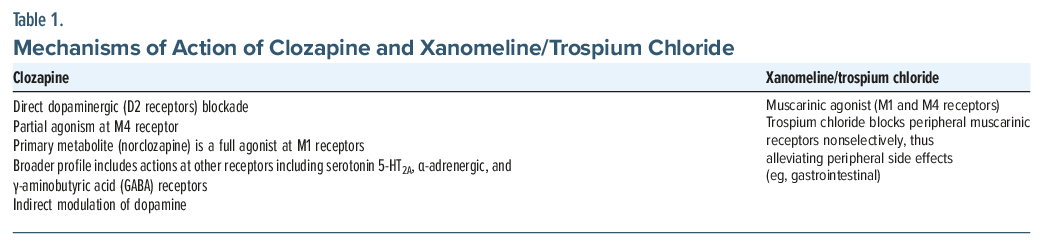
Clozapine is an atypical antipsychotic used to treat positive and negative symptoms of schizophrenia and schizophrenia-related disorders.1 It has broad effects across multiple receptors (eg, dopamine, serotonin, norepinephrine, glutamate, and acetylcholine),1,2 although its mechanism of action is incompletely understood (Table 1).1
Central to its ability to serve as an antipsychotic, clozapine binds to dopamine-2 (D2) receptors, which blocks dopamine binding in the striatum and suppresses psychotic symptoms.1–3 Such D2 receptor antagonism has been associated with extrapyramidal symptoms (EPS) (eg, rigidity, tremor, akathisia).1,3 However, these motoric side effects only arise once 72%–80% of D2 receptors have been occupied, a level that clozapine rarely exceeds. Clozapine has weak D2 receptor affinity; thus, it is readily displaced by endogenous dopamine concentrations,3 which can lead to relief of psychotic symptoms and to fewer EPS.
Clozapine interacts with several muscarinic receptors, specifically the M1 and M4 receptors. At M1 receptors, clozapine is a potent antagonist,3 although its primary metabolite, norclozapine, exhibits full agonism,2 which produces its beneficial effects. Norclozapine’s M1 agonism potentially increases downstream N-methyl-D-aspartate (NMDA) receptor activity and responsiveness by enhancing astroglial release of L-glutamate and D-serine. This may improve glutamatergic dysfunction and dopamine regulation, a key element of its efficacy in treatment-resistant schizophrenia. This is facilitated by clozapine’s partial agonism at the M4 receptor, which is thought to reduce mesostriatal dopamine release. Clozapine’s unique partial agonist/full agonist muscarinic activity is thought to be crucial for its complete and potent efficacy.2
Clozapine also affects other receptors, including 5-hydroxytryptamine receptor 2A (5-HT2A), α-adrenergic, and γ-aminobutyric acid (GABA) receptors, which are believed to modulate and complement clozapine’s antidopaminergic and proglutamatergic effects.2,3 Clozapine’s broad receptor profile may explain its clinical benefits for anxiety disorders, mood disorders, substance use, and suicidality.1,2
What Is Xanomeline/Trospium Chloride, and How Does It Work?
Xanomeline/trospium chloride is a novel, first-in-class antipsychotic that targets cholinergic receptors rather than dopaminergic receptors that are the targets of traditional antipsychotics (Table 1).4 Developed as a fixed-dose combination of xanomeline (a muscarinic agonist) and trospium chloride (a muscarinic antagonist),5 xanomeline/trospium chloride exerts its effects at M1 and M4 receptors. Although xanomeline does not directly block dopamine, it is an agonist of M1 and M4 receptors and indirectly modulates dopamine. Through its effects on the muscarinic system, xanomeline reduces psychotic symptoms in the central nervous system (CNS) in a manner similar to that of clozapine and norclozapine’s modulation of muscarinic, glutamatergic, and dopaminergic regulation.2,5 Although xanomeline’s therapeutic effects on schizophrenia were known for over a decade, its adverse gastrointestinal (GI) effects that are related to its peripheral muscarinic activation have negatively impacted its usage.2
Trospium chloride, on the other hand, is a nonselective muscarinic receptor antagonist that blocks all peripheral muscarinic receptors (including M1 and M4). Trospium does not significantly cross the blood-brain barrier; this allows it to exert its receptor antagonism primarily in peripheral tissues, while sparing the CNS.5 Thus, combining these agents allows xanomeline to exercise its CNS effects while reducing its adverse effects through attenuation by trospium.4,5 Xanomeline/trospium chloride also reduces adverse effects that result from dopamine receptor blockade. Early results suggest that there are fewer positive and negative symptoms in adults with schizophrenia when xanomeline/trospium chloride is used.5
Which Adverse Effects of Xanomeline/Trospium Chloride Can Be Problematic?
Although xanomeline/trospium chloride lacks some of the serious adverse effects associated with xanomeline alone, the combination of these drugs is not without risks. In long-term trials, at least 1 treatment-related adverse effect was seen in most (60%) subjects.5 Its most common adverse effects included nausea, vomiting, upset stomach, constipation, hypertension, abdominal pain, dry mouth, diarrhea, tachycardia, dizziness, and GI reflux disease.4,5 In phase 1 trials with healthy adults, several of these adverse reactions (eg, nausea, vomiting, diarrhea, excessive sweating, and salivary hypersecretion) were seen in fewer than half (46%) of subjects, which was a lower figure than when xanomeline monotherapy was used. Most of these adverse effects were rated as mild or moderate.5
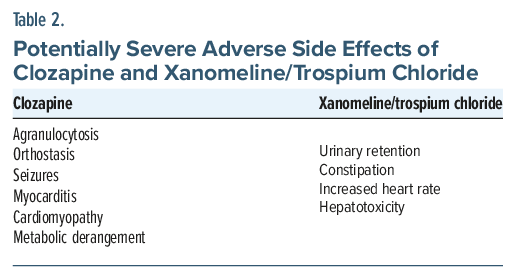
Although rarer, and more serious, adverse effects (eg, urinary retention, constipation, increased heart rate, and hepatotoxicity) can develop (Table 2).4,5 These findings suggest that xanomeline may be contraindicated in patients with moderate to severe renal or hepatic impairment and that regular monitoring of hepatic and renal function and cholinergic side effects should be recommended.4
Why (and How) Should Patients Be Transitioned From Clozapine to Xanomeline/Trospium Chloride?
While clozapine is often used in those with treatment-resistant psychotic conditions, its side effect profile may make it incompatible with use in certain patients; therefore, a transition from one medication to another may be needed. Severe side effects of clozapine include agranulocytosis, orthostasis, seizures, myocarditis, cardiomyopathy, and profound metabolic derangement (Table 2). Although, to the best of our knowledge, no studies have compared clozapine and xanomeline/trospium chloride in head-to-head studies, the unique mechanism of action of xanomeline/trospium may make it a viable alternative when clozapine cannot be used; when attempting to reduce antidopaminergic burden, the risk of metabolic effects, or the likelihood of motor effects that are seen with traditional antipsychotics; or when clozapine has been ineffective.6
In a recent case report, clozapine was discontinued in favor of a combination of xanomeline/trospium and olanzapine in a patient with deep vein thrombosis and a pulmonary embolism; it demonstrated the viability of xanomeline/trospium as an alternative to clozapine in the context of severe side effects.7
Two strategies for transitioning from clozapine exist. The first involves tapering clozapine over 1 to 2 weeks before it is discontinued, after which xanomeline/trospium may be initiated. The second involves a gradual cross-titration of the agents, while remaining vigilant for cholinergic and anticholinergic symptoms. This strategy may lead to a favorable side effect profile (by minimizing the dose of each agent).6,8
Does Catatonia That Is Associated With Clozapine Withdrawal Differ From Other Types of Catatonia?
Catatonia is thought to arise in response to myriad medical and neuropsychiatric disorders.9 Traditionally, it has been categorized as “stuporous” (hypokinetic) or “excited” (hyperkinetic) subtypes; an additional subtype of life-threatening malignant catatonia also exists. Hypokinetic catatonia is marked by reduced motor activity (stupor), posturing, catalepsy, mutism, and negativism, whereas hyperkinetic catatonia is characterized by increased psychomotor activity (eg, agitation/aggression or grimacing).10 Progression of catatonia in its earlier stages may lead to malignant catatonia, which represents a medical emergency manifest by an altered mental status, fever, autonomic instability, and rigidity.11
Unfortunately, the neurobiological underpinnings of catatonia remain incompletely understood.12–15 Dopamine dysregulation has been considered, given that antipsychotic medications have induced catatonia and neuroleptic malignant syndrome (NMS).16,17
Despite dopamine blockade serving as a contributor to catatonia, remission of catatonia may follow use of atypical antipsychotics.18 Clozapine, unlike other atypical antipsychotic medications, is rarely associated with precipitating or exacerbating catatonia.18 Clozapine withdrawal, however, is known to precipitate catatonia,19 with reports of clozapine withdrawal–induced catatonia having predominantly hypokinetic or hyperkinetic features, and having autonomic instability and rigidity with elevated creatine kinase levels.20 Catatonia may also arise following benzodiazepine (BZ) withdrawal when BZs are discontinued abruptly, tapered too rapidly, or when GABA activity decreases.21 No cases of catatonia, to our knowledge, have been precipitated or exacerbated by use of xanomeline/trospium chloride.
How Can Catatonia Be Treated?
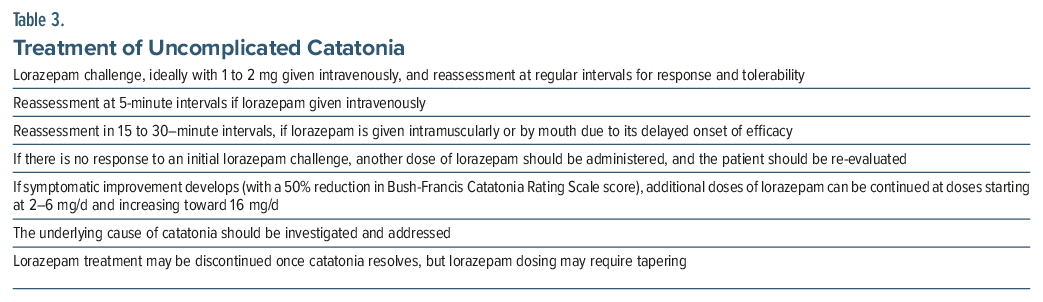
Treatment of uncomplicated cases of catatonia are well-documented (Table 3) and beyond the scope of this discussion.22 When concern for malignant catatonia arises, electroconvulsive therapy (ECT) should be considered as a first-line treatment. Although a universal treatment protocol for the treatment of catatonia with ECT is lacking, many clinicians believe that at least 3 bilateral ECT treatments per week should be administered, given the potential for catatonia to morph into malignant catatonia (as the benefits of treatment with ECT outweigh the potential for memory deficits associated with ECT). Treatment parameters (such as brief pulse width and suprathreshold stimulus) are often favored in these circumstances.23,24
Why Might Catatonia Fail to Respond to Treatment?
Myriad conditions can result in catatonia (eg, mood and psychotic disorders, metabolic disorders, infections, underlying CNS disease/disorders [such as parkinsonism] and seizures), and its manifestations vary.25 Failure to identify and treat these conditions may lead to persistent catatonia. The role of medications (eg, steroids, immunosuppressants, antibiotics, and substances of abuse) in the exacerbation of catatonia should also be considered.26 In addition, undertreatment with BZs (eg, lorazepam) or suboptimal treatment via ECT may also contribute to catatonia.23,24
How Should Catatonia Secondary to Clozapine Withdrawal Be Treated?
When catatonia is secondary to clozapine withdrawal, clozapine reinitiation is the treatment of choice. If restarting clozapine can be achieved within 48 hours, therapy can be resumed at the previous dosage; however, if more than 48 hours has elapsed since the last dose was administered, dosing should be reinitiated at the usual starting dose for clozapine and then titrated as tolerated.22
Following this initial treatment approach, treatment with BZs and ECT should be pursued, as is done with catatonia that is associated with other etiologies. Like with BZs, the efficacy of ECT for catatonia may involve actions on GABA receptors and the release of dopamine. In cases of malignant catatonia, ECT should be pursued. Simultaneous supportive care options include maintaining adequate hydration and nutrition, mobilizing the patient if possible, administering anticoagulation as indicated, instituting aspiration precautions, and monitoring of vital signs frequently to observe for progression to a malignant phenotype.27
For catatonia that is refractory to the above treatments, or when use of BZs might predispose to delirium, other agents (eg, amantadine, memantine, ketamine, NMDA receptor antagonists) may be employed,22,28 Valproate and carbamazepine are adjunctive agents for catatonia, given the similarities between the phenomenology of catatonia and seizure disorders.22
Finally, while clozapine is preferred for the treatment of catatonia that has been precipitated by clozapine withdrawal, other atypical antipsychotics can be used to modulate 5-HT1A agonism and 5-HT2A antagonism. Caution should be used when introducing these agents due to their risk for predisposing to NMS. A serum iron level should be checked, given the association between low serum iron levels and NMS. In addition, treatment pathways suggest that these agents only be introduced following the failure of the aforementioned approaches.22,29
How Might Xanomeline/Trospium Chloride Worsen Clozapine Withdrawal–Induced Catatonia?
Clozapine is known for its relatively low D2 receptor occupancy despite being one of the more potent antipsychotics for treatment-resistant schizophrenia.2 Clozapine serves as a potent antagonist at M4 receptors, although its metabolite, norclozapine, functions as a full agonist (Table 1). At M4, clozapine functions as a partial agonist, yielding an overall mixed agonist-antagonist profile that is relatively unique to the medication.2
In contrast, xanomeline/trospium chloride modulates M1 and M4 through direct agonism. In catatonia precipitated by clozapine withdrawal, rebound cholinergic stimulation may play a role in its pathophysiology. Over time, receptors on the postsynaptic neuron will upregulate given the chronic antagonism in the face of clozapine.5,21
What Happened to Mr C?
Valproate (500 mg twice a day) was started and subsequently increased to 750 mg twice a day to manage Mr C’s agitation and impulsivity. Quetiapine 200 mg twice a day and 100 mg twice a day as needed was initiated as an adjunctive treatment for agitation. Following these interventions, Mr C’s BFCRS score increased to 17, with disorganization, intrusiveness, hypersexuality, and hyperreligiosity. Valproate was discontinued, and amantadine was initiated and increased to 200 mg in the morning and 100 mg in the afternoon.
With continued lack of improvement in his BFCRS score and increasing heart rate (up to 115 beats/minute), Mr C’s presentation became concerning for malignant catatonia. Given local statutes, ECT could not be consented for with a durable power of attorney, which would require obtaining an emergent guardianship. However, due to symptom progression toward a malignant phenotype, the guardianship process was bypassed, allowing for emergency treatment with ECT. Mr C underwent 13 treatments with marked improvement; simultaneously, he was restarted on clozapine when he was able to consent to necessary lab draws, and the dose was titrated to 300 mg/day. Mr C’s BFCRS score at hospital discharge was 4.
CONCLUSION
Clozapine is an effective medication in treatment-resistant psychosis, although it has been associated with severe side effects that on occasion limit its use. Treatment teams should remain vigilant for catatonia that is associated with clozapine withdrawal, which should be considered in the context of recent discontinuation of clozapine and a high BFCRS score. Since antipsychotics may worsen the symptomatology of catatonia, treatment of catatonia should start with lorazepam, with early consideration of ECT when it is available.
The side effect profile of xanomeline/trospium chloride makes this novel agent a promising alternative to dopaminergic antipsychotics, such as clozapine. As this agent becomes more widely used, special attention should be paid to the different mechanism of action between this agent and more well-established dopaminergic antipsychotic agents. For those who are taking clozapine and being considered for transition to xanomeline/trospium chloride, tapering (and discontinuation) of clozapine before starting xanomeling/trospium chloride could reduce the risk of inducing clozapine withdrawal–induced catatonia. Future studies should examine the role that rebound cholinergic stimulation might play in the genesis of catatonia that is precipitated by clozapine withdrawal, and how xanomeline/trospium chloride might exacerbate catatonia in this context.
Article Information
Published Online: August 11, 2026. https://doi.org/10.4088/PCC.26f04194
© 2026 Physicians Postgraduate Press, Inc.
Submitted: January 23, 2026; accepted April 1, 2026.
To Cite: Matsuo R, Caldwell MR, Cheng W, et al. Combining clozapine and xanomeline/trospium chloride: mechanisms of action and the genesis of catatonia. Prim Care Companion CNS Disord 2026;28(4):26f04194.
Author Affiliations: Dartmouth-Hitchcock Medical Center, Lebanon, New Hampshire (Matsuo, Caldwell, Ho); Northeast Ohio Medical University in Rootstown, Ohio (Cheng); Geisel School of Medicine at Dartmouth, Lebanon, New Hampshire (Rustad, Ho); Larner College of Medicine, University of Vermont, Burlington, Vermont (Rustad); White River Junction VA Medical Center, White River Junction, Vermont (Rustad); Burlington Lakeside Community Based Outpatient Clinic, Burlington, Vermont (Rustad); Massachusetts General Hospital/Harvard Medical School, Boston, Massachusetts (Stern).
Corresponding Author: Patrick A. Ho, MD, MPH, Dartmouth-Hitchcock Medical Center, 1 Medical Center Dr, Lebanon, New Hampshire 03756 ([email protected]).
Matsuo, Caldwell, Cheng, Ho, and Rustad are co-first authors; Stern is senior author.
Financial Disclosure: Dr Stern has received royalties from Elsevier for editing textbooks on Psychiatry. Drs Matsuo, Caldwell, Cheng, Ho, and Rustad have no disclosures to report.
Funding/Support: None.
Clinical Points
- Clozapine is an atypical antipsychotic that affects the dopaminergic system and interacts with muscarinic receptors in the cholinergic system.
- Xanomeline/trospium chloride is a novel antipsychotic that works primarily on muscarinic receptors in the cholinergic system.
- Clozapine withdrawal might provoke catatonia due to rebound cholinergic stimulation, while xanomeline/trospium chloride might worsen catatonic symptoms in the context of clozapine withdrawal due to its effects on the cholinergic system.
- Restarting clozapine and initiating electroconvulsive therapy should be considered when catatonia may be due to clozapine withdrawal.
References (29)

- Khokhar JY, Henricks AM, Sullivan EDK, et al. Unique effects of clozapine: a pharmacological perspective. Adv Pharmacol San Diego Calif. 2018;82:137–162.
- Murray RM, Egerton A, Gao Y, et al. Why is clozapine uniquely effective in treatment-resistant schizophrenia? A review and proposal. Biol Psychiatry. 2025:S0006-3223(25)01270-3.
- Seeman P. Clozapine, a fast-off-D2 antipsychotic. ACS Chem Neurosci. 2014;5(1):24–29.
- Hasan AH, Abid MA. Cobenfy (xanomeline-trospium chloride): a new frontier in schizophrenia management. Cureus. 2024;16(10):e71131.
- Syed YY. Xanomeline/trospium chloride: first approval. Drugs. 2025;85(1):103–109.
- Melnick I, Crown EC, Zinzuvadia M, et al. Real-world implementation of xanomeline-trospium in schizophrenia: a consensus panel report. J Clin Psychiatry. 2025;86(4):hxtachi2509.
- Went NS, Alonso JD, Rigunay RR, et al. Managing treatment-resistant schizophrenia following clozapine cessation: a case report of xanomeline-trospium and olanzapine combination therapy. Front Psychiatry. 2025;16:1679678. PubMed CrossRef
- Price MZ, Price RL. Early outpatient clinical experience with xanomeline and trospium chloride for schizophrenia: a case report. Front Psychiatry. 2025;16:1630574. CrossRef
- Wilson JE, Niu K, Nicolson SE, et al. The diagnostic criteria and structure of catatonia. Schizophr Res. 2015;164(1-3):256–262. PubMed CrossRef
- Taylor MA, Fink M. Catatonia in psychiatric classification: a home of its own. Am J Psychiatry. 2003;160(7):1233–1241.
- Fink M, Taylor MA. The catatonia syndrome: forgotten but not gone. Arch Gen Psychiatry. 2009;66(11):1173–1177.
- Samra K, Rogers J, Mahdi-Rogers M, et al. Catatonia with GABAA receptor antibodies. Pract Neurol. 2020;20(2):139–143.
- Nair PC, McKinnon RA, Miners JO, et al. Binding of clozapine to the GABAB receptor: clinical and structural insights. Mol Psychiatry. 2020;25(9):1910–1919. PubMed CrossRef
- Haroche A, Rogers J, Plaze M, et al. Brain imaging in catatonia: systematic review and directions for future research. Psychol Med. 2020;50(10):1585–1597. PubMed CrossRef
- Perkins RJ. Catatonia: the ultimate response to fear?. Aust N Z J Psychiatry. 1982;16(4):282–287.
- Virolle J, Redon M, Montastruc F, et al. What clinical analysis of antipsychotic-induced catatonia and neuroleptic malignant syndrome tells us about the links between these two syndromes: a systematic review. Schizophr Res. 2023;262:184–200. CrossRef
- Ariza-Salamanca DF, Corrales-Hernández MG, Pachón-Londoño MJ, et al. Molecular and cellular mechanisms leading to catatonia:An integrative approach from clinical and preclinical evidence. Front Mol Neurosci. 2022;15:993671. CrossRef
- Saini A, Begum N, Matti J, et al. Clozapine as a treatment for catatonia: a systematic review. Schizophr Res. 2024;263:275–281.
- Wilkinson B, Snyder W, Shah Z, et al. Clozapine withdrawal-induced catatonia. Prim Care Companion CNS Disord. 2025;27(6):25cr04014.
- Bilbily J, McCollum B, de Leon J. Catatonia secondary to sudden clozapine withdrawal: a case with three repeated episodes and a literature review. Case Rep Psychiatry. 2017;2017:2402731. PubMed CrossRef
- Lander M, Bastiampillai T, Sareen J. Review of withdrawal catatonia: what does this reveal about clozapine?. Transl Psychiatry. 2018;8(1):139. PubMed CrossRef
- Wilson JE, Oldham MA, Francis A, et al. Catatonia: American Psychiatric Association resource document. J Acad Consult-Liaison Psychiatry. 2025;66(4):277–299.
- Sienaert P, Dhossche DM, Vancampfort D, et al. A clinical review of the treatment of catatonia. Front Psychiatry. 2014;5:181.
- Fink M, Kellner CH, McCall WV. Optimizing ECT technique in treating catatonia. J ECT. 2016;32(3):149–150.
- Solmi M, Pigato GG, Roiter B, et al. Prevalence of catatonia and its moderators in clinical samples: results from a meta-analysis and meta-regression analysis. Schizophr Bull. 2018;44(5):1133–1150. PubMed CrossRef
- Duggal HS, Singh I. Drug-induced catatonia. Drugs Today Barc Spain 1998. 2005;41(9):599–607.
- Rustad JK, Landsman HS, Ivkovic A, et al. Catatonia: an approach to diagnosis and treatment. Prim Care Companion CNS Disord. 2018;20(1):17f02202.
- Lee JH, Suzuki J. N-methyl-d-aspartate (NMDA) receptor antagonists for treatment of catatonia in adults: narrative review. Gen Hosp Psychiatry. 2024;91:60–65. CrossRef
- Beach SR, Gomez-Bernal F, Huffman JC, et al. Alternative treatment strategies for catatonia: a systematic review. Gen Hosp Psychiatry. 2017;48:1–19.
Please sign in or purchase this PDF for $40.