
Patients presenting with safety concerns who are seeking inpatient psychiatric care can ideally receive this care in traditional inpatient psychiatric settings. Traditional inpatient psychiatric units often cannot accommodate patients who are caring for newborns, which presents a challenge when treating patients who have recently given birth and do not want to be separated from their newborns. In this case, we describe a patient receiving psychiatric care in an inpatient hospital medicine setting, where she could continue to be with and care for her 8-week-old infant.
Case Report
Ms A, a 35-year-old gravida 4 para 3 woman, 8 weeks postpartum after a term cesarean delivery of a healthy infant, presented to the emergency department with homicidal and suicidal ideation. The patient reported acute distress, precipitated when her husband and his extramarital sexual partner discussed emergency contraception at the dinner table. Ms A picked up a kitchen knife and had thoughts of stabbing her husband, his partner, her children, and herself. Instead, she put down the knife, took her infant, and drove to the hospital.
Upon evaluation, Ms A met criteria for involuntary psychiatric hospitalization but was amenable to voluntary inpatient psychiatric treatment. She prioritized staying with her infant and did not want to be separated. Because no local psychiatric units permitted parent-baby coadmission, she was admitted to the hospital’s internal medicine service with her infant, with a family member continuously present per hospital policy and additional 1:1 constant observation by staff. Consultation-liaison (CL) psychiatry diagnosed her with postpartum depression and initiated sertraline, titrated to 75 mg daily. Ms A also participated in individual supportive psychotherapy. Medical workup revealed postpartum thyroiditis, treated with as-needed propranolol.
By hospital day 6, Ms A reported improved mood and denied suicidal or homicidal ideation. She was discharged with primary care and obstetrics and gynecology follow-up, along with referrals to psychotherapy providers in her community.
Discussion
Perinatal mental illness causes significant maternal and infant morbidity and mortality, making it one of the most common childbirth complications.1,2 Five to twenty percent of perinatal maternal deaths in high-income countries are attributed to suicide, and US maternal mortality rates are 2–3 times those of other countries in the category.1,3 The early postpartum period carries an elevated risk of mental illness for mothers, with 1–2 per 1,000 admitted for postpartum psychosis during the first few months.1 Psychiatric admission rises 22-fold during the first month postpartum versus prepregnancy, regardless of prior illness.1
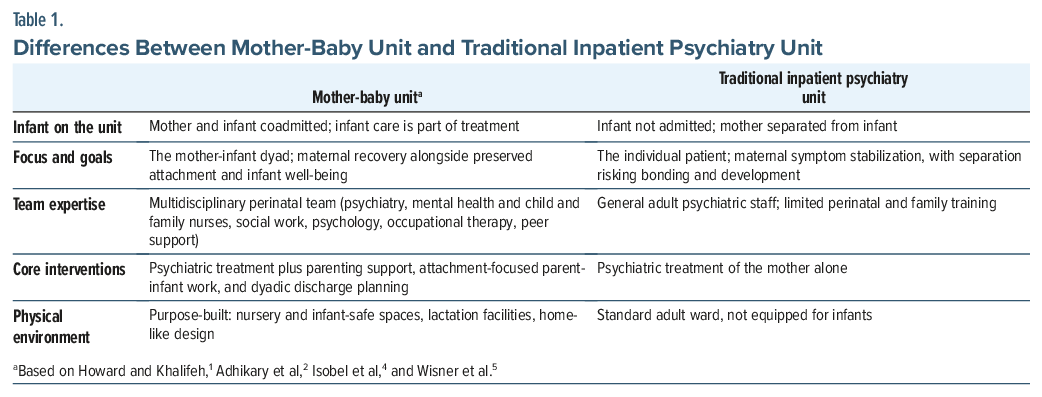
Mother-baby units (MBUs) provide inpatient psychiatric treatment while preserving mother-infant attachment and are now internationally recognized as the standard of care.2,4 Multidisciplinary teams with perinatal expertise tailor treatment across modalities to the mother-infant dyad (Table 1).2,4
Without units that accept dual admission, mothers often decline care or face involuntary separation, with consequences for maternal-infant bonding and child developmental outcomes.5 Most significantly, postpartum symptoms may not present when the infant is absent, preventing treatment of the underlying illness, undermining the purpose of admission, and possibly requiring readmission.5
Because MBUs are not widely adopted in the United States, clinicians must develop alternative approaches to dyadic care. Temporary treatment plans for dyadic admission must be tailored to their hospital’s constraints, as was the case with Ms A. These plans face staffing constraints and knowledge barriers, with caregivers lacking specialized perinatal expertise to support dyadic care.4 Because Ms A’s suicidal and homicidal ideation included her children, continuous family presence and 1:1 observation safeguarded the infant during coadmission. Ms A’s admission to the inpatient hospital medicine service achieved dyadic care through a CL psychiatry consultation, but lacked the multidisciplinary perinatal expertise central to MBU care. Until MBUs are widely available, clinicians can use the MBU model of care to approximate the standard in improvised dyadic admissions.
Article Information
Published Online: November 24, 2026. https://doi.org/10.4088/PCC.26cr04306
© 2026 Physicians Postgraduate Press, Inc.
Prim Care Companion CNS Disord 2026;28(6):26cr04306
Submitted: June 16, 2026; accepted August 11, 2026.
To Cite: Norris SV, Dodge CP, Ho PA. Hospital medicine as a venue for inpatient psychiatric care for mothers with newborns. Prim Care Companion CNS Disord 2026;28(6):26cr04306.
Author Affiliations: Northeast Ohio Medical University, Rootstown, Ohio (Norris); Department of Psychiatry, Dartmouth Hitchcock Medical Center, Lebanon, New Hampshire (Dodge, Ho).
Corresponding Author: Patrick A. Ho, MD, MPH, Department of Psychiatry, Dartmouth Hitchcock Medical Center, One Medical Center Drive, Lebanon, NH 03756 ([email protected]).
Financial Disclosure: None.
Funding/Support: None.
Additional Information: Information has been de-identified to protect patient anonymity.
Additional Information: In the writing of this manuscript, the authors used Claude (Anthropic, PBC) to improve readability and language. The authors have reviewed the content and take full responsibility for the content of the publication.
References (5)

- Howard LM, Khalifeh H. Perinatal mental health: a review of progress and challenges. World Psychiatry. 2020;19(3):313–327. PubMed CrossRef
- Adhikary S, Gillespie K, Kimball H, et al. A systematic review of research examining mothers, infants, family and staff in psychiatric mother-baby units. Acta Psychiatr Scand. 2024;150(5):284–307. PubMed CrossRef
- Wisner KL, Murphy C, Thomas MM. Prioritizing maternal mental health in addressing morbidity and mortality. JAMA Psychiatry. 2024;81(5):521–526. PubMed CrossRef
- Isobel S, Green A, Lim-Gibson S. The early infancy of a parent and baby mental health unit: a reflection. Matern Child Health J. 2025;29(1):17–22. PubMed CrossRef
- Wisner KL, Jennings KD, Conley B. Clinical dilemmas due to the lack of inpatient mother-baby units. Int J Psychiatry Med. 1996;26(4):479–493. PubMed CrossRef
Please sign in or purchase this PDF for $40.